
No products in the cart.
AI SEO Semantic Architecture: The Complete Blueprint for Modern Search Dominance
10
Aug
Aug
The digital landscape has shifted dramatically. Search engines no longer merely match keywords; they interpret meaning, context, and user intent. This transformation has given rise to a critical discipline known as AI SEO Semantic Architecture. This approach moves beyond traditional keyword stuffing to create a structured, interconnected web of content that artificial intelligence systems can understand and rank with precision. For businesses aiming to secure top positions in 2025 and beyond, mastering this architecture is not optional—it is essential for survival in organic search.
Understanding AI SEO Semantic Architecture
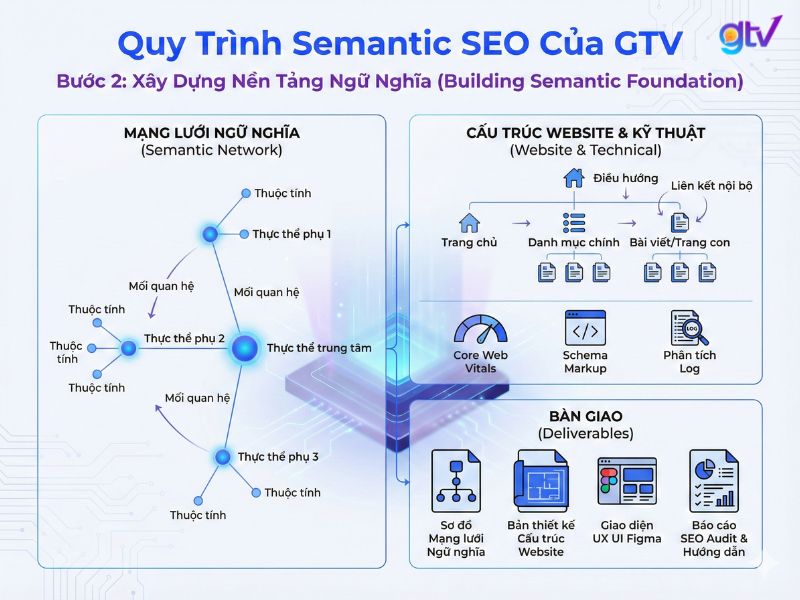
AI SEO Semantic Architecture refers to the strategic organization of a website’s content, data, and internal links to help search engine algorithms—specifically those powered by machine learning like Google’s RankBrain and MUM—comprehend the relationships between entities and concepts. It is the practice of building a digital ecosystem where every page clearly communicates its topic, its subtopics, and its connection to other pages on your site.
Unlike traditional SEO, which focuses on individual pages targeting specific keywords, semantic architecture focuses on the holistic meaning of your entire domain. It involves using structured data (Schema.org), topic clusters, and natural language processing (NLP) optimization to create a knowledge graph within your site. This allows AI crawlers to see your website not as a collection of isolated articles, but as a single, authoritative source on a broad subject matter.
The Shift from Keywords to Entities
For years, SEO professionals chased exact-match keywords. Today, AI algorithms analyze entities—people, places, things, and concepts—and the relationships between them. For example, a page about “apple” could mean the fruit or the tech company. Semantic architecture uses context clues, related terms, and schema markup to disambiguate these entities. By clearly defining what your entities are and how they relate, you provide the AI with a roadmap to your content’s true value.
Core Components of a Semantic Architecture Strategy
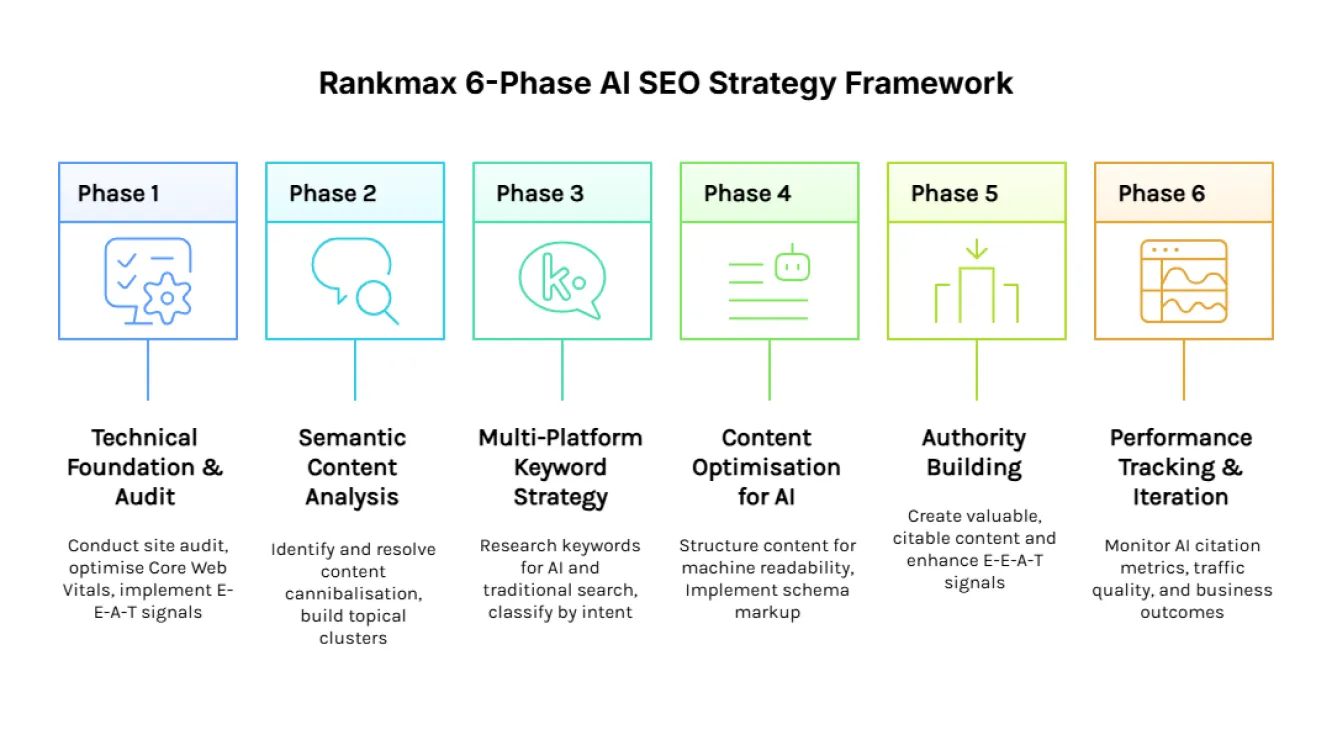
Building a robust AI SEO Semantic Architecture requires a multi-layered approach. You cannot simply add a few internal links and expect results. The following components form the foundation of a system designed for AI comprehension and user satisfaction.
1. Structured Data and Schema Markup
Schema markup is the language of AI. It is a code that you place on your website to tell search engines exactly what your content means. Instead of guessing whether a paragraph is a review, a recipe, or a product description, schema explicitly labels it. For semantic architecture, focus on the following types:
- Article: Defines the type of content and its author.
- BreadcrumbList: Shows the hierarchical path of the page.
- FAQPage: Marks up question-and-answer sections for rich results.
- Product/Service: Provides detailed attributes and pricing.
- Organization: Establishes your business as a distinct entity.
- Consistency is Key: Regularly publish new cluster content to demonstrate freshness and continued authority.
- Monitor Performance: Use Google Search Console to track how your pages perform in search. Identify which clusters are gaining traction and which need more support.
- Update Old Content: The internet changes. Update your pillar pages and cluster articles with new data, examples, and insights to keep them relevant.
- Focus on E-E-A-T: Experience, Expertise, Authoritativeness, and Trustworthiness. Ensure your content is written by experts and cites credible sources. This builds trust with both users and AI.
Implementing these schemas helps AI connect your content to the broader knowledge graph, increasing the likelihood of appearing in rich snippets and voice search results.
2. Topic Clusters and Pillar Pages
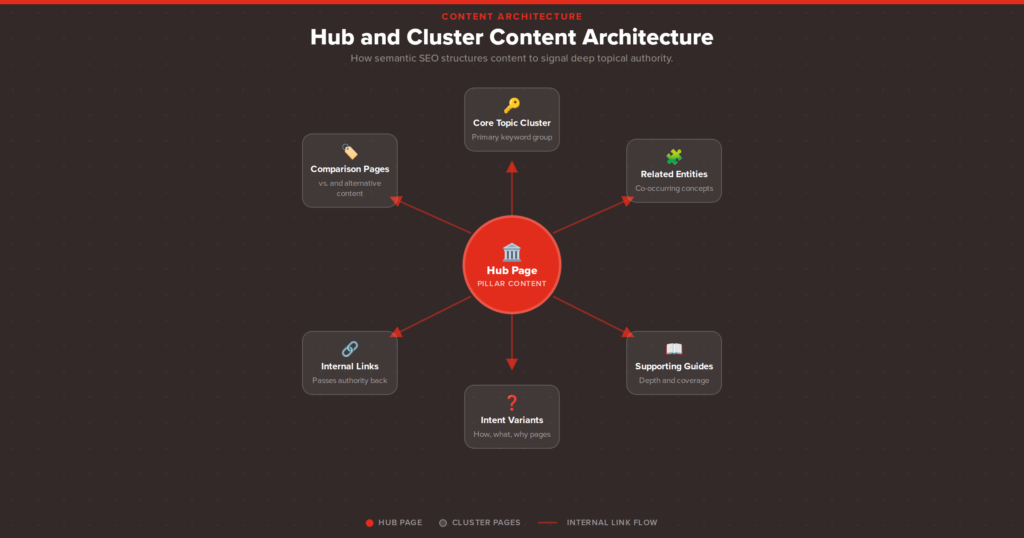
The pillar-cluster model is the structural backbone of semantic SEO. A pillar page is a comprehensive, long-form guide on a core topic. Cluster content consists of multiple, detailed blog posts or pages that address specific subtopics related to the pillar. Every cluster piece links up to the pillar page, and the pillar links out to all cluster pieces.
This structure creates a clear semantic signal. The AI sees that you have a central authority page (the pillar) supported by a network of detailed, relevant content. This interlinking passes authority and helps the crawler understand the breadth and depth of your coverage on that subject.
3. Internal Linking with Descriptive Anchor Text
Internal links are the streets of your semantic city. They guide users and AI crawlers through your content. However, the anchor text matters more than ever. Using generic text like “click here” provides zero semantic value. Instead, use descriptive, keyword-rich anchors that tell the AI what the linked page is about. For instance, linking to a page about “semantic SEO tools” should use that exact phrase as the anchor text.
4. Natural Language Processing (NLP) Optimization
AI uses NLP to read your content like a human. This means your writing must be natural, fluid, and comprehensive. Avoid robotic keyword repetition. Instead, use synonyms, related terms, and latent semantic indexing (LSI) keywords naturally within the text. Cover the topic thoroughly, answering potential follow-up questions within the body of the content. This helps the AI recognize your page as a complete resource.
Benefits of Implementing AI SEO Semantic Architecture
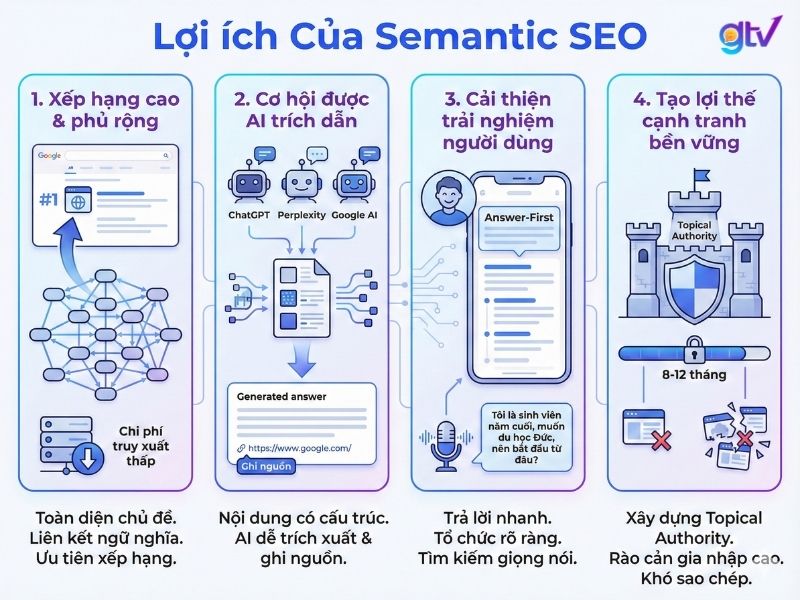
The advantages of this approach extend far beyond simple rankings. It creates a superior foundation for all your digital marketing efforts. The benefits are tangible and measurable across multiple metrics.
Improved Search Relevance and Rankings
When AI understands your content perfectly, it can match it to the correct search queries. This leads to higher rankings for your target keywords and, more importantly, for the hundreds of long-tail variations you may not have explicitly targeted. Your content becomes visible for the questions people are actually asking, not just the terms you guessed they would use.
Enhanced Click-Through Rates (CTR)
Semantic architecture enables you to earn rich results. Structured data allows your listings to display star ratings, FAQs, breadcrumbs, and product images. These visual enhancements make your listing stand out on the search engine results page (SERP), significantly boosting your CTR compared to plain text links.
Future-Proofing Against Algorithm Updates
Search engines are constantly evolving, but the direction is always toward better understanding. By building a semantic architecture, you align your site with the core mission of search engines: to understand and organize information. This means you are less likely to be penalized by future updates that target thin content or keyword stuffing, as your site is built on genuine topical authority.
Superior User Experience
This architecture forces you to organize your content logically. Users can easily navigate from a broad topic to a specific detail and back again. This reduces bounce rates and increases dwell time, both of which are positive signals to search engines. A well-structured site is simply easier to use.
AI SEO Semantic Architecture vs. Traditional SEO
To fully grasp the power of semantic architecture, it is helpful to compare it directly with the outdated methods of traditional SEO. The differences highlight the evolution of search technology.
| Feature | Traditional SEO | AI SEO Semantic Architecture |
|---|---|---|
| Focus | Individual keywords and pages | Entities, topics, and relationships |
| Content Strategy | Separate articles for each keyword | Interlinked topic clusters |
| Data Markup | Rarely used | Essential (Schema.org) |
| Link Building | Quantity of backlinks | Quality of internal linking and topical relevance |
| Goal | Rank for a specific term | Become the authority on a subject |
| AI Understanding | Limited | High |
Traditional SEO is a short-term tactic. Semantic architecture is a long-term investment in your digital footprint. While traditional methods may yield quick wins, they are fragile. Semantic architecture builds a moat around your rankings that is difficult for competitors to cross.
Practical Implementation: A Step-by-Step Guide

Transitioning to an AI-driven semantic architecture requires a systematic plan.
Step 1: Conduct a Semantic Audit
Begin by auditing your existing content. Identify your main business categories and the core topics you want to own. Use tools like Google Search Console to see which queries you already rank for. Group these queries into logical topics. This will form the basis of your pillar pages and clusters.
Step 2: Map Your Entity Relationship
Create a visual map of your entities. Start with your main topic in the center. Branch out to subtopics, and then to specific details. This map will guide your site structure. For example, if your main entity is “Digital Marketing,” your subtopics might be “SEO,” “Content Marketing,” and “Social Media.” Each of those becomes a pillar page with its own cluster of detailed articles.
Step 3: Build or Update Pillar Pages
Your pillar pages must be the most comprehensive resource on the internet for that specific topic. They should be long (2,000+ words), well-structured with clear headings, and cover the topic from every angle. Include a table of contents and link out to every relevant cluster article.
Step 4: Create Cluster Content
For each pillar, create 5-10 cluster articles. Each article should target a specific long-tail keyword or question related to the pillar. These articles should be detailed (1,000+ words) and link back to the pillar page using descriptive anchor text. They should also link to other relevant cluster articles to create a web of connectivity.
Step 5: Implement Schema Markup
Add the appropriate schema markup to every page. Use the Article schema for blog posts, FAQ schema for question sections, and BreadcrumbList schema for navigation. Test your markup using Google’s Rich Results Test tool to ensure it is valid.
Step 6: Optimize for NLP
Rewrite your content to sound more conversational. Use tools like Surfer SEO or Clearscope to analyze your content against top-ranking pages. These tools provide recommendations for related terms and entities to include. Ensure your paragraphs are short, your sentences are clear, and you answer the “who, what, when, where, and why” of your topic.
Common Mistakes and How to Avoid Them
Even with the best intentions, many marketers make critical errors when building their semantic architecture. Awareness of these pitfalls is the first step to avoiding them.
Mistake 1: Cannibalizing Your Own Keywords
Creating multiple pages targeting the exact same keyword confuses AI. The algorithm does not know which page to rank. Solution: Ensure each cluster article targets a unique subtopic or question. If two pages are too similar, merge them into one comprehensive guide.
Mistake 2: Ignoring the “Why” Behind the Search
Focusing solely on keywords without understanding user intent is a fatal flaw. Solution: Analyze the SERP for your target keyword. Are the results informational, transactional, or navigational? Tailor your content to match that intent. If users want a list, give them a list. If they want a tutorial, provide steps.
Mistake 3: Over-Optimizing Anchor Text
While descriptive anchor text is good, using the exact same keyword-rich anchor for every link looks spammy. Solution: Vary your anchor text. Use natural phrases, brand names, and even “here” or “this guide” occasionally. The goal is to provide context, not to manipulate.
Mistake 4: Neglecting Technical SEO
Semantic architecture cannot fix a broken website. If your site is slow, not mobile-friendly, or has crawl errors, A Solution: Ensure your technical foundation is solid. Optimize page speed, fix broken links, and ensure your XML sitemap is up-to-date.
Important Notes for Long-Term Success
Building this architecture is not a one-time project. It is an ongoing process of refinement and expansion. Several key principles should guide your ongoing efforts.
Frequently Asked Questions (FAQ)
What is the difference between semantic SEO and traditional SEO?
Traditional SEO focuses on optimizing individual pages for specific keywords. Semantic SEO focuses on building a website-wide structure that demonstrates expertise on a broad topic. It uses entities, topic clusters, and schema markup to help AI understand the relationships between different pieces of content, leading to more authoritative rankings.
How does AI use semantic architecture to rank content?
AI algorithms like Google’s RankBrain use natural language processing to analyze the meaning of your content. Semantic architecture provides clear signals—through internal links, structured data, and comprehensive topic coverage—that help the AI map your content to user queries. It allows the AI to understand the context and depth of your information, not just the literal text.
Is schema markup necessary for semantic SEO?
While not strictly mandatory, schema markup is highly recommended. It removes ambiguity and explicitly tells search engines what your data means. It is the most direct way to communicate with AI crawlers and is essential for earning rich results like FAQs and breadcrumbs, which improve visibility and click-through rates.
How long does it take to see results from semantic architecture?
This is a long-term strategy. While you may see minor improvements within a few weeks, significant ranking shifts typically take 3 to 6 months. The process involves restructuring your site, creating new content, and waiting for search engines to crawl and re-index your pages. Patience and consistency are vital.
Can small websites benefit from AI SEO Semantic Architecture?
Absolutely. In fact, it is often easier for smaller, niche sites to establish topical authority than for large, generic sites. By focusing on a specific niche and building a tight-knit cluster of high-quality content, a small site can quickly become the go-to resource for that specific topic, outranking larger competitors with weaker relevance.
Conclusion
The era of keyword counting is over. The future of search is defined by AI SEO Semantic Architecture. By restructuring your website to communicate meaning, context, and relationships, you align your digital presence with the very algorithms that decide your visibility. This approach requires effort—auditing your content, restructuring your site, and committing to high-quality, interconnected writing. However, the payoff is substantial: sustained rankings, higher traffic, and a digital asset that grows in value over time. Start mapping your entities, building your clusters, and implementing your schema today. The AI is ready to understand you; make sure your website is ready to be understood.
Xem thêm:
- AI SEO LocalBusiness Schema: The Complete Guide to Smarter Local Rankings
- AI SEO Publishing Workflow: The Complete Guide to Scaling Content Production in 2025
- AI SEO Content Editing: The Complete Guide to Smarter, Faster Optimization
- AI SEO Entity Mapping: The Complete Guide to Future-Proofing Your Search Rankings
- AI SEO Automated Content Audit: The Complete Guide to Scaling Content Optimization
Bài viết cùng chủ đề:

AI SEO SEO Automation with Make: The Complete Workflow Guide

AI SEO SEO Automation with Zapier: The Complete Workflow Guide

AI SEO SEO Automation with n8n: The Complete Workflow Guide
AI SEO SEO Automation with Gemini: The Complete Guide to Scaling Organic Growth

AI SEO SEO Automation with Claude: The Complete Guide to Scaling Content in 2025

AI SEO SEO Automation with ChatGPT: The Complete Playbook for 2025

AI SEO & SEO Automation for Affiliate Sites: The 2025 Playbook for Passive Income Growth
AI SEO & SEO Automation for Bloggers: The Complete Guide to Scaling Your Content

AI SEO & SEO Automation for Agencies: The Complete 2025 Playbook

AI SEO and SEO Automation for Ecommerce: The Complete Playbook for 2025

AI SEO & SEO Automation for WordPress: The Complete Playbook for 2025
AI SEO SEO Automation Strategy: The Complete Playbook for 2025

Mastering the AI SEO SEO Automation Process: A Complete Guide to Scaling Organic Growth
AI SEO SEO Automation System: The Complete Guide to Scaling Organic Growth in 2025
AI SEO SEO Automation Platform: The Complete Guide to Scaling Organic Growth in 2025
AI SEO SEO Automation Software: The Complete Guide to Scaling Organic Growth in 2025















