
No products in the cart.
AI SEO Frase: The Complete Guide to AI-Powered Content Optimization in 2025
31
Jul
Jul
Search engine optimization has shifted dramatically with the rise of artificial intelligence, and AI SEO Frase stands at the center of this transformation. Frase.io has evolved from a simple content brief generator into a full-fledged AI SEO platform that helps marketers research, write, and optimize content that ranks. This guide breaks down exactly how Frase works, where it excels, where it falls short, and how you can use it to build a content engine that drives organic traffic. Whether you are a solo blogger or part of a large SEO team, understanding AI SEO Frase is no longer optional—it is essential for staying competitive.
What Is AI SEO Frase and How Does It Work?
AI SEO Frase refers to the suite of artificial intelligence tools built into Frase.io, a content optimization platform launched in 2017. The core premise is simple: instead of guessing what to write, Frase analyzes the top-ranking pages for any given keyword and extracts the questions, subtopics, and entities that Google considers relevant. It then uses this data to generate a content brief, an outline, and even a full first draft using its integrated GPT-powered writer.
The platform operates on a three-step workflow. First, it connects to Google Search Console and other data sources to understand what queries your audience is searching for. Second, it uses natural language processing to compare your content against the top 20 results for a target keyword, scoring your content on a scale from 0 to 100 based on how well it covers the identified subtopics. Third, it provides real-time suggestions as you write, telling you which questions to answer, which keywords to include, and which sections to add to improve your relevance score.
Frase’s AI models are trained on massive datasets of search queries and content patterns. The system does not just look at keyword density; it looks at semantic relevance, meaning it understands that a page about “best running shoes” should also mention “cushioning,” “heel drop,” and “pronation” even if those exact phrases are not in the primary keyword. This semantic understanding is what separates Frase from older tools like Yoast or Surfer SEO.
The Core Components of the Frase Platform
To fully leverage AI SEO Frase, you need to understand its four main modules. Each serves a distinct purpose in the content lifecycle, from research to publication.
1. AI Research and SERP Analysis
This is the foundation of the platform. You enter a keyword, and Frase pulls the top 20 organic results from Google. It then breaks down each page into its component parts: headings, paragraphs, lists, and images. The AI identifies the most common questions people ask about the topic, the key entities mentioned, and the statistical distribution of terms across all top-ranking pages. The output is a visual map of the topic, showing you exactly what Google expects a comprehensive article to cover.
2. Content Brief Generator
Once the SERP analysis is complete, Frase generates a detailed content brief. This brief includes a recommended title, meta description, target word count, and a list of headings (H2s and H3s) that should be included. It also lists the top questions to answer, pulled directly from the “People Also Ask” boxes and the content of your competitors. This brief acts as a blueprint, ensuring that your writer covers every angle that Google has already deemed relevant.
3. AI Writer and Document Editor
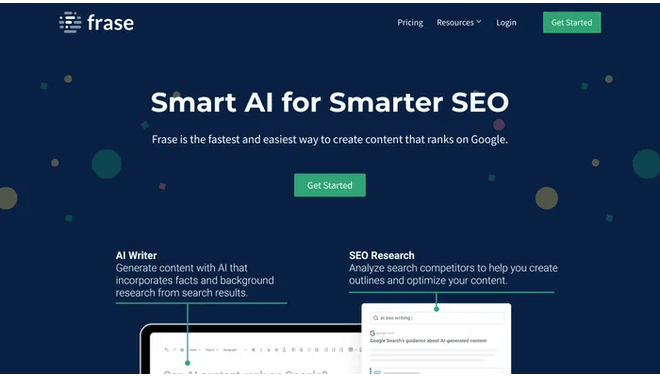
Frase integrates a GPT-based AI writer directly into its document editor. You can generate an entire first draft based on your brief, or you can use the AI to write specific sections, rewrite paragraphs, or expand on bullet points. The editor also includes a real-time SEO score panel on the right side. As you type, the score updates, showing you which keywords you have used, which questions you have answered, and which subtopics are still missing. This is the core of the “AI SEO” experience—the machine actively guides your writing process.
4. Optimization and Content Scoring
After you finish writing, Frase provides a final content score. This score is based on how well your text matches the semantic profile of the top-ranking pages. It checks for term frequency, question coverage, and structural elements like the use of lists and tables. You can also run a “Readability” check and a “Plagiarism” check directly within the tool. The goal is to hit a score of 90 or above before publishing, which statistically correlates with higher rankings.
Benefits of Using Frase for AI SEO
Adopting AI SEO Frase offers several concrete advantages that go beyond simple time savings. These benefits directly impact your ability to rank in a competitive landscape.
- Faster Research: What used to take an hour of manually reading competitor pages now takes 30 seconds. Frase aggregates the data for you, presenting it in a digestible format.
- Higher Content Relevance: By following the AI-generated brief, you ensure that your content covers all the subtopics Google associates with the main keyword. This reduces the risk of publishing thin content that fails to satisfy search intent.
- Improved Internal Linking: Frase can analyze your existing content library and suggest internal links to and from your new article, helping to distribute page authority across your site.
- Scalability: For agencies and content teams, Frase allows you to produce high-quality, optimized content at scale. The briefs ensure consistency across different writers.
- Question-Based Optimization: The tool excels at extracting “People Also Ask” questions, which are prime real estate for featured snippets. Answering these questions directly in your content increases your chances of winning position zero.
Limitations and Challenges of Frase
No tool is perfect, and Frase has its share of limitations that users must navigate carefully. Understanding these will help you set realistic expectations.
The primary limitation is that Frase’s AI is based on existing data. It can only analyze what is currently ranking. If you are trying to rank for a brand-new topic with no search volume or a topic where the SERP is dominated by low-quality pages, Frase’s suggestions may be off-base. The tool is reactive, not proactive; it tells you what works now, not necessarily what will work in six months.
Another challenge is the potential for generic content. If you follow the AI brief too literally, your article may end up looking exactly like every other article on the first page. The AI can tell you what to cover, but it cannot tell you how to add your unique perspective, personal experience, or proprietary data. You must layer your own expertise on top of the AI’s suggestions to create content that stands out.
Finally, the cost can be a barrier for small businesses. Frase’s pricing starts at around $15 per month for the basic plan, but that plan has limited AI credits. To use the AI writer extensively, you will likely need the $45 per month plan or higher. For high-volume content operations, the cost can quickly escalate.
Frase vs. Surfer SEO vs. Clearscope: A Comparison
Frase is often compared to other AI SEO tools, primarily Surfer SEO and Clearscope. While they share similarities, they have distinct strengths that cater to different workflows.
| Feature | Frase | Surfer SEO | Clearscope |
|---|---|---|---|
| Primary Focus | Content creation and research | On-page optimization | Content relevance and grading |
| AI Writing | Built-in GPT writer for full drafts | Limited AI writing, focuses on guidelines | No AI writer, only optimization suggestions |
| SERP Analysis | Deep question extraction and topic mapping | Detailed content structure and word count analysis | Keyword grouping and entity extraction |
| Best For | Bloggers and agencies needing end-to-end workflow | SEO specialists who want granular control | Enterprise teams focused on content quality scoring |
| Pricing | Starts at $15/month | Starts at $89/month | Starts at $170/month |
Surfer SEO is more aggressive in its on-page recommendations, often suggesting specific word counts for paragraphs and exact keyword placements. Clearscope is more enterprise-focused, with a cleaner interface and a stronger emphasis on content grading rather than content generation. Frase sits in the middle, offering the best balance of research, writing, and optimization for the price. If you need a tool that can actually write the article for you, Frase is the clear winner. If you already have strong writers and just need a checklist, Surfer or Clearscope might be better fits.
Practical Guide: How to Use Frase for a Blog Post
To get the most out of AI SEO Frase, follow this step-by-step workflow. This process has been refined by thousands of SEO professionals and represents the best practices for using the tool.
Step 1: Keyword Selection and SERP Analysis
Start by entering your target keyword into Frase. Before you even look at the generated brief, analyze the SERP results manually. Look at the top 3 pages. Are they blog posts or product pages? Are they listicles or long-form guides? This tells you the dominant content format. Then, look at the “People Also Ask” section on Google. Note down the questions. Now, open the Frase SERP analysis and compare its findings with your manual observations. The tool should confirm your analysis and add additional data points you missed.
Step 2: Generate and Customize the Brief
Click “Create Brief” and let Frase generate the outline. Do not accept it blindly. Review the suggested H2s and H3s. Are they logical? Do they flow naturally? Remove any that seem forced or irrelevant. Add your own headings based on your expertise. The AI brief is a starting point, not a final product. Your goal is to create a brief that is 80% AI-generated and 20% human-refined.
Step 3: Write with the AI Assistant
Open the document editor and start writing. Use the AI writer to generate a draft for each section, but then rewrite it in your own voice. The AI text is often generic and lacks personality. Use it as a skeleton. As you write, keep an eye on the SEO score panel. If the score is stuck below 80, look at the “Missing Terms” section. These are keywords that your competitors use but you have not yet included. Naturally incorporate these terms into your sentences. Do not force them in; the A
Step 4: Optimize for Questions and Featured Snippets
Scroll through the “Questions” tab in the editor. Frase will list dozens of questions related to your topic. Pick the 5-7 most important ones and answer them directly in your content. Use the exact question as an H3 heading, and then provide a concise, direct answer in the paragraph below. This formatting is the most likely to trigger a featured snippet. Keep your answers between 40-60 words for the best chance of being pulled by Google.
Step 5: Final Review and Export
Once your content score reaches 90 or above, run the plagiarism checker. Then, export the document to your CMS (WordPress, HubSpot, etc.) using the built-in integration. After publishing, monitor your rankings. If you do not see improvement in 4-6 weeks, revisit the article and use Frase to re-analyze the SERP. The competitive landscape may have changed, and the tool will show you what new content you need to add.
Common Mistakes When Using Frase and How to Avoid Them
Many users fail to see results with Frase because they make predictable errors. Here are the most common pitfalls and the strategies to overcome them.
Mistake 1: Ignoring the SERP Context. Users often input a keyword and immediately generate a brief without checking if the SERP is actually relevant. If you search for “best coffee” and the top results are all product roundups, writing a single-product review will not rank, no matter how well you optimize. Always verify that the search intent matches your content goal before using Frase.
Mistake 2: Over-Optimizing for the Score. Chasing a 100% content score can lead to keyword stuffing and unnatural prose. Google’s algorithms are sophisticated enough to detect when content is written for machines rather than humans. Aim for a score between 85 and 95, and prioritize readability over hitting a perfect number. If a suggested keyword does not fit naturally into your sentence, skip it.
Mistake 3: Relying Solely on AI-Generated Text. The AI writer in Frase is powerful, but it lacks real-world experience. It cannot share a personal anecdote, cite a proprietary study, or offer a unique opinion. Content that is 100% AI-generated tends to be bland and fails to build trust with readers. Use the AI to overcome writer’s block, but always inject your own expertise and data.
Mistake 4: Not Updating Old Content. Frase is not just for new articles. You can paste an existing underperforming post into the editor and run a fresh SERP analysis. The tool will show you exactly what has changed in the rankings since you published. This is one of the most effective ways to revive old content, yet most users ignore this feature.
Important Notes on AI SEO and Google’s Guidelines
Google’s stance on AI-generated content is clear: it does not penalize content simply because it is created with AI. However, it does penalize content that is created primarily to manipulate search rankings, regardless of how it is produced. This means that using Frase to generate a draft is acceptable, but publishing that draft without human review and added value violates Google’s spam policies.
To stay compliant, always follow the E-E-A-T framework. Experience, Expertise, Authoritativeness, and Trustworthiness. Frase can help with the “Expertise” part by ensuring you cover all relevant subtopics. But “Experience” and “Trustworthiness” must come from you. Include personal examples, cite credible sources, and provide accurate information. The AI cannot verify facts; it can only generate text based on patterns. You are responsible for the accuracy of the content.
Another critical note is the importance of original research. In 2025, Google’s algorithms heavily favor content that includes unique data, surveys, or case studies. Frase cannot generate this for you. If you want to rank for competitive keywords, you need to conduct your own research and present the findings in your article. This is the single biggest differentiator between content that ranks and content that gets buried.
Frequently Asked Questions About AI SEO Frase
Is Frase better than writing content manually?
Frase is not a replacement for human writers; it is a productivity enhancer. It reduces research time by 80% and ensures you do not miss important subtopics. However, the final quality of the article depends on your ability to add unique insights, personal experience, and a compelling writing style. Writers who use Frase as a guide produce better content faster than those who write without any data.
Can Frase guarantee a #1 ranking on Google?
No tool can guarantee a #1 ranking. Frase optimizes your content for relevance, but rankings depend on hundreds of factors, including domain authority, backlinks, page speed, and user engagement. Frase gives you the best chance to rank by ensuring your content is structurally and semantically sound, but it cannot overcome a weak domain or a lack of external links.
Does Google penalize content written with Frase?
Google does not penalize content based on the tool used to create it. The algorithm looks at the quality and usefulness of the content itself. If you use Frase to generate a draft and then significantly edit it to add value, your content is treated the same as any other well-written article. If you publish unedited AI text, you risk being flagged as spam.
What is the difference between Frase and ChatGPT for SEO?
ChatGPT is a general-purpose language model that can generate text on any topic. Frase is a specialized SEO tool that combines AI writing with SERP analysis and content scoring. While ChatGPT can write an article, it does not know what keywords to target or what subtopics Google expects. Frase provides that context, making it far more effective for SEO-specific tasks.
How long does it take to see results with Frase?
SEO is a long-term game. After publishing an optimized article, it typically takes 4 to 12 weeks to see significant movement in rankings. This timeline depends on the competitiveness of your keyword and the authority of your website. For new domains, it may take longer. Consistently publishing well-optimized content with Frase will compound your results over time.
Conclusion: Is Frase Worth It for Your SEO Strategy?
AI SEO Frase is a powerful ally in the fight for organic visibility. It streamlines the research process, provides actionable optimization suggestions, and helps you create content that aligns with Google’s semantic understanding. The tool is particularly valuable for content teams that need to produce a high volume of articles without sacrificing quality. The combination of SERP analysis, AI writing, and real-time scoring creates a feedback loop that continuously improves your content’s chances of ranking.
However, Frase is not a magic bullet. It requires a human touch to transform AI-generated drafts into authoritative, trustworthy content. The best results come from using Frase to handle the data-heavy lifting while you focus on storytelling, original research, and unique perspectives. If you are willing to put in that effort, Frase will pay for itself many times over in increased traffic and reduced research time. For any serious SEO practitioner in 2025, adding Frase to your toolkit is a strategic move that aligns with the future of search.
Xem thêm:
- How to Create SEO Briefs with AI: A Step-by-Step System for Faster, Smarter Content Planning
- AI SEO Comparison Generator: The Complete Guide to Smarter Competitive Analysis
- AI SEO GEO Citations: The Complete Guide to Future-Proofing Your Local Search Strategy
- AI SEO Strategy 2026: The Complete Blueprint for Search Dominance
- AI SEO Bing Webmaster Tools: The Complete Guide to Smarter Search Optimization
Bài viết cùng chủ đề:

AI SEO SEO Automation with Make: The Complete Workflow Guide

AI SEO SEO Automation with Zapier: The Complete Workflow Guide

AI SEO SEO Automation with n8n: The Complete Workflow Guide
AI SEO SEO Automation with Gemini: The Complete Guide to Scaling Organic Growth

AI SEO SEO Automation with Claude: The Complete Guide to Scaling Content in 2025

AI SEO SEO Automation with ChatGPT: The Complete Playbook for 2025

AI SEO & SEO Automation for Affiliate Sites: The 2025 Playbook for Passive Income Growth
AI SEO & SEO Automation for Bloggers: The Complete Guide to Scaling Your Content

AI SEO & SEO Automation for Agencies: The Complete 2025 Playbook

AI SEO and SEO Automation for Ecommerce: The Complete Playbook for 2025

AI SEO & SEO Automation for WordPress: The Complete Playbook for 2025
AI SEO SEO Automation Strategy: The Complete Playbook for 2025

Mastering the AI SEO SEO Automation Process: A Complete Guide to Scaling Organic Growth
AI SEO SEO Automation System: The Complete Guide to Scaling Organic Growth in 2025
AI SEO SEO Automation Platform: The Complete Guide to Scaling Organic Growth in 2025
AI SEO SEO Automation Software: The Complete Guide to Scaling Organic Growth in 2025















