
No products in the cart.
AI SEO Generative Search Traffic: The Complete Playbook for 2025
10
Aug
Aug
The way users discover content online has fundamentally shifted. Traditional search engine results pages (SERPs) are no longer the sole gateway to traffic. The rise of AI-powered search experiences, including Google’s AI Overviews, Bing Chat, and Perplexity, has introduced a new metric that every marketer must understand: AI SEO Generative Search Traffic. This refers to the visits and brand visibility your website earns when an AI model cites, references, or extracts information from your content to generate a direct answer. Unlike traditional clicks, this traffic often comes from users who never scroll past the AI-generated summary, yet the brand exposure and referral visits from follow-up queries are becoming indispensable for digital growth.
Understanding the Shift from Clicks to Answers
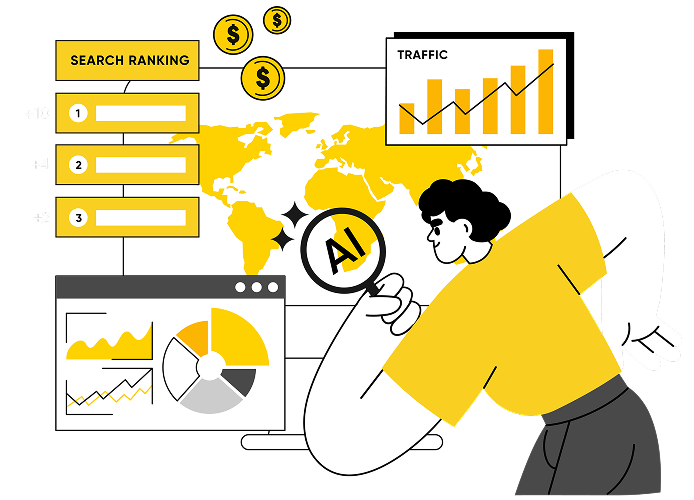
For two decades, the goal of SEO was simple: rank in the top ten blue links. The user would click, land on your page, and you would measure that session. Generative search changes this dynamic entirely. When a user asks a complex question, the AI engine synthesizes information from multiple sources to provide a single, cohesive answer. If your content is the primary source, you gain a “generative citation.” This does not always result in a direct click, but it builds immense authority and often leads to a “zero-click” brand impression that drives traffic later through direct navigation or branded searches.
The critical distinction lies in intent. Traditional SEO captures users who are actively looking for a specific website. Generative search captures users who are looking for an answer. Your content must be structured to be the answer, not just a link to a potential answer. This requires a shift in how we write, structure, and validate content.
How AI Engines Select Content for Generative Traffic
To capture AI SEO Generative Search Traffic, you must understand the selection criteria of large language models (LLMs). These models do not rank pages in the traditional sense; they rank information chunks. They look for clarity, factual accuracy, and the ability to resolve a query without requiring the user to visit multiple pages.
The Role of Entity Clarity
AI models rely on entities—people, places, concepts, and things—to build their knowledge graphs. Your content must clearly define the entities you discuss. If you write about “Apple,” the AI needs to determine if you mean the fruit or the technology company. Using precise terminology, defining acronyms on first use, and providing context-rich sentences helps the AI map your content correctly. This increases the likelihood of your content being selected as the authoritative source for that specific entity.
Structured Data and Schema Markup
While AI models can read unstructured text, they excel at parsing structured data. Implementing schema markup (JSON-LD) for articles, FAQs, How-To, and Products provides explicit signals about the type of content you offer. This is not a direct ranking factor for generative engines, but it significantly improves the “crawlability” and understanding of your page’s purpose. Pages with clear schema are more likely to be used as direct answer sources because the AI can extract the exact question-and-answer pairs without ambiguity.
Factual Consistency and Authority Signals
Generative engines are programmed to avoid hallucinations. They prefer sources that are consistent with other high-authority references. If your content contradicts the consensus of other reputable sites, the A Building topical authority—publishing multiple, interlinked pieces on the same subject—signals to the AI that you are a reliable resource. Consistency across your own content and alignment with industry standards is paramount.
Optimizing Content Structure for Generative Search
The format of your content is just as important as the words you use. AI engines favor content that is easy to parse and extract. Long, rambling paragraphs are difficult for a model to summarize. Conversely, concise, well-structured sections with clear headings allow the AI to isolate the exact sentence that answers the query.
Direct Answer Paragraphs
Place the direct answer to your primary keyword within the first 100 words of the article. This is not just for SEO; it is for the AI’s extraction algorithm. If a user asks “What is AI SEO Generative Search Traffic?”, the AI looks for a paragraph that starts with “AI SEO Generative Search Traffic is…” or similar direct phrasing. By providing this clear, declarative statement early, you make it effortless for the AI to quote you.
Utilizing Lists and Tables
Information presented in lists (ul, ol) and tables is highly digestible for AI models. When you compare features, prices, or pros and cons, use a table. When you provide steps, use a numbered list. This structured format allows the AI to copy the data directly into its response without needing to paraphrase, which increases the accuracy of the citation and the likelihood of a link back to your site.
Comprehensive FAQ Sections
An FAQ section is a goldmine for generative traffic. Users often phrase queries as questions. By explicitly writing out these questions as H3 headings and providing concise answers beneath them, you create a direct mapping between the user’s query and your content. This is the most effective way to win the featured snippet in traditional search and the “source” citation in generative search.
Key Differences: Traditional SEO vs. Generative Search Optimization
Understanding the difference between these two disciplines is crucial for resource allocation. They are not mutually exclusive, but they require different tactics.
| Aspect | Traditional SEO | Generative Search Optimization |
|---|---|---|
| Primary Goal | Rank for keywords to earn clicks. | Become a cited source for AI answers. |
| Content Focus | Keyword density and backlinks. | Entity clarity and factual precision. |
| User Intent | Navigational and transactional. | Informational and comparative. |
| Measurement | Click-Through Rate (CTR) and Bounce Rate. | Brand Mentions and Referral Traffic from AI platforms. |
| Content Format | Long-form with subheadings. | Structured data, lists, and direct answers. |
Traditional SEO focuses on the “link graph.” Generative SEO focuses on the “knowledge graph.” While backlinks still matter for authority, the AI’s ability to understand and extract your content is the new battleground. You must optimize for the machine’s comprehension, not just the user’s click.
Practical Strategies to Increase Generative Search Traffic
Capturing this traffic requires a proactive approach. You cannot simply wait for the AI to discover you; you must architect your site to be AI-friendly. The following strategies are proven methods to increase your visibility in generative engines.
1. Create “Answer-First” Content
Analyze your existing high-ranking pages. Identify the primary question they answer. Rewrite the introduction to provide that answer immediately. Do not make the user read three paragraphs of fluff before getting to the point. The A If the answer is buried, the A
2. Build Topical Clusters
Instead of writing one article on a broad topic, create a pillar page and multiple cluster pages that dive deep into subtopics. This creates a web of interlinked content that demonstrates deep expertise. For example, if your pillar page is about “AI SEO,” your cluster pages should cover “Prompt Engineering for SEO,” “AI Content Detection,” and “Generative Engine Optimization.” This internal linking structure helps AI models understand the breadth and depth of your knowledge.
3. Optimize for “People Also Ask”
The questions found in Google’s “People Also Ask” boxes are the exact questions users are asking AI assistants. Scrape these questions and create dedicated sections or FAQ entries for them. This aligns your content with the real-world queries that generative engines are trained on.
4. Leverage Original Data and Research
AI models are trained on existing data. If you publish original research, statistics, or surveys, you provide new data points that the AI cannot find elsewhere. This makes your content uniquely valuable. When the AI needs to cite a statistic, it will often choose the original source over a secondary source that merely republishes the data. This is a powerful way to earn authoritative generative citations.
5. Monitor Your Brand Mentions in AI Outputs
Use tools to track where your brand appears in AI-generated responses. You can manually test queries in ChatGPT, Perplexity, and Google AI Overviews. Look for patterns. Are you cited for certain types of questions but not others? Use this data to refine your content strategy. If you are cited for “what is” questions but not “how to” questions, you know you need to create more process-oriented content.
Common Mistakes That Kill Generative Search Visibility
Many websites are inadvertently blocking themselves from earning generative traffic. Understanding these pitfalls is essential to avoid wasting your optimization efforts.
Ignoring the “Zero-Click” Reality
Many marketers panic when they see a drop in organic clicks, assuming their SEO is failing. In reality, the traffic is being absorbed by the AI overview. The mistake is not the loss of the click; it is the failure to capture the brand impression. If you are not in the AI overview, you are invisible. If you are in the overview, you are winning even without the click, as users are more likely to trust and visit your brand later.
Using Vague or Ambiguous Language
Writing for humans is great, but you must also write for machines. Avoid using pronouns without clear antecedents. Do not use idioms or colloquialisms that an AI might misinterpret. Be literal and specific. If you say “this tool is a game-changer,” the AI does not know what “this” refers to or what “game-changer” means in a literal sense. Say “This specific tool increases productivity by 20%.”
Blocking AI Crawlers
Some websites have robots.txt files that block GPTBot, ClaudeBot, or other AI crawlers. While this is a privacy decision, it is a death sentence for generative traffic. If the AI cannot crawl your site, it cannot cite you. If you want to be visible in generative search, you must allow these crawlers access to your public content.
Neglecting Content Freshness
AI models have a knowledge cutoff, but they also prioritize recent information for real-time queries. If your content is outdated, the A Regularly update your statistics, examples, and product information. A “Last Updated” date on your article is a strong signal to the AI that your content is current and relevant.
Measuring the Impact of Generative Search Traffic
Measuring this new traffic channel is challenging because it does not appear as a standard referral source in Google Analytics. You must use a combination of metrics to gauge your performance.
Branded Search Volume
Monitor your branded search queries. If a user reads an AI-generated answer that cites your brand, they may not click the link immediately. However, they might search for your brand name directly later. An increase in branded search volume, without a corresponding increase in ad spend, is a strong indicator that you are gaining generative visibility.
Referral Traffic from AI Platforms
Check your analytics for referrals from domains like perplexity.ai, chat.openai.com, or bard.google.com. While these numbers may be small, they are direct proof of generative traffic. An increase in these referrals indicates that your content is being used as a source.
Share of Voice in AI Overviews
Use SEO tools that track your presence in Google AI Overviews. These tools can tell you which keywords trigger an AI overview and whether your URL appears within that overview. Tracking this “share of voice” over time gives you a clear picture of your growth in the generative space.
Important Notes on Content Quality and E-E-A-T
Generative engines are designed to prioritize trustworthy information. Google’s E-E-A-T (Experience, Expertise, Authoritativeness, and Trustworthiness) framework is now more critical than ever. AI models are trained to favor content that demonstrates first-hand experience and verifiable expertise.
To signal this to AI, you must include author bios with credentials, cite your sources with outbound links to reputable domains, and provide clear contact information. If you are writing about a product, include your personal experience using it. If you are writing about a process, include specific data points or case studies. The more “human” evidence you provide, the more the A
Furthermore, avoid AI-generated fluff. Ironically, content written by AI to rank for AI is often penalized. The algorithms are sophisticated enough to detect low-value, mass-produced content. Your unique perspective, personal anecdotes, and original analysis are the only things that will differentiate you from the millions of other pages on the internet.
Frequently Asked Questions (FAQ)
What is the difference between AI SEO and Generative Search Traffic?
AI SEO is the overarching strategy of optimizing your website to be visible in AI-powered search results. Generative Search Traffic is the specific outcome of that strategy—the visits and impressions you receive when an AI model generates an answer that includes your content. AI SEO is the process; Generative Search Traffic is the result.
Will traditional SEO become obsolete?
No, traditional SEO is not obsolete, but it is evolving. The fundamentals of technical SEO (site speed, mobile-friendliness, crawlability) remain essential. However, the focus is shifting from link-building and keyword density to entity optimization and content structure. Traditional SEO and Generative SEO must work in tandem for a complete digital strategy.
How long does it take to see results from Generative Search Optimization?
It varies. If you are updating existing high-authority pages, you may see changes within a few weeks. If you are building new content clusters from scratch, it can take several months. The AI models are constantly updating their knowledge bases, so consistency is key. T
Should I block AI crawlers to protect my content?
Blocking AI crawlers will prevent you from earning generative search traffic. While it protects your content from being used without a click, it also removes your brand from the conversation. For most businesses, the brand exposure and potential for referral traffic outweigh the risk of content being summarized without a visit. The exception is for businesses that sell content directly and rely on subscriptions, where scraping could be a direct threat to revenue.
What is the best tool to track AI search visibility?
T Tools like Semrush, Ahrefs, and SE Ranking have started adding AI Overview tracking features. For more specific analysis, platforms like Profound and Peec AI offer dedicated tracking for LLM citations. It is best to use a combination of these tools along with manual testing on the major AI platforms.
Conclusion
AI SEO Generative Search Traffic represents the next frontier of digital marketing. The shift from click-based metrics to answer-based visibility requires a fundamental change in content strategy. By focusing on entity clarity, structured data, and direct answers, you can position your brand as the primary source for AI-generated responses. While the loss of direct clicks can be alarming, the gain in brand authority and long-term trust is far more valuable. The brands that adapt to this new reality—optimizing for the machine’s comprehension while maintaining human-centric quality—will dominate the search landscape of the future. Start by auditing your current content for answer clarity, implement structured data, and begin tracking your presence in AI overviews today. The future of search is generative, and your traffic depends on how well you prepare for it.
Xem thêm:
- AI SEO Automated Content Audit: The Complete Guide to Scaling Content Optimization
- AI SEO Backlink Prospects: The Complete Guide to Smarter Link Building in 2025
- AI SEO Review Content: The Complete Guide to Automated Reviews That Rank
- AI SEO Ahrefs: The Complete Guide to Smarter Search Optimization
- AI SEO Transactional Intent: The Complete Guide to Converting Search Traffic
Bài viết cùng chủ đề:

AI SEO SEO Automation with Make: The Complete Workflow Guide

AI SEO SEO Automation with Zapier: The Complete Workflow Guide

AI SEO SEO Automation with n8n: The Complete Workflow Guide
AI SEO SEO Automation with Gemini: The Complete Guide to Scaling Organic Growth

AI SEO SEO Automation with Claude: The Complete Guide to Scaling Content in 2025

AI SEO SEO Automation with ChatGPT: The Complete Playbook for 2025

AI SEO & SEO Automation for Affiliate Sites: The 2025 Playbook for Passive Income Growth
AI SEO & SEO Automation for Bloggers: The Complete Guide to Scaling Your Content

AI SEO & SEO Automation for Agencies: The Complete 2025 Playbook

AI SEO and SEO Automation for Ecommerce: The Complete Playbook for 2025

AI SEO & SEO Automation for WordPress: The Complete Playbook for 2025
AI SEO SEO Automation Strategy: The Complete Playbook for 2025

Mastering the AI SEO SEO Automation Process: A Complete Guide to Scaling Organic Growth
AI SEO SEO Automation System: The Complete Guide to Scaling Organic Growth in 2025
AI SEO SEO Automation Platform: The Complete Guide to Scaling Organic Growth in 2025
AI SEO SEO Automation Software: The Complete Guide to Scaling Organic Growth in 2025















