
No products in the cart.
AI SEO Google Analytics 4: The Complete Guide to Smarter Data-Driven Rankings
31
Jul
Jul
The digital marketing landscape has shifted dramatically. Traditional SEO relied on manual data analysis, guesswork, and reactive adjustments. Today, the convergence of artificial intelligence and advanced analytics has created a new paradigm. When you combine AI SEO Google Analytics 4, you unlock a powerful system that predicts user behavior, automates reporting, and surfaces actionable insights that human analysts often miss. This guide explains exactly how to leverage this combination to improve organic visibility, understand user intent, and drive sustainable traffic growth.
Understanding the Core Concepts: AI, SEO, and GA4
Before diving into tactics, it is essential to understand what each component brings to the table. AI refers to machine learning models that process vast datasets to identify patterns, make predictions, and automate decisions. SEO is the practice of optimizing websites to rank higher in search engine results. Google Analytics 4 is the latest iteration of Google’s analytics platform, built specifically with event-based tracking and machine learning at its core.
The synergy between these three elements is not accidental. GA4 was designed from the ground up to support AI-driven insights. Its event-based data model captures every interaction, not just pageviews. This granular data feeds into AI algorithms that can forecast revenue, identify churn risks, and suggest content improvements. For SEO professionals, this means moving beyond “how many visitors” to “why did they come and what will they do next.”
Why GA4 is Different from Universal Analytics
Universal Analytics relied on session-based data, which grouped user interactions into timed sessions. GA4 uses an event-based model, where every action—scroll, click, video view, purchase—is an independent event. This fundamental shift allows for more flexible and accurate tracking. For SEO, this means you can measure engagement quality, not just traffic volume. A page with 1,000 visits and a 90% bounce rate is less valuable than a page with 300 visits and a 40% engagement rate. GA4 makes this distinction clear.
Furthermore, GA4 includes built-in machine learning features like predictive metrics. These metrics estimate the probability that a user will complete a conversion within 7 or 30 days. When applied to SEO, you can identify which organic landing pages attract users with high purchase intent, even if they have not converted yet. This is a game-changer for content prioritization.
The Role of AI in Modern SEO Workflows
AI is not replacing SEO professionals; it is augmenting their capabilities. The most effective use of AI in SEO involves automating repetitive tasks, analyzing large datasets, and generating hypotheses for testing. Tools like ChatGPT, Jasper, and Surfer SEO assist with content creation, keyword clustering, and on-page optimization. However, the strategic direction still requires human expertise.
When you integrate AI with GA4 data, the possibilities expand. For instance, AI can analyze your organic search queries and automatically group them into topical clusters. It can then compare the performance of these clusters in GA4, showing you which topics drive engagement and conversions. This allows you to double down on high-performing areas and prune underperforming content.
Predictive Analytics for Organic Traffic
One of the most powerful AI features in GA4 is predictive analytics. The platform uses historical data to forecast future user behavior. For SEO, this translates into predicting which pages will gain or lose traffic. If the model identifies a downward trend for a specific keyword, you can proactively update the content or build new internal links to counteract the decline.
Another practical application is identifying “high-value” users. GA4’s predictive models can score users based on their likelihood to purchase. By segmenting your organic traffic by this score, you can tailor your content strategy. For example, if users from a specific blog post have high purchase intent scores, you might add more product-related CTAs or create a follow-up guide that moves them down the funnel.
Setting Up GA4 for AI-Powered SEO Insights
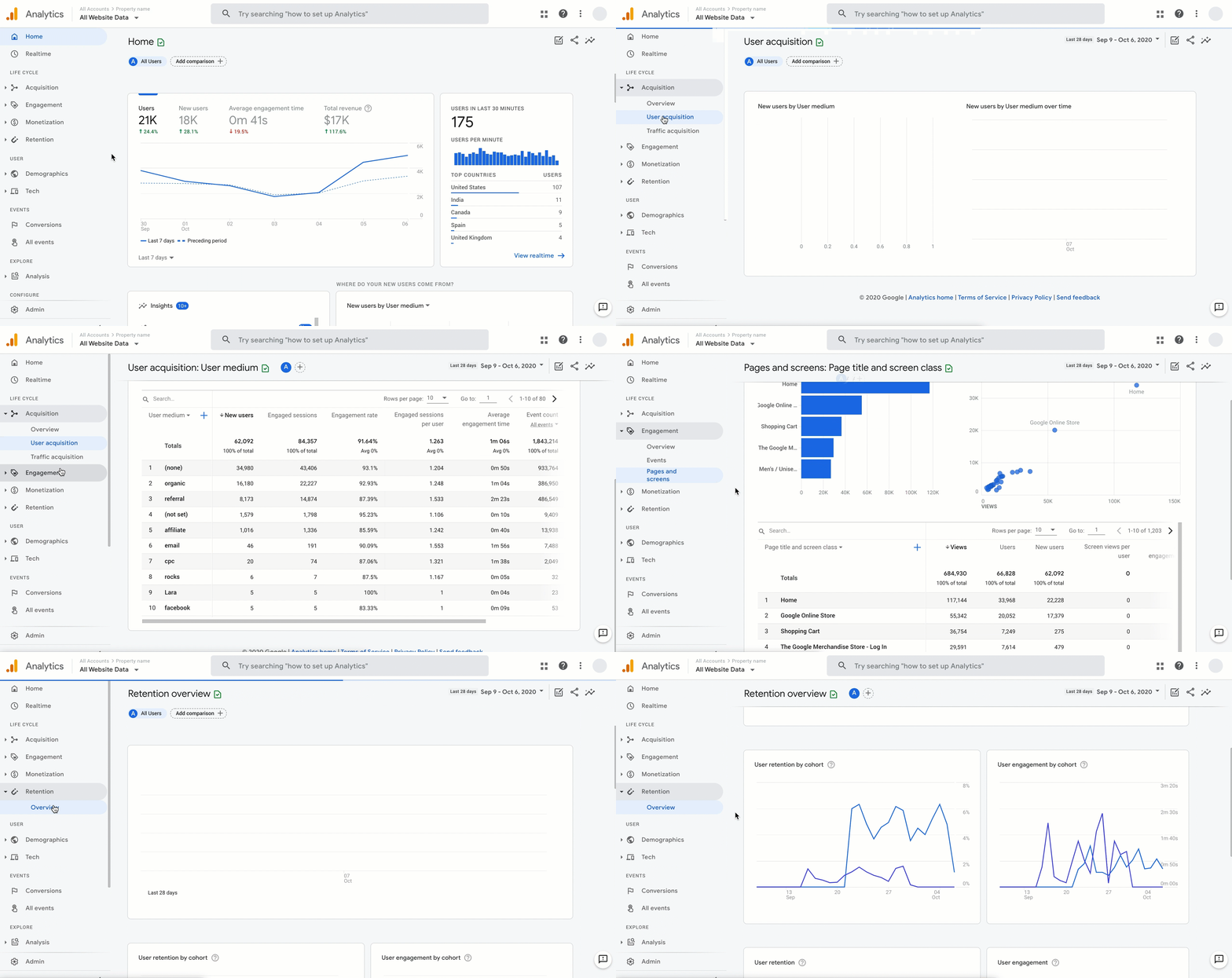
To fully leverage AI SEO Google Analytics 4, you need a properly configured property. A default GA4 setup provides basic data, but advanced SEO analysis requires custom events, conversions, and dimensions.
Step 1: Define Key Events and Conversions
Start by identifying what constitutes a meaningful interaction for your SEO goals. Standard events include page_view, scroll, and session_start. However, you should create custom events for actions like newsletter signups, video plays, or form submissions. In GA4, mark these as conversions. This data becomes the training ground for AI models. Without clear conversion definitions, predictive analytics will not know what to optimize for.
Step 2: Implement Enhanced Measurement
GA4 offers enhanced measurement, which automatically tracks interactions like outbound clicks, site search, and file downloads. Enable this feature to capture more data without writing additional code. For SEO, tracking site search is particularly valuable. It reveals what users are looking for when they cannot find it through navigation. This is a goldmine for content gap analysis.
Step 3: Use Custom Dimensions for SEO Segmentation
Custom dimensions allow you to send additional data with each event. For SEO, consider creating dimensions for “content type,” “author,” or “target keyword.” This enables you to slice your GA4 reports by these attributes. For example, you can compare the engagement rate of listicles versus long-form guides. AI algorithms can then identify which content format performs best for specific search intents.
Leveraging AI Tools to Analyze GA4 Data
GA4’s built-in insights are helpful, but external AI tools can take your analysis further. Tools like Looker Studio with AI add-ons, or custom Python scripts using machine learning libraries, can uncover complex patterns. The key is to ask the right questions. Instead of “what was my traffic last week,” ask “which organic landing pages are most likely to drive conversions next month based on current trends.”
Natural Language Processing (NLP) tools can also analyze the content of your top-performing pages. By feeding GA4 engagement data into an NLP model, you can identify common themes, sentiment, and readability scores that correlate with high rankings. This bridges the gap between quantitative analytics and qualitative content quality.
Automated Reporting and Anomaly Detection
AI excels at detecting anomalies. GA4’s built-in insights automatically flag sudden changes in traffic, such as a spike from a new backlink or a drop due to a Google algorithm update. However, these insights are often generic. By using AI-powered reporting tools, you can set up custom alerts that correlate traffic changes with specific SEO actions. For instance, if you publish a new blog post, the AI can track its performance against similar posts from the past and predict its long-term trajectory.
Automated reporting also saves significant time. Instead of manually compiling weekly reports, AI tools can generate narrative summaries. These summaries explain not just what happened, but why it happened, based on correlations in the data. This allows you to focus on strategy rather than data extraction.
Practical Applications: Using AI and GA4 for Keyword Research
Traditional keyword research relies on search volume and difficulty scores. AI and GA4 add a new dimension: actual user behavior. By analyzing which keywords bring users who engage deeply and convert, you can prioritize terms that drive business value, not just traffic.
For example, you might find that the keyword “best running shoes” brings 10,000 visits per month, but the keyword “trail running shoes for women” brings only 2,000 visits. However, GA4 data shows that the latter has a 15% conversion rate, while the former has only 1%. AI can help you identify this pattern automatically and suggest creating more content around high-converting, long-tail keywords.
Content Optimization with AI Insights
Once you have identified high-performing topics, use AI to optimize existing content. Tools like Clearscope or MarketMuse analyze your content against top-ranking pages and suggest semantic keywords. Combine this with GA4 engagement data to see which sections of your page users spend the most time on. Heatmaps and scroll depth data can be integrated into GA4, providing a complete picture of content effectiveness.
AI can also generate content briefs based on GA4 data. For instance, if you know that users from a specific organic channel prefer video content, the AI can recommend embedding videos in your next article. This level of personalization is only possible when analytics and AI work together.
Benefits and Limitations of AI-Driven GA4 SEO
Adopting this approach offers significant advantages, but it is not without challenges. Understanding both sides helps you set realistic expectations and avoid common pitfalls.
Key Benefits
- Enhanced Accuracy: AI models process more data points than a human can, reducing the risk of missing critical trends.
- Time Efficiency: Automated insights and reporting free up hours each week for strategic work.
- Predictive Capabilities: Forecast traffic and conversions, allowing for proactive SEO adjustments.
- Deeper User Understanding: Move beyond surface-level metrics to understand intent and engagement quality.
- Scalability: Analyze thousands of pages and keywords simultaneously, which is impossible manually.
- Data Quality Dependency: AI is only as good as the data it receives. Poor tracking setup leads to flawed insights.
- Black Box Problem: Some AI models do not explain why they made a specific prediction, making it hard to trust or act upon.
- Over-Reliance Risk: Blindly following AI suggestions without human judgment can lead to generic, uncompetitive content.
- Implementation Complexity: Setting up custom events and integrating external AI tools requires technical expertise.
- Privacy Constraints: With increasing data privacy regulations, AI models may have less data to work with, reducing accuracy.
Limitations to Consider
Comparison: Traditional SEO Analytics vs. AI-Powered GA4
To appreciate the value of this integration, compare it with traditional methods. The table below highlights the key differences.
| Aspect | Traditional SEO Analytics | AI-Powered GA4 SEO |
|---|---|---|
| Data Model | Session-based, pageview-centric | Event-based, user-centric |
| Reporting | Manual, periodic, reactive | Automated, real-time, predictive |
| Keyword Analysis | Volume and ranking position | User engagement and conversion probability |
| Content Optimization | Based on historical performance | Based on predictive models and intent signals |
| Anomaly Detection | Manual review of charts | Automated alerts with root cause analysis |
| Scalability | Limited by human capacity | Unlimited, handles massive datasets |
This comparison shows that AI-powered GA4 is not just an upgrade; it is a fundamentally different approach. It shifts the focus from reporting the past to predicting the future.
Common Mistakes and How to Avoid Them
Many SEO professionals make errors when integrating AI with GA4. Recognizing these mistakes early can save you from wasted effort and misleading conclusions.
Mistake 1: Ignoring Data Hygiene
Feeding messy data into AI models produces garbage outputs. Ensure your tracking code is correctly implemented, filters are applied, and spam traffic is excluded. Regularly audit your GA4 property for data quality issues.
Mistake 2: Focusing Only on Traffic Volume
AI can predict traffic, but traffic alone does not pay the bills. Focus on engagement and conversion metrics. Use GA4’s predictive metrics to identify users likely to convert, and optimize for that segment.
Mistake 3: Overcomplicating the Setup
You do not need to track every possible event. Start with the essential interactions that align with your business goals. Add complexity only when you have a clear question that requires it.
Mistake 4: Treating AI as a Replacement for Strategy
AI provides insights, but you still need to define your SEO strategy, understand your audience, and craft compelling content. Use AI to inform decisions, not to make them entirely.
Mistake 5: Neglecting the Human Element
Search engines are getting better at understanding human intent. AI can help you identify patterns, but you still need human creativity to write content that resonates emotionally and builds trust.
Important Notes for Implementation
When implementing AI SEO Google Analytics 4, keep these critical points in mind. First, always maintain a test environment. GA4 properties can be complex, and changes should be tested before going live. Second, document your tracking plan. This ensures that any team member can understand what data is being collected and why.
Third, stay updated with GA4 changes. Google frequently updates the platform, adding new features and deprecating old ones. Follow official Google blogs and reputable SEO news sources. Fourth, consider privacy regulations like GDPR and CCPA. AI models that rely on personal data may face restrictions. Use aggregated and anonymized data where possible.
Finally, invest in training. Both AI and GA4 have learning curves. Ensure your team understands the fundamentals of event-based tracking and machine learning concepts. This investment pays off in more accurate analysis and better decision-making.
Frequently Asked Questions
How does AI improve SEO analysis in GA4?
AI improves SEO analysis in GA4 by automating pattern recognition, providing predictive insights, and generating natural language summaries. It can analyze vast amounts of event data to identify which organic keywords and pages are most likely to drive conversions, allowing for proactive optimization rather than reactive reporting.
What are the key differences between GA4 and Universal Analytics for SEO?
The key differences include the data model (event-based vs. session-based), the focus on user engagement over pageviews, and the built-in machine learning capabilities. GA4 also offers more flexible custom dimensions and predictive metrics, which are essential for advanced SEO analysis.
Can AI predict organic traffic changes in GA4?
Yes, GA4 uses machine learning to forecast traffic trends based on historical data. It can predict the probability of future conversions and identify potential traffic declines. However, these predictions are probabilistic, not certain, and should be used as a guide for strategy, not a definitive forecast.
What is the best way to set up GA4 for AI-driven SEO?
The best way is to define clear conversion events, enable enhanced measurement, and use custom dimensions to segment data by content type or keyword. Ensure your tracking is accurate and consistent. Then, connect GA4 to AI-powered tools or use its built-in insights to analyze the data.
Is AI going to replace SEO professionals?
No, A It will automate repetitive tasks and provide data-driven insights, but strategic thinking, creative content creation, and understanding human psychology remain essential. SEO professionals who leverage A
Conclusion
The integration of AI SEO Google Analytics 4 represents a significant leap forward for digital marketing. By moving beyond simple traffic metrics and embracing predictive, event-based analytics, you gain a competitive edge. AI helps you interpret the vast amounts of data GA4 collects, turning raw numbers into actionable strategies.
Start by auditing your current GA4 setup, define your key events, and explore the built-in predictive insights. Then, experiment with external AI tools to deepen your analysis. Remember that the goal is not to replace human judgment but to enhance it. The future of SEO belongs to those who can harness the power of AI to understand user intent, predict behavior, and deliver content that truly satisfies search queries. Embrace this technology, stay curious, and continuously refine your approach based on the data-driven insights you uncover.
Xem thêm:
- AI Robots.txt: The Complete Guide to Controlling AI Crawlers on Your Website
- AI SEO Content Scoring: The Complete Guide to Data-Driven Content Optimization
- AI SEO Heatmaps: The Complete Guide to Visualizing Search Intent in 2025
- AI SEO Knowledge Base: The Complete Guide to Building and Using One in 2025
- AI SEO Trends 2028: The Complete Blueprint for Search Dominance
Bài viết cùng chủ đề:

AI SEO SEO Automation with Make: The Complete Workflow Guide

AI SEO SEO Automation with Zapier: The Complete Workflow Guide

AI SEO SEO Automation with n8n: The Complete Workflow Guide
AI SEO SEO Automation with Gemini: The Complete Guide to Scaling Organic Growth

AI SEO SEO Automation with Claude: The Complete Guide to Scaling Content in 2025

AI SEO SEO Automation with ChatGPT: The Complete Playbook for 2025

AI SEO & SEO Automation for Affiliate Sites: The 2025 Playbook for Passive Income Growth
AI SEO & SEO Automation for Bloggers: The Complete Guide to Scaling Your Content

AI SEO & SEO Automation for Agencies: The Complete 2025 Playbook

AI SEO and SEO Automation for Ecommerce: The Complete Playbook for 2025

AI SEO & SEO Automation for WordPress: The Complete Playbook for 2025
AI SEO SEO Automation Strategy: The Complete Playbook for 2025

Mastering the AI SEO SEO Automation Process: A Complete Guide to Scaling Organic Growth
AI SEO SEO Automation System: The Complete Guide to Scaling Organic Growth in 2025
AI SEO SEO Automation Platform: The Complete Guide to Scaling Organic Growth in 2025
AI SEO SEO Automation Software: The Complete Guide to Scaling Organic Growth in 2025















