
No products in the cart.
AI SEO LLM Recommendations: The Complete Guide to Future-Proof Search Rankings
10
Aug
Aug
The digital marketing landscape is undergoing a seismic shift. Traditional search engine optimization focused on keywords and backlinks, but the rise of large language models (LLMs) like ChatGPT, Gemini, and Claude has introduced a new paradigm. Understanding AI SEO LLM recommendations is no longer optional; it is essential for brands that want to maintain visibility in both classic search engines and AI-generated answers. This guide provides a comprehensive roadmap for adapting your strategy to satisfy both algorithms and AI models, ensuring your content remains the primary source of truth in an AI-driven world.
What Are AI SEO LLM Recommendations?
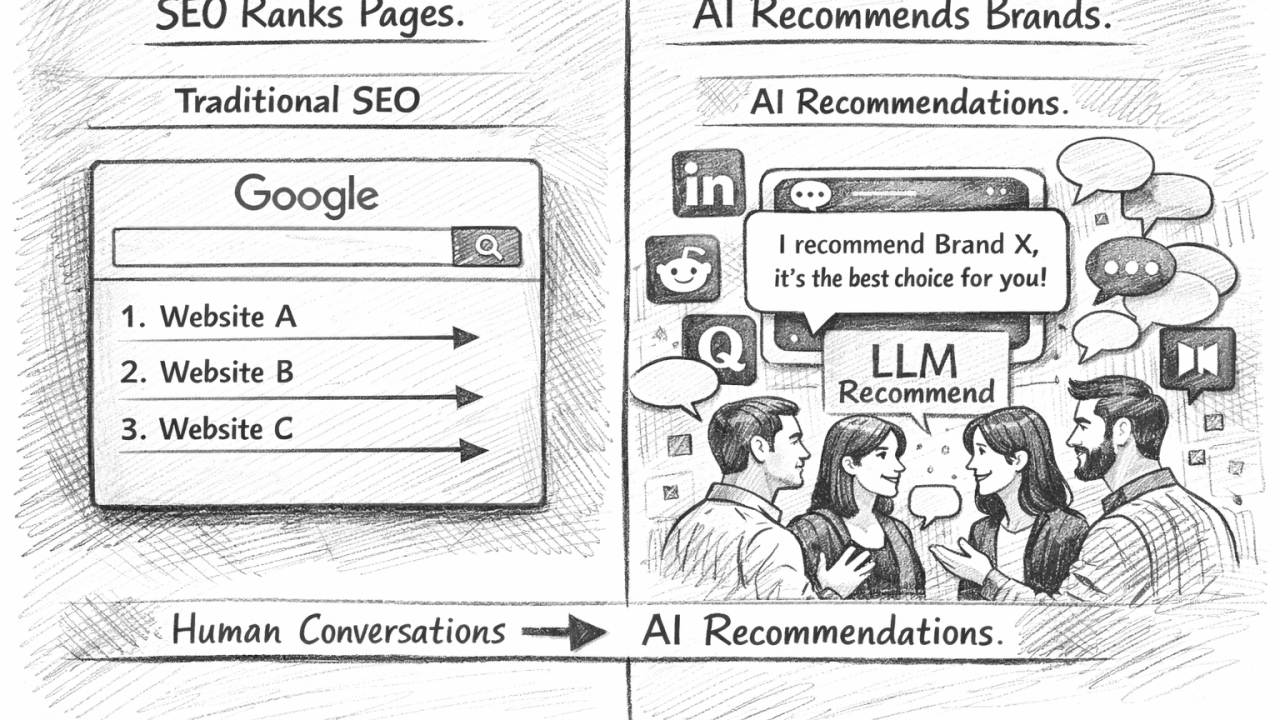
AI SEO LLM recommendations refer to the strategic practices used to optimize digital content so that it is not only ranked well on traditional search engines like Google but also cited and recommended by generative AI systems. These recommendations focus on making content easily parseable, factually accurate, and structurally clear for machine learning models.
Unlike traditional SEO, which relies heavily on crawling and indexing, LLM optimization focuses on entity recognition and semantic understanding. When a user asks an AI chatbot for a recommendation, the model does not “search” the web in real-time (unless it has browsing enabled). Instead, it relies on its training data, which includes your published content. Therefore, your goal is to create content that is statistically likely to be included in that training data and recognized as authoritative.
The Shift from PageRank to EntityRank
For decades, Google’s PageRank dominated how we viewed search. It counted links as votes. Today, while links still matter, the focus has shifted to EntityRank. This involves understanding the relationships between people, places, things, and concepts. LLMs excel at mapping these relationships. Your content must clearly define who you are, what you offer, and how it relates to the broader ecosystem of your industry.
To align with AI SEO LLM recommendations, you must move away from “writing for bots” and start writing for “machine reading comprehension.” This means using clear subject-verb-object structures, defining acronyms on first use, and avoiding ambiguous pronouns that could confuse a model trying to extract facts.
Why Traditional SEO Fails with LLMs
Traditional SEO tactics often involve keyword density, exact-match anchor text, and link farming. These tactics are becoming less effective in the age of AI. LLMs do not care about keyword density; they care about concept coverage. If your article is about “best running shoes,” but you only use that exact phrase repeatedly without discussing “pronation,” “cushioning,” or “heel drop,” the LLM may not consider your content comprehensive enough to recommend.
Furthermore, traditional SEO often encourages “skyscraper” content—long, 3000-word articles that bury the lead. LLMs prefer concise, direct answers. The “zero-click” search is evolving into the “zero-visit” search, where the AI provides the answer directly in the chat interface. To combat this, your content must be structured to be extracted. If an AI can pull a perfect 50-word definition from your page, it is more likely to cite you as the source.
Core Components of LLM-Friendly Content
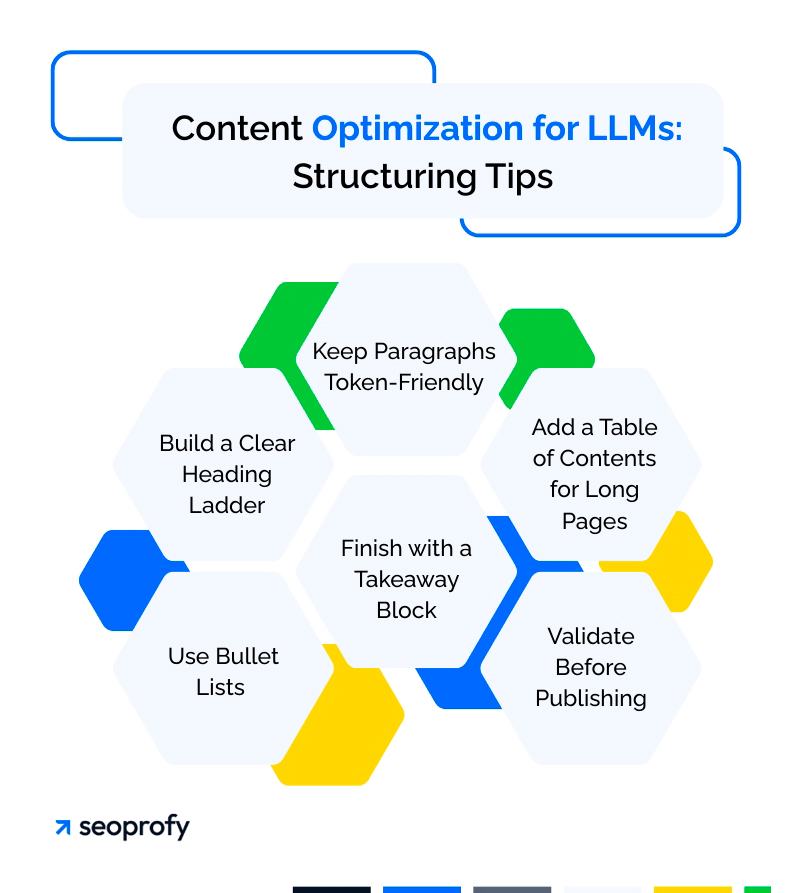
To implement effective AI SEO LLM recommendations, you must deconstruct your content strategy into specific components that AI models can digest. These components ensure that your content is not just visible, but preferred.
1. Structured Data and Schema Markup
Schema markup is the most direct way to communicate with search engines and LLMs. By implementing JSON-LD structured data, you are explicitly telling the machine what your content means. For example, using FAQPage schema or HowTo schema helps the AI understand the format of your information.
- Organization Schema: Helps the AI verify your brand’s identity.
- Article Schema: Clarifies the headline, author, and date published.
- Product Schema: Essential for e-commerce, providing price and availability directly to the model.
- Fast loading speeds (Core Web Vitals).
- Clean URL structures.
- No paywalls that block crawlers.
- Robots.txt files that allow GPTBot and Google-Extended to access your site.
- Future-Proofing: As search evolves, you are already aligned with the new algorithms.
- Higher Trust: Content that is clear and structured is often higher quality, improving user trust.
- Brand Visibility: Being cited by ChatGPT or Gemini positions your brand as a thought leader in the AI space.
- Voice Search Optimization: LLM-friendly content is naturally optimized for voice assistants like Siri and Alexa, which rely on similar NLP models.
- Lack of Attribution: Often, AI models will summarize your content without linking back to you, resulting in zero referral traffic.
- Data Drift: LLMs are updated infrequently. Your content might be “learned” today but forgotten in the next model update.
- Technical Complexity: Implementing schema and managing AI crawler access requires technical expertise that small businesses may lack.
- Consistency is Key: AI models learn from patterns. Publishing one optimized article will not change your visibility. You need a consistent stream of structured, high-quality content.
- Monitor AI Chatbots: Regularly ask ChatGPT or Gemini questions about your industry. See if your brand is mentioned. If not, analyze what the AI is recommending and why.
- Focus on Unique Data: LLMs are trained on public data. If you have proprietary research, unique case studies, or original data, you have a massive advantage. AI models love citing unique statistics because it adds credibility to their answers.
- Don’t Forget the Human: The ultimate goal is to drive revenue. While AI citations are great for branding, you still need to convert users. Ensure your content has clear calls to action for the human readers who do click through.
Without schema, the LLM has to guess the context. With schema, you remove the guesswork, significantly increasing the chances of your data being used in AI-generated answers.
2. Entity Clarity and Topical Authority
LLMs build knowledge graphs. To be included in these graphs, you must establish your site as a topical authority. This means creating content clusters that cover a subject from every angle. If you write one article about “AI SEO,” you are a blogger. If you write 50 articles about “AI SEO,” “LLM optimization,” “Prompt engineering,” and “Semantic search,” you are an authority.
Your content should explicitly link these entities together. Use internal links with descriptive anchor text that tells the AI exactly where it will go. For instance, instead of linking “click here,” link “learn more about semantic search optimization.” This helps the model traverse your site and understand the relationship between your pages.
3. The Inverted Pyramid for AI Extraction
Journalists use the inverted pyramid to put the most important information at the top. This is critical for AI SEO. Assume the LLM will only read the first 200 words of your article. If the answer to the user’s query is not in those first 200 words, the AI might skip your content entirely.
Structure your paragraphs so that the conclusion is stated first, followed by the supporting evidence. This is the opposite of academic writing, where you build up to a conclusion. In the AI era, you state the conclusion immediately and then provide the proof.
Practical Applications: How to Optimize for LLMs
Knowing the theory is one thing; applying it is another. Here are actionable steps you can take today to align with AI SEO LLM recommendations.
Optimizing for Natural Language Processing (NLP)
NLP is how computers understand human language. To optimize for NLP, you must write the way people speak. Use contractions, transition words, and varied sentence lengths. Avoid jargon unless you define it immediately. The goal is to make your text as easy to “read” for the algorithm as it is for a human.
Consider using latent semantic indexing (LSI) keywords. These are terms related to your main topic. If you are writing about “AI SEO LLM recommendations,” LSI keywords might include “retrieval-augmented generation,” “vector databases,” and “generative engine optimization.” Including these terms helps the LLM understand the depth of your knowledge.
Leveraging Retrieval-Augmented Generation (RAG)
RAG is a technique used by LLMs to pull real-time information from external sources. When a chatbot uses RAG, it searches the web for the most relevant documents to answer a query. To be the document it retrieves, you need to ensure your content is technically accessible. This means:
If you block these crawlers, you are explicitly telling the AI that you do not want to be recommended. Allowing these bots is a foundational step in AI SEO.
Benefits and Limitations of AI SEO Optimization
Adopting AI SEO LLM recommendations comes with a distinct set of advantages and challenges. Understanding both sides allows for a balanced strategy that mitigates risk while maximizing reward.
The Benefits
The Limitations
Comparison: Traditional SEO vs. AI SEO
To fully grasp the shift, it is helpful to compare the two methodologies side-by-side. This table highlights the key differences in strategy and execution.
| Aspect | Traditional SEO | AI SEO (LLM Focus) |
|---|---|---|
| Primary Goal | Rank #1 on Search Engine Results Pages (SERPs) | Be cited as a source in AI-generated answers |
| Content Length | Long-form (2000+ words) for depth | Concise, extractable answers (50-100 words) within larger content |
| Keyword Strategy | Exact match and close variants | Semantic relevance and entity coverage |
| Technical Focus | Backlinks and domain authority | Schema markup and crawler access (GPTBot) |
| User Intent | Click-through rate and dwell time | Direct answer satisfaction and factual accuracy |
This comparison shows that AI SEO is not a replacement for traditional SEO but an evolution. You still need backlinks to establish authority, but you need schema to explain that authority to machines.
Common Mistakes and How to Avoid Them
Many marketers are rushing to implement AI SEO strategies without understanding the nuances. Here are the most common pitfalls and how to navigate them effectively.
Mistake 1: Blocking AI Crawlers
Many websites have security plugins that block all bots except Google. This is a fatal error. If GPTBot cannot access your site, you are invisible to the AI ecosystem. Solution: Review your robots.txt file and explicitly allow GPTBot, Google-Extended, and ClaudeBot.
Mistake 2: Over-Optimizing for AI
Writing content that sounds robotic or overly simplified to please the algorithm will alienate your human readers. Solution: Write for humans first, then adjust the structure for AI. Use natural language and ensure the content is genuinely helpful.
Mistake 3: Ignoring Factual Accuracy
LLMs are prone to hallucination, but they are also trained to avoid citing unreliable sources. If your content contains outdated statistics or incorrect information, the A Solution: Regularly audit your content for accuracy. Update statistics and dates frequently. Cite your own sources (links to studies) to build trust.
Mistake 4: Neglecting the “People Also Ask” Data
Google’s “People Also Ask” boxes are goldmines for AI SEO. These questions represent the exact queries users are asking. Solution: Create dedicated FAQ sections that answer these questions directly. Use the question as the H2 or H3 heading, and provide a succinct answer in the paragraph below.
Important Notes for Implementation
As you begin to implement these AI SEO LLM recommendations, keep these critical notes in mind to ensure long-term success.
Frequently Asked Questions (FAQ)
What is the difference between SEO and GEO (Generative Engine Optimization)?
GEO is a subset of AI SEO. While traditional SEO focuses on ranking in lists of links, GEO focuses specifically on appearing in the narrative text generated by AI models. GEO involves optimizing content so that a generative engine (like ChatGPT) chooses to cite it as a reference. AI SEO is the umbrella term that includes GEO, technical crawler management, and schema markup.
How do I check if my content is being used by LLMs?
You can check your server logs for traffic from “GPTBot” or “ClaudeBot.” If you see these user agents accessing your pages, it means the AI is crawling your site. Additionally, you can manually ask an AI chatbot a question related to your niche and see if your brand is mentioned in the response. Tools like “ChatGPT” with browsing enabled can show you which sources it used to generate the answer.
Does AI SEO require new technical skills?
Yes, but they are manageable. You need to understand how to edit your robots.txt file and implement JSON-LD schema. Most CMS platforms like WordPress have plugins that handle schema automatically. The bigger skill shift is in content strategy—learning to write for “extraction” rather than just “reading.”
Will AI SEO replace traditional link building?
No. Links are still a primary signal of authority. However, the quality of the link matters more than the quantity. A link from a high-authority site that is relevant to your niche tells the LLM that you are a trusted source. The focus is shifting from “link volume” to “link relevance” and “entity association.”
How long does it take to see results from AI SEO?
It takes longer than traditional SEO. LLMs are not crawled in real-time. The training data for models like GPT-5 may take months to update. You should expect to wait 3-6 months before you see significant mentions in AI responses. Consistency and patience are critical.
Conclusion
The integration of AI into search is not a passing trend; it is the new reality. By embracing AI SEO LLM recommendations, you are positioning your brand at the forefront of this evolution. The strategies outlined here—from implementing schema markup to allowing AI crawlers and writing for extraction—are the building blocks of a resilient digital presence.
The key takeaway is to view AI as a distinct audience. You must serve this audience with clear, factual, and structured data. While the methods differ from traditional SEO, the underlying principle remains the same: provide value. By providing undeniable value to both human readers and machine learning models, you ensure that your content remains the definitive source of information in the age of artificial intelligence. Start auditing your content today, adjust your technical settings, and commit to a strategy that bridges the gap between human curiosity and machine intelligence.
Xem thêm:
- AI SEO AI Search Citations: The Complete Guide to Winning AI Search Visibility
- AI SEO JSON-LD Generator: The Complete Guide to Automated Structured Data
- The Ultimate AI SEO Prompt Library: Streamline Your Content Strategy with Ready-to-Use Prompts
- AI SEO & SEO Automation for Agencies: The Complete 2025 Playbook
- AI SEO Digital Authority: The Complete Playbook for Dominating Search in 2025
Bài viết cùng chủ đề:

AI SEO SEO Automation with Make: The Complete Workflow Guide

AI SEO SEO Automation with Zapier: The Complete Workflow Guide

AI SEO SEO Automation with n8n: The Complete Workflow Guide
AI SEO SEO Automation with Gemini: The Complete Guide to Scaling Organic Growth

AI SEO SEO Automation with Claude: The Complete Guide to Scaling Content in 2025

AI SEO SEO Automation with ChatGPT: The Complete Playbook for 2025

AI SEO & SEO Automation for Affiliate Sites: The 2025 Playbook for Passive Income Growth
AI SEO & SEO Automation for Bloggers: The Complete Guide to Scaling Your Content

AI SEO & SEO Automation for Agencies: The Complete 2025 Playbook

AI SEO and SEO Automation for Ecommerce: The Complete Playbook for 2025

AI SEO & SEO Automation for WordPress: The Complete Playbook for 2025
AI SEO SEO Automation Strategy: The Complete Playbook for 2025

Mastering the AI SEO SEO Automation Process: A Complete Guide to Scaling Organic Growth
AI SEO SEO Automation System: The Complete Guide to Scaling Organic Growth in 2025
AI SEO SEO Automation Platform: The Complete Guide to Scaling Organic Growth in 2025
AI SEO SEO Automation Software: The Complete Guide to Scaling Organic Growth in 2025















