
No products in the cart.
12 AI SEO Mistakes That Will Crash Your Rankings (And How to Avoid Them)
29
Jul
Jul
Artificial intelligence has transformed the way marketers approach search engine optimization. From generating blog outlines in seconds to analyzing thousands of keywords effortlessly, AI tools promise efficiency and scale. However, when AI is applied without human oversight and strategic thinking, the results can be catastrophic. An alarming number of sites are already seeing rankings plummet because of critical AI SEO mistakes that are easy to make and hard to undo. These errors range from publishing unedited machine content to misinterpreting search intent on a massive scale. This article dissects the most damaging AI SEO mistakes, explains exactly why they hurt your organic visibility, and provides actionable steps to fix them.
Understanding AI in Modern SEO
AI in SEO is no longer just about tools that suggest keywords. Large language models now write full articles, create meta descriptions, optimize internal linking, and even generate schema markup. Platforms like ChatGPT, Jasper, and Google’s own AI-powered features have blurred the line between human and machine-generated optimization. While this unlocks tremendous productivity, it also opens the door to AI SEO mistakes that jeopardize trust, authority, and rankings.
The core issue is that AI predicts patterns based on training data. It does not understand your brand, your audience’s unique pain points, or the subtle contextual cues that Google’s ranking algorithms increasingly reward. When you treat AI output as a final deliverable rather than a starting point, you are walking straight into a minefield of SEO penalties and lost traffic.
Why AI SEO Mistakes Are So Costly
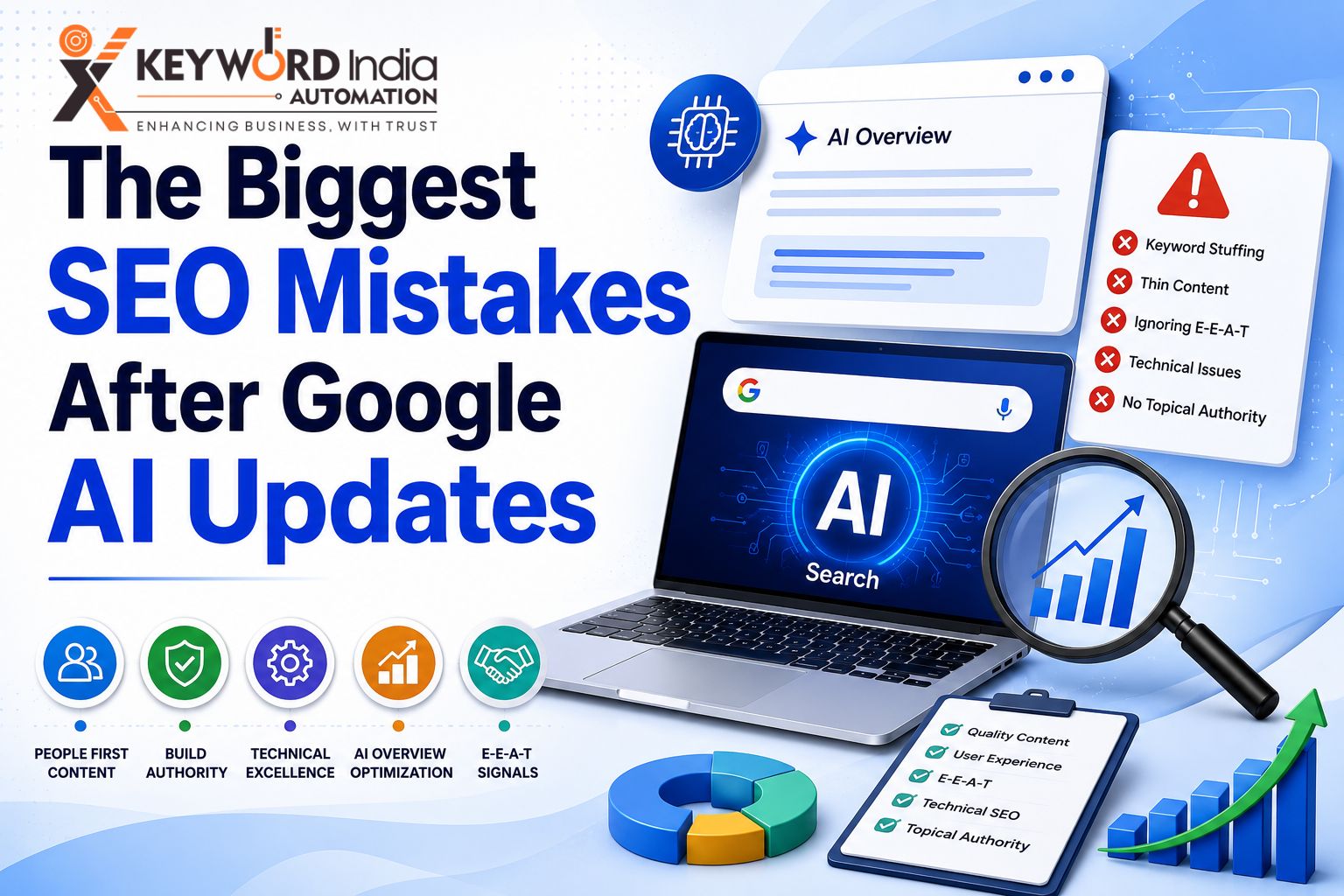
Google’s helpful content system, E-E-A-T guidelines, and constant algorithm updates are designed to surface genuinely useful, trustworthy information. AI SEO mistakes often trigger the very signals that these systems demote. Thin, repetitive, or factually incorrect content created at scale can lead to site-wide quality hits that take months to recover from. Moreover, once your domain loses credibility, even high-quality pages suffer. The compounding effect of these mistakes means a single poor AI implementation can erase years of organic growth.
Many site owners initially see a traffic bump because AI can pump out volumes of content that capture long-tail queries. Then the decline begins. Understanding why this happens and how to avoid the trap separates sustainable SEO growth from temporary spikes followed by oblivion.
| Human-Driven SEO | AI-Only SEO Without Oversight |
|---|---|
| Original insights from real experience | Regurgitated common knowledge with zero novelty |
| Natural brand voice and nuanced storytelling | Generic, robotic tone across all pages |
| Strategic internal linking based on topical authority | Random or over-optimized anchors crammed by an AI script |
| Fact-checked data, statistics, and expert quotes | Hallucinated facts, fabricated statistics, and non-existent sources |
| Content tailored to user intent stages | One-size-fits-all articles that miss commercial, transactional, or navigational intent |
12 Critical AI SEO Mistakes to Avoid
1. Publishing Completely Unedited AI Content
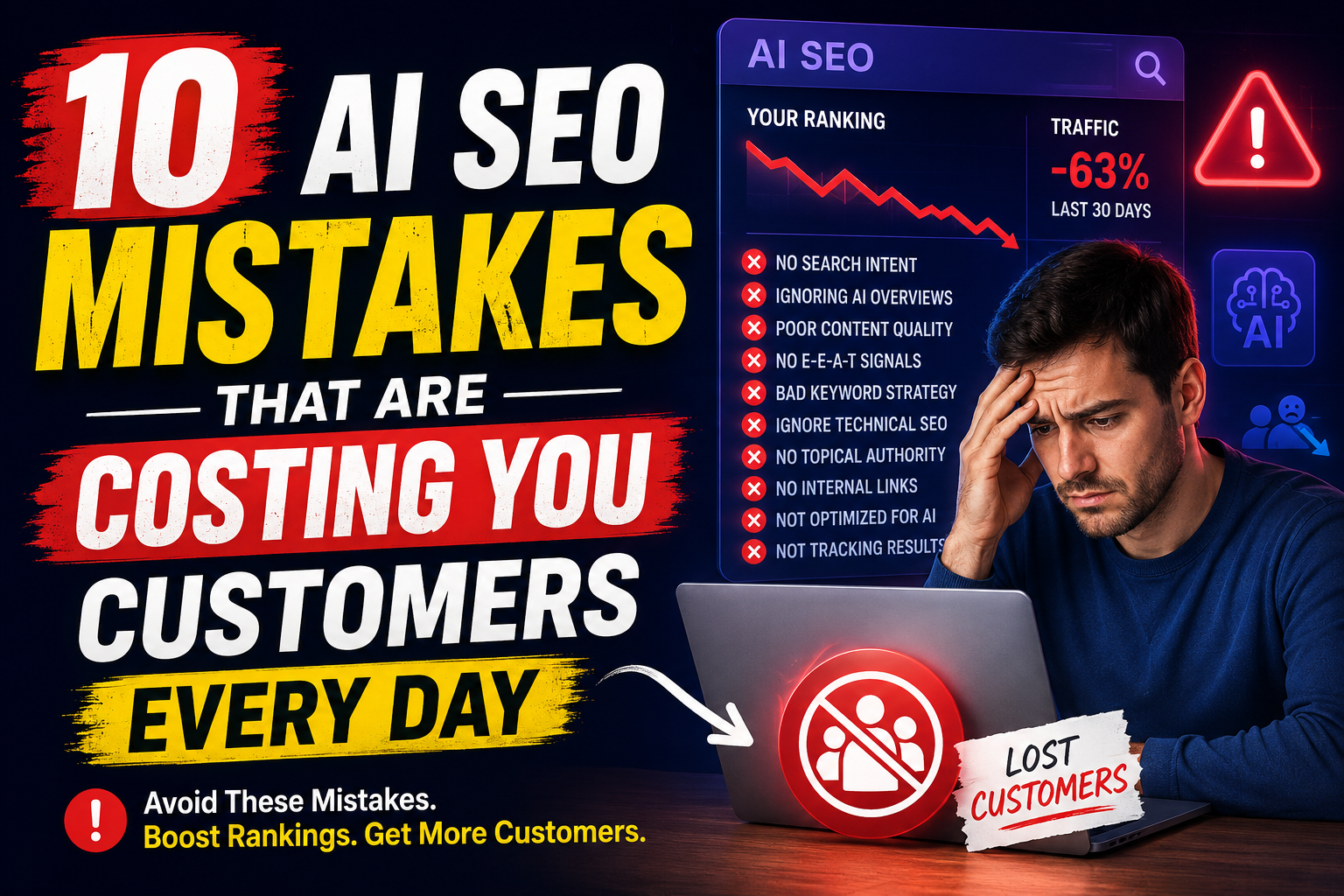
One of the most widespread AI SEO mistakes is taking an AI-generated article and hitting publish without any human review. The content may read fluently on the surface, but it often lacks depth, contains outdated information, and fails to differentiate your site from competitors. Google’s algorithms are increasingly adept at detecting machine-generated text that offers no added value. When you publish raw AI content, you signal that your site prioritizes quantity over quality, directly violating the helpful content guidelines. The fix is simple but non-negotiable: every piece of AI output must be fact-checked, enriched with unique anecdotes or case studies, and infused with expert perspective before it goes live.
2. Ignoring E-E-A-T Signals
Experience, Expertise, Authoritativeness, and Trustworthiness form the backbone of modern SEO evaluations, especially in YMYL niches. AI SEO mistakes here include generating medical, financial, or legal advice pages without author bylines, lacking citations from credible sources, and omitting any indication that a real human expert stands behind the information. AI does not automatically establish trust; in fact, it can erode it if readers sense a lack of genuine authority. To avoid penalties, always attribute content to qualified authors, include real credentials, and link to verifiable, authoritative references. Never let AI pretend to be a licensed professional.
3. AI-Generated Keyword Stuffing at Scale
When AI tools are fed a list of keywords without clear instructions, they often over-optimize by forcing terms into every paragraph, subheading, and image alt text. This classic AI SEO mistake produces pages that read awkwardly and trigger spam filters. Modern search engines use advanced natural language processing to understand context. Cramming keywords in unnatural patterns does more harm than good. Instead, provide AI with a content brief that emphasizes topic coverage, semantic entities, and user intent. After generation, manually check for excessive repetition and rewrite sections that sound forced.
4. Creating Thousands of Thin Content Pages
Programmatic AI content creation can lead to hundreds or thousands of near-identical pages targeting minor location or product variations. Without substantial unique value, these pages become a classic thin content problem. AI SEO mistakes of this nature cannibalize rankings, waste crawl budget, and invite manual actions. If you use AI to scale landing pages, ensure each page includes genuinely unique descriptions, reviews, pricing data, or inventory availability that users cannot find elsewhere. Merge or noindex pages that end up duplicating each other.
5. Misinterpreting Search Intent Due to AI Blind Spots
AI models are trained on text patterns, not on real-world user behavior. They frequently misclassify the intent behind a query, turning an informational blog post into a transactional landing page or vice versa. This ranks among the most damaging AI SEO mistakes because even perfectly written content will not rank if it does not align with what searchers actually want. Always manually validate the top-ranking pages for your target keyword. Observe the dominant content format, angle, and depth. Then instruct your AI with that specific intent in mind, and review its suggested structure before writing begins.
6. Neglecting Original Research, Data, and Expert Quotes
Search engines reward content that introduces new information or unique perspectives. AI, by design, remixes existing web data. If you never inject proprietary data, internal surveys, case studies, or interviews with subject matter experts, your content remains a mirror of what already exists. Among the most overlooked AI SEO mistakes, this one starves your site of the link-worthy assets that build authority. Use AI to format and structure data, but originate the insights yourself. A single original statistic can earn more backlinks than a hundred AI-spun listicles.
7. Using AI for Entire Link Building Sequences Without Human Judgment
Automated outreach emails, AI-written guest posts, and scripted forum comments may seem efficient, but they leave digital footprints that Google and spam filters easily detect. Mass-produced AI pitches often lack personalization and are ignored or flagged. True AI SEO mistakes in link building include generating unnatural anchor text distributions and creating low-quality PBN content at scale. If you use AI for outreach, treat it as a draft assistant, not a replacement. Personalize every message, ensure guest content meets editorial standards, and manually vet every backlink source for relevance and authority.
8. Relying on AI for Technical Audits Without Human Verification
Several AI-powered audit tools can crawl your site and flag issues, but they operate on generalized rules. They may misinterpret JavaScript-rendered content, miss subtle canonicalization problems, or suggest changes that conflict with your platform’s architecture. Blindly implementing AI recommendations constitutes one of the more technical AI SEO mistakes that can lead to deindexing, broken navigation, or hreflang disasters. Always have an experienced SEO professional validate AI-generated technical suggestions before pushing changes to a live site.
9. Publishing Generic AI-Written Meta Tags and Titles
Title tags and meta descriptions are your first chance to earn a click. AI generators often produce bland, templated tags like “Best X in 2024 – Your Ultimate Guide.” These fail to stand out in the SERPs and rarely include the emotional or urgency triggers that drive click-through rates. AI SEO mistakes at the meta level cause even well-ranking pages to underperform. Use AI to brainstorm variations, but finalize each title manually to incorporate your unique value proposition, power words, and a compelling reason for the searcher to click your result over nine others.
10. Failing to Fact-Check AI Outputs
AI language models confidently invent statistics, quote non-existent studies, and misattribute claims. Publishing these fabrications is a fast track to losing user trust and getting flagged by quality raters. In the health, finance, and legal sectors, such AI SEO mistakes can have serious real-world consequences. Establish a rigorous fact-checking workflow: verify every data point with a primary source, cross-reference dates, and ensure that cited studies actually exist. If a claim cannot be verified, it must be removed or clearly labeled as speculative.
11. Ignoring Content Structure, Readability, and Accessibility
AI can produce a wall of text devoid of proper heading hierarchy, bullet lists, or scannable breaks. While the raw word count may be high, the user experience suffers and bounce rates increase. AI SEO mistakes related to formatting signal to search engines that your content is not optimized for readers. Always restructure AI drafts by adding descriptive subheadings, short paragraphs, relevant images with alt text, and clear calls to action. Format for featured snippets by using concise definitions, tables, and step-by-step instructions where appropriate.
12. Adopting a Single AI Tone That Ignores Brand Identity
When every piece on your site sounds like a neutral encyclopedia entry, you lose the brand personality that differentiates you from competitors. Users develop loyalty through voice, storytelling, and emotional connection. AI SEO mistakes that strip away brand identity reduce dwell time and social sharing. Train your AI with examples of your best-performing content, specify the desired tone, and consistently edit the output to reflect your brand’s values, humor, or authority. Content that sounds human and relatable consistently outperforms sterile AI prose in both rankings and conversions.
How to Use AI for SEO Without Making Mistakes
AI can be a powerful co-pilot when you establish guardrails. Begin every project with a detailed content brief that includes target audience, search intent, primary and secondary keywords, and a list of unique insights you plan to add. Use AI for research synthesis, first-draft generation of factual sections, and data formatting. Then layer on your expertise: incorporate real case studies, review for accuracy, and optimize for on-page SEO elements manually. Treat AI as a junior assistant whose work always needs senior review.
Implement content scoring criteria: every piece must include at least one original insight, one credible external link, and a clear author profile. Regularly audit AI-assisted pages using Google Search Console and analytics to identify early signs of ranking drops or user engagement declines. Intervene immediately if a batch of AI content shows higher bounce rates or lower average session duration than your human-written articles.
Important Notes on AI SEO Pitfalls
- Algorithm updates disproportionately hit AI-heavy sites. With each helpful content update, Google refines its ability to detect low-value machine content. Sites that rely too heavily on AI see drastic traffic drops during these rollouts.
- Legal and ethical risks cannot be outsourced to AI. AI may plagiarize, infringe copyright, or generate sensitive content without disclaimers. Human legal review is mandatory.
- User signals matter more than ever. If visitors quickly leave your AI-generated pages, Google interprets that as a quality issue, which can cascade across your entire domain.
- Not all AI tools are equal. Some are trained on outdated data, others lack safety filters, and many produce generic content. Vetting tools and customizing prompts is part of the strategy.
Frequently Asked Questions
What are the most common AI SEO mistakes beginners make?
Beginners often treat AI output as publish-ready, neglect fact-checking, and ignore search intent. They also stuff keywords blindly, produce thin affiliate content at scale, and forget to add author expertise signals. These foundational AI SEO mistakes lead to poor user experience and eventual ranking penalties.
Can Google detect AI-generated content and penalize it?
Google can detect patterns typical of unedited AI content, especially when it lacks originality and user value. T The key is whether the content is helpful, reliable, and people-first. Avoiding the AI SEO mistakes outlined here keeps your content on the right side of those guidelines.
How do I fact-check AI-generated SEO content efficiently?
Cross-reference every statistic, date, and claim with primary sources. Use tools like reverse image search for charts, and verify quoted individuals or studies exist. For technical or medical topics, consult licensed experts before publication. Building a fact-checking checklist and a library of trusted sources significantly reduces the risk of AI SEO mistakes involving misinformation.
Is it safe to use AI for internal linking and technical SEO?
It can be safe if you treat AI suggestions as recommendations, not mandates. AI may propose unnatural anchor text or fail to recognize nuanced site architecture. Always test internal linking changes on a staging environment first, and have a developer review any technical SEO code generated by AI. Blind automation in this area is a common cause of severe AI SEO mistakes such as broken navigation or noindexing important pages.
Conclusion
Avoiding AI SEO mistakes is not about rejecting artificial intelligence; it is about wielding it with precision, oversight, and a deep understanding of what search engines and users truly value. The most successful SEO strategies today combine AI’s speed and data-processing power with human creativity, subject matter expertise, and rigorous editorial standards. Companies that master this balance will build sustainable organic growth while those that continue to publish AI-generated content without guardrails will watch their rankings erode. Audit your current AI workflows now, implement the safeguards discussed, and turn AI from a liability into your most productive assistant.
Xem thêm:
- AI Affiliate SEO: How Artificial Intelligence Is Reshaping Affiliate Search Rankings
- AI SEO Content Clusters: The Complete Strategy for Dominating Search Rankings in 2025
- AI SEO Ecommerce Category Pages: The Complete Guide to Higher Rankings
- AI Writing Assistants: The Complete 2025 Guide to Smarter, Faster Content Creation
- AI SEO Outranking: The Complete Playbook for Dominating Search in 2025
Bài viết cùng chủ đề:

AI SEO SEO Automation with Make: The Complete Workflow Guide

AI SEO SEO Automation with Zapier: The Complete Workflow Guide

AI SEO SEO Automation with n8n: The Complete Workflow Guide
AI SEO SEO Automation with Gemini: The Complete Guide to Scaling Organic Growth

AI SEO SEO Automation with Claude: The Complete Guide to Scaling Content in 2025

AI SEO SEO Automation with ChatGPT: The Complete Playbook for 2025

AI SEO & SEO Automation for Affiliate Sites: The 2025 Playbook for Passive Income Growth
AI SEO & SEO Automation for Bloggers: The Complete Guide to Scaling Your Content

AI SEO & SEO Automation for Agencies: The Complete 2025 Playbook

AI SEO and SEO Automation for Ecommerce: The Complete Playbook for 2025

AI SEO & SEO Automation for WordPress: The Complete Playbook for 2025
AI SEO SEO Automation Strategy: The Complete Playbook for 2025

Mastering the AI SEO SEO Automation Process: A Complete Guide to Scaling Organic Growth
AI SEO SEO Automation System: The Complete Guide to Scaling Organic Growth in 2025
AI SEO SEO Automation Platform: The Complete Guide to Scaling Organic Growth in 2025
AI SEO SEO Automation Software: The Complete Guide to Scaling Organic Growth in 2025















