
No products in the cart.
AI SEO Outranking: The Complete Playbook for Dominating Search in 2025
31
Jul
Jul
The digital landscape has shifted beneath the feet of traditional marketers. The term AI SEO outranking no longer refers to a futuristic concept but to the daily reality of competing against machine-generated content and AI-optimized strategies. To win the search engine results page (SERP) today, you must understand how artificial intelligence evaluates, ranks, and rewards content. This guide provides a tactical framework for using AI not just to publish faster, but to outrank competitors who are still relying on outdated tactics.
What Is AI SEO Outranking?
AI SEO outranking is the strategic process of leveraging artificial intelligence tools and machine learning algorithms to analyze search patterns, predict content performance, and optimize web pages to achieve higher rankings than competing URLs. It moves beyond simple keyword insertion. It involves using AI to understand the semantic relationships between topics, the intent behind user queries, and the specific structural elements that Google’s RankBrain and BERT algorithms prioritize.
This approach combines data analysis with content generation. AI tools can process millions of data points about competitor backlinks, content gaps, and user engagement metrics in seconds. The output is a content strategy that is not only relevant but also precisely calibrated to match the search engine’s understanding of a topic. The goal is to create pages that are so aligned with user intent that they naturally outperform existing results.
How AI Algorithms Determine Your Rankings
To outrank competitors, you must first understand the referee. Google’s core ranking systems are now predominantly driven by neural networks. These systems do not look for exact-match keywords. Instead, they analyze the conceptual depth of a page. They evaluate whether your content satisfies the “search intent” behind a query, which is often a mix of informational, navigational, and transactional needs.
AI models like MUM (Multitask Unified Model) are capable of understanding language across multiple formats and languages. This means your content must be comprehensive enough to answer questions that are not explicitly stated in the query. For instance, if someone searches for “best running shoes,” the AI might prioritize content that also discusses pronation, arch support, and durability, even if those words are not in the query. The AI is looking for topical authority, not just keyword density.
The Role of Entity Recognition in Outranking
Modern search engines use entity recognition to map out the relationships between people, places, and things. When you write about “AI SEO outranking,” the algorithm identifies “AI,” “SEO,” and “outranking” as distinct entities. It then looks at how these entities connect to others, such as “natural language processing,” “content optimization,” and “search engine results.”
To leverage this, your content must explicitly define these relationships. Use structured data, clear headings, and internal links that reinforce the connections between these entities. A page that simply repeats the phrase “AI SEO outranking” without exploring related concepts will be seen as shallow. A page that builds a web of related entities will be seen as an authority.
Core Components of an AI-Driven Outranking Strategy
Implementing AI SEO outranking requires a multi-layered approach. It is not a single tool or a one-time action. It is a continuous cycle of analysis, creation, and optimization. The following components form the backbone of a successful strategy.
Predictive Keyword Clustering
Traditional keyword research groups terms by similarity. AI takes this further by clustering keywords based on search intent and user behavior. It identifies which keywords are likely to convert and which are merely informational. This allows you to create content that targets a cluster of related terms, rather than a single phrase, increasing your visibility across a broader range of queries.
For example, instead of targeting only “AI SEO outranking,” an AI tool might identify a cluster that includes “outrank competitors with AI,” “AI content optimization tools,” and “machine learning for SEO.” By creating one comprehensive guide that addresses all these terms, you signal to the search engine that your page is the definitive resource for this topic.
Competitor Gap Analysis
AI tools can crawl your top-ranking competitors and analyze their content structure, word count, readability, and backlink profile. This analysis reveals gaps in their coverage. Perhaps they are missing a specific subtopic, or their content is too technical for the average reader. You can then create content that fills these gaps, providing a more complete answer than the current ranking pages.
This is not about copying. It is about identifying weaknesses. If a competitor ranks for “AI SEO outranking” but fails to mention the importance of user experience signals, you can create a section that covers this in detail. This gives search engines a reason to rank your page higher because it is more thorough.
Practical Guide: How to Outrank with AI Tools
Knowing the theory is not enough. You need a step-by-step process to implement AI SEO outranking in your workflow. The following guide outlines a practical approach using available technology.
Step 1: Define Your Search Intent Map
Before you write a single word, use an AI-powered SEO tool to analyze the top 10 results for your target keyword. Look at the “People Also Ask” section and the related searches. This gives you a map of the questions users are asking. Create a document that lists these questions and categorize them by intent: informational (how to), commercial (best), and navigational (brand).
Your content must address all these categories. If the top results are all listicles, you might outrank them with a detailed guide that includes a comparison table. If the results are all technical, you might outrank them with a beginner-friendly explanation that is easier to understand.
Step 2: Generate a Content Brief with AI
Use an AI writing assistant to generate a detailed content brief. This brief should include the primary keyword, secondary keywords, suggested headings, and key points to cover. The A This ensures you do not miss any critical aspects of the topic.
Review the brief critically. Add your own expertise and experience. The AI provides the skeleton, but you must provide the flesh and blood. Include real-world examples, case studies, and data points that only you can provide. This is where E-E-A-T (Experience, Expertise, Authoritativeness, Trustworthiness) comes into play.
Step 3: Write for Humans, Optimize for Machines
Write your content in a natural, conversational tone. Use short paragraphs and clear headings. Do not force the keyword “AI SEO outranking” into every sentence. Instead, use variations and synonyms. The AI algorithm will understand the context.
After writing, use an AI optimization tool to check your content against the top-ranking pages. These tools provide a “content score” based on keyword usage, readability, and semantic relevance. They will suggest adding specific terms or phrases that are missing. This is the final step in aligning your content with the algorithm’s expectations.
Benefits and Limitations of AI SEO Outranking
Like any strategy, AI SEO outranking has its advantages and potential drawbacks. Understanding these helps you set realistic expectations and avoid common pitfalls.
Key Benefits
- Scalability: AI can analyze thousands of keywords and competitors in minutes, allowing you to scale your content strategy rapidly.
- Speed: Content generation and optimization are significantly faster, allowing you to publish new pages before your competitors.
- Data-Driven Decisions: You rely on data rather than intuition, reducing the risk of creating content that no one is searching for.
- Improved Relevance: AI helps you understand the nuances of search intent, leading to content that better matches user needs.
- Lack of Originality: AI models are trained on existing data. They can produce generic content that lacks a unique perspective or original research.
- Dependency on Data Quality: The output is only as good as the input data. If your tools are using outdated or biased data, your strategy will be flawed.
- Over-Optimization Risk: Relying too heavily on AI suggestions can lead to content that is stuffed with keywords and reads unnaturally, which can trigger spam filters.
- Inability to Replicate Human Experience: AI cannot share personal anecdotes, case studies from your own life, or the nuanced understanding that comes from real-world experience.
Critical Limitations
AI SEO Outranking vs. Traditional SEO
The difference between traditional SEO and AI-driven SEO is significant. Traditional SEO focuses on manual analysis and link building. AI SEO focuses on predictive analysis and content optimization. The table below highlights the key differences.
| Feature | Traditional SEO | AI SEO Outranking |
|---|---|---|
| Keyword Research | Manual analysis of volume and difficulty | Predictive clustering based on intent and behavior |
| Content Creation | Human writers using keyword lists | AI-assisted writing with semantic analysis |
| Competitor Analysis | Manual review of top-ranking pages | Automated gap analysis of thousands of pages |
| Optimization | Meta tags and exact-match keywords | Entity mapping and topical authority building |
| Speed | Slow, iterative process | Fast, real-time adjustments |
Traditional SEO is not obsolete. It provides the foundation. AI SEO outranking builds on that foundation to achieve faster and more precise results. The most successful strategies combine the analytical power of AI with the creative and strategic thinking of human experts.
Common Mistakes and How to Avoid Them
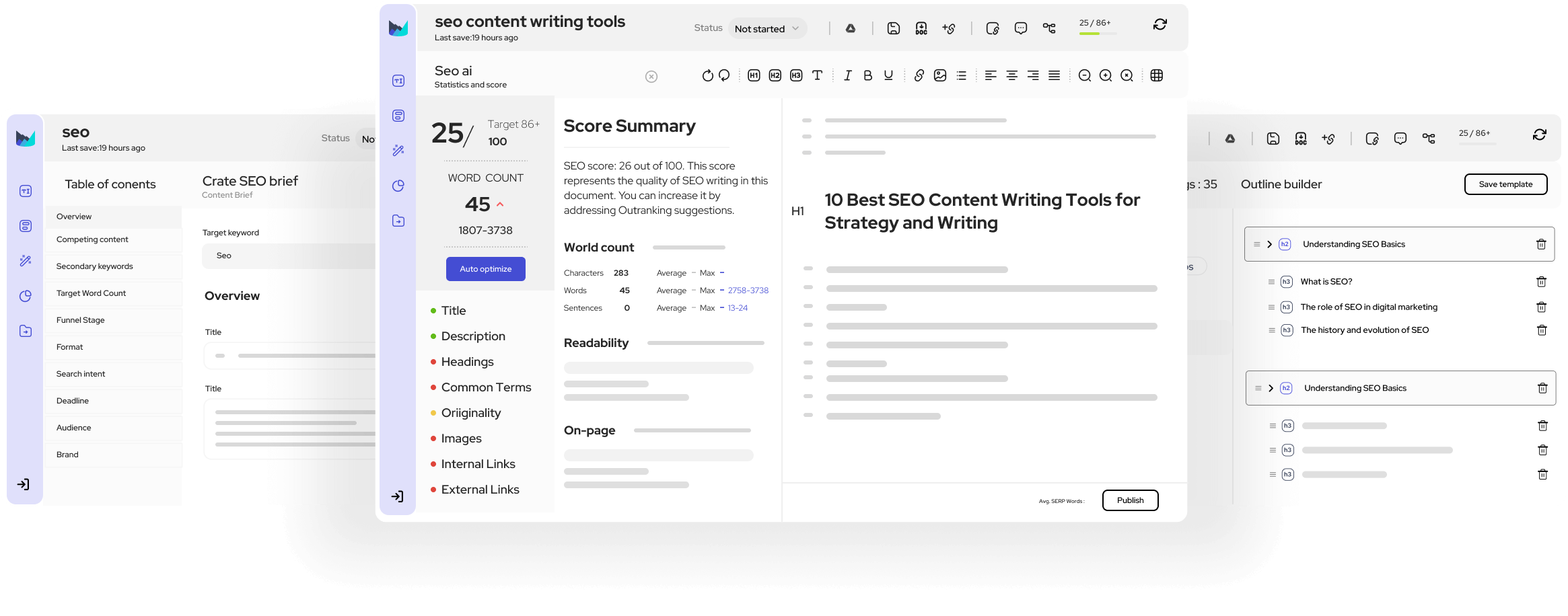
Many marketers fail to see results from AI SEO outranking because they make critical errors in implementation. Avoiding these mistakes is essential for success.
Mistake 1: Publishing Unedited AI Content
Publishing raw AI output without human review is a fast track to failure. The content often lacks depth, contains inaccuracies, and reads poorly. Search engines are getting better at detecting this. Always edit and fact-check AI-generated content. Add your own insights and data to make it unique.
Mistake 2: Ignoring User Experience Signals
AI SEO outranking is not just about the words on the page. It is also about how users interact with your page. Metrics like bounce rate, time on page, and click-through rate are crucial. If your page is slow, cluttered, or difficult to navigate, users will leave quickly. The AI algorithm will notice this and lower your ranking. Ensure your page is fast, mobile-friendly, and easy to read.
Mistake 3: Focusing Only on Content Creation
Content is only one part of the equation. Off-page factors like backlinks and domain authority still matter. AI can help you identify link-building opportunities, but you still need to execute the outreach. A great piece of content with no backlinks will struggle to outrank a mediocre piece with many high-quality backlinks.
Important Notes on Algorithm Updates
Search engine algorithms are constantly evolving. What works today may not work tomorrow. Google frequently updates its core algorithms to improve the quality of search results. These updates often target “content farms” and low-quality AI-generated content.
To stay ahead, you must monitor your rankings and traffic regularly. Use AI tools to track changes in the SERP. If you see a sudden drop in rankings, analyze what changed. Did a competitor publish new content? Did Google update its algorithm? Adapt your strategy accordingly. The key is to remain agile and not become complacent.
Frequently Asked Questions (FAQ)
Can AI really help me outrank my competitors?
Yes, AI can significantly improve your chances of outranking competitors by providing deeper insights into search intent, identifying content gaps, and optimizing your pages for semantic relevance. However, it is not a magic bullet. It requires a solid strategy and human oversight to be effective.
What is the best AI tool for SEO outranking?
T The right choice depends on your budget and needs. Popular options include Surfer SEO for content optimization, Clearscope for semantic analysis, and Frase for content briefs. Many professionals use a combination of tools to get the best results.
Is AI-generated content penalized by Google?
Google does not penalize content simply because it is generated by AI. However, it penalizes content that is low-quality, regardless of how it was created. If AI-generated content is useful, original, and provides a good user experience, it can rank well. If it is spammy and unhelpful, it will be penalized.
How long does it take to see results with AI SEO outranking?
Results vary depending on the competitiveness of your niche and the authority of your domain. Some pages may see improvements in a few weeks, while others may take several months. Consistency is key. Continuously publishing optimized content and building backlinks will eventually lead to higher rankings.
Do I still need human writers if I use AI for SEO?
Yes, human writers are still essential. AI can generate drafts and suggest optimizations, but it cannot replicate the creativity, empathy, and unique insights of a human writer. The best approach is a collaboration where AI handles the data analysis and heavy lifting, and humans provide the final polish and strategic direction.
Conclusion: The Future of Search is Intelligent
AI SEO outranking is not a passing trend. It is the new standard for digital marketing. The search engines are using AI to understand content, and you must use AI to create content that meets those standards. The strategies outlined in this guide provide a roadmap for success.
The key takeaway is balance. Use AI to analyze data, find gaps, and optimize structure. Use human intelligence to add experience, authority, and trust. By combining these forces, you can create content that not only ranks well but also genuinely helps your audience. The future of search is intelligent, and your content strategy must be too.
Xem thêm:
- Gemini SEO: Mastering Search Optimization in Google’s AI-First Era
- Mastering the AI SEO Prompt Workflow: A Complete Guide to Scaling Organic Growth
- AI SEO Claude Projects: The Complete Guide to Automating Search Rankings in 2025
- AI SEO AI Search Discovery: The Complete Guide to Winning Generative Search
- AI SEO Extensions: The Smart Way to Automate and Supercharge Your Search Rankings
Bài viết cùng chủ đề:

AI SEO SEO Automation with Make: The Complete Workflow Guide

AI SEO SEO Automation with Zapier: The Complete Workflow Guide

AI SEO SEO Automation with n8n: The Complete Workflow Guide
AI SEO SEO Automation with Gemini: The Complete Guide to Scaling Organic Growth

AI SEO SEO Automation with Claude: The Complete Guide to Scaling Content in 2025

AI SEO SEO Automation with ChatGPT: The Complete Playbook for 2025

AI SEO & SEO Automation for Affiliate Sites: The 2025 Playbook for Passive Income Growth
AI SEO & SEO Automation for Bloggers: The Complete Guide to Scaling Your Content

AI SEO & SEO Automation for Agencies: The Complete 2025 Playbook

AI SEO and SEO Automation for Ecommerce: The Complete Playbook for 2025

AI SEO & SEO Automation for WordPress: The Complete Playbook for 2025
AI SEO SEO Automation Strategy: The Complete Playbook for 2025

Mastering the AI SEO SEO Automation Process: A Complete Guide to Scaling Organic Growth
AI SEO SEO Automation System: The Complete Guide to Scaling Organic Growth in 2025
AI SEO SEO Automation Platform: The Complete Guide to Scaling Organic Growth in 2025
AI SEO SEO Automation Software: The Complete Guide to Scaling Organic Growth in 2025















