
No products in the cart.
AI SEO Monitoring: The Ultimate Guide to Smarter Search Performance Tracking
29
Jul
Jul
The landscape of search engine optimization has evolved far beyond manual rank checks and static spreadsheets. Today, AI SEO monitoring stands at the forefront of digital strategy, empowering businesses to track, analyze, and predict search performance with unprecedented precision. By leveraging artificial intelligence, marketers can now process millions of data points in real time, uncover hidden patterns, and make proactive decisions that directly impact organic traffic and revenue. This comprehensive guide explores every facet of AI SEO monitoring, from foundational concepts to advanced implementation tactics, ensuring you can harness its full potential.
What Is AI SEO Monitoring?
AI SEO monitoring refers to the use of artificial intelligence and machine learning algorithms to continuously observe, measure, and report on a website’s search engine optimization health. Unlike traditional monitoring that relies on static alerts and manual data collection, AI-driven systems ingest vast streams of data—from keyword rankings and backlink profiles to user behavior and algorithm shifts—and deliver actionable insights automatically.
At its core, AI SEO monitoring combines natural language processing, predictive analytics, and anomaly detection. It not only tells you that a ranking dropped but explains why, predicts future performance under different scenarios, and recommends specific remediation steps. This shift transforms SEO from a reactive discipline into a strategic, forward-looking function.
Key capabilities include automated rank tracking across thousands of keywords, content gap analysis, real-time competitor movement alerts, technical health scoring, and integration with business metrics like conversion rates and revenue. The technology can identify subtle correlations that human analysts might miss, such as the impact of a core web vitals fluctuation on mobile rankings or the influence of unstructured data mentions on brand authority.
How AI SEO Monitoring Works
Understanding the mechanics behind AI-driven monitoring clarifies why it delivers superior results. The process generally follows four distinct stages, each enriched by machine learning models trained on historical SEO data and search engine behaviors.
1. Data Aggregation and Normalization
AI systems pull data from disparate sources: Google Search Console, Bing Webmaster Tools, third-party rank trackers, analytics platforms, server logs, social signals, and even competitor sites. They normalize this data to create a unified view, eliminating silos that block a holistic understanding of SEO health. For example, a single dashboard might fuse organic click-through rates with page speed metrics and backlink acquisition velocity.
2. Pattern Recognition and Correlation Analysis
Machine learning models scan historical and real-time data to detect patterns. They learn what a “normal” ranking fluctuation looks like for your niche and can instantly flag anomalies—say, a sudden 15% traffic drop correlated with a new competitor’s content push. The AI also identifies correlations that matter: a drop in featured snippet presence tied to a change in content structure, or a spike in impressions linked to a seasonal trend amplified by a recent algorithm update.
3. Predictive Modeling and Forecasting
This is where AI SEO monitoring truly diverges from basic tracking. Algorithms build predictive models that forecast future keyword ranking positions, traffic levels, and even revenue impact based on current trends and planned optimizations. If you’re considering a content refresh, the system can simulate the likely uplift, helping prioritize tasks by ROI. These models become more accurate over time as they ingest outcome data from your actions.
4. Intelligent Alerts and Actionable Recommendations
The final layer translates data into action. Instead of a generic “ranking for keyword X decreased by 3 positions” alert, AI provides context: the drop coincides with a new Google snippet feature, and based on historical data, the system recommends optimizing for that snippet format with specific structural changes. It can even auto-generate tasks for your CMS or project management tool, accelerating the fix cycle from days to minutes.
Core Components of an AI SEO Monitoring System
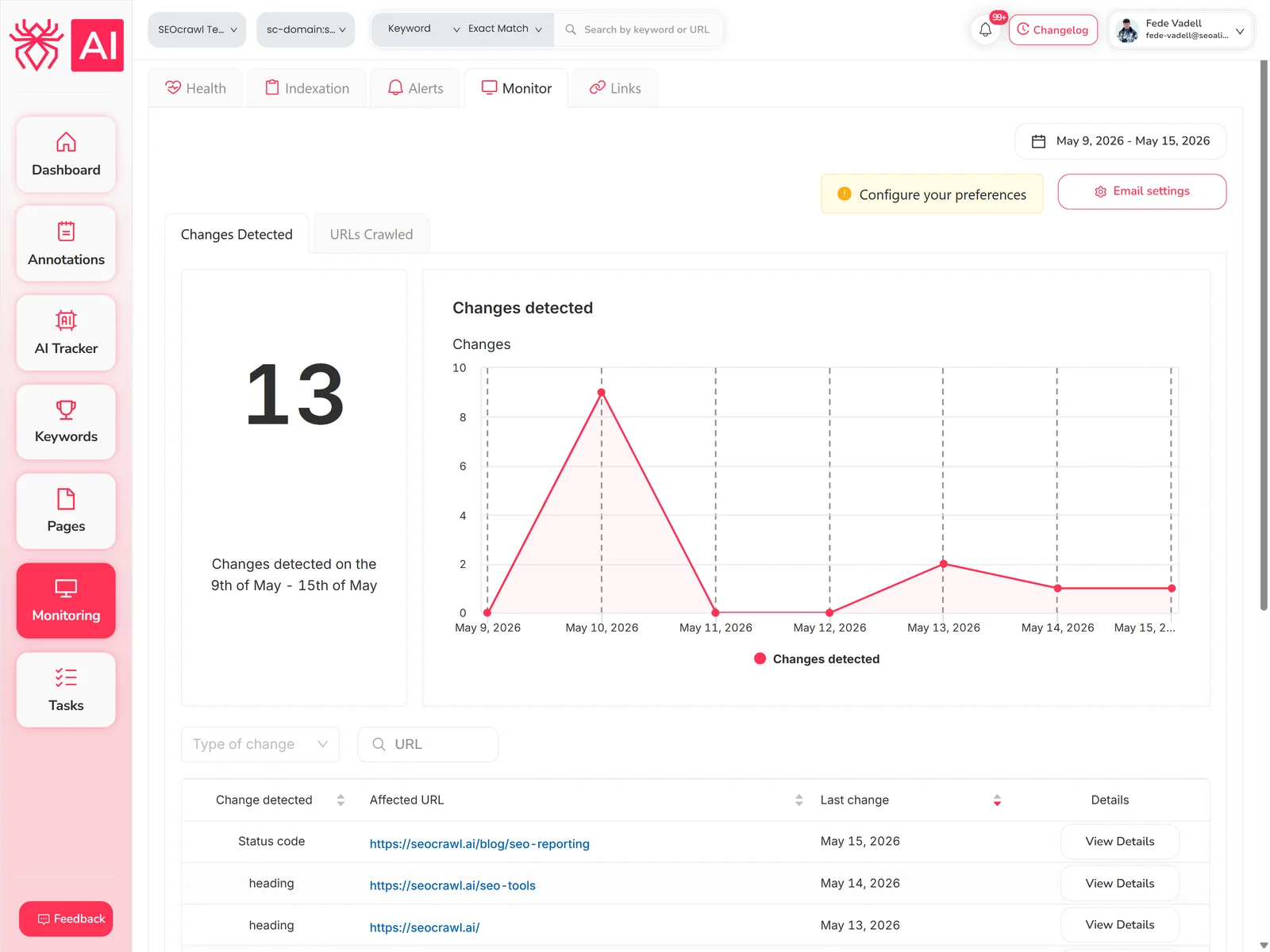
To fully appreciate what AI can monitor, it’s helpful to break down the SEO ecosystem into components. Each area benefits from intelligent oversight.
- Ranking and Visibility Monitoring: Tracks keyword positions across devices, locations, and search features (featured snippets, People Also Ask, image packs). AI detects cannibalization, identifies new ranking opportunities, and predicts ranking volatility.
- Content Performance Analysis: Evaluates content engagement metrics, dwell time, scroll depth, and conversion attribution. AI can identify which content pieces are losing traction and why, even suggesting updates based on competitor content comparisons.
- Backlink Profile Monitoring: Continuously catalogues new and lost backlinks, assesses link quality using AI-driven evaluation (beyond simple domain authority), and alerts on toxic links that could trigger a penalty.
- Technical SEO Health: Crawls site architecture to detect broken links, duplicate content, indexing issues, page speed regressions, and mobile usability problems. Some systems use computer vision to detect layout shifts that impact Core Web Vitals.
- User Experience and Engagement Signals: Monitors real user behavior metrics from search to conversion, linking organic traffic quality to business outcomes. AI can attribute revenue changes directly to specific SEO changes or external factors.
- Competitor Intelligence: Tracks competitor domain changes, content updates, backlink acquisitions, and SERP feature ownership. AI compares your performance against a moving competitive landscape, not just static benchmarks.
- Ultra-fast Issue Detection and Resolution: From indexing blips to traffic anomalies, AI cuts the time between occurrence and human awareness. Some systems can even auto-apply fixes for known technical issues.
- Data-Driven Decision Making at Scale: When managing hundreds of thousands of pages, manual analysis is impossible. AI surfaces only the most impactful insights, allowing teams to focus on high-priority tasks.
- Proactive Rather Than Reactive Strategy: Predictive models alert you before a ranking is lost. If a competitor’s content cadence signals a future threat, you can act preemptively.
- Resource Optimization: By automating reporting, routine checks, and data crunching, teams can devote more time to creative strategy and content development. AI also highlights which efforts drive the most business value, reducing wasted spend.
- Improved Accuracy and Reduced Human Bias: AI evaluates data impartially. It won’t overlook a slow decay because a metric still falls within a “green” zone, nor will it prioritize a pet project over evidence-based needs.
- Unified Cross-Channel Insights: AI connects SEO performance with paid search, social media, and email marketing data, revealing integrated campaign effects that siloed monitoring misses.
- Data Quality Dependency: AI models are only as good as the data they ingest. Incomplete or noisy tracking can lead to misguided recommendations.
- Black-Box Algorithms: Some tools offer recommendations without transparent reasoning, making it hard to validate or learn from the system.
- Over-Reliance on Automation: Teams may stop questioning AI outputs, missing nuances like a sudden but temporary ranking shift due to a news event that needs no action.
- Cost and Integration Complexity: Enterprise-grade AI monitoring platforms can be expensive and require technical resources to integrate with existing martech stacks.
- Constant Model Retraining Needs: Search engine algorithm updates change the underlying data patterns, so AI models must be continuously retrained to remain accurate.
- Lack of Creative Interpretation: AI can’t replicate the strategic intuition needed for brand storytelling or understanding broad cultural shifts that affect search intent.
- Ignoring Model Confidence Scores: Many AI tools provide a confidence level for predictions. Acting on every low-confidence alert wastes resources. Set a threshold—act only when confidence exceeds 85-90% for high-impact changes.
- Treating AI Recommendations as Infallible: Algorithms lack context about your brand’s upcoming product launch or a PR crisis. Always overlay human judgment, especially for content and messaging decisions.
- Monitoring Too Much, Too Soon: Flooding the system with every possible metric before it has learned baseline patterns causes noisy alerts. Start with a focused set of core KPIs, then expand gradually.
- Neglecting Data Privacy Regulations: If monitoring user behavior or integrating CRM data, ensure compliance with GDPR, CCPA, and other frameworks. AI models that link search queries to personal data can create privacy risks.
- Failing to Retrain After Core Algorithm Updates: Google updates like core, helpful content, or product reviews shifts can reset what “good” looks like. Retrain models immediately after such events to avoid false positives.
- Setting and Forgetting Alerts: Over time, alert fatigue can set in. Regularly review your alerting logic—are you still getting value from every notification? Prune outdated triggers.
Benefits of AI SEO Monitoring
Adopting intelligent monitoring yields concrete advantages that scale with your organization’s SEO complexity. Below are the most significant benefits observed across industries.
Limitations and Challenges
While powerful, AI SEO monitoring is not a magic wand. Understanding its limitations is crucial for sensible adoption.
Traditional SEO Monitoring vs. AI SEO Monitoring
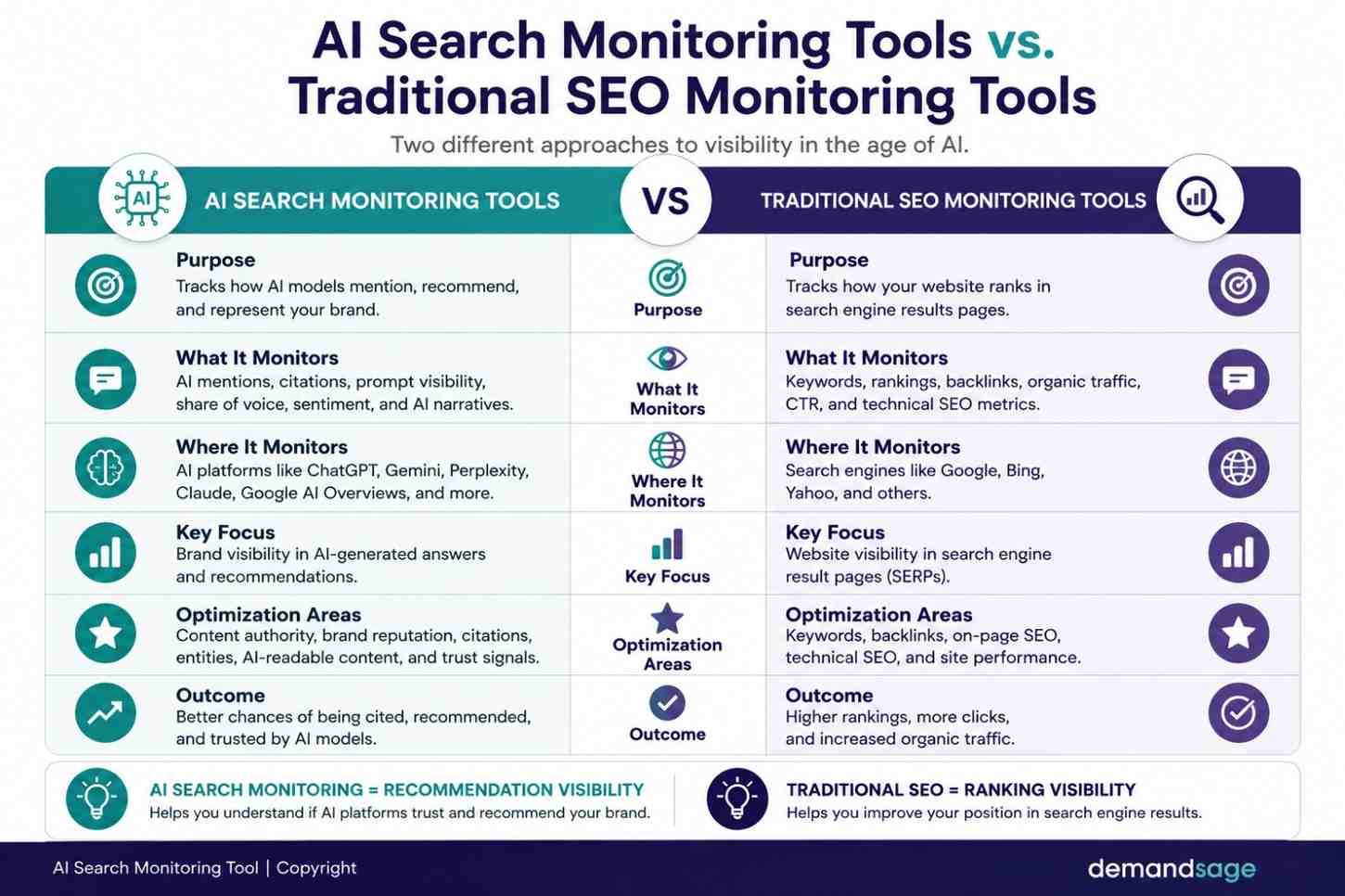
A side-by-side comparison highlights why organizations are migrating to AI-driven approaches. The table below encapsulates the fundamental differences.
| Aspect | Traditional Monitoring | AI SEO Monitoring |
|---|---|---|
| Data Processing | Manual extraction, static reports | Real-time, automated aggregation |
| Insight Generation | Descriptive only (what happened) | Descriptive + Predictive + Prescriptive |
| Scale | Limited to a few hundred keywords | Hundreds of thousands of keywords, pages, backlinks |
| Anomaly Detection | Threshold-based alerts | Pattern-based anomaly detection with context |
| Competitor Analysis | Periodic manual lookups | Continuous automated tracking with trend analysis |
| Action Integration | Manual task creation | Automated ticket generation, CMS hookups |
| Personalization | One-size-fits-all dashboards | Custom models built on your site’s unique data patterns |
Practical Implementation: How to Set Up AI SEO Monitoring

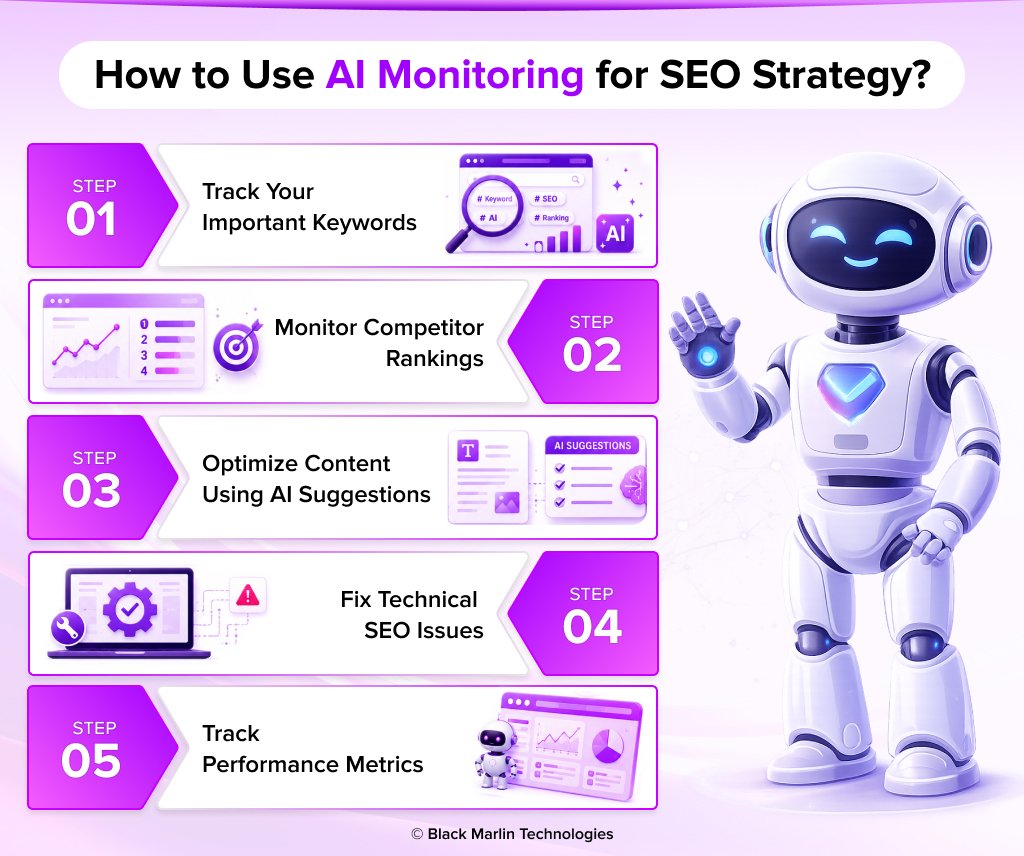
Transitioning to AI-powered monitoring requires a structured approach. Below is a step-by-step guide that accounts for typical organizational readiness levels.
Step 1: Audit Your Current SEO Data Infrastructure
Before adopting any AI tool, map every data source you currently use: rank trackers, analytics, server logs, backlink tools, and CMS data. Identify gaps—whether that’s missing mobile traffic data or incomplete local search tracking. Clean historical data is essential; the AI needs at least 12-18 months of accurate records to build reliable baseline models.
Step 2: Define Monitoring Objectives and Key Business Metrics
AI can monitor everything, but not everything matters. Align with stakeholders on what success looks like: is it organic revenue, lead quality, or content engagement? Then identify the leading indicators that predict those outcomes. This step ensures the AI model trains on the right signals, not vanity metrics.
Step 3: Select the Right AI SEO Monitoring Platform
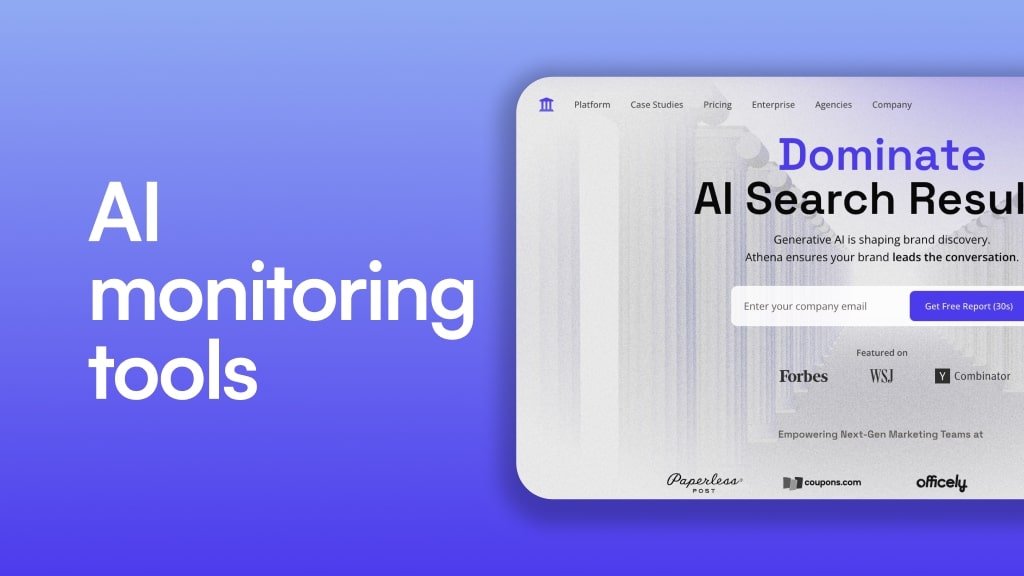
Choose a tool that matches your scale and technical maturity. For enterprise, platforms like Botify, Conductor, or seoClarity offer deep AI capabilities. Mid-market teams might use SE Ranking, which layers AI on rank tracking and content scoring. Small businesses can leverage Ahrefs’ or Semrush’s AI-powered alerts. Evaluate each for model transparency, integration depth, and customization options. Prioritize platforms that allow you to define your own event rules and retrain models on your data.
Step 4: Integrate and Train the AI Model
Connect all data sources to the monitoring platform via APIs or data warehouses. The initial training phase may take a few weeks as the system learns your domain’s normal volatility patterns, seasonal trends, and content lifecycle. During this period, human oversight is critical to correct misinterpretations early. For instance, if every Friday traffic dips due to a B2B pattern, the AI must learn that is not an anomaly.
Step 5: Configure Intelligent Alerts and Workflows
Move beyond generic notifications. Set up multi-condition alerts: if ranking drops more than 5 positions AND traffic decreases by 10% AND the page’s last update is older than 6 months, trigger a content refresher task. Integrate with Slack, Teams, or Jira so actionable items enter the team’s workflow instantly. Define escalation paths for critical issues like sudden deindexation.
Step 6: Establish Human-AI Collaboration Protocols
Create a feedback loop where SEO managers regularly review AI recommendations, mark them as accurate or not, and feed that feedback back into the model. Allocate time for strategic analysis of AI-flagged trends, using the time saved on reporting. Best practice is to hold a weekly “AI insights review” where the team decides which automated opportunities to pursue.
Step 7: Iterate and Evolve
AI SEO monitoring is never “done.” As search algorithms change, user behavior shifts, and your site evolves, retrain models quarterly. Add new data sources, such as voice search query logs or visual search performance, as they become relevant. Continuously shrink the time from insight to action.
Common Mistakes When Using AI SEO Monitoring and How to Avoid Them
Even experienced teams can fall into traps that undermine the value of intelligent monitoring. Recognizing these pitfalls will accelerate your success.
Important Considerations for Long-Term Success
For AI SEO monitoring to remain effective, embed these practices into your governance model.
Transparency and Explainability: Whenever possible, select tools that provide “why” behind an alert. This builds team trust and accelerates skill development. If the AI says “update this article to add LSI keywords X, Y, Z,” it should cite the competitive analysis that drove that suggestion.
Continuous Learning Culture: Encourage SEO team members to understand basic machine learning principles. This knowledge helps them interpret model outputs correctly and contribute better feedback for retraining.
Integration with Broader Business Intelligence: Feed organic search data into the company’s main BI tool. When SEO insights sit in a separate dashboard, they lose influence. AI monitoring becomes most powerful when it influences product inventory decisions, content marketing budgets, and C-suite strategy.
Ethical Use of AI: Avoid manipulative tactics that misuse AI monitoring, such as automatically generating click-farm traffic to increase search volume signals. Ethical frameworks preserve brand integrity and maintain search engine trust.
Frequently Asked Questions
What exactly is AI SEO monitoring?
AI SEO monitoring uses artificial intelligence to track, analyze, and predict organic search performance automatically. It goes beyond manual rank checks by processing vast data sets, detecting patterns, and offering actionable recommendations in real time. This technology covers rankings, content, backlinks, technical health, and competitor movements, all unified under intelligent alerting systems.
How does AI improve the accuracy of SEO monitoring?
AI improves accuracy by learning normal fluctuation patterns specific to your website and niche. It distinguishes between harmless variance and genuine threats, reducing false alarms. Machine learning also identifies non-obvious correlations—like the impact of a single slow-loading image on mobile rankings—that human analysis would likely overlook.
What are the best AI SEO monitoring tools available?
Leading platforms include enterprise solutions like Botify and Conductor that offer deep AI-driven crawling and predictive analytics. Mid-range tools such as SE Ranking incorporate AI for content scoring and anomaly detection, while Ahrefs and Semrush provide AI layers on top of extensive data sets. The best tool depends on your site size, budget, and integration needs. Always trial platforms to test their model transparency and customization.
Can AI SEO monitoring replace human SEO experts?
No, it complements human expertise. AI handles data processing, pattern detection, and routine alerting at scale, freeing SEO professionals to focus on strategy, creative content, and complex problem-solving. Human oversight remains essential to interpret AI outputs within business context and to make ethical judgment calls. The combination of human intuition and machine speed yields the strongest results.
How do I set up AI SEO monitoring for a small business?
Start with a budget-friendly tool that includes AI-powered alerts (e.g., SE Ranking or the integrated AI features in Semrush/Ahrefs). Connect Google Search Console and Analytics, define 3-5 key performance indicators, and let the system learn your typical traffic patterns. Focus initial monitoring on critical issues: sudden traffic drops, key page ranking losses, and index coverage problems. Gradually expand as you see value.
What metrics should I prioritize in AI SEO monitoring?
Prioritize leading indicators that predict business outcomes rather than vanity metrics. Essential metrics include organic conversions by landing page, non-branded click-through rates, crawl budget efficiency, Core Web Vitals scores, and backlink quality trends. Map each metric to a revenue or lead impact, so the AI can help you focus on what truly moves the bottom line.
Conclusion
AI SEO monitoring represents a fundamental shift from retrospective reporting to proactive search performance management. By automating data ingestion, pattern recognition, and predictive modeling, it empowers teams to detect threats before they impact traffic, uncover growth opportunities hidden in the data, and allocate resources with surgical precision. Yet the technology’s true value emerges when paired with human expertise—interpreters who can question AI recommendations, inject creativity, and adapt strategies to the ever-evolving search landscape.
As search engines grow more sophisticated, the organizations that thrive will be those that use AI not as a crutch but as an amplifier of their SEO talent. Start by auditing your data, selecting a transparent and adaptable monitoring platform, and building a team culture that embraces continuous learning. The result will be a resilient, insight-driven SEO practice that consistently outperforms competitors still relying on spreadsheets and guesswork.
Xem thêm:
- AI SEO Smart Search: The Complete Guide to Future-Proofing Your Organic Traffic
- AI SEO Crawl Budget: The Complete Guide to Smarter Crawling in 2025
- AI SEO for Lawyers: The Complete Guide to Dominating Legal Search in 2025
- AI SEO Knowledge Panel Optimization: The Complete Guide to Dominating Search in 2025
- AI SEO Keyword Suggestions: The Complete Guide to Smarter Search Rankings
Bài viết cùng chủ đề:

AI SEO SEO Automation with Make: The Complete Workflow Guide

AI SEO SEO Automation with Zapier: The Complete Workflow Guide

AI SEO SEO Automation with n8n: The Complete Workflow Guide
AI SEO SEO Automation with Gemini: The Complete Guide to Scaling Organic Growth

AI SEO SEO Automation with Claude: The Complete Guide to Scaling Content in 2025

AI SEO SEO Automation with ChatGPT: The Complete Playbook for 2025

AI SEO & SEO Automation for Affiliate Sites: The 2025 Playbook for Passive Income Growth
AI SEO & SEO Automation for Bloggers: The Complete Guide to Scaling Your Content

AI SEO & SEO Automation for Agencies: The Complete 2025 Playbook

AI SEO and SEO Automation for Ecommerce: The Complete Playbook for 2025

AI SEO & SEO Automation for WordPress: The Complete Playbook for 2025
AI SEO SEO Automation Strategy: The Complete Playbook for 2025

Mastering the AI SEO SEO Automation Process: A Complete Guide to Scaling Organic Growth
AI SEO SEO Automation System: The Complete Guide to Scaling Organic Growth in 2025
AI SEO SEO Automation Platform: The Complete Guide to Scaling Organic Growth in 2025
AI SEO SEO Automation Software: The Complete Guide to Scaling Organic Growth in 2025















