
No products in the cart.
AI SEO Pillar Content: The Complete Blueprint for Dominating Search Rankings in 2025
31
Jul
Jul
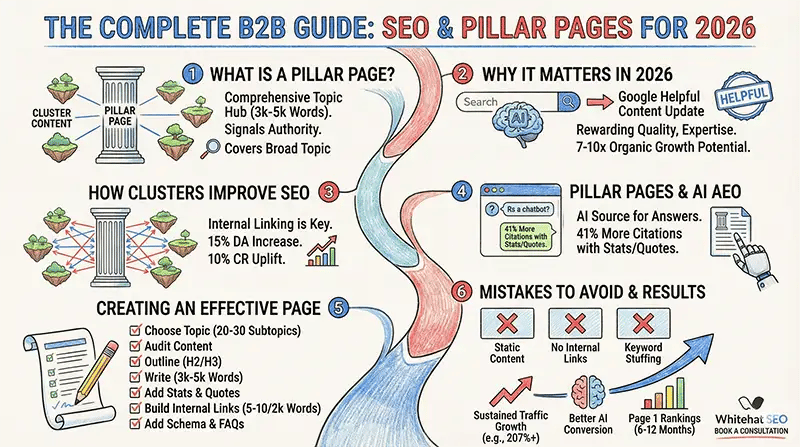
Search engine optimization has undergone a seismic shift. The days of churning out hundreds of thin blog posts and hoping for traffic are over. Today, Google’s algorithms prioritize depth, relevance, and user experience, powered by machine learning models like MUM and RankBrain. This is where AI SEO pillar content enters the picture. It is not just a buzzword; it is the strategic fusion of artificial intelligence with the classic pillar-cluster model. This guide explains how to leverage AI to create comprehensive, authoritative resources that rank, convert, and establish topical authority.
What is AI SEO Pillar Content?

AI SEO pillar content refers to a long-form, comprehensive guide that serves as the foundational hub for a specific topic cluster. It is designed to cover a broad subject in exhaustive detail, answering the majority of user questions on that topic. The “AI” component signifies the use of artificial intelligence tools to accelerate and enhance the research, structuring, drafting, and optimization of this content.
Unlike a standard blog post, a pillar page is typically 2,000 to 5,000 words or more. It links out to “cluster” content—smaller, more specific articles that dive into subtopics. This architecture signals clear topical authority to search engines. AI tools assist by analyzing search intent, identifying semantic gaps, and generating outlines that mirror the questions real users are asking, ensuring the content is not just long, but strategically comprehensive.
The Evolution from Traditional Pillar Pages to AI-Driven Strategies
Traditional pillar pages were manually researched and written. Marketers relied on keyword tools and personal expertise. This process was slow and often missed nuanced user queries. The evolution to AI-driven strategies changes the game in three critical ways.
First, AI accelerates data analysis. Tools like Clearscope or Surfer SEO can analyze the top 20 ranking pages for a keyword in seconds, extracting common subtopics and entities. Second, AI assists with content generation. Large Language Models (LLMs) like GPT-4 can draft sections, suggest analogies, and rephrase complex concepts, acting as a tireless writing assistant. Third, AI enables dynamic internal linking. Algorithms can suggest which cluster articles to link to based on semantic relevance, not just exact-match keywords.
This shift does not replace human expertise. It removes the grunt work, allowing SEO professionals to focus on strategy, fact-checking, and adding unique insights that AI cannot replicate.
Why AI SEO Pillar Content is Critical for Topical Authority
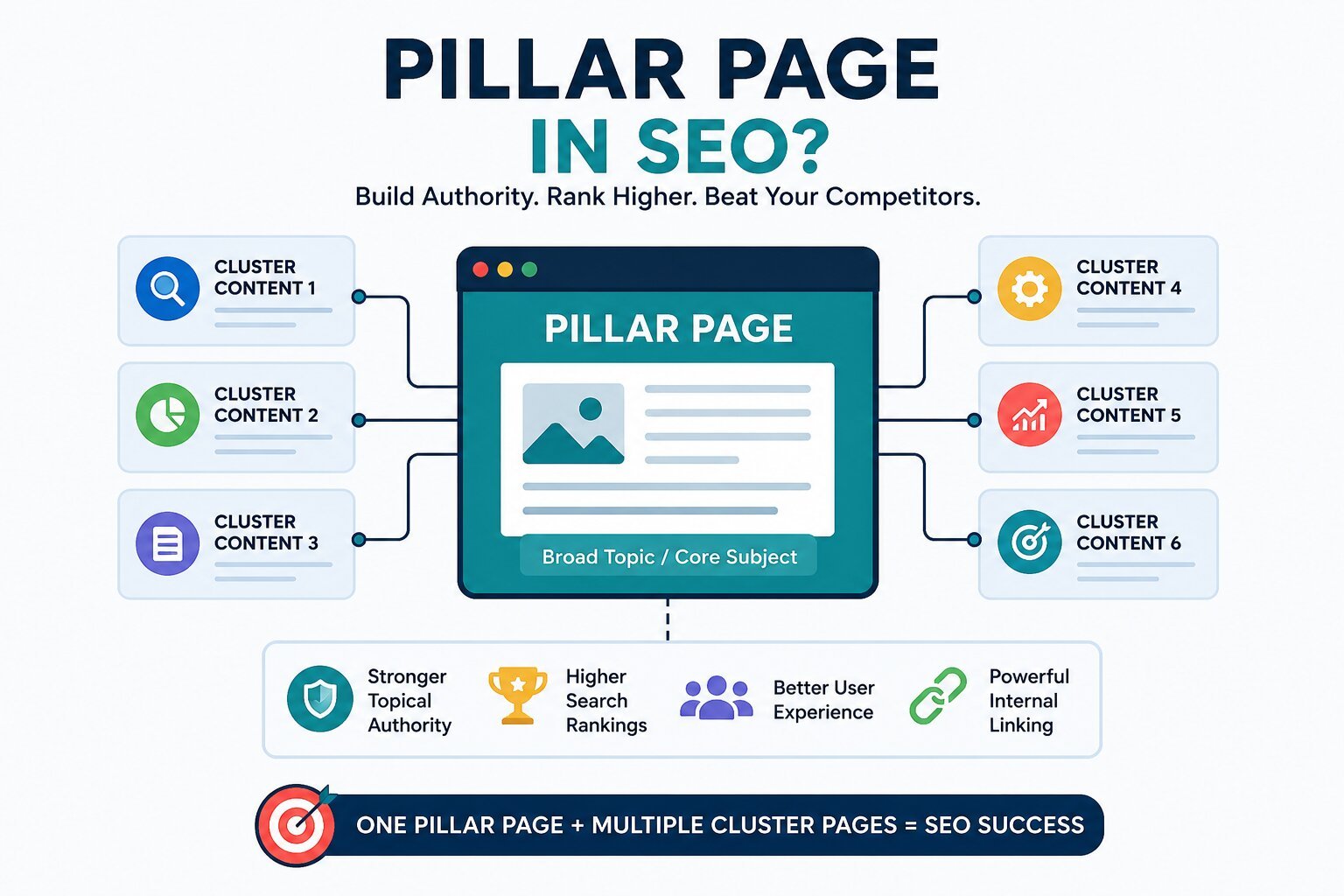
Google’s helpful content system rewards websites that demonstrate experience and expertise. Topical authority is the measure of how comprehensively a site covers a subject. AI SEO pillar content is the most efficient vehicle for building this authority.
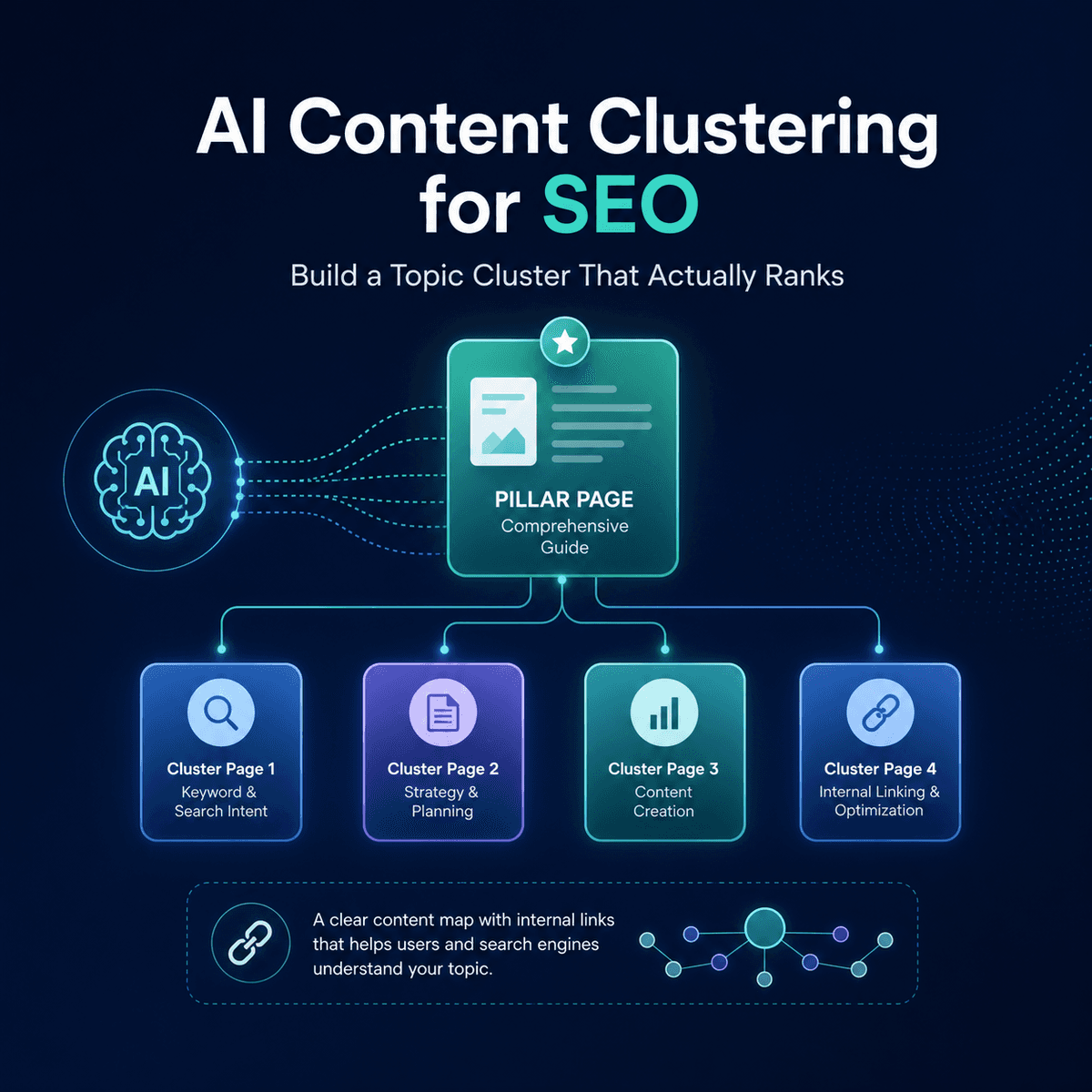
When you publish a pillar page that covers “AI SEO Pillar Content” in depth, you tell Google you are an expert on that subject. When you then link to cluster posts about “AI keyword research,” “AI content optimization,” and “AI link building,” you create a web of interconnected relevance. This structure helps search engines crawl and index your site more effectively, passing link equity throughout the cluster.
Moreover, pillar content attracts high-quality backlinks. Other websites prefer to link to a comprehensive resource rather than a superficial overview. A well-researched pillar page becomes a digital asset that earns links naturally, compounding your authority over time.
Core Components of a High-Performing AI SEO Pillar Page
Creating a pillar page that ranks requires more than just length. It requires a specific structural blueprint. The following components are non-negotiable for success.
1. Comprehensive Topic Coverage
The page must answer the “who, what, when, where, why, and how” of the main topic. Use AI to analyze the “People Also Ask” boxes and related searches to ensure you cover every angle. The goal is to be the last resource a user needs on the topic.
2. Strategic Internal Linking Hub
Every pillar page must link to relevant cluster content. These links should be contextual, using descriptive anchor text. This creates a hierarchy where the pillar page holds the most weight, and cluster pages support it with specific details.
3. Structured Data and Schema Markup
Implementing FAQPage and Article schema helps search engines understand the structure of your content. This increases the chance of earning rich snippets, which significantly boost click-through rates. AI tools can generate the JSON-LD code required for this markup.
4. Multimedia Integration
Text alone is insufficient. Embedding videos, infographics, and interactive charts increases dwell time and user engagement. AI tools can generate image alt text and even create basic data visualizations, making the page more accessible and engaging.
How to Create AI SEO Pillar Content: A Step-by-Step Guide
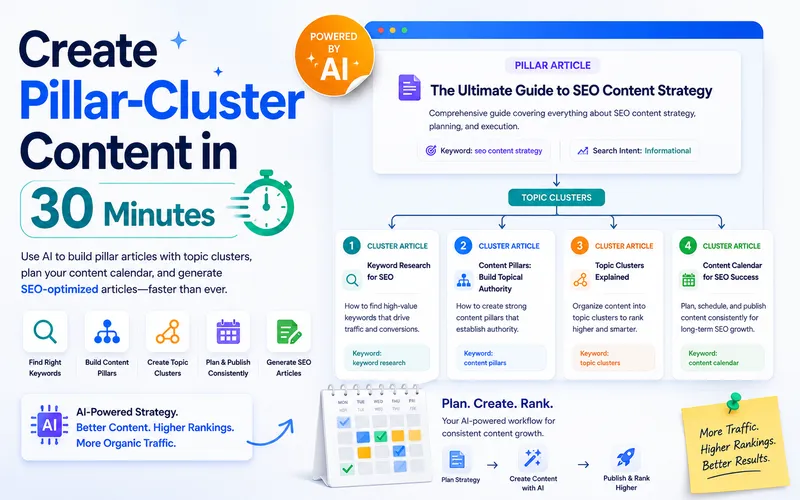
Implementing this strategy involves a clear workflow.
Step 1: AI-Powered Topic Selection and Keyword Research
Start with a broad topic that has commercial or informational value. Use AI tools to expand this into a list of subtopics. For example, if your topic is “Digital Marketing,” AI might suggest subtopics like “SEO,” “Content Marketing,” “Social Media,” and “Email Marketing.” Use keyword research tools to validate search volume and difficulty. The main keyword, “AI SEO Pillar Content,” should have a clear search intent that matches your goal.
Step 2: Generate a Data-Driven Outline
Input your main keyword into an AI content optimization tool. It will analyze the SERP and generate an outline based on the headings used by top-ranking competitors. This is not about copying; it is about understanding the structural expectations of the search engine. Add your unique sections to differentiate your content.
Step 3: Draft with AI Assistance, Edit with Human Expertise
Use an LLM to draft the initial sections. Provide it with specific instructions, data points, and your brand voice. The A Your job is to edit rigorously. Add personal experiences, case studies, and specific examples that AI cannot invent. Fact-check every statistic and claim. This is where E-E-A-T is built.
Step 4: Optimize On-Page Elements
Write a compelling meta title and description that includes the main keyword. Use AI to generate multiple variations and A/B test them. Optimize your URL structure to be short and descriptive. Ensure your H1 and H2 tags follow a logical hierarchy. Use internal links to your cluster content naturally within the body text.
Step 5: Implement Technical SEO and Schema
Ensure the page loads quickly and is mobile-friendly. Add FAQPage schema to the FAQ section. Use image compression tools to reduce file sizes. AI can automate many of these technical checks, flagging issues before you publish.
Benefits of Using AI for Pillar Content Creation
The advantages of integrating AI into this process are tangible and measurable. They extend beyond simple time savings.
- Scalability: AI allows you to produce comprehensive pillar pages for multiple topics simultaneously, something impossible with a purely manual workflow.
- Consistency: AI ensures your content maintains a consistent tone and style across different sections, which is crucial for brand identity.
- Data-Driven Insights: AI tools provide real-time data on search trends and competitor gaps, allowing you to create content that is proactive rather than reactive.
- Cost Efficiency: While t
- Enhanced Internal Linking: AI algorithms can identify linking opportunities that a human might miss, improving site architecture and crawlability.
- Publishing Unedited AI Output: This is the fastest way to destroy your credibility. AI output is a starting point, not a finished product. Always edit for accuracy, flow, and brand voice.
- Ignoring Search Intent: Creating a pillar page for a keyword with transactional intent when the user wants a product page will fail. Ensure the intent matches the format.
- Neglecting Internal Links: A pillar page without links to cluster content is just a long blog post. It does not build topical authority. The links are the glue that holds the cluster together.
- Keyword Stuffing: Using the main keyword in every paragraph is a red flag. Use it naturally in the H1, first 100 words, and a few subheadings. Focus on semantic relevance.
- Forgetting to Update: Pillar pages are not “set and forget.” They require regular updates to stay current. AI can help monitor changes in the SERP and suggest updates.
Limitations and Risks of AI-Generated Pillar Content
Relying solely on AI without human oversight is a recipe for failure. The limitations are significant and must be managed.
The most critical risk is factual inaccuracy. LLMs can “hallucinate” or generate plausible-sounding but incorrect information. This is dangerous for YMYL (Your Money or Your Life) topics. Another risk is lack of originality. AI trained on public data can produce generic, derivative content that offers no unique value. Google’s algorithms are adept at detecting this “thin” content, even if it is long.
Furthermore, AI cannot replicate genuine human experience. A pillar page about “Recovering from Burnout” written by an A This is where E-E-A-T suffers. The solution is a hybrid approach: AI for research and drafting, humans for validation and voice.
AI SEO Pillar Content vs. Traditional Blog Posts: A Comparison
Understanding the difference between these two formats is essential for your content strategy. They serve different purposes and should not be confused.
| Feature | AI SEO Pillar Content | Traditional Blog Post |
|---|---|---|
| Word Count | 2,000 – 5,000+ words | 500 – 1,500 words |
| Purpose | Comprehensive authority hub | Specific query or news update |
| Internal Linking | Links out to many cluster posts | Links to a few related posts |
| Update Frequency | Quarterly or bi-annual major updates | Frequent, often weekly |
| Keyword Focus | Broad, high-volume head terms | Long-tail, specific phrases |
| AI Usage | High (research, structuring, drafting) | Low to medium (topic ideation) |
Pillar content is the strategic foundation. Blog posts are the tactical support. You need both. The pillar page captures the broad traffic, while the blog posts capture the specific, high-intent queries.
Practical Application: Building a Pillar Page for “AI SEO Pillar Content”
Let us apply this framework to the exact keyword of this article. The pillar page would be this guide. The cluster content would include specific articles like “Top 10 AI Tools for Keyword Research,” “How to Use GPT-4 for Content Outlines,” and “Case Study: AI-Generated Content Ranking on Page One.”
In practice, you would start by using an AI tool to analyze the SERP for “AI SEO Pillar Content.” The tool would reveal that competitors are covering subtopics like “definition,” “benefits,” “steps,” and “tools.” You would then structure your pillar page to cover these, but add a unique section on “Common Mistakes” based on your experience. This differentiates your content from the generic AI-generated pages that simply rehash the same information.
You would then link to your cluster posts using anchor text like “best AI SEO tools” or “AI content optimization techniques.” This creates a semantic network that boosts the ranking potential of all pages involved.
Common Mistakes to Avoid When Creating AI SEO Pillar Content
Many marketers fail to see results because they fall into predictable traps. Avoiding these errors will set you apart from the competition.
Important Notes on E-E-A-T and AI Content
Google’s guidelines emphasize Experience, Expertise, Authoritativeness, and Trustworthiness. AI content inherently lacks “Experience.” To compensate, you must inject human elements into the content.
Include original data from surveys or case studies. Add quotes from industry experts. Share specific anecdotes about your successes and failures. Show the “how” and “why” behind your conclusions. This is what separates a high-ranking pillar page from a generic AI-generated one. Always review AI-generated content for bias and factual errors, especially when discussing statistics or legal matters.
Transparency is also key. While you do not need to label content as “AI-assisted,” you must ensure the final output is accurate and helpful. Google rewards helpful content, regardless of how it was produced, as long as it meets quality standards.
Frequently Asked Questions (FAQ)
What is the ideal length for AI SEO pillar content?
The ideal length is typically between 2,000 and 5,000 words. The exact length should be determined by the topic’s complexity and the depth of coverage provided by top-ranking competitors. The goal is to be the most comprehensive resource, not just the longest.
How does AI improve the pillar content creation process?
AI improves the process by automating keyword research, generating data-driven outlines, drafting initial text, suggesting internal links, and optimizing on-page elements like meta descriptions and schema markup. This reduces production time by up to 70%.
Is AI-generated pillar content penalized by Google?
Google does not penalize AI content per se. It penalizes low-quality, unhelpful content, regardless of whether it is written by a human or an AI. If the AI content is accurate, well-edited, and provides unique value, it can rank well.
What is the difference between a pillar page and a blog post?
A pillar page is a comprehensive, long-form guide that covers a broad topic and links to related cluster content. A blog post is typically shorter, focuses on a specific subtopic, and is published more frequently. The pillar page is the hub; the blog posts are the spokes.
How often should I update my AI SEO pillar content?
You should review and update your pillar content at least every six months. However, if the topic is in a fast-moving industry like technology or finance, you may need to update it quarterly. Monitor your search rankings and the SERP for new competitors to determine the frequency.
Can I use AI to write the entire pillar page without human editing?
Technically, yes, but it is not recommended. The output will likely be generic, contain factual errors, and lack the unique insights needed to rank. Human editing is essential for ensuring accuracy, adding experience, and aligning the content with your brand voice.
Conclusion
AI SEO pillar content represents the pinnacle of modern content strategy. It combines the structural power of pillar pages with the efficiency of artificial intelligence. The result is a scalable, data-driven approach to building topical authority that directly aligns with Google’s ranking algorithms.
The key to success lies in the hybrid approach. Use AI to handle the heavy lifting of research and drafting, but never relinquish control of the final product. Your human expertise, experience, and editorial judgment are the factors that transform a generic AI draft into a high-ranking, authoritative resource. By following the blueprint outlined here, you can create pillar content that not only ranks but also establishes your brand as the definitive source of information in your niche. The future of SEO is not about choosing between human and machine; it is about leveraging the best of both.
Xem thêm:
- AI SEO Forums: The Hidden Hubs Where Search Strategy Gets Rewired by Machine Intelligence
- AI SEO Keyword Grouping: The Complete Guide to Smarter Content Clusters
- AI SEO Keyword Semantics: The Complete Guide to Search Intent Optimization
- How to Use DeepSeek for SEO: The Complete Guide to AI-Powered Optimization
- Mastering AI EEAT Optimization: The Strategic Blueprint for Next-Level Search Authority
Bài viết cùng chủ đề:

AI SEO SEO Automation with Make: The Complete Workflow Guide

AI SEO SEO Automation with Zapier: The Complete Workflow Guide

AI SEO SEO Automation with n8n: The Complete Workflow Guide
AI SEO SEO Automation with Gemini: The Complete Guide to Scaling Organic Growth

AI SEO SEO Automation with Claude: The Complete Guide to Scaling Content in 2025

AI SEO SEO Automation with ChatGPT: The Complete Playbook for 2025

AI SEO & SEO Automation for Affiliate Sites: The 2025 Playbook for Passive Income Growth
AI SEO & SEO Automation for Bloggers: The Complete Guide to Scaling Your Content

AI SEO & SEO Automation for Agencies: The Complete 2025 Playbook

AI SEO and SEO Automation for Ecommerce: The Complete Playbook for 2025

AI SEO & SEO Automation for WordPress: The Complete Playbook for 2025
AI SEO SEO Automation Strategy: The Complete Playbook for 2025

Mastering the AI SEO SEO Automation Process: A Complete Guide to Scaling Organic Growth
AI SEO SEO Automation System: The Complete Guide to Scaling Organic Growth in 2025
AI SEO SEO Automation Platform: The Complete Guide to Scaling Organic Growth in 2025
AI SEO SEO Automation Software: The Complete Guide to Scaling Organic Growth in 2025















