
No products in the cart.
AI SEO Planning Workflow: The Complete Guide to Scaling Organic Growth in 2025
31
Jul
Jul
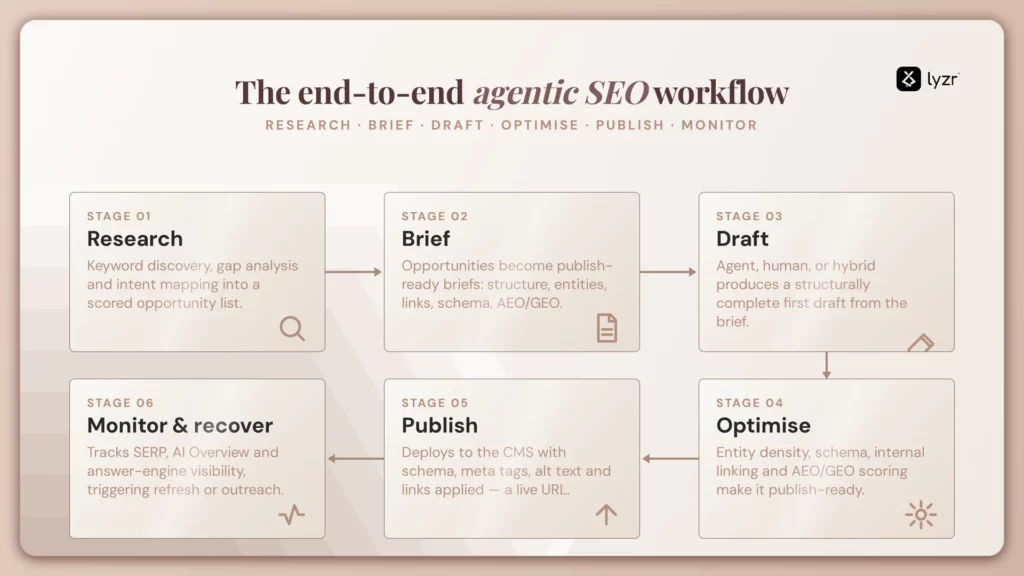
An AI SEO planning workflow is no longer a futuristic concept; it is the operational backbone of modern search optimization. As search engines evolve toward semantic understanding and generative experiences, teams that rely on manual keyword research and static content calendars are losing ground. This guide breaks down a practical, data-driven AI SEO planning workflow that combines machine learning speed with human strategic oversight. You will learn how to structure a repeatable process that identifies opportunities, predicts content performance, and allocates resources with unprecedented precision.
What Is an AI SEO Planning Workflow?
An AI SEO planning workflow is a structured sequence of steps where artificial intelligence tools assist in data collection, pattern recognition, forecasting, and task prioritization. Unlike traditional SEO planning, which relies heavily on manual audits and intuition, this workflow uses algorithms to process vast datasets—search queries, competitor backlinks, user behavior signals, and content gaps—to generate actionable insights.
The core difference lies in the speed and scale of analysis. A human analyst might review 500 keywords in a week; an AI system can evaluate 500,000 in minutes. However, the workflow is not about replacing human judgment. It is about augmenting it. The best workflows position AI as the research engine and the SEO professional as the decision-maker who interprets the output through the lens of brand context and business goals.
The Core Components of a Modern AI-Driven SEO Process
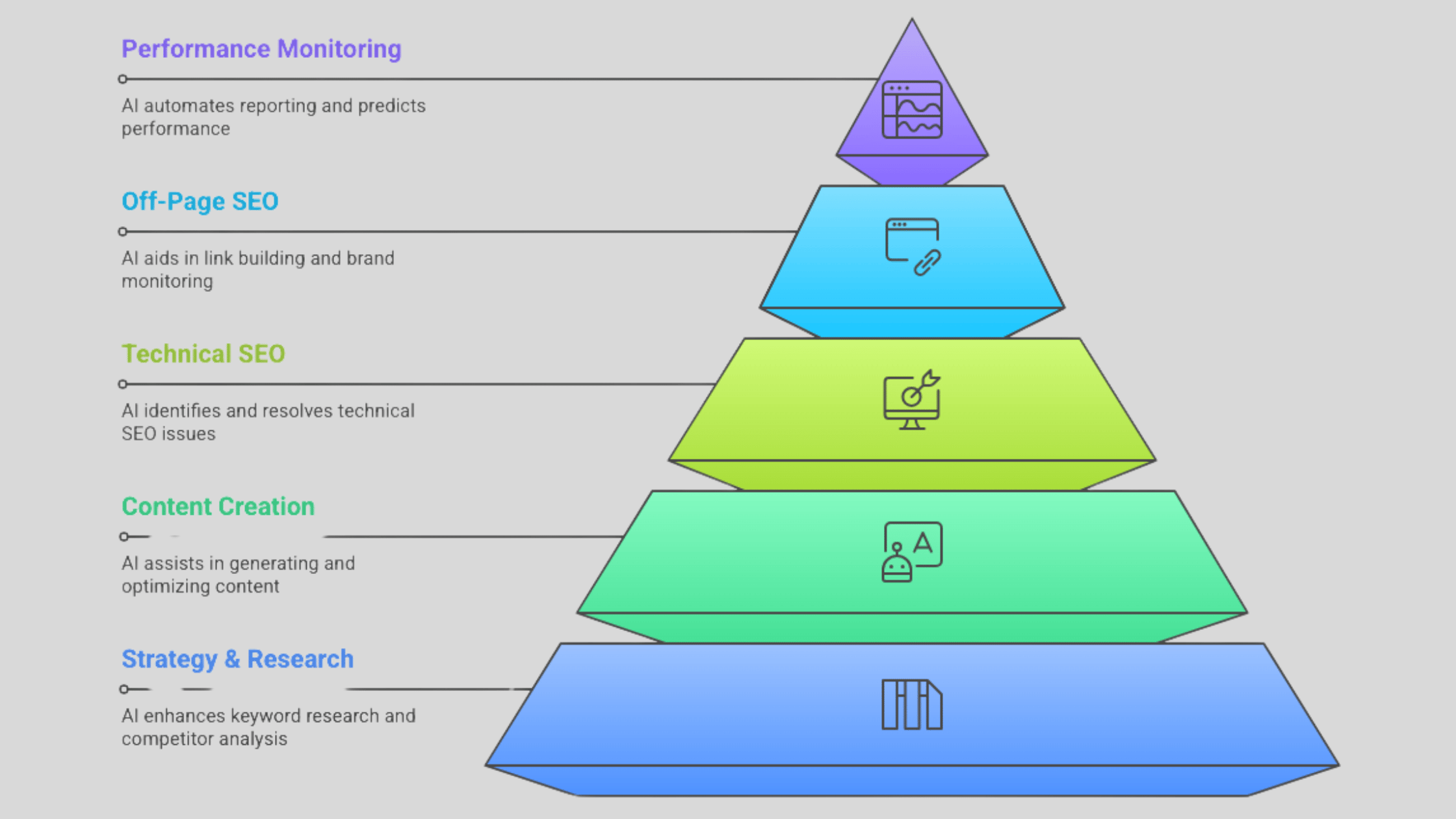
To build a functional AI SEO planning workflow, you need to understand its four foundational pillars. Each pillar feeds into the next, creating a continuous loop of improvement rather than a one-time campaign.
- Data Ingestion: Connecting your analytics, search console, and CRM data to AI platforms.
- Pattern Recognition: Using machine learning to identify topic clusters and search intent shifts.
- Predictive Modeling: Forecasting traffic potential and keyword difficulty based on historical trends.
- Automated Reporting: Generating real-time dashboards that track progress against strategic goals.
These components work together to eliminate the guesswork from prioritization. Instead of asking “which keyword should we target?”, the workflow answers “which keyword will yield the highest ROI given our current authority and resources?”
Why Traditional SEO Planning Fails Without AI Integration
The volume of search queries grows exponentially each year, and user behavior is becoming more conversational. Traditional planning methods—spreadsheets, manual SERP analysis, and quarterly brainstorming sessions—cannot keep pace with the dynamic nature of search results. Google’s algorithms now consider hundreds of ranking factors, many of which change in weight based on the query type and user context.
Consider the rise of AI Overviews in search results. These generative responses often push traditional blue links down the page. A manual planner might not notice this shift for weeks. An AI SEO planning workflow detects the change in click-through rates immediately and adjusts the content strategy to target featured snippet positions or long-tail conversational queries that appear within these AI summaries.
Furthermore, the cost of manual labor is prohibitive. Hiring agencies to conduct quarterly link audits or content gap analyses can cost thousands of dollars. AI tools perform these same tasks for a fraction of the cost, freeing up budget for content production and digital PR.
Step-by-Step Guide to Building Your AI SEO Planning Workflow
Implementing this workflow requires a systematic approach. The following seven steps provide a blueprint that can be adapted to any business size or industry. Each step includes specific tools and outputs to ensure clarity.
Step 1: Define Strategic Objectives and KPIs
Before any AI tool is activated, you must define what success looks like. Are you aiming for revenue growth, brand awareness, or lead generation? The AI SEO planning workflow will optimize for whichever metric you prioritize. Set clear KPIs such as organic sessions, keyword rankings for transactional terms, or conversion rate from organic traffic.
This step also involves segmenting your audience. AI models perform better when they understand the different buyer personas. Create detailed profiles for each segment, including their pain points, search habits, and content preferences. This data will be fed into the AI system to personalize content recommendations.
Step 2: Aggregate and Clean Your Data Sources
An AI model is only as good as the data it receives. Consolidate data from Google Search Console, Google Analytics 4, Ahrefs, Semrush, and your internal site search logs. Ensure that the data is clean—remove spam referrals, filter out branded queries if you are analyzing new audience reach, and reconcile discrepancies between different tracking platforms.
Use a data warehouse or a tool like Supermetrics to automate this aggregation. The goal is to have a single source of truth that the AI can query in real-time. This eliminates the common problem of conflicting reports between departments.
Step 3: Conduct AI-Powered Keyword and Topic Clustering
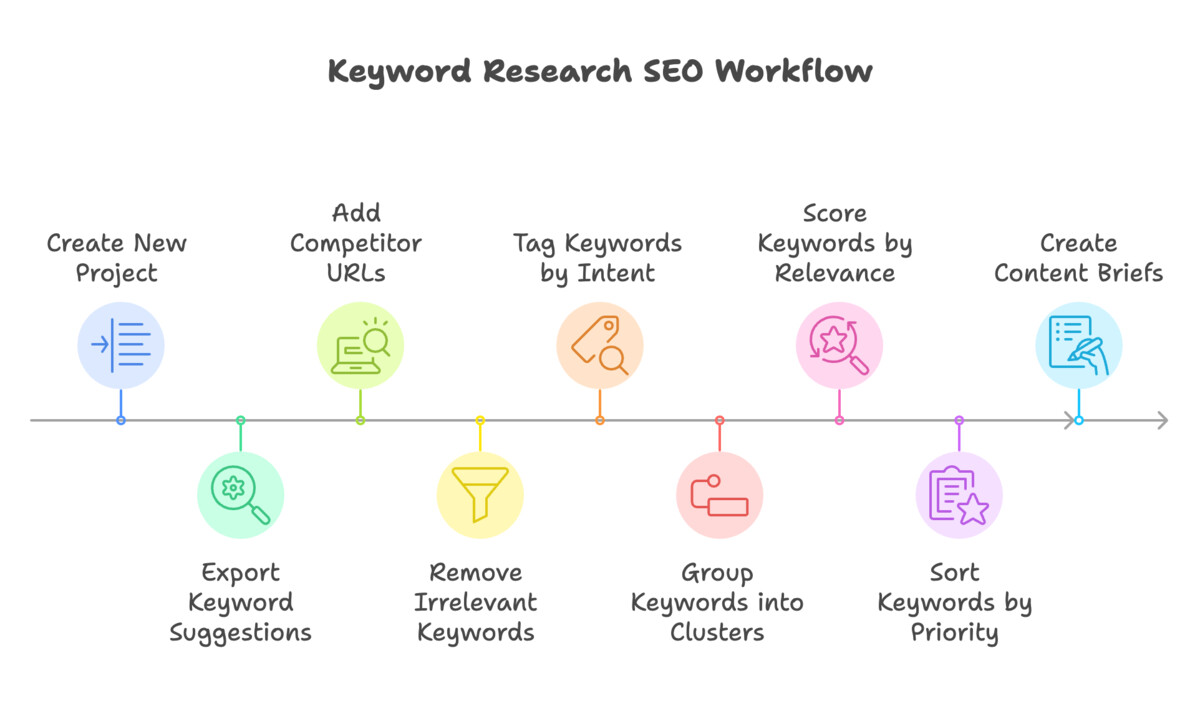
Move beyond individual keywords and focus on topic clusters. AI tools like Clearscope, MarketMuse, or Surfer SEO analyze the semantic relationship between terms. They group keywords into clusters based on shared search intent and topical relevance. For example, the keyword “AI SEO planning workflow” would be clustered with “SEO automation tools,” “content optimization workflow,” and “predictive search analytics.”
This clustering reveals the true structure of your content architecture. Instead of creating 50 separate blog posts that compete with each other, you create one pillar page and several supporting articles that link back to it. The AI identifies which cluster has the highest commercial potential based on search volume trends and the presence of transactional keywords.
Step 4: Analyze Competitor Gaps Using Machine Learning
Competitor analysis in an AI workflow goes beyond checking who ranks for your target keywords. It involves analyzing the entire content ecosystem of your top competitors. AI tools can scrape their entire sitemap, identify their top-performing pages by backlinks and traffic, and reverse-engineer their internal linking structure.
The output is a gap analysis report that shows you exactly which topics your competitors cover that you do not. More importantly, it shows you which of their pages are underperforming, giving you an opportunity to create superior content that addresses the same query with better depth and user experience.
This process also identifies link-building opportunities. The AI can analyze the backlink profiles of your competitors’ top pages and flag which referring domains are likely to accept guest posts or resource page links.
Step 5: Generate Content Briefs with Predictive Scoring
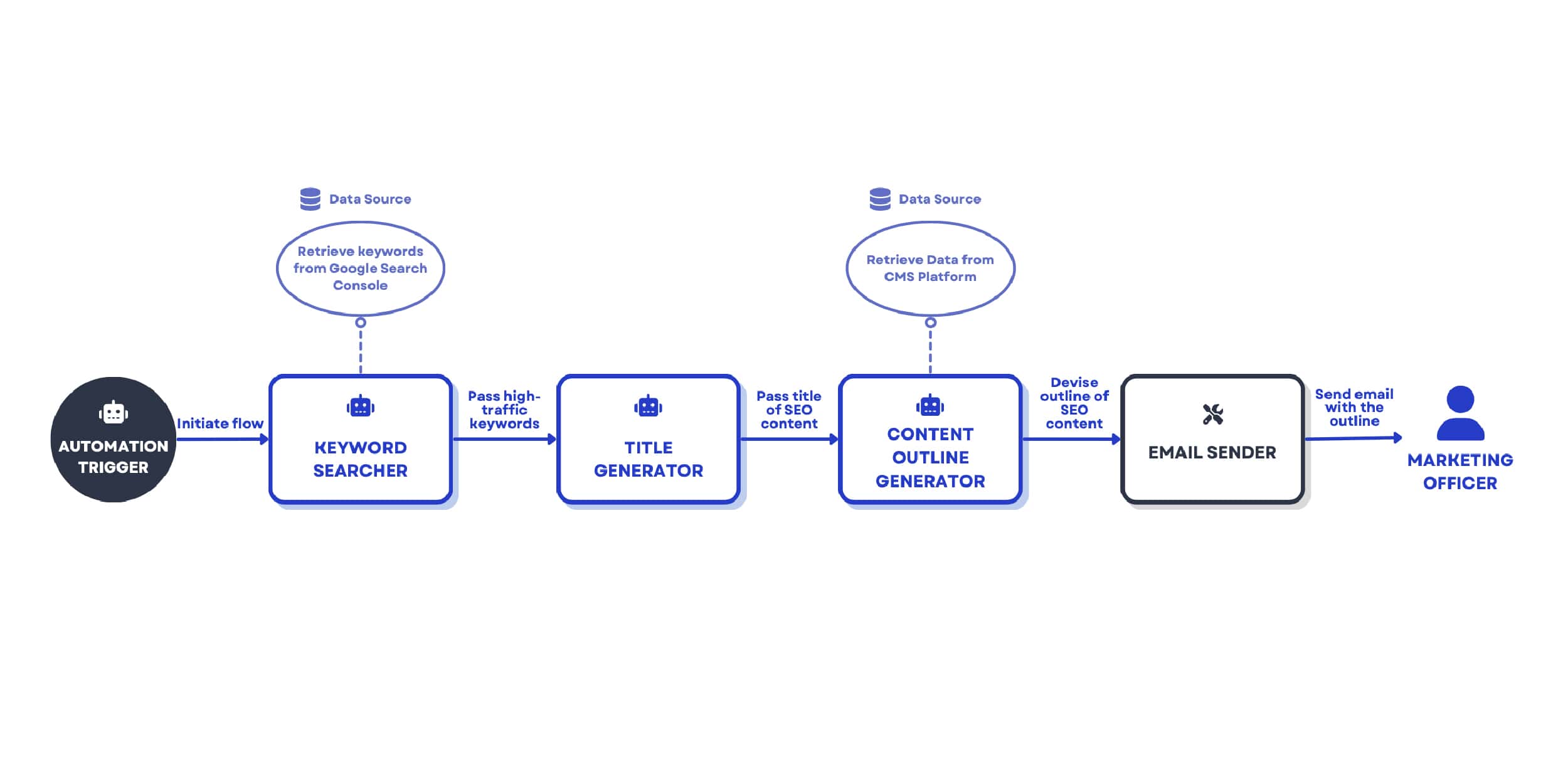
Once you have identified the topics, the AI generates comprehensive content briefs. These briefs include suggested headings, semantic keywords to include, recommended word count, and even readability scores. The key differentiator is predictive scoring. The AI estimates the potential traffic and ranking difficulty for each topic based on your domain authority and the current SERP landscape.
This scoring allows you to prioritize your content calendar. You might choose to target a “quick win” keyword with low difficulty and high relevance, or you might invest in a high-difficulty pillar page that will take six months to rank but will drive substantial long-term traffic. The workflow provides the data to make this trade-off decision rationally.
Step 6: Automate Content Creation and Optimization
AI writing assistants can draft initial versions of your content based on the brief. However, the most effective workflow uses AI for the heavy lifting of research and drafting, followed by human editing for tone, brand voice, and factual accuracy. The AI ensures that the content covers all semantic entities that Google expects for the topic, reducing the risk of missing key subtopics.
During the optimization phase, AI tools analyze your draft against the top-ranking pages. They provide real-time suggestions for adding related terms, improving sentence structure, and optimizing meta tags. This iterative process happens in minutes, not days.
Step 7: Monitor, Learn, and Iterate
The final step is continuous monitoring. The AI SEO planning workflow is not a set-and-forget system. It tracks your rankings daily and alerts you to significant drops or spikes. It also monitors changes in the SERP features—such as the appearance of a video carousel or an AI Overview—that might affect your click-through rate.
Use this data to feed back into Step 1. If a piece of content is underperforming, the AI analyzes why. It might be a mismatch between search intent and content format, or it might be a technical issue like slow page speed. The workflow then recommends specific actions to rectify the issue.
Benefits of Implementing an AI SEO Planning Workflow
The advantages of this approach are measurable and tangible. Teams that adopt this workflow typically see a 30-50% reduction in time spent on manual research tasks. This efficiency gain translates directly into faster content production cycles and quicker time-to-market for new campaigns.
Accuracy improves as well. AI models can detect subtle shifts in user behavior that humans miss. For instance, they can identify a rising trend in “near me” queries for a specific product category weeks before it becomes mainstream. This early detection gives you a first-mover advantage in content creation.
Scalability is another critical benefit. A small team of three can manage the SEO strategy for a large enterprise website with thousands of pages using an AI workflow. The system handles the data processing and reporting, allowing the team to focus on creative strategy and relationship building.
Limitations and Risks to Consider
Despite its power, an AI SEO planning workflow has limitations. The most significant risk is over-reliance on AI-generated insights without human validation. AI models can sometimes identify correlations that are not causal. For example, the AI might suggest that adding more images to a page improves rankings, but the real reason for the ranking improvement might be the increased dwell time from users who find the images helpful.
Data privacy is another concern. Feeding sensitive customer data into third-party AI tools can create compliance issues with GDPR or CCPA. You must ensure that your data aggregation process anonymizes personal information before it enters the AI system.
Finally, the cost of premium AI tools can be substantial. While they save money in the long run, the initial investment in software subscriptions and training can be a barrier for small businesses. A phased implementation approach—starting with one or two tools and expanding as ROI is proven—is often the most prudent strategy.
AI SEO Planning Workflow vs. Traditional Manual Planning
To understand the value proposition clearly, consider the following comparison across key operational dimensions.
| Dimension | Traditional Manual Planning | AI SEO Planning Workflow |
|---|---|---|
| Research Speed | Days to weeks for a full keyword audit | Minutes to hours for the same scope |
| Data Volume | Limited to top 100-500 keywords manually reviewed | Analyzes millions of queries and SERP features |
| Predictive Accuracy | Based on intuition and historical trends | Uses machine learning to forecast volatility |
| Content Personalization | Generic content for broad audience segments | Dynamic content adjustments based on user intent clusters |
| Reporting Frequency | Monthly or quarterly static reports | Real-time dashboards with automated alerts |
| Resource Allocation | High manual labor cost | Lower labor cost, higher software subscription cost |
This table illustrates that the AI workflow is not just a faster version of the manual process; it is a fundamentally different approach that enables strategies which are impossible to execute manually, such as real-time content adaptation based on live search behavior.
Common Mistakes in AI SEO Planning and How to Avoid Them
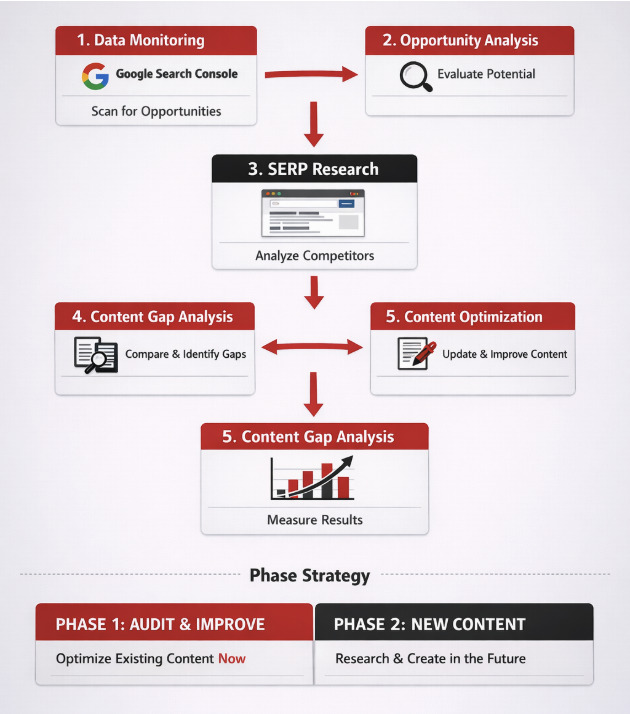
Implementing this workflow incorrectly can lead to wasted budgets and poor results. Here are the most frequent pitfalls and their solutions.
Mistake 1: Ignoring the Human Review Layer
Publishing AI-generated content without human oversight is a recipe for disaster. AI can produce grammatically correct text, but it often lacks the nuance, personal experience, and brand voice that builds trust with readers. Always have a subject matter expert review and edit the AI draft before publication.
Solution: Establish a clear editorial workflow where AI drafts are treated as a starting point, not a final product. The human editor should verify all facts, add unique insights from their experience, and ensure the content aligns with the brand’s tone of voice.
Mistake 2: Focusing Only on High-Volume Keywords
AI tools can easily identify high-volume keywords, but these are often the most competitive and least likely to convert. A common mistake is letting the AI prioritize purely by search volume, leading to content that attracts traffic but no sales.
Solution: Configure your AI workflow to weight keywords by commercial intent and conversion probability. Use the predictive scoring feature to balance difficulty against potential ROI, and prioritize long-tail keywords that indicate a user is closer to a purchasing decision.
Mistake 3: Neglecting Technical SEO in the Workflow
Many AI planning tools focus exclusively on content and keywords, ignoring technical issues like site speed, crawlability, and structured data. A brilliant content strategy will fail if search engines cannot crawl and index your pages efficiently.
Solution: Integrate a technical SEO audit tool into your workflow. Run automated crawls weekly to identify broken links, duplicate content, and missing schema markup. The AI should flag these issues and prioritize them alongside content recommendations.
Mistake 4: Failing to Update the AI Model with New Data
Search behavior changes constantly. If you set up your AI workflow and never retrain the models with new data, your insights will become stale within a few months. The A
Solution: Schedule monthly data refreshes. Import the latest Search Console data, competitor rankings, and market trend reports. Most AI platforms allow you to automate this data ingestion, ensuring your models are always learning from the most recent information.
Important Notes for Successful Implementation
Adopting an AI SEO planning workflow requires a cultural shift within your organization. It is not merely a tool implementation; it is a change in how decisions are made. The following notes will help ensure a smooth transition.
Start small. Choose one specific business unit or content vertical to pilot the workflow. Measure the results against a control group that uses traditional methods. This provides clear evidence of ROI before you scale the system across the entire organization.
Invest in training. Your team needs to understand not just how to use the AI tools, but also how to interpret their outputs critically. Provide workshops on prompt engineering and data literacy. The goal is to create a team that can ask the AI the right questions, not just accept its answers.
Maintain a feedback loop with the AI vendor. These tools are evolving rapidly. If you find a specific feature lacking or a prediction consistently wrong, report it. Vendors often prioritize feature requests from enterprise clients, and your feedback can shape the tool’s roadmap.
Remember that AI is a tool for efficiency, not a substitute for strategy. The strategic vision—which markets to enter, which products to promote, how to position against competitors—must come from human leadership. The AI workflow excels at executing that vision with precision and speed.
Frequently Asked Questions
What is the difference between AI SEO planning and traditional SEO planning?
Traditional SEO planning relies on manual research, intuition, and historical data analysis. It is time-consuming and often limited to a small sample of keywords. AI SEO planning uses machine learning algorithms to process massive datasets, identify patterns, and predict future performance. It enables real-time adjustments and scales to thousands of pages, which is impossible with manual methods.
How long does it take to see results from an AI SEO planning workflow?
Results vary based on your website’s current authority and the competitiveness of your niche. For low-competition keywords, you might see ranking improvements within 2-4 weeks. For high-competition pillar pages, it can take 3-6 months to see significant movement. The workflow’s main advantage is that it helps you prioritize the quick wins first, building momentum while longer-term strategies mature.
Can small businesses afford AI SEO planning tools?
Yes, there are entry-level pricing tiers for most AI SEO tools. Tools like Surfer SEO, Frase, and Clearscope offer plans starting around $50-100 per month. Additionally, many free or low-cost alternatives exist, such as Google’s own AI-powered recommendations in Search Console. Small businesses should start with a single tool that addresses their most pressing need, such as content optimization, and expand as revenue grows.
Will AI replace SEO professionals?
No, A The routine tasks of data collection and basic reporting will be automated. The professional’s value will shift toward strategic interpretation, creative content direction, and relationship building for link acquisition. Professionals who learn to work with A
How does an AI SEO planning workflow handle Google’s AI Overviews?
Modern AI SEO tools monitor the SERP for the presence of AI Overviews and adjust their recommendations accordingly. They can identify which queries trigger these features and suggest content formats optimized for inclusion in the overview, such as concise definitions, comparative tables, or step-by-step instructions. The workflow also tracks the impact of AI Overviews on click-through rates, helping you adapt your traffic expectations.
Conclusion
The AI SEO planning workflow represents a fundamental shift in how organic growth is achieved. It moves the discipline from a reactive, manual craft to a proactive, data-driven science. By automating research, enhancing predictive accuracy, and enabling real-time adaptation, this workflow empowers teams to achieve results that were previously unattainable.
The key to success lies in balance. Use AI to handle the scale and speed of data analysis, but retain human judgment for strategic direction and creative execution. The workflow is a continuous loop of learning and improvement, not a one-time project. As search engines evolve and user behavior shifts, the AI system will help you stay ahead of the curve, provided you feed it quality data and review its insights with a critical eye.
Start by auditing your current planning process. Identify the bottlenecks where manual effort is highest. Then, introduce AI tools to address those specific pain points. Measure the impact, refine your approach, and scale. The future of SEO belongs to those who can harness the power of artificial intelligence without losing the human touch that builds lasting brands.
Xem thêm:
- AI SEO Cornerstone Content: The Complete Playbook for Dominating Search Rankings
- AI SEO for Real Estate: The Complete Guide to Dominating Local Search in 2025
- AI SEO Planning: How Machine Intelligence Transforms Search Strategy from Reactive to Predictive
- AI SEO for Automotive: The Complete Guide to Dominating Search in 2025
- AI SEO LLM Content: The Complete Guide to Ranking in the Age of Generative Search
Bài viết cùng chủ đề:

AI SEO SEO Automation with Make: The Complete Workflow Guide

AI SEO SEO Automation with Zapier: The Complete Workflow Guide

AI SEO SEO Automation with n8n: The Complete Workflow Guide
AI SEO SEO Automation with Gemini: The Complete Guide to Scaling Organic Growth

AI SEO SEO Automation with Claude: The Complete Guide to Scaling Content in 2025

AI SEO SEO Automation with ChatGPT: The Complete Playbook for 2025

AI SEO & SEO Automation for Affiliate Sites: The 2025 Playbook for Passive Income Growth
AI SEO & SEO Automation for Bloggers: The Complete Guide to Scaling Your Content

AI SEO & SEO Automation for Agencies: The Complete 2025 Playbook

AI SEO and SEO Automation for Ecommerce: The Complete Playbook for 2025

AI SEO & SEO Automation for WordPress: The Complete Playbook for 2025
AI SEO SEO Automation Strategy: The Complete Playbook for 2025

Mastering the AI SEO SEO Automation Process: A Complete Guide to Scaling Organic Growth
AI SEO SEO Automation System: The Complete Guide to Scaling Organic Growth in 2025
AI SEO SEO Automation Platform: The Complete Guide to Scaling Organic Growth in 2025
AI SEO SEO Automation Software: The Complete Guide to Scaling Organic Growth in 2025















