
No products in the cart.
AI SEO Predictions: How Artificial Intelligence Will Reshape Search in 2025 and Beyond
29
Jul
Jul
The landscape of search engine optimization is shifting faster than ever, and artificial intelligence sits at the center of that transformation. AI SEO predictions are no longer speculative thought experiments; they are roadmaps drawn from the algorithms already reshaping how content is created, ranked, and consumed. From Google’s continuous rollout of machine learning models to the explosive adoption of generative AI tools, understanding where A This article breaks down the most credible AI SEO predictions, explains the underlying mechanisms driving them, and provides actionable strategies to prepare for the coming changes.
The Evolution of AI in Search Algorithms
Search engines have been using artificial intelligence for more than a decade, though its influence was initially invisible to most marketers. The first major shift came with Google’s deployment of RankBrain in 2015, a machine learning system designed to interpret never-before-seen queries. RankBrain didn’t replace the core algorithm; it added a layer of semantic understanding that allowed Google to connect ambiguous phrases with the most relevant results.
In 2019, BERT (Bidirectional Encoder Representations from Transformers) dramatically improved the search engine’s ability to grasp the context of words in a sentence. Suddenly, prepositions and subtle linguistic cues mattered much more. Queries like “can you get medicine for someone pharmacy” were no longer matched solely on the keyword “medicine”; BERT understood the nuance of the user wanting to pick up someone else’s prescription. This change marked the beginning of a genuine pivot from keyword matching to intent matching.
The latest leap is MUM (Multitask Unified Model), announced in 2021 and gradually integrated into multiple search features. MUM is multimodal, meaning it can understand information across text, images, and video simultaneously, and it is trained across 75 languages. Its vast knowledge transfer ability allows a search engine to learn from high-quality content in one language and apply insights to answer a query in another. These models form the backbone of all current AI SEO predictions, because they prove that Google’s future lies in understanding the world, not just indexing strings of characters.
Core AI SEO Predictions That Will Define the Next Three Years
1. Hyper-Personalized Search Results Become the Norm
Search personalization is not new, but A Future algorithms will combine real-time behavior signals, device context, time of day, and even inferred mood to deliver results that feel tailor-made. A query like “best coffee” might show a local artisan roaster for a user who frequently reads specialty food blogs, while showing a major chain for someone whose purchase history suggests convenience is the priority.
This level of personalization means that AI SEO predictions must account for ranking volatility that is entirely user-specific. Traditional rank tracking, which relies on a single set of positions for a given keyword, will become far less meaningful. SEO professionals will need to monitor performance through aggregate impressions, click-through rates, and conversion data segmented by audience persona rather than a single SERP snapshot.
To optimize for hyper-personalized search, content must be structured to serve multiple intents within one asset. A comprehensive guide that addresses beginner, intermediate, and expert needs in clearly marked sections will be favored over a thin piece targeting a single keyword.
2. The Rise of Generative AI in Search Results
The introduction of Google’s Search Generative Experience (SGE) and Microsoft’s AI-powered Bing Chat has already shown what the near future holds. Generative AI directly answers complex questions at the top of the search results, synthesizing information from multiple sources into a single, coherent block of text. These AI-generated snapshots often remove the need to click through to a website.
This shift has deep implications for SEO content strategy. Websites that rely on informational traffic for top-of-funnel queries will face significant declines in clicks. However, sites that are cited as sources within the AI-generated snapshot can still earn visibility and brand authority. The key is to produce content that is so authoritative, uniquely detailed, and structured in a way that large language models find easy to parse and cite.
Structured data becomes a non-negotiable asset. Using schema types like FAQ, HowTo, Article, and ClaimReview increases the chances that a generative engine will ingest and attribute your content correctly. Original research, proprietary data, and expert interviews will carry even more weight because they form the distinct signals that an AI summary engine cannot easily replicate from general knowledge.
3. The Shift from Keywords to Deep Intent Understanding
For decades, SEO revolved around matching target keywords in titles, headings, and body text. AI models like BERT and MUM have already started breaking that pattern, and the trend will accelerate. Search engines are moving toward a reality where a single piece of content can rank for thousands of semantically related queries without ever explicitly containing those exact words.
The future of content optimization is topical authority, not keyword density. Google’s algorithms can now map entire knowledge domains, identifying whether a website comprehensively covers an entity and its related subtopics. A site that thoroughly explains “digital camera sensors,” “aperture mechanics,” “ISO performance,” and “mirrorless versus DSLR” will rank broadly for camera-related queries even if it doesn’t obsess over individual long-tail phrases.
This means AI SEO predictions point toward a content architecture built around pillar pages and topic clusters. Internal linking that signals semantic relationships will be just as important as the text itself. SEO tools will need to analyze entity gaps rather than mere keyword gaps, helping writers understand which concepts they haven’t yet covered in a meaningful way.
4. Visual and Voice Search Optimization Powered by AI
Voice assistants like Google Assistant, Siri, and Alexa have trained billions of users to speak queries in natural language. Meanwhile, Google Lens processes over 10 billion visual searches per month. Both modalities rely heavily on AI, and their influence on SEO is only going to grow.
Voice search queries tend to be longer, more conversational, and local in nature. Optimizing for voice means creating content that answers specific questions directly, using natural language that mirrors how people talk. Claiming and optimizing Google Business Profiles becomes even more critical, as voice queries for nearby services will pull from those listings almost exclusively.
Visual search optimization demands high-quality, original images with descriptive alt text and structured file names. Google’s multimodal AI can extract information from photographs and match them with products, landmarks, and even recipes. E-commerce sites should invest in multiple high-resolution images per product, from various angles, with schema markup specifying product details. The visual web is not a separate channel; it is becoming deeply integrated into the core search experience.
5. Automated Technical SEO and Predictive Auditing
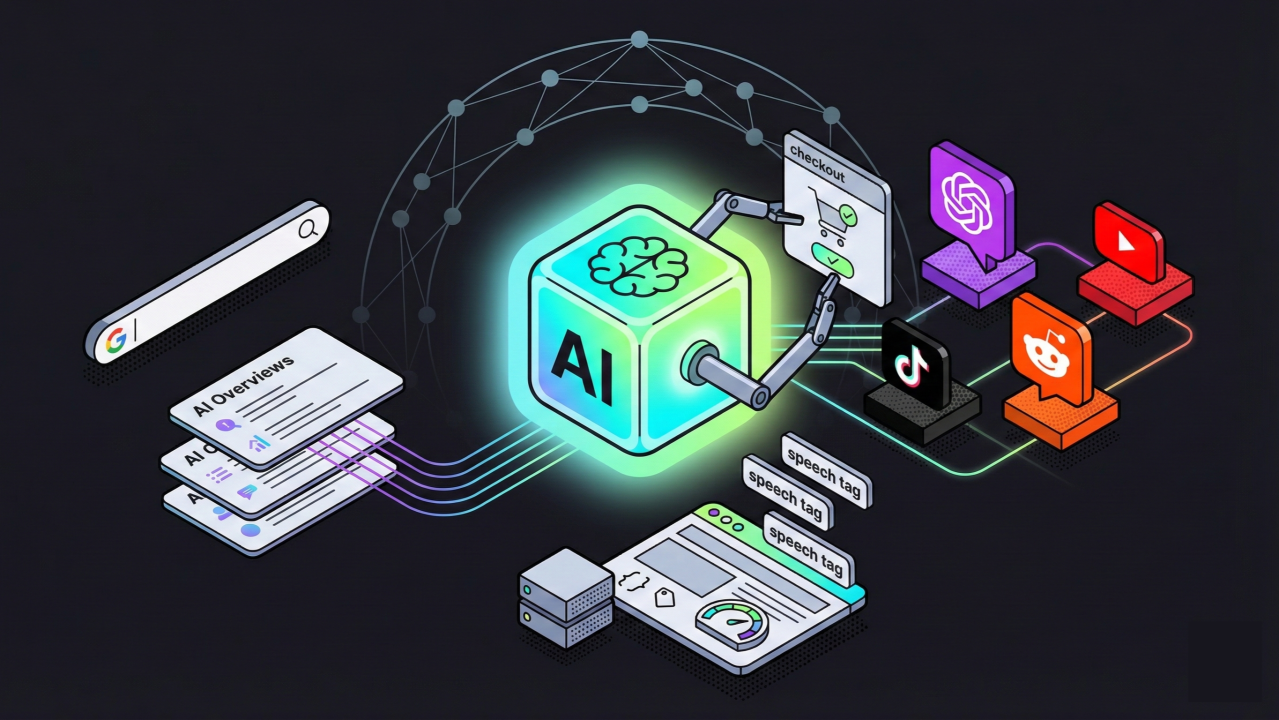
AI is not only changing how search engines work; it is revolutionizing how SEO professionals do their work. Tools like DeepCrawl, Botify, and Semrush already use machine learning to detect anomalies in log files, predict crawl budget issues, and identify pages that are underperforming relative to their potential.
In the very near future, automated systems will handle the routine technical health of a website with minimal human intervention. A
This automation frees up SEO strategists to focus on higher-level thinking: understanding audience needs, crafting genuinely distinctive content, and building brand signals that no machine can fake. The technical side will become a baseline, not a differentiator.
Benefits and Limitations of AI-Driven SEO
- Benefits:
- Faster, more accurate analysis of large datasets enables real-time strategy adjustments.
- Better user experiences through personalized, intent-aware content delivery.
- Reduction of manual, repetitive tasks like meta tag generation and broken link checking.
- Improved accessibility as voice and visual search open new traffic channels.
- Limitations:
- Heightened dependency on third-party AI tools can lead to homogenized strategies.
- Algorithmic personalization makes it harder to measure consistent rankings.
- Generative AI summaries may dramatically reduce organic click-through rates for informational content.
- The risk of AI-generated content creating a spam feedback loop, where low-value articles proliferate.
- Chasing every AI tool without a strategy: Adding dozens of automation plugins can create conflicts and dilute focus. Start with one or two proven solutions that address your biggest technical gaps.
- Over-optimizing for AI at the expense of human readers: Content that reads like a machine-generated keyword lattice may satisfy some algorithms temporarily but will fail when user engagement signals signal low satisfaction.
- Ignoring the fundamentals: Even with AI advances, site speed, mobile usability, secure HTTPS, and crawl accessibility remain the foundation. AI cannot rescue a site search engines cannot properly crawl or render.
- Neglecting brand building: When AI answers queries directly, users still remember the sources cited. Websites with strong brand trust are more likely to be cited and clicked when users do decide to explore further.
- Assuming AI content alone can rank: Google’s helpful content system explicitly rewards people-first content. Sites that publish unedited AI-generated articles at scale without expert human review are increasingly being demoted.
Comparison: Traditional SEO vs. AI-Powered SEO
| Aspect | Traditional SEO | AI-Powered SEO |
|---|---|---|
| Keyword strategy | Exact-match keywords in title, headings, text | Topic clusters, entity optimization, semantic relevance |
| Content creation | Human-written, often optimized for a single primary keyword | Human-led but AI-assisted content that serves multiple intents |
| Rank tracking | Static position for a keyword on a given day | Dynamic, user-specific; measurement via impressions and conversion segments |
| Technical audits | Manual crawling, spreadsheets, periodic checks | Predictive auditing, automated fixes, real-time anomaly detection |
| User experience signals | Primarily bounce rate and time on page | AI-evaluated user satisfaction, implicit feedback loops, interaction quality |
| Search features | Blue links, featured snippets gained by simple Q&A | AI-generated snapshots, multimodal answers, conversational search |
Practical Application: Preparing Your SEO Strategy for AI
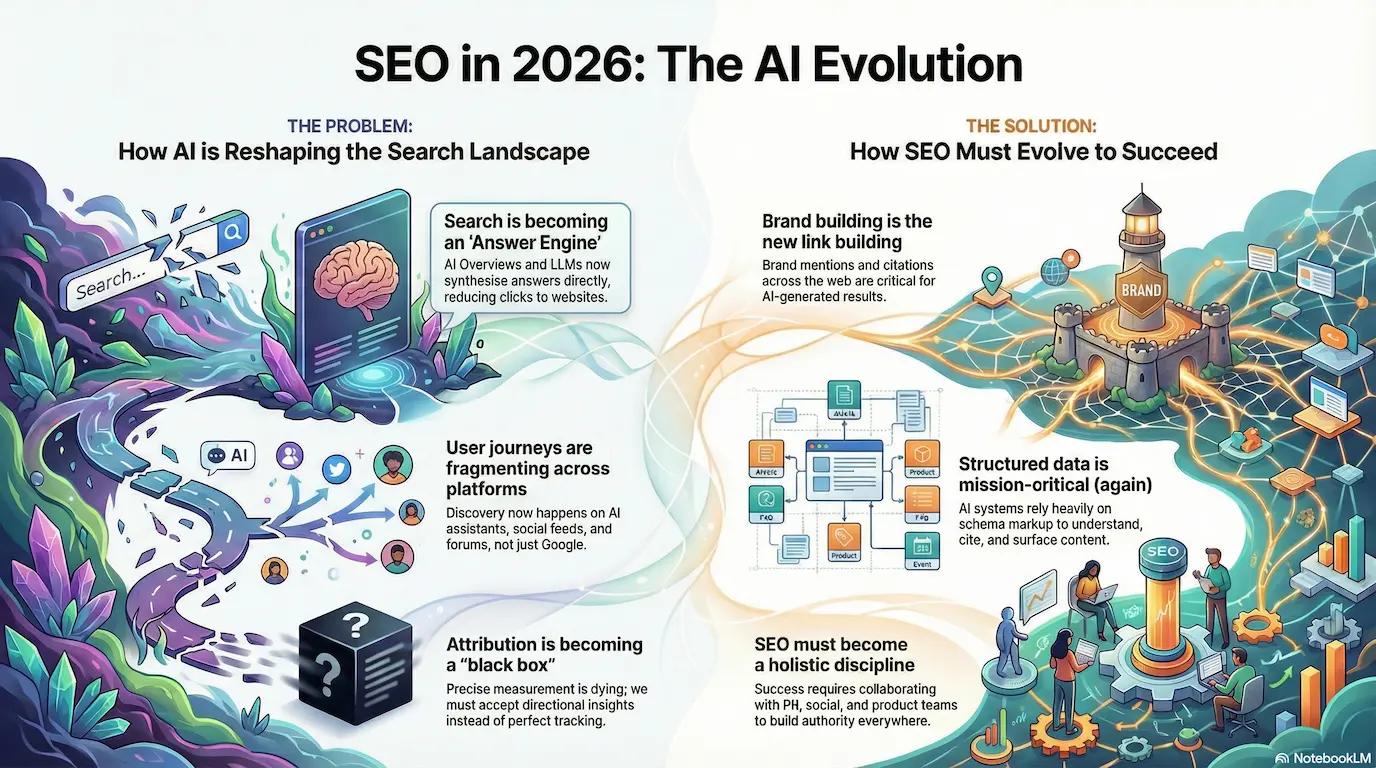
Adapting to these AI SEO predictions requires concrete changes to how digital strategies are planned and executed. Start by auditing your existing content for topical depth. Map every piece of content to a parent topic and identify the subtopics you have not yet covered. This entity-first approach aligns with how modern search engines understand your site.
Next, implement comprehensive structured data. Use schema.org types relevant to your industry: Article, Product, Recipe, Event, LocalBusiness, and FAQ. Structured data acts as a direct feed to AI models, helping them parse your information with minimal ambiguity. Validate all markup with Google’s Rich Results Test tool before deployment.
Invest in original research that cannot be replicated by AI. Data-driven studies, proprietary surveys, and case studies with unique insights become more valuable when search engines are aggregating common knowledge. Publish white papers, host webinars with transcripts, and create infographics that encapsulate data points other sites lack.
For e-commerce and local businesses, ensure all visual assets are optimized. Compress images for speed, use descriptive file names, and provide contextually relevant alt attributes. A product image named “handmade-espresso-cup-green-glaze.jpg” with alt text describing the cup’s features will be far more discoverable in visual search than “IMG_3421.jpg.”
Finally, rethink success metrics. Instead of obsessing over a single keyword position, monitor organic traffic to topic clusters, engagement rates by audience segment, and brand appearance frequency in AI-generated answers. Tools that track entity visibility and share-of-search within generative experiences will become standard KPIs.
Common Mistakes to Avoid When Acting on AI SEO Predictions
Important Notes for Long-Term Success
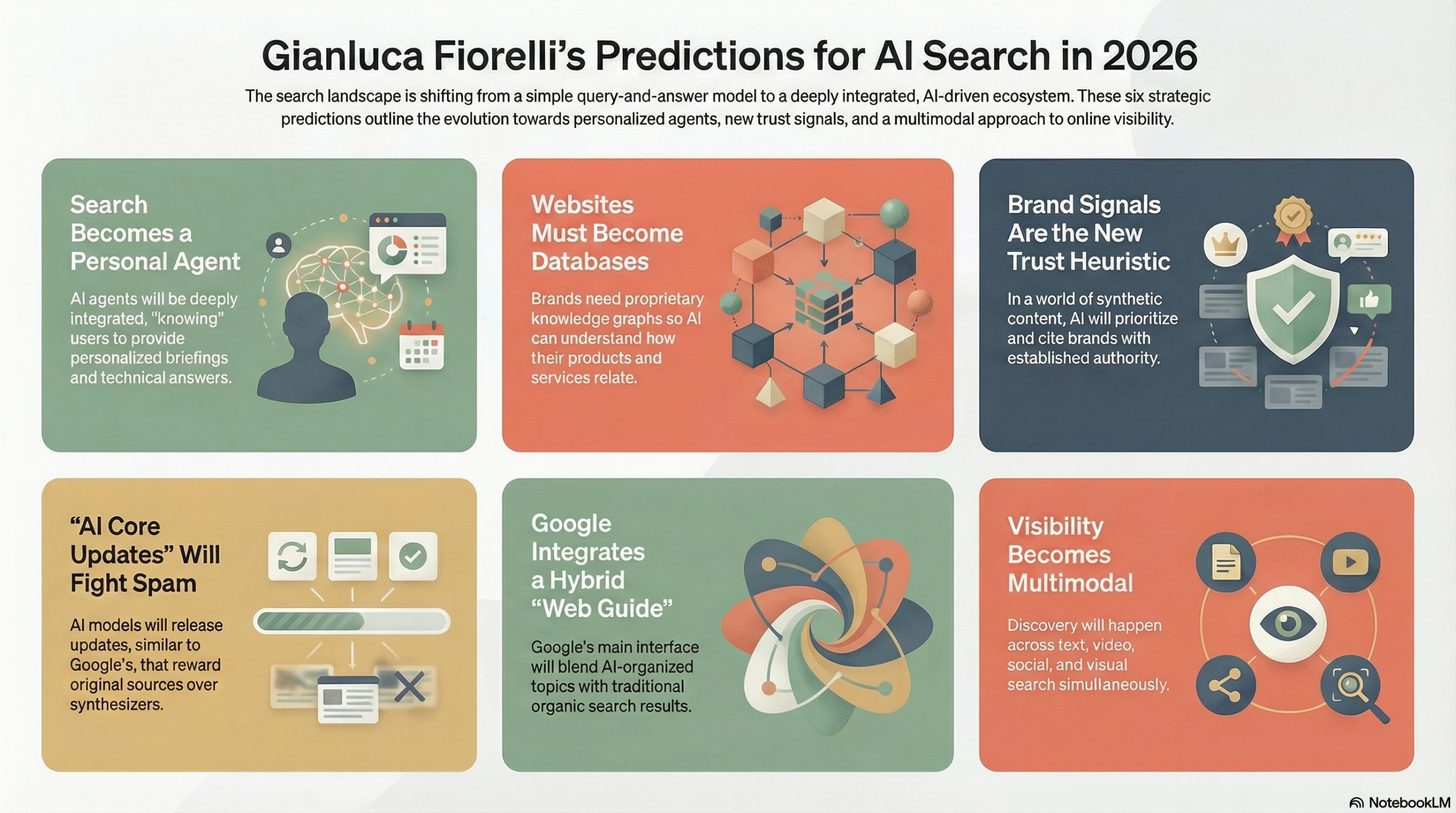
Search engines have been explicit about one thing: AI is a tool to improve the user’s journey, not a shortcut for content creators. The E-E-A-T framework (Experience, Expertise, Authoritativeness, Trustworthiness) becomes even more critical when AI amplifies the spread of both high-quality and low-quality information. Demonstrate real-world experience through author bios, case studies, and transparent sourcing.
Keep an extremely close eye on how Google’s SGE evolves. Early data from multiple SEO studies suggests that the presence of an AI-generated snapshot can reduce organic click-through rates by 30% or more for informational queries that are fully answered within the snapshot. This does not spell the end of SEO; it changes the funnel. The traffic that does click through will be more ready to convert or engage deeply because their basic question has already been answered. Optimize for that deeper engagement by providing tools, calculators, community forums, or personalized experiences that an AI snapshot cannot replicate.
Do not treat voice, visual, and text search as separate silos. The same AI models power all of them, and consistent information across every format reinforces your entity’s authority. Ensure your business information is identical across your website, Google Business Profile, social media pages, and any directory listings.
Frequently Asked Questions (FAQ)
What are the most important AI SEO predictions for 2025?
The most significant predictions include widespread hyper-personalization of search results, generative AI answers dominating informational queries, a complete shift from keywords to intent and entity understanding, massive growth in voice and visual search, and automated technical SEO becoming a standard baseline rather than a competitive edge.
Will AI replace SEO professionals?
A The role will shift from execution specialist to strategic analyst who interprets AI-generated insights and makes high-level decisions.
How does Google’s Search Generative Experience affect organic traffic?
Google’s SGE can reduce click-through rates for simple informational queries by providing an instant answer at the top of the results. However, queries with commercial or transactional intent, and those requiring detailed, nuanced responses, continue to drive clicks. The overall effect is a filtering of traffic: fewer casual visitors, but a higher percentage of genuinely interested users.
Is AI-generated content good for SEO?
AI-generated content that is thoroughly reviewed, fact-checked, and enhanced with human expertise can perform well. Content that relies entirely on AI without human oversight often fails Google’s helpful content evaluation and is at risk of algorithmic penalties. The best approach is using AI as a research and drafting assistant, not a replacement for human authorial judgment.
Which structured data types matter most for AI search?
The most impactful types include Article, FAQ, HowTo, Product, BreadcrumbList, LocalBusiness, and Organization markup. These schemas help AI models parse and attribute content accurately, increasing the chance of appearing in rich results and generative answer citations.
Conclusion
The accelerating integration of artificial intelligence into every layer of search means that AI SEO predictions are no longer optional to watch; they are essential to act on. Algorithms are moving from recognizing strings of text to understanding entities, intent, and user context with human-like depth. Content strategies must follow suit by building comprehensive topical authority, structuring data for machine readability, and investing in the uniquely human elements that AI cannot replicate—original insight, trust, and genuine experience.
Those who adapt now by embracing topic clusters, structured data, visual optimization, and real human expertise will find themselves well positioned when AI-powered search fully settles in. The fundamentals of clear communication, technical excellence, and audience understanding remain constant even as the machines evolve. Treat these predictions not as distant speculation, but as a blueprint for building a resilient, future-proof search presence.
Xem thêm:
- AI SEO Checklist for Ecommerce: The Complete 2025 Guide to Automating Product Page Optimization
- AI SEO for News Websites: The Complete Playbook for 2025 and Beyond
- AI SEO Pagination: The Complete Guide to Smarter Site Architecture in 2025
- LLM SEO: The Ultimate Guide to Optimizing for Large Language Model Search
- AI SEO Outbound Link Strategy: The Complete Guide to Building Authority in 2025
Bài viết cùng chủ đề:

AI SEO SEO Automation with Make: The Complete Workflow Guide

AI SEO SEO Automation with Zapier: The Complete Workflow Guide

AI SEO SEO Automation with n8n: The Complete Workflow Guide
AI SEO SEO Automation with Gemini: The Complete Guide to Scaling Organic Growth

AI SEO SEO Automation with Claude: The Complete Guide to Scaling Content in 2025

AI SEO SEO Automation with ChatGPT: The Complete Playbook for 2025

AI SEO & SEO Automation for Affiliate Sites: The 2025 Playbook for Passive Income Growth
AI SEO & SEO Automation for Bloggers: The Complete Guide to Scaling Your Content

AI SEO & SEO Automation for Agencies: The Complete 2025 Playbook

AI SEO and SEO Automation for Ecommerce: The Complete Playbook for 2025

AI SEO & SEO Automation for WordPress: The Complete Playbook for 2025
AI SEO SEO Automation Strategy: The Complete Playbook for 2025

Mastering the AI SEO SEO Automation Process: A Complete Guide to Scaling Organic Growth
AI SEO SEO Automation System: The Complete Guide to Scaling Organic Growth in 2025
AI SEO SEO Automation Platform: The Complete Guide to Scaling Organic Growth in 2025
AI SEO SEO Automation Software: The Complete Guide to Scaling Organic Growth in 2025















