
No products in the cart.
LLM SEO: The Ultimate Guide to Optimizing for Large Language Model Search
29
Jul
Jul
The way people discover information online is undergoing a seismic shift. Generative AI and large language models are no longer just research projects; they are powering search experiences for billions of users. Optimizing for these AI-driven interfaces has given rise to a new discipline: LLM SEO. This comprehensive guide explains what LLM SEO is, how it differs from traditional search engine optimization, and exactly how to adapt your content strategy so your brand gets cited, referenced, and recommended by Google’s AI Overviews, Bing Copilot, ChatGPT, Perplexity, and other LLM-powered search tools.
What Is LLM SEO?
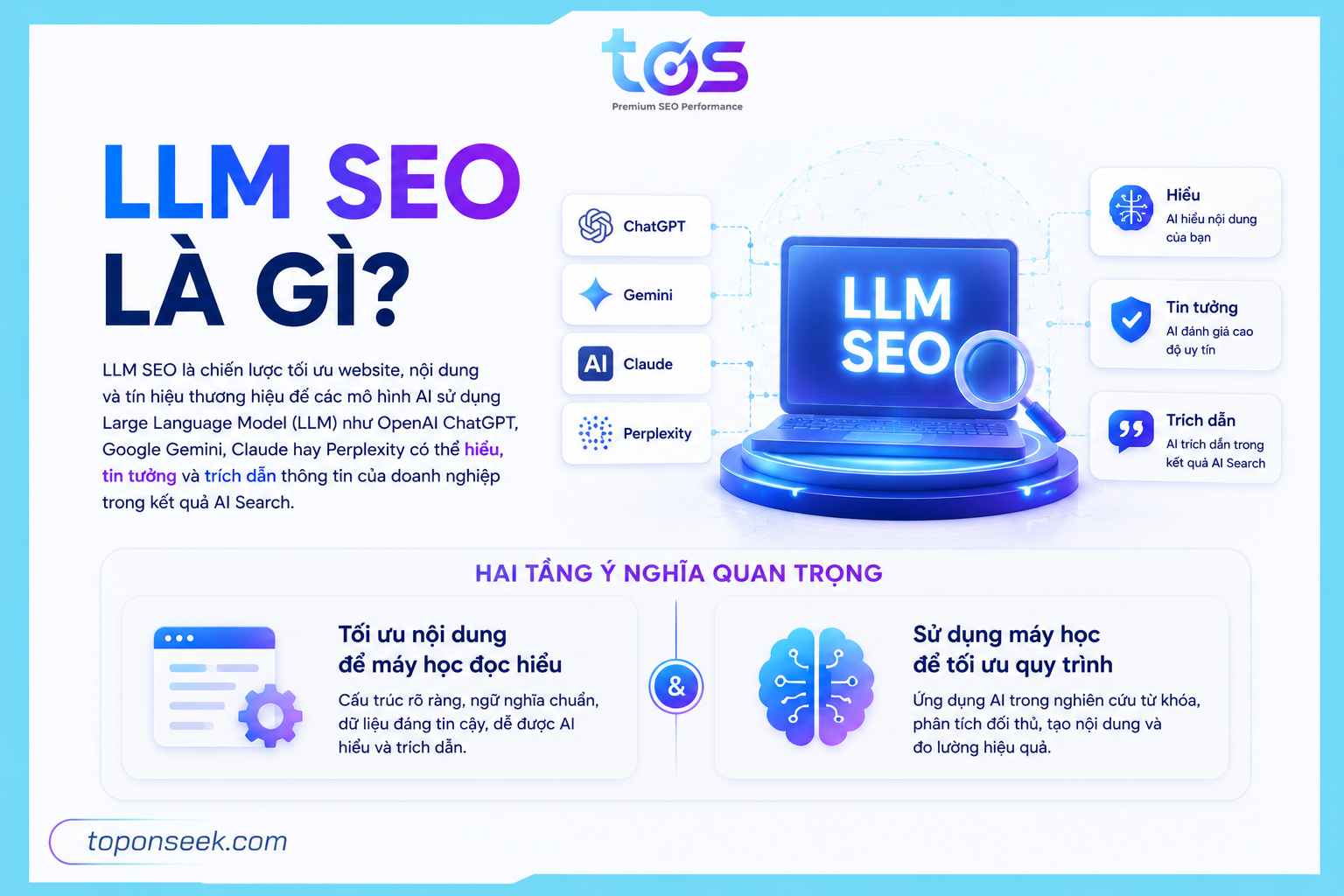
LLM SEO is the practice of making digital content discoverable, understandable, and citable by large language models used in search contexts. Unlike traditional SEO, which focuses on ranking within a list of blue links, LLM SEO aims to secure visibility inside AI-generated answers, summaries, and conversational responses. When a user asks a complex question, the model pulls information from multiple sources, synthesizes it, and often attributes it to specific websites. Getting your content chosen as a source in that synthesis is the core goal of LLM SEO.
This type of optimization goes beyond keyword matching. It requires building content that demonstrates deep expertise, uses clear and logical structure, and provides factual, verifiable claims that AI models can trust. As LLMs become the entry point for search—Google’s AI Overviews now appear for a significant portion of informational queries—LLM SEO moves from a futuristic concept to an immediate necessity for brands that depend on organic traffic.
How Large Language Models Change Search
Traditional search engines index webpages by crawling, parsing HTML, and ranking them based on hundreds of signals like backlinks, keyword relevance, and page authority. A user gets a list of links. LLMs flip this model. They pre-train on massive text corpora, then use retrieval-augmented generation (RAG) at query time to fetch real-time information from an index and generate a fluid, paragraph-form answer. The retrieved documents serve as grounding sources.
This changes user behavior. More queries are answered directly on the search results page, making “zero-click searches” even more common. For content creators, the new battlefield is the AI snapshot, not just position one. Visibility means being one of the sources the model relies on. It also means that content must be optimized for extraction: the LLM needs to identify your key points, product details, or data points quickly and accurately.
Key Differences Between Traditional SEO and LLM SEO
While traditional SEO and LLM SEO share foundational principles—quality content, authority, and good user experience—the mechanics of ranking versus being cited differ significantly. Understanding these differences helps reallocate resources effectively.
| Aspect | Traditional SEO | LLM SEO |
|---|---|---|
| Goal | Rank in top 10 blue links; earn clicks | Be cited in AI-generated answers; build brand visibility even without a click |
| Content format | Optimized for landing pages, meta titles, headings | Optimized for information extraction; clear, declarative statements and structured data |
| Keyword strategy | Exact-match and long-tail keywords mapped to pages | Semantic topic modeling, entity-rich content, answering multiple related intents in one resource |
| Authority signals | Backlinks, domain authority, page-level metrics | Entity recognition, factual consistency, co-citation across trusted sources, schema markup |
| Measurement | Organic traffic, click-through rate, keyword positions | Citation frequency in AI outputs, brand mentions, referral traffic from generative engines |
Core Components of LLM SEO
LLM SEO is built on several interdependent pillars. Each one strengthens your content’s ability to be surfaced by AI models.
Entity Optimization
LLMs understand the world through entities—people, places, brands, concepts, and their relationships. Your content must clearly identify which entities it discusses and connect them in a knowledge-graph-friendly manner. Use precise product names, attribute authors, and link to authoritative Wikidata or Wikipedia entries where relevant. Schema markup like Organization, Person, and Product helps machines map your text to known entities.
Semantic Richness and Topical Depth
Keyword density is obsolete for LLM SEO. Instead, comprehensive coverage of a topic matters. When a model retrieves documents for a query like “best running shoes for flat feet,” it looks for content that not only mentions the phrase but also discusses arch support, pronation, cushioning types, and presents comparisons. Covering a subject cluster exhaustively in a logically ordered article signals to the model that your page is a rich source of answers.
Clear Information Architecture
AI models parse HTML to extract main content, headings, and lists. Proper use of H1, H2, H3 tags, unordered lists, and tables makes it easy for the model to chunk your content. Each section should present a self-contained nugget of information, because the LLM may pull a single paragraph or bullet list as part of its answer without reading the entire page.
Authoritative and Verifiable Content
LLMs tend to favor content that is supported by external evidence, bears author credentials, and aligns with what other high-trust sources say. Original research, data studies, and consistently cited statistics get referenced more often. Adding author bios that showcase relevant expertise and linking to primary sources within your text can increase citation potential.
Freshness and Maintenance
Search-integrated LLMs often use a real-time index. Keeping content up to date signals relevance. Regularly updating statistics, removing outdated advice, and adding newly published research makes your page a more reliable source when the model retrieves current information.
LLM SEO Strategies That Actually Work
Practical implementation matters. The following strategies translate the core components into actionable steps.
1. Adopt Question-Answer Content Formats
LLMs are built to answer questions. Content structured as a clear question followed by a concise, factual answer and then deeper explanation aligns with how the models extract information. Include a dedicated FAQ section on your pages, but also weave question-based subheadings throughout the article. This format matches many AI prompt-response patterns.
2. Use Structured Data Extensively
Schema markup is no longer optional. While traditional SEO uses it for rich snippets, LLMs rely on structured data to understand content type, author, date, ratings, and entity connections. Implement Article, FAQ, HowTo, Product, and Review schemas where applicable. Validated structured data gives your content a machine-readable layer that dramatically improves the accuracy of information extraction.
3. Build Topical Authority with Content Hubs
One-off blog posts rarely win citations in LLM answers. Instead, create pillar pages supported by clusters of related, interlinked content. When a model encounters a site that has covered every angle of a subject over a dozen high-quality pages, it considers that domain a go-to source for the topic. Internal linking between these pages reinforces semantic relationships.
4. Optimize for Retrieval, Not Just Ranking
In a RAG pipeline, the document is first retrieved by a vector search system. That retrieval relies on semantic similarity, not just keyword occurrence. Write in natural, clear language that mirrors how users ask questions. Use synonyms, related concepts, and clear definitions. Tools like embedding visualizers can help you understand how your content appears in vector space relative to competitor pages.
5. Earn Citations from Trusted Sources
Just as backlinks served as votes of confidence for traditional search, being cited by well-recognized sources matters for LLMs. If your original data is referenced by news sites, academic journals, or Wikipedia, models are more likely to pull your original page when answering relevant queries. Proactively share unique data and insights with journalists and researchers.
6. Monitor AI-Generated Referral Traffic
New analytics methods are emerging. While most AI chat interfaces do not yet send a referrer string, some generative engines like Perplexity and Bing Copilot do appear in server logs. Monitor your traffic for referral sources that indicate AI-driven visits. Additionally, brand monitoring tools can track mention frequency in AI outputs. This feedback loop helps refine your LLM SEO efforts.
Tools and Technologies for LLM SEO
Several tools can assist in researching, implementing, and measuring LLM SEO.
- Schema Markup Generators: Tools like Merkle’s Schema Markup Generator or Google’s Structured Data Markup Helper help create error-free structured data.
- Entity Recognition APIs: Google Natural Language API, IBM Watson NLU, and spaCy can analyze your content to verify that key entities are recognized and linked correctly.
- Semantic Content Analyzers: MarketMuse, Clearscope, and Frase help optimize for topic coverage rather than keyword density, aligning with how LLMs assess comprehensiveness.
- AI Visibility Monitoring: Sistrix and Semrush have started rolling out features that estimate visibility in AI-generated results. Brandwatch and manual queries through ChatGPT or Bing Copilot can also be used for spot checks.
- Vector Database Explorers: For advanced users, tools like Pinecone can help you understand how your embeddings compare, though this is more technical.
Common Mistakes in LLM SEO and How to Avoid Them
Without careful strategy, LLM SEO efforts can backfire or waste resources. Here are pitfalls to avoid.
Over-Optimizing for AI at the Expense of Humans
Writing in an unnatural, bullet-ridden style just to please LLMs can harm readability. Users still visit your page after an AI citation, and a poor experience will damage brand trust. Always write for humans first; structure for machines second.
Ignoring Technical SEO Fundamentals
LLM SEO cannot work if your pages are not crawlable, have slow load times, or lack a clear URL structure. Google’s AI Overviews still rely on the same index, and Bing Copilot uses Bing’s index. Technical SEO remains the foundation.
Focusing Only on Text and Forgetting Multimedia
LLMs increasingly incorporate image and video understanding. Alt text, video transcripts, and image captions provide additional semantic context. An infographic with descriptive alt text can be cited just as a text paragraph can.
Neglecting Brand Building and Off-Page Signals
A brand that is frequently searched for, discussed on social media, and featured in traditional media inherently builds entity authority. LLMs often favor recognized brands. Off-page SEO—digital PR, social presence, and brand mentions—remains vital.
Assuming LLM SEO Replaces Traditional SEO
For the foreseeable future, AI snapshots and traditional listings coexist. A comprehensive organic strategy must pursue both. Some queries will still result in direct traffic from blue links, and often the same foundational improvements serve both.
Important Notes for Practitioners
LLM SEO is an evolving field. Search engines frequently update their AI models, the weight given to different signals changes, and new interfaces emerge. Continuous testing is essential. Run controlled experiments with a subset of pages: add structured data, improve entity definitions, or rewrite content in a more declarative style, then monitor changes in referral traffic and citation rates over several months.
Also, collaboration between content teams, SEO specialists, and data analysts becomes even more important. The content that performs best in LLM contexts often requires input from subject matter experts who can provide unique insights and data that generic writers cannot replicate.
Frequently Asked Questions
What exactly is LLM SEO?
LLM SEO is the practice of optimizing web content to be selected and cited by large language models when they generate answers in search environments like Google AI Overviews, Bing Copilot, and Perplexity. It focuses on entity recognition, semantic richness, structured data, and authority rather than traditional blue-link ranking factors alone.
How does LLM SEO differ from traditional SEO?
Traditional SEO targets higher rankings in a list of links, while LLM SEO targets inclusion in AI-generated answer snapshots. LLM SEO requires a greater emphasis on factual accuracy, clear information hierarchy, schema markup, and topic coverage depth rather than backlink volume and exact-match keywords.
Is LLM SEO the same as Generative Engine Optimization (GEO)?
They are closely related and often used interchangeably. GEO sometimes has a broader scope, encompassing any optimization for generative AI interfaces, including non-search chatbots. LLM SEO more specifically targets search-based LLM applications. In practice, the techniques overlap heavily.
Do traditional backlinks still matter for LLM SEO?
Backlinks remain relevant because they help establish entity authority and contribute to a site’s overall trustworthiness. However, their role is indirect. A backlink from a high-authority news site signals that your content is citable. Yet, the direct ranking mechanism of PageRank is less central in an LLM citation scenario.
Can small websites compete in LLM SEO?
Absolutely. LLMs often cite niche, highly specialized content when it provides detailed, original information that larger generic sites lack. A small blog with deep expertise on a narrow topic can become the go-to source for related AI-generated answers. Focus on unique data, clear presentation, and strong entity associations.
How do I measure success in LLM SEO?
Success metrics differ. Track brand mention frequency in AI outputs using monitoring tools, watch for referral traffic from generative search platforms, and measure the click-through rate from AI snapshots (when available). Additionally, monitor overall organic visibility because strong LLM performance often correlates with improved traditional rankings due to shared foundational signals.
What are the most important technical elements for LLM SEO?
Implementation of schema markup, a logical heading structure, fast page speed, mobile-friendliness, and error-free HTML are critical. Ensure content is easily extractable, with clear sections and minimal intrusive interstitials that could block AI crawlers.
Does LLM SEO work for all types of queries?
Not all queries trigger an AI-generated answer. Transactional queries like “buy running shoes” still largely show product listings and ads. LLM SEO is most impactful for informational, research-oriented, and how-to queries where users seek synthesized explanations.
Conclusion
LLM SEO represents the next evolution of search visibility. As AI becomes the mediator between users and information, the ability to earn citations in large language model responses is paramount. Building a content ecosystem rooted in clarity, authority, and entity-rich semantics, while maintaining robust technical foundations, positions any brand to thrive in this new landscape. The shift is already underway, and those who adapt early stand to capture attention where it increasingly resides: inside the intelligent, conversational answers that define modern search.
Xem thêm:
- AI Search Intent Analysis: The Definitive Guide to Understanding What Users Really Want
- AI Long Tail Keywords: The Definitive Guide to Capturing High-Intent Traffic with Intelligent Search
- AI SEO Playbook: The Complete Guide to Ranking in the Age of Machine Learning
- AI SEO Fresh Content: The Complete Guide to Scaling Rankings in 2025
- AI SEO Keyword Relationships: The Complete Guide to Semantic Search Optimization
Bài viết cùng chủ đề:

AI SEO SEO Automation with Make: The Complete Workflow Guide

AI SEO SEO Automation with Zapier: The Complete Workflow Guide

AI SEO SEO Automation with n8n: The Complete Workflow Guide
AI SEO SEO Automation with Gemini: The Complete Guide to Scaling Organic Growth

AI SEO SEO Automation with Claude: The Complete Guide to Scaling Content in 2025

AI SEO SEO Automation with ChatGPT: The Complete Playbook for 2025

AI SEO & SEO Automation for Affiliate Sites: The 2025 Playbook for Passive Income Growth
AI SEO & SEO Automation for Bloggers: The Complete Guide to Scaling Your Content

AI SEO & SEO Automation for Agencies: The Complete 2025 Playbook

AI SEO and SEO Automation for Ecommerce: The Complete Playbook for 2025

AI SEO & SEO Automation for WordPress: The Complete Playbook for 2025
AI SEO SEO Automation Strategy: The Complete Playbook for 2025

Mastering the AI SEO SEO Automation Process: A Complete Guide to Scaling Organic Growth
AI SEO SEO Automation System: The Complete Guide to Scaling Organic Growth in 2025
AI SEO SEO Automation Platform: The Complete Guide to Scaling Organic Growth in 2025
AI SEO SEO Automation Software: The Complete Guide to Scaling Organic Growth in 2025















