
No products in the cart.
AI SEO Standard Operating Procedures: The Definitive Playbook for 2025
31
Jul
Jul
Search engine optimization has undergone a fundamental transformation. The days of manual keyword stuffing and link chasing are over. Today, teams that scale organic growth rely on AI SEO Standard Operating Procedures to systematize their workflows, eliminate guesswork, and maintain consistency across every piece of content they produce. An AI-powered SOP is not just a document; it is a living framework that integrates machine learning, natural language processing, and predictive analytics into your daily SEO tasks. This guide provides a comprehensive, actionable blueprint for building, implementing, and refining these procedures to achieve measurable, long-term results.
What Are AI SEO Standard Operating Procedures?
An AI SEO Standard Operating Procedure is a documented, step-by-step process that leverages artificial intelligence tools to execute repetitive, data-heavy, or complex SEO tasks. Unlike traditional SOPs that rely on human judgment for every step, these procedures automate the heavy lifting—from keyword clustering and content brief generation to technical audits and performance forecasting.
The core value lies in the “standard” part. By codifying how your team uses AI, you ensure that a junior analyst and a senior manager produce the same quality of output. This consistency is critical for testing, scaling, and maintaining brand voice across hundreds of pages. The “procedure” aspect dictates the sequence: data collection, AI analysis, human review, and final implementation.
The Shift from Manual to AI-Driven Workflows
Traditional SEO relied on spreadsheets, manual SERP analysis, and gut feeling. Modern AI SEO Standard Operating Procedures replace this with a structured pipeline. For example, instead of manually checking page titles for length, an AI tool scans thousands of URLs, flags issues, and even suggests fixes based on top-ranking competitors. This shift does not remove the human expert; it elevates their role to strategic oversight, creative direction, and final quality assurance.
The result is a significant reduction in time-to-market for content and a higher accuracy rate in technical fixes. Teams that adopt these procedures report a 30-50% reduction in routine task time, allowing them to focus on link building, digital PR, and content differentiation—areas where human creativity still outshines algorithms.
Core Components of an Effective AI SEO SOP
Building a robust AI SEO Standard Operating Procedure requires a modular approach. Each module addresses a specific part of the SEO lifecycle. Below are the essential components that every high-performing SOP should include.
1. Automated Keyword Research and Clustering
The first step in any SEO campaign is understanding what your audience searches for. An AI-driven SOP uses tools like Clearscope, Surfer SEO, or custom GPT models to analyze search intent. The procedure should define how to feed seed keywords into the AI, how to filter output for relevance, and how to cluster keywords into topic groups.
For instance, the SOP might dictate that the AI must pull the top 50 results for a seed keyword, extract the common entities, and group them into “informational,” “commercial,” and “transactional” buckets. This ensures that content creation targets the correct stage of the buyer’s journey. The human expert then reviews the clusters to ensure they align with business goals, rejecting any that are off-brand.
2. AI-Generated Content Briefs
Content briefs are the backbone of a scalable content operation. An AI SEO Standard Operating Procedure for briefs should specify the exact data points the AI must gather: competitor word count, header structure, internal linking opportunities, and entity mentions. The SOP should require the AI to generate a detailed outline, including suggested H2s and H3s, based on SERP analysis.
The procedure must also include a mandatory human review step. The AI provides the skeleton, but the human editor adds unique insights, proprietary data, and brand-specific examples. This hybrid approach ensures the content is not just optimized for search engines but is genuinely useful for readers.
3. Technical SEO Auditing and Monitoring
Technical issues can silently kill your rankings. An AI-powered SOP automates the detection of crawl errors, broken links, duplicate content, and schema markup issues. The procedure should define a weekly or monthly cadence for running these audits using tools like Screaming Frog integrated with AI analysis.
The SOP should also outline the prioritization matrix. For example, the AI flags a 404 page on a high-traffic URL. The procedure dictates that this is a “P0” priority, requiring immediate redirect. Lower-priority issues, like missing alt text on images, are batched into a monthly fix cycle. This ensures that critical issues are never overlooked due to manual oversight.
4. Predictive Performance Modeling
Advanced AI SEO Standard Operating Procedures include a forecasting module. By feeding historical ranking data, backlink velocity, and content freshness metrics into a machine learning model, the SOP can predict which pages are likely to climb or drop in rankings. This allows teams to proactively update content before a traffic dip occurs.
For example, the AI might identify that a blog post is losing rankings due to a new competitor with a more comprehensive guide. The SOP triggers a “content refresh” workflow, automatically generating a list of new sections to add and outdated statistics to replace. This predictive capability transforms SEO from a reactive discipline to a proactive growth engine.
Benefits and Limitations of AI-Driven SEO SOPs
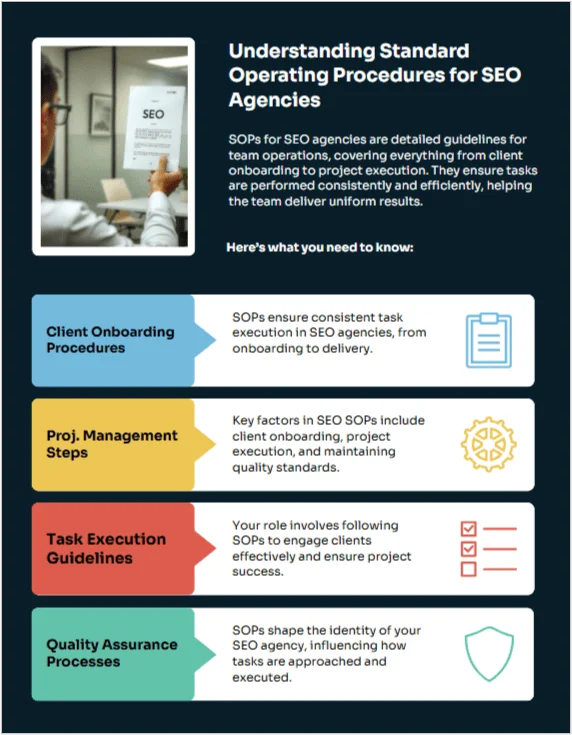
Understanding the trade-offs is essential for successful implementation. While the benefits are substantial, ignoring the limitations can lead to frustration and poor results.
Key Benefits
- Scalability: AI can process thousands of data points in seconds, allowing you to scale content production and technical fixes without proportionally increasing headcount.
- Consistency: Standardized procedures ensure that every piece of content follows the same quality and optimization checklist, reducing variance.
- Speed: Tasks that took hours, such as competitor gap analysis, are reduced to minutes, accelerating the entire SEO cycle.
- Data-Driven Decisions: AI removes emotional bias, ensuring that decisions are based on actual search data and user behavior patterns.
- Lack of Creativity: AI cannot replicate the nuance of a human storyteller or the insight of a subject matter expert. Pure AI content often reads as generic.
- Data Dependency: The output is only as good as the input data. If your analytics tracking is broken, the A
- Over-Optimization Risk: Following AI suggestions too literally can lead to keyword cannibalization or unnatural content that violates Google’s spam policies.
Critical Limitations
Comparison: Traditional SOP vs. AI SEO SOP
To fully grasp the value proposition, it helps to see the direct comparison between the old way and the new way.
| Feature | Traditional SEO SOP | AI SEO SOP |
|---|---|---|
| Keyword Research | Manual export from tools, human sorting | Automated clustering and intent prediction |
| Content Briefing | Based on editor’s experience | Data-driven outlines from SERP analysis |
| Technical Audits | Monthly manual crawl | Continuous monitoring with automated alerts |
| Reporting | Static PDFs generated weekly | Real-time dashboards with anomaly detection |
| Error Handling | Reactive, after traffic drops | Predictive, before issues impact rankings |
This table illustrates that the AI SOP is not just faster; it changes the fundamental workflow from reactive to proactive. The human role shifts from data collector to data interpreter and strategist.
Practical Implementation: A Step-by-Step Guide
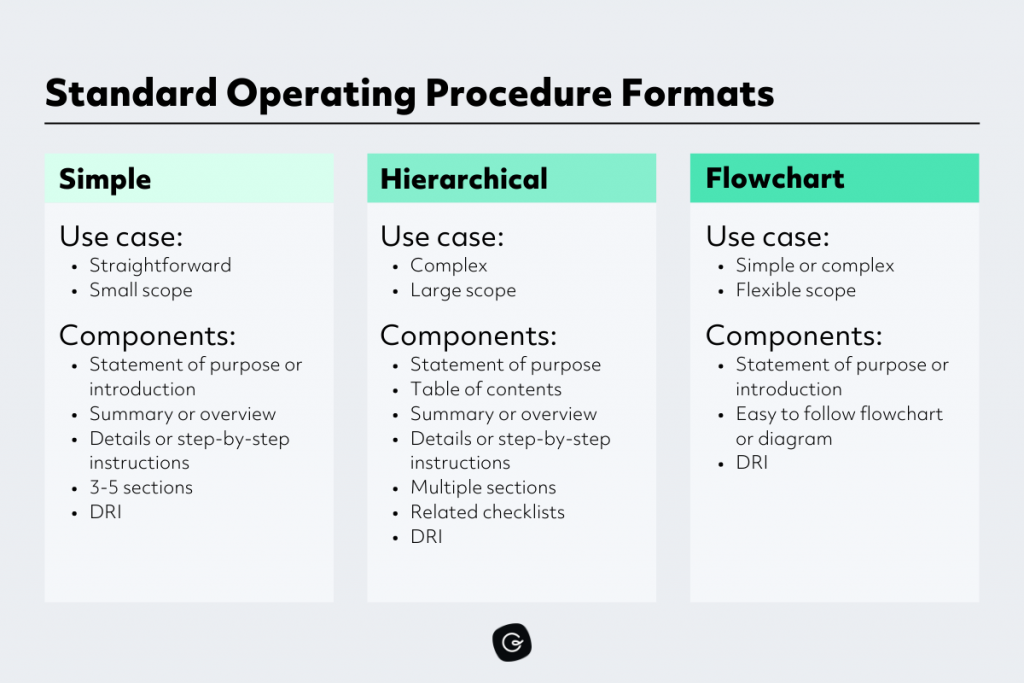
Implementing an AI SEO Standard Operating Procedure requires careful planning.
Step 1: Audit Your Current Workflow
Before introducing AI, map out your existing SEO processes. Identify bottlenecks. Is it content production? Technical fixes? Link building? The SOP should target the most painful area first. For most teams, this is content briefing and optimization.
Document the current time spent on each task. This baseline will help you measure the ROI of the AI implementation later. For example, if you spend 10 hours a week on keyword clustering, you have a clear target for improvement.
Step 2: Select the Right AI Tools
Do not buy every tool on the market. Choose tools that integrate well with your existing stack. For content, consider tools that offer API access for custom workflows. For technical SEO, look for tools that provide automated crawl scheduling and issue tracking.
Your SOP should specify which tool is the “source of truth” for each task. Having multiple tools doing the same job creates confusion and contradicts the purpose of standardization.
Step 3: Document the Procedure
Write the SOP in clear, actionable language. Use screenshots and video walkthroughs. The document should answer three questions: What do we do? Why do we do it? How do we do it with the AI tool?
Include a decision tree for common scenarios. For example, “If the AI suggests a title with over 60 characters, the editor must manually shorten it.” This removes ambiguity and ensures the human review step is effective.
Step 4: Train Your Team
Resistance to AI is common. The SOP should include a training module that addresses fears about job security. Emphasize that AI handles the mundane tasks, freeing up time for strategic thinking and creative campaigns.
Run a pilot project with a small team. Gather feedback on what is working and what is confusing. Iterate on the SOP before rolling it out company-wide.
Step 5: Monitor and Iterate
An AI SEO Standard Operating Procedure is not a static document. Review it quarterly. Analyze the performance data. Are the AI-generated briefs leading to higher rankings? If not, adjust the prompts or the data sources.
Set up a feedback loop where SEO specialists can suggest improvements to the SOP. This ensures the procedure evolves with algorithm updates and changes in search behavior.
Common Mistakes and How to Avoid Them
Even with the best intentions, teams often stumble when implementing AI SEO SOPs. Here are the most frequent pitfalls and the strategies to sidestep them.
Mistake 1: Blindly Trusting AI Output
AI hallucination is a real phenomenon. The AI might suggest a keyword that has no search volume or recommend a technical fix that breaks your site. The SOP must mandate a human verification step for all critical actions. Never let the AI publish content or implement redirects without a human click.
Solution: Build a “human-in-the-loop” checkpoint into every stage of the SOP. This is non-negotiable for maintaining quality and safety.
Mistake 2: Over-Automation of Content
Publishing hundreds of AI-generated articles without human editing is a fast track to a Google penalty. The search engine’s algorithms are sophisticated enough to detect unoriginal, low-value content.
Solution: Use AI for the research and outline, but mandate that a human writer creates the final draft. The SOP should require that every article includes at least one unique insight, a proprietary data point, or a direct quote from an internal expert.
Mistake 3: Ignoring the “Why”
If your team does not understand the reasoning behind the SOP, they will revert to old habits. The procedure should not just say “use this prompt.” It should explain why this prompt works and what the expected outcome is.
Solution: Include a “Rationale” section in your SOP document. This educates the team and builds trust in the process.
Mistake 4: Failing to Update the SOP
Search algorithms change hundreds of times a year. An SOP written in 2023 may be obsolete in 2025. Sticking to outdated procedures can cause significant ranking drops.
Solution: Assign a dedicated owner to the SOP. This person is responsible for monitoring industry news, testing new AI features, and updating the document at least quarterly.
Important Notes for Long-Term Success
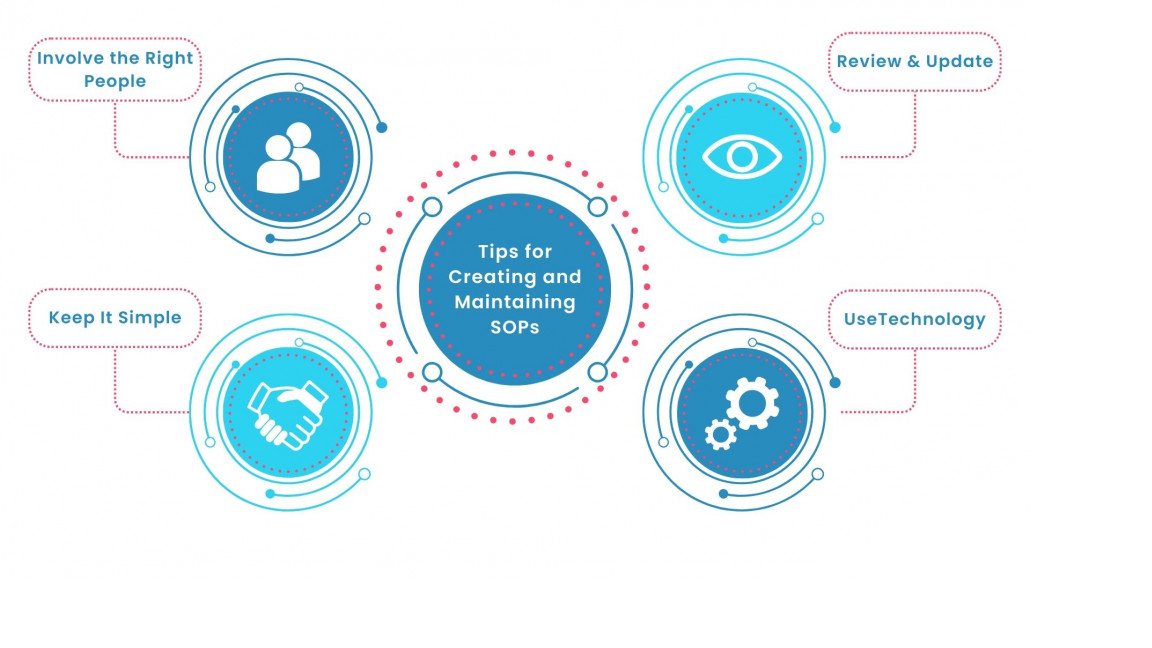
Beyond the tactical steps, there are strategic considerations that determine whether your AI SEO Standard Operating Procedures will deliver sustained value.
First, prioritize data quality. Ensure your analytics and search console are properly configured. Garbage in, garbage out applies directly to AI. If your tracking is broken, the A
Second, focus on entity optimization. Modern search engines understand concepts, not just keywords. Your SOP should instruct the AI to identify related entities and semantic terms to include in content. This helps search engines understand the depth and relevance of your page.
Third, maintain a human editorial voice. The best AI SEO SOPs produce content that does not sound like it was written by a machine. Encourage your writers to inject personality, humor, and real-world examples. This differentiation is what earns backlinks and social shares.
Finally, integrate your SEO SOP with other marketing channels. The insights from AI-driven SEO should inform your paid search, social media, and email marketing strategies. A unified approach amplifies your overall digital presence.
Frequently Asked Questions (FAQ)
What is the difference between AI SEO and traditional SEO?
Traditional SEO relies on manual analysis, human intuition, and static processes. AI SEO uses machine learning algorithms to automate data analysis, predict trends, and personalize content at scale. The key difference is speed and the ability to process vast datasets that are impossible for humans to analyze manually.
How do I create an AI SEO Standard Operating Procedure?
Start by documenting your current workflow. Identify repetitive tasks that consume the most time. Select AI tools that address those specific tasks. Write a step-by-step guide that includes data inputs, AI prompts, human review checkpoints, and output criteria. Test the procedure with a small team, gather feedback, and refine it before full deployment.
Will AI replace SEO specialists?
No, A The routine tasks of data collection and basic optimization will be automated. The specialist’s role will evolve to focus on strategy, creative content direction, and interpreting AI insights. Specialists who learn to leverage A
What are the best AI tools for SEO in 2025?
The best tools depend on your specific needs. For content optimization, tools like Surfer SEO and Clearscope are popular. For technical audits, Screaming Frog with AI integrations is effective. For keyword research, tools like Ahrefs and Semrush have built-in AI features. The key is to choose tools that integrate with your existing workflow and provide API access for custom automation.
How often should I update my AI SEO SOP?
You should review your SOP at least quarterly. However, you should also have a trigger-based review process. If you notice a significant drop in rankings, a major algorithm update, or a new feature release from your AI tools, you should revisit the SOP immediately. Staying agile is crucial in the fast-paced world of SEO.
Conclusion
Implementing AI SEO Standard Operating Procedures is no longer a competitive advantage; it is a necessity for teams that want to scale efficiently. These procedures provide the structure needed to harness the power of artificial intelligence while maintaining the human oversight required for quality and brand safety. By automating the mundane, predicting trends, and standardizing output, you free your team to focus on what truly matters: creating exceptional content and building a brand that users trust.
The journey requires an initial investment of time and resources, but the payoff is substantial. You will see faster turnaround times, more consistent quality, and a clearer path to achieving your organic growth targets. Start small, document everything, and iterate relentlessly. The future of SEO belongs to those who can effectively blend the analytical power of AI with the strategic vision of human experts.
Xem thêm:
- AI SEO SERP Scraping: The Complete Guide to Automated Rank Tracking in 2025
- AI SEO Looker Studio: The Complete Guide to Automated Reporting
- AI SEO KPIs: The Definitive Guide to Measuring the Impact of Artificial Intelligence on Search Visibility
- AI SEO AI Overview Ranking: The Complete Playbook for 2025
- AI SEO Keyword Grouping Tool: The Complete Guide to Smarter Content Clusters
Bài viết cùng chủ đề:

AI SEO SEO Automation with Make: The Complete Workflow Guide

AI SEO SEO Automation with Zapier: The Complete Workflow Guide

AI SEO SEO Automation with n8n: The Complete Workflow Guide
AI SEO SEO Automation with Gemini: The Complete Guide to Scaling Organic Growth

AI SEO SEO Automation with Claude: The Complete Guide to Scaling Content in 2025

AI SEO SEO Automation with ChatGPT: The Complete Playbook for 2025

AI SEO & SEO Automation for Affiliate Sites: The 2025 Playbook for Passive Income Growth
AI SEO & SEO Automation for Bloggers: The Complete Guide to Scaling Your Content

AI SEO & SEO Automation for Agencies: The Complete 2025 Playbook

AI SEO and SEO Automation for Ecommerce: The Complete Playbook for 2025

AI SEO & SEO Automation for WordPress: The Complete Playbook for 2025
AI SEO SEO Automation Strategy: The Complete Playbook for 2025

Mastering the AI SEO SEO Automation Process: A Complete Guide to Scaling Organic Growth
AI SEO SEO Automation System: The Complete Guide to Scaling Organic Growth in 2025
AI SEO SEO Automation Platform: The Complete Guide to Scaling Organic Growth in 2025
AI SEO SEO Automation Software: The Complete Guide to Scaling Organic Growth in 2025















