
No products in the cart.
AI SEO Success Stories: Real-World Wins and Lessons From Automated Search Strategies
29
Jul
Jul
When search teams pair artificial intelligence with human expertise, the results often rewrite what’s possible for organic growth. AI SEO success stories are no longer rare experiments; they are repeatable plays documented across e‑commerce, SaaS, publishing and local services. The common thread is not magic technology but a disciplined marriage of data‑driven automation and editorial judgment. This article unpacks how real companies used AI to slash content research time, fix technical debt at scale and earn featured snippets, all while staying firmly within Google’s quality guidelines.
What Really Defines an AI SEO Success Story

An AI SEO success isn’t about replacing writers or automating rankings. It’s a measurable improvement in organic traffic, engagement or conversions that can be directly attributed to a specific use of artificial intelligence. These stories share a few markers: a clear baseline metric before the AI rollout, a controlled implementation and a result that holds over multiple algorithm updates.
Typical success signals include:
- Double‑digit percentage increases in non‑branded clicks month over month
- Time saved on keyword clustering or technical audits that gets reinvested into strategy
- Sustained featured snippet ownership across a content cluster
- Improved crawl efficiency and indexation rates after AI‑powered log file analysis
- Speed to insight. A content gap analysis that once took two weeks can be generated in hours, letting teams act while the data is still fresh.
- Consistent on‑page optimization. AI tools can enforce internal linking rules, meta description patterns and image alt text best practices across thousands of pages without drift.
- Scalable entity optimization. NLP models surface related entities (people, places, concepts) that top pages include. Adding these systematically can lift a page’s topical authority without keyword stuffing.
- Predictive maintenance. AI can forecast which high‑value pages are likely to lose rankings based on freshness signals and competitor activity, triggering proactive updates.
- Resource reallocation. When AI handles repetitive tasks, senior staff focus on editorial strategy, expert interviews and unique research that drive true differentiation.
- Factual grounding. Large language models fabricate data, citations and statistics. In YMYL (Your Money or Your Life) niches, an unchecked AI assertion can destroy credibility and violate search quality guidelines.
- Nuance and brand voice. AI drafts tend toward a homogeneous, upbeat style. They struggle with irony, cultural references and the subtle positioning that makes a brand stand out.
- Real‑time knowledge. Most models have a knowledge cutoff and cannot verify breaking news, price changes or product availability without external connectors.
- Over‑optimization risk. Early adopters who relied too heavily on AI‑generated content sometimes saw traffic spikes followed by steep drops, especially when Google’s helpful content updates rolled out.
- Tool integration overhead. Enterprise‑grade AI SEO workflows require APIs, data pipelines and QA checkpoints. The setup cost can be prohibitive for smaller teams unless they use out‑of‑the‑box platforms.
- Factual accuracy of all claims, statistics and quoted data
- Compliance with E‑E‑A‑T guidelines, including author bios and attribution
- Absence of hallucinated links or product references
- Tone alignment with brand voice guidelines
- Original insights or examples that AI cannot generate
- Trusting AI‑generated statistics without verification. The output often looks authoritative but contains invented numbers. One health site had to retract 30 articles after discovering fabricated clinical trial data slipped through.
- Ignoring content freshness. AI tools can archive stale information. Without a system to flag and update time‑sensitive pages, rankings decay.
- Automating entire content funnels end‑to‑end. Google’s helpful content system rewards people‑first content. Sites that appear fully automated risk classifier demotion.
- Skipping structured data validation. AI can generate schema markup, but it often contains syntax errors or wrong entity types. Always validate with Google’s Rich Results Test.
- Underestimating the prompt engineering learning curve. Teams that don’t invest in prompt libraries and iteration cycles get generic output that fails to outrank competitors.
In the most convincing cases, the AI didn’t just accelerate output. It surfaced patterns humans would have missed, like the exact paragraph length that correlated with higher dwell time in a B2B niche or the semantic entities that competitors consistently overlooked.
Three Types of AI SEO Wins and How They Work
Successful implementations fall into three broad categories. Knowing which bucket a project belongs to makes it easier to forecast ROI and choose the right tool stack.
Content Intelligence and Creation Assisted by AI
This is where most public success stories sit. AI tools analyze top‑ranking pages to generate content briefs, first drafts or metadata at scale. The AI doesn’t publish autonomously; subject‑matter experts refine every paragraph for accuracy, tone and E‑E‑A‑T signals. Companies that treat AI drafts as a starting point rather than a finish line report the strongest and most durable gains.
One comparison shopping site used large language models to expand 2,000 thin category pages with unique buyer’s guides. After editorial review, each page contained structured comparison tables and troubleshooting tips. Organic traffic to those URLs rose 47% within three months, and the average session duration jumped from 38 seconds to just over two minutes.
Technical SEO Automation at Enterprise Scale
Large e‑commerce and marketplace sites often wrestle with millions of indexable URLs, dynamic faceted navigation and seasonal spikes. AI classifiers can automatically detect thin, duplicate or near‑duplicate pages, then trigger rules for canonicalization, noindex or redirects. The result is a cleaner crawl budget and fewer wasted indexing slots.
A global electronics retailer deployed a custom AI model trained on its own search console data to flag product variants with identical descriptions. After merging 120,000 near‑duplicate PDPs into canonical clusters, organic traffic to the consolidated pages increased by 26% year over year, and Google began crawling fresher inventory pages 40% faster.
AI‑Driven Keyword Strategy and SERP Analysis
Traditional keyword research relies on volume and difficulty scores. AI tools add layers: search intent classification, semantic gap analysis and content decay prediction. They can identify queries where a site already ranks on page two but is missing a critical sub‑entity or structured data type. Acting on those insights turns a stagnant ranking into a quick win.
A B2B software vendor used an AI platform to map its entire keyword universe against real‑time SERP features. The platform spotted 400 long‑tail queries where Google displayed a “People also ask” box but no dedicated answer page. The team wrote tightly aligned FAQ sections for those topics and captured the featured snippet for 60% of them, adding an estimated 18,000 monthly organic visits within five months.
Measurable Benefits That Make the Case for AI in SEO
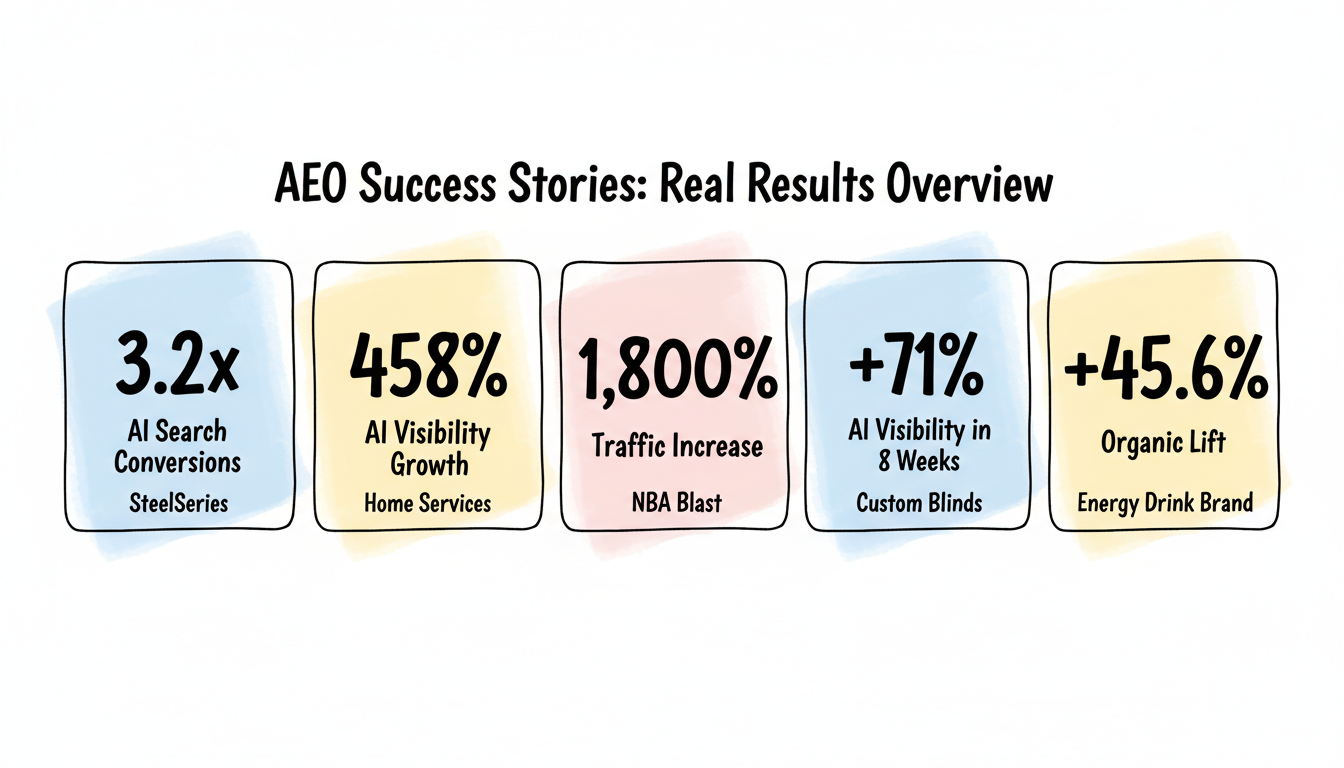
Beyond traffic numbers, AI SEO success stories reveal several consistent upsides that compound over time. They help SEO managers secure budget and cross‑functional support.
However, these benefits only materialize when the output is treated as a recommendation engine, not an autopilot. Success stories where teams blindly published AI content without human oversight typically ended with traffic volatility and algorithmic corrections.
Realistic Limitations and Where AI Falls Short
Any honest discussion of AI SEO success stories must also examine the failures. The technology has hard boundaries that even the best prompts cannot override.
The most mature success stories acknowledge these limits openly. They build human review gates, fact‑checking protocols and periodic content audits into the process instead of hoping A”
Comparing AI SEO Approaches: Light‑Touch vs. Deep Integration
Not all AI implementations are equal. The table below contrasts two common paths observed across published case studies.
| Aspect | Light‑Touch AI Assistance | Deep AI Integration |
|---|---|---|
| Typical use case | Outline generation, meta tags, basic keyword grouping | Content briefs with entity scoring, automated internal linking, dynamic page creation |
| Human involvement | High; writers and editors control final output | Moderate; experts set rules, review samples and handle exceptions |
| Setup complexity | Low; often a browser extension or simple SaaS tool | High; requires API integration, data warehouse access and custom scoring models |
| Traffic uplift potential | 15–30% over 6 months (from case review) | 40–100%+ when scaled across large asset inventories |
| Risk profile | Low; content stays human‑centric | Medium; quality control at scale is harder to maintain |
| Best for | Blogs, SMBs, early‑stage sites | Enterprise, e‑commerce, publishers with thousands of pages |
Many success stories evolve from light‑touch to deep integration as trust in the AI’s recommendations grows and the team builds internal QA frameworks. The migration is gradual, often taking 12 to 18 months.
Practical Blueprint: How to Build Your Own AI SEO Success Story
Replicating these wins requires process, not just tools. The following framework has been observed across multiple organizations that published detailed breakdowns of their AI SEO journeys.
1. Audit Your Current Bottlenecks First
Start by listing every repetitive, data‑heavy SEO task. For most teams, the list includes keyword categorization, meta description writing, image alt text generation and content performance audits. Then rank these by time consumed and potential impact if automated. Address one high‑impact bottleneck at a time.
2. Choose a Tool That Matches Your Maturity Level
A marketing agency with 50 clients needs different capabilities than a solo affiliate site owner. For content‑focused workflows, tools that combine SERP analysis with AI writing assistance (e.g., Surfer SEO, Frase, Jasper) have documented strong case studies. For technical SEO at scale, platforms like Botify or DeepCrawl now offer AI modules for log file analysis and anomaly detection.
3. Build a Human‑in‑the‑Loop Content Standard
Define exactly what human reviewers must check before any AI‑assisted piece goes live. At a minimum, this checklist should cover:
4. Run Controlled Tests with Clear KPIs
Isolate the AI’s impact by setting up a test group of pages that receive AI‑assisted updates against a control group that gets manual treatment. Track organic clicks, average position, impressions and conversions in Google Search Console. Document the time saved and the cost per page. A B2C brand that published its results saw AI‑assisted pages achieve an average 22% higher click‑through rate because the AI generated more compelling meta descriptions than the human baseline.
5. Expand Gradually and Monitor for Volatility
After a successful pilot, increase the AI’s scope to similar page types. Pay close attention to indexation trends and any Google manual actions in Search Console. Several teams reported that the biggest risk surfaced when they accelerated too quickly and the AI started producing near‑identical templates, diluting the site’s uniqueness.
Common Mistakes That Turn AI SEO Into a Liability
For every celebrated AI SEO success story, there are quiet post‑mortems. Avoiding these errors often makes the difference between a case study and a cautionary tale.
The fix for each mistake is the same: treat AI as a junior analyst who needs constant supervision, not a senior strategist. Build standard operating procedures that assume the A
Important Notes for Long‑Term AI SEO Success
Several nuanced insights separate fleeting wins from lasting results. These points surface repeatedly in the most robust case studies.
E‑E‑A‑T must remain human‑centric. Google’s quality raters look for demonstrable experience and expertise. AI can help organize evidence of expertise—such as author credentials, citations and original data—but it cannot fabricate genuine experience. Every success story that held through updates featured visible, credible authors and subject‑matter review.
Brand authority compounds faster when AI handles operations. When AI takes over operational SEO tasks, internal teams gain bandwidth to build real‑world authority signals: speaking engagements, original research, industry partnerships. That brand authority, in turn, makes it easier for AI‑optimized pages to rank. This is a virtuous cycle, not a quick hack.
Monitoring unseen competitors using AI. Many success stories involved defensive plays. The team used AI to detect new competitors entering their space with AI‑generated content at scale. By monitoring SERP churn and entity footprints, they could respond with deeper, more authoritative pieces before the new entrants gained traction.
Tool diversity reduces over‑reliance. Relying on a single AI model for everything makes a site vulnerable to biases in its training data. The strongest programs combine multiple tools—one for entity extraction, another for content scoring, a third for technical audits—and cross‑validate the outputs.
Frequently Asked Questions
What is the simplest AI SEO success story a small business can replicate?
A local service business used AI to generate location‑specific FAQ sections for 15 city pages. Each page answered the top five questions residents ask about the service, drawn from “People also ask” data. Human editors ensured accuracy. Organic traffic rose 65% in six months, and the business appears in the local pack and featured snippets simultaneously.
How long does it take to see results from AI‑assisted SEO?
In documented cases, visible improvements typically appear between 8 and 16 weeks. Content‑focused interventions can show faster traction if the baseline content was thin and the AI helped add depth. Technical SEO fixes, like AI‑powered canonical consolidation, often yield results within two crawl cycles.
Can AI replace a human SEO strategist?
No documented success story suggests full replacement. AI handles execution and data processing exceptionally well, but strategy—understanding a business’s unique value proposition, anticipating search behavior shifts and managing stakeholder alignment—remains a human responsibility. Teams that tried to replace strategists with AI saw short‑term efficiency followed by strategic drift.
What is the biggest risk of openly sharing an AI SEO success story?
Google’s algorithms and guidelines evolve. Some teams worry that public case studies will invite scrutiny. In practice, the risk is low as long as the disclosed workflow demonstrates genuine human oversight and complies with spam policies. More often, the greater risk is internal: teams may over‑promise AI’s capabilities to executives and create unrealistic expectations.
Are there AI SEO success stories in competitive YMYL niches?
Yes, but they follow stricter guardrails. A financial education site used AI to draft articles on budgeting and credit, then had each piece reviewed by a certified financial planner. The byline showed the planner’s credentials, and all statistics were sourced from public government data. The site’s organic traffic grew 42% year over year without any manual actions.
Wrapping Up the Real Picture of AI SEO Success
AI SEO success stories are not fairy tales of magical traffic surges. They are engineering stories of process design, quality control and continuous learning. The tools amplify what skilled teams already do: understand user intent, deliver genuine value and maintain technical excellence. Whether it’s an enterprise consolidating duplicate pages or a niche blog capturing featured snippets, the consistent factor is human judgment steering the machine.
The most compelling lesson from every documented win is that AI lowers the cost of being thorough. It frees up minds to focus on the creative, connective and trust‑building work that search engines and users reward. For teams willing to pair automation with accountability, the next success story is entirely within reach.
Xem thêm:
- AI SEO for Agencies: The Complete Blueprint to Scale, Automate, and Dominate Search Rankings
- Best AI Writing Tools in 2025: Streamline Content Creation with Top AI Assistants
- AI Overview Optimization: Master Google’s Generative Search for Maximum Visibility
- LLM SEO: The Ultimate Guide to Optimizing for Large Language Model Search
- AI SEO Compression: The Complete Guide to Slimming Down Your Content for Higher Rankings
Bài viết cùng chủ đề:

AI SEO SEO Automation with Make: The Complete Workflow Guide

AI SEO SEO Automation with Zapier: The Complete Workflow Guide

AI SEO SEO Automation with n8n: The Complete Workflow Guide
AI SEO SEO Automation with Gemini: The Complete Guide to Scaling Organic Growth

AI SEO SEO Automation with Claude: The Complete Guide to Scaling Content in 2025

AI SEO SEO Automation with ChatGPT: The Complete Playbook for 2025

AI SEO & SEO Automation for Affiliate Sites: The 2025 Playbook for Passive Income Growth
AI SEO & SEO Automation for Bloggers: The Complete Guide to Scaling Your Content

AI SEO & SEO Automation for Agencies: The Complete 2025 Playbook

AI SEO and SEO Automation for Ecommerce: The Complete Playbook for 2025

AI SEO & SEO Automation for WordPress: The Complete Playbook for 2025
AI SEO SEO Automation Strategy: The Complete Playbook for 2025

Mastering the AI SEO SEO Automation Process: A Complete Guide to Scaling Organic Growth
AI SEO SEO Automation System: The Complete Guide to Scaling Organic Growth in 2025
AI SEO SEO Automation Platform: The Complete Guide to Scaling Organic Growth in 2025
AI SEO SEO Automation Software: The Complete Guide to Scaling Organic Growth in 2025















