
No products in the cart.
AI SEO Team Workflow: The Complete Guide to Scaling Organic Growth in 2025
31
Jul
Jul
The modern SEO landscape has shifted dramatically. What once required a dozen manual tools and endless spreadsheet tracking now demands a coordinated blend of human creativity and machine intelligence. An AI SEO team workflow is no longer a futuristic concept; it is the operational standard for teams aiming to scale content production, technical audits, and link building without sacrificing quality. This guide breaks down how to structure, implement, and optimize a workflow where artificial intelligence handles the heavy lifting while your team focuses on strategy and editorial judgment.
What Is an AI SEO Team Workflow?
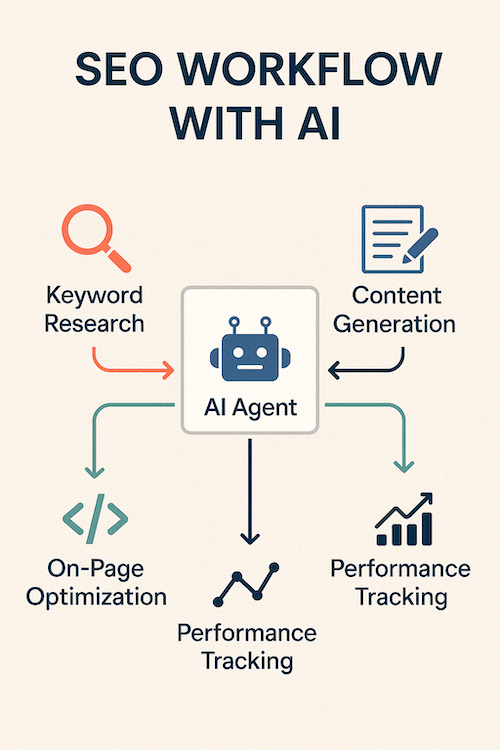
An AI SEO team workflow is a structured process that integrates artificial intelligence tools into every stage of search engine optimization—from keyword research and content brief creation to technical crawling and performance analysis. Unlike traditional workflows where human analysts manually compile data, an AI-driven workflow automates repetitive tasks, surfaces predictive insights, and accelerates the iteration cycle.
The core principle is division of labor. AI excels at processing vast datasets, identifying patterns, and generating drafts. Humans excel at brand voice, nuanced judgment, and strategic decision-making. A successful workflow defines clear handoff points where AI output becomes human input, ensuring that automation enhances rather than replaces expertise.
The Shift from Manual to Hybrid Operations
Traditional SEO teams spent 60-70% of their time on data collection and basic reporting. An AI-integrated workflow flips this ratio. Tools like Semrush, Ahrefs, and Surfer SEO now offer AI-driven content optimization, while custom GPT models can analyze search intent across thousands of queries in minutes. The result is a team that spends more time on creative problem-solving and less on administrative drudgery.
Core Components of an Effective AI SEO Workflow
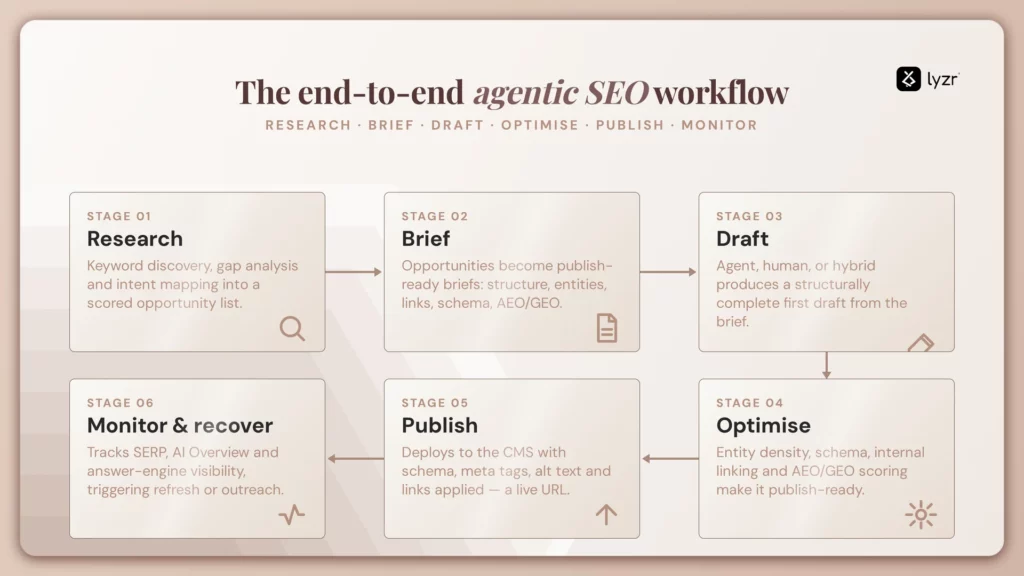
Building a robust workflow requires understanding the distinct modules that connect to form a cohesive system. Each component serves a specific function and feeds data into the next stage.
1. AI-Powered Keyword and Intent Research
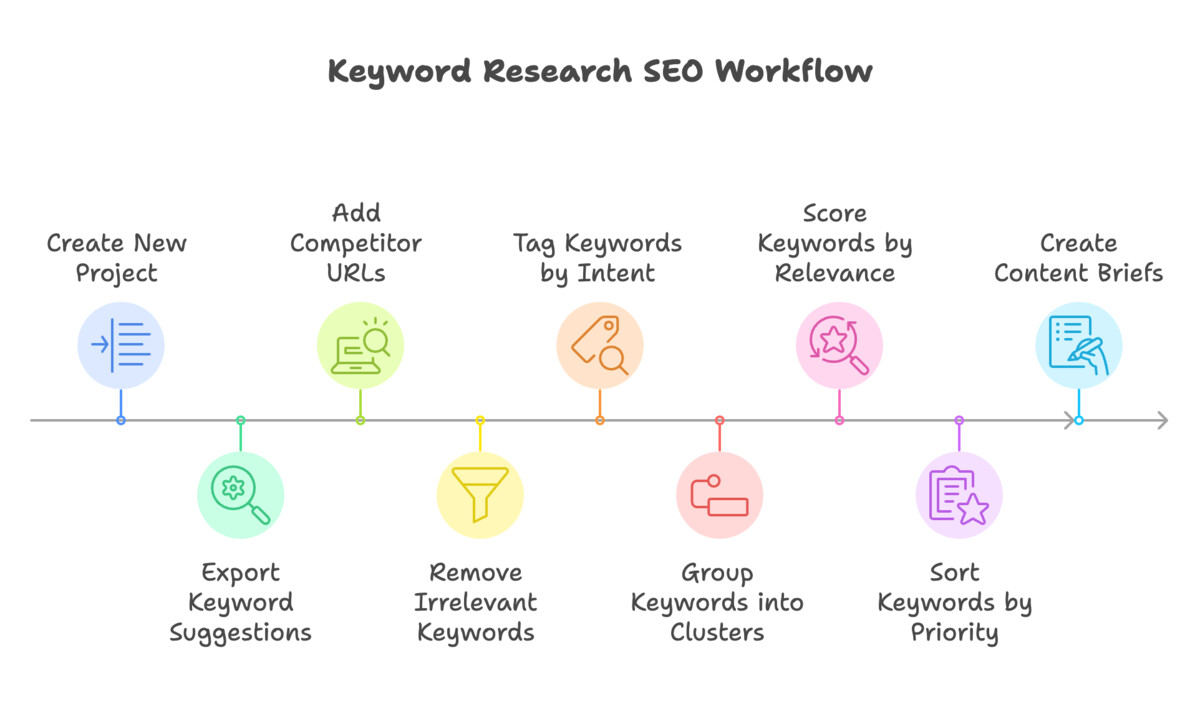
The foundation of any SEO campaign is understanding what users search for and why. AI tools like Clearscope, MarketMuse, and Google’s own AI-powered Search Console insights analyze search engine results pages (SERPs) to identify semantic relationships, question-based queries, and content gaps.
In this phase, the workflow includes:
- Automated clustering of keywords by search intent (informational, transactional, navigational)
- Predictive difficulty scoring based on competitor authority and content depth
- Identification of “topic clusters” that support pillar page strategies
- Real-time trend detection using AI models that monitor social signals and news cycles
- Recommended title tags and meta descriptions
- Suggested H2 and H3 structure based on SERP analysis
- Key entities and related terms to include for topical authority
- Questions from “People Also Ask” boxes to address
- Internal linking suggestions to existing relevant content
- Infuses the content with unique experiences and case studies
- Adjusts tone to match brand guidelines
- Verifies all statistics and claims against primary sources
- Adds original quotes from internal experts or industry contacts
- Keyword position changes with predicted volatility
- Content performance against industry benchmarks
- Backlink acquisition rate and quality scoring
- Conversion rate analysis by landing page and user segment
- Keyword research: Ahrefs or Semrush with AI features
- Content optimization: Surfer SEO or Clearscope
- Drafting: ChatGPT or Jasper with custom prompts
- Technical monitoring: Sitebulb or Screaming Frog with AI plugins
- Analytics: Google Analytics 4 with Looker Studio dashboards
The human team reviews these AI-generated clusters to validate business relevance and prioritize high-value opportunities. This step prevents the common pitfall of chasing high-volume keywords that do not convert.
2. Automated Content Brief Generation
Once keywords are selected, the next step is creating detailed content briefs. AI tools can analyze the top 10 ranking pages for a keyword and extract common headings, word count, entity mentions, and backlink profiles. This data transforms into a comprehensive brief that includes:
This automation reduces brief creation time from two hours to fifteen minutes. The SEO strategist then reviews the brief, adds brand-specific insights, and assigns it to a writer.
3. AI-Assisted Content Creation and Optimization
Writers use AI tools like Jasper, Copy.ai, or ChatGPT to generate first drafts, but the workflow mandates human editing. The AI produces a structurally sound draft based on the brief, including data points and examples. The human writer then:
Real-time optimization tools like Surfer SEO or Frase provide a content score that measures keyword density, readability, and entity coverage. The workflow requires the writer to achieve a minimum score before submission, ensuring consistency across all published pieces.
4. Technical SEO Automation and Monitoring
Technical audits are a prime candidate for AI automation. Tools like Screaming Frog with AI plugins or Sitebulb can crawl thousands of URLs and automatically categorize issues such as broken links, duplicate content, missing schema, and slow page speed. Advanced AI models can even predict which technical issues will have the highest impact on rankings based on historical data.
The workflow includes a weekly automated crawl that generates a prioritized issue list. The technical SEO specialist reviews this list, assigns tickets to developers, and tracks resolution progress. This continuous monitoring prevents small issues from becoming ranking disasters.
5. Predictive Analytics and Reporting
Standard reporting shows what happened. AI-driven reporting explains why it happened and predicts what will happen next. Tools like Google Analytics 4 with machine learning capabilities can forecast traffic trends, identify unusual drops, and attribute changes to specific algorithm updates or site changes.
An effective workflow includes a monthly AI-generated report that covers:
The SEO manager interprets these insights and adjusts the strategy for the next cycle. This closes the loop between execution and learning.
Benefits of Implementing an AI SEO Workflow
Teams that adopt this structured approach report measurable improvements across several dimensions. The benefits extend beyond simple time savings.
Increased Operational Efficiency
Automating repetitive tasks like keyword grouping, rank tracking, and basic reporting frees up 15-20 hours per week per specialist. This time redirects toward high-impact activities like link outreach, content gap analysis, and stakeholder communication.
Improved Content Quality and Consistency
AI ensures that every piece of content meets a baseline standard for SEO best practices. The workflow enforces the use of structured headings, internal links, and entity-rich vocabulary. This consistency builds topical authority over time, which is a critical ranking factor.
Faster Adaptation to Algorithm Changes
AI tools monitor search engine updates in real-time and can analyze the impact on your site within hours. A manual workflow might take weeks to identify a pattern. This speed advantage allows teams to pivot their strategy before significant traffic loss occurs.
Enhanced Scalability
Scaling content production from 10 to 100 pieces per month is impossible without automation. An AI workflow allows you to maintain quality while increasing volume because the brief generation, drafting, and optimization processes are standardized and repeatable.
Limitations and Risks to Manage
While the benefits are substantial, an AI SEO workflow is not without challenges. Understanding these limitations is crucial for successful implementation.
Risk of Generic Content
AI models trained on public data tend to produce similar outputs. If your team relies too heavily on AI drafts without significant human rewriting, your content may lack differentiation. This can lead to lower engagement and reduced brand authority.
Data Privacy and Security Concerns
Using AI tools requires sharing data with third-party platforms. Sensitive business information, proprietary research, or unreleased product details could be exposed. Teams must establish clear policies about what data can be input into AI systems.
Over-Reliance on Predictive Models
AI predictions are based on historical data, which does not always account for unprecedented events. A sudden market shift or a viral competitor campaign can invalidate the model’s assumptions. Human oversight remains essential for strategic decisions.
AI SEO Team Workflow vs. Traditional Workflow: A Comparison
| Aspect | Traditional SEO Workflow | AI SEO Team Workflow |
|---|---|---|
| Keyword Research | Manual export from tools, manual grouping | Automated clustering and intent prediction |
| Content Brief Creation | 2-3 hours per brief, based on manual SERP review | 15-30 minutes per brief, data-driven structure |
| Drafting | Human writer from scratch | AI draft + human editing and enhancement |
| Technical Audits | Monthly manual crawl and spreadsheet analysis | Weekly automated crawl with prioritized fixes |
| Reporting | Static PDFs with lagging indicators | Real-time dashboards with predictive insights |
| Team Focus | Data collection and processing | Strategy, creativity, and relationship building |
Practical Implementation: A Step-by-Step Guide
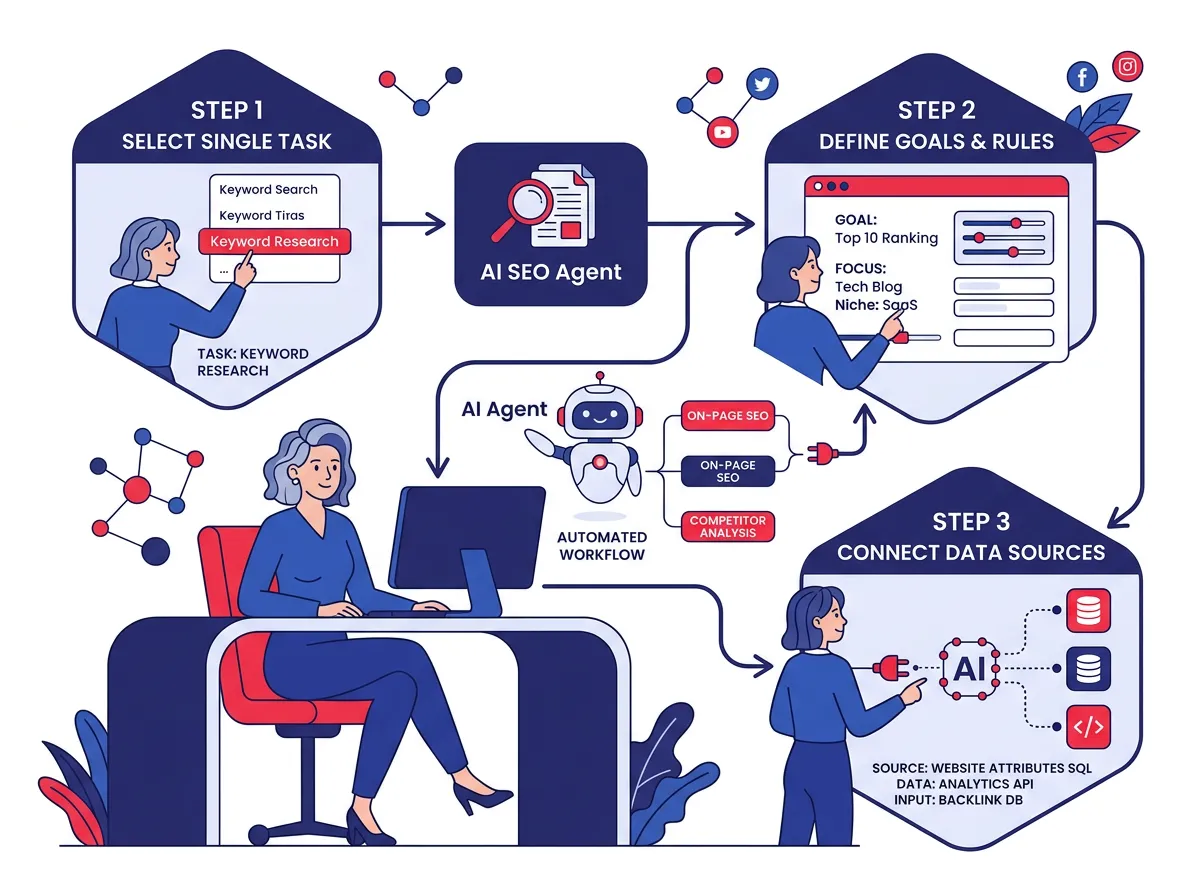
Transitioning to an AI-driven workflow requires a phased approach to avoid disruption. Follow this roadmap to integrate AI tools effectively.
Step 1: Audit Your Current Process
Document every task your team performs over a two-week period. Categorize tasks into three groups: repetitive data tasks, analytical tasks, and creative tasks. Identify which repetitive tasks consume the most time and have clear rules—these are the best candidates for AI automation.
Step 2: Select the Right Tool Stack
Choose tools that integrate with your existing tech stack. A typical stack includes:
Start with one tool per category to avoid overwhelming your team. Pilot the tool on a single project before rolling it out across all accounts.
Step 3: Define Clear Handoff Protocols
Create a documented workflow that specifies exactly what the AI produces and what the human must verify. For example, the protocol might state that AI-generated statistics must be verified against the original source before publication. This prevents the spread of hallucinated data.
Step 4: Train Your Team on Prompt Engineering
The quality of AI output depends heavily on the quality of input prompts. Invest in training your team on how to write specific, contextual prompts that include brand voice guidelines, target audience definitions, and desired output format. A well-crafted prompt reduces editing time by 50%.
Step 5: Establish a Feedback Loop
AI models improve with feedback. When your team edits an AI draft, track the types of changes made. If the AI consistently misses a certain nuance, update the prompt template. If the tool’s keyword suggestions are off-target, adjust the input parameters. This continuous refinement is the key to long-term success.
Common Mistakes and How to Avoid Them
Many teams fail to realize the full potential of an AI SEO workflow due to avoidable errors. Here are the most frequent pitfalls.
Mistake 1: Treating AI as a Replacement for Strategy
AI can tell you what to write about, but it cannot tell you why your business should write about it. Teams that blindly follow AI suggestions often produce content that ranks but does not convert. Avoid this by always aligning AI recommendations with your business goals and customer journey.
Mistake 2: Ignoring the Editing Phase
Publishing AI-generated content without human review is a fast track to losing credibility. Search engines are increasingly sophisticated at detecting low-effort AI content. Always have a human editor review for factual accuracy, tone, and originality.
Mistake 3: Failing to Update Prompts
Search trends and your brand messaging evolve. Your AI prompts must evolve too. Schedule a monthly review of all prompt templates to ensure they reflect current priorities and learnings from past campaigns.
Mistake 4: Over-Automating Communication
While automation is great for data processing, it should not replace human communication with stakeholders. Clients and executives still value personal explanations of strategy and results. Use AI to prepare the data, but deliver the insights personally.
Important Notes for Long-Term Success
Several factors determine whether your AI SEO workflow delivers sustained results or fades into another failed initiative.
First, prioritize data quality. AI models are only as good as the data they process. Ensure your analytics tracking is clean, your search console is verified, and your historical data is accurate. Garbage in, garbage out applies directly to AI workflows.
Second, maintain a human-centric review process. The best workflows include a mandatory “human touch” step where a senior team member reviews content for strategic alignment and brand voice. This step cannot be automated.
Third, stay updated on AI capabilities. The field evolves monthly. What was impossible last year is now standard. Allocate time each quarter for your team to test new tools and features. This keeps your workflow competitive.
Fourth, document everything. Create a standard operating procedure (SOP) for your AI workflow. This ensures consistency when team members change and provides a baseline for continuous improvement.
Frequently Asked Questions
What is the ideal team size for an AI SEO workflow?
The ideal team size depends on your content volume. A minimum viable team includes an SEO strategist, a content writer, and a technical specialist. Larger organizations may add dedicated data analysts and prompt engineers. The workflow scales by adding more writers and editors, not more managers.
How long does it take to see results from an AI SEO workflow?
Most teams see operational efficiency gains within the first month. Ranking improvements typically take 3-6 months, as search engines need time to crawl and index new content. The workflow accelerates this timeline by ensuring every piece of content is fully optimized before publication.
Can small businesses benefit from an AI SEO workflow?
Yes. Small businesses can use AI tools to compete with larger companies by producing high-quality content at a fraction of the cost. The key is to start with free or low-cost tools and focus on a narrow set of keywords where you can establish authority.
Will AI replace SEO professionals?
A The role shifts from manual execution to strategic oversight and quality control. Professionals who master prompt engineering and data interpretation will be in high demand.
How do you measure the ROI of an AI SEO workflow?
Measure ROI by comparing your cost per acquisition (CPA) and time-to-rank before and after implementation. Track metrics like organic traffic growth, keyword ranking velocity, and content production cost per piece. A successful workflow should show a 30-50% reduction in production time and a measurable increase in top-3 keyword rankings.
Conclusion
The AI SEO team workflow represents a fundamental shift in how digital marketing teams operate. By automating data-heavy tasks and augmenting human creativity, this approach enables teams to produce more content, rank faster, and adapt to algorithm changes with agility. The key to success lies not in the tools themselves but in the structured process that governs their use. Teams that define clear handoffs, maintain rigorous human review, and continuously refine their prompts will gain a significant competitive advantage. The future of SEO is not human versus machine; it is a partnership where each plays to its strengths. Implementing this workflow today positions your team to lead in the increasingly competitive organic search landscape of tomorrow.
Xem thêm:
- AI SEO Workflow Automation: Streamline Your Search Strategy with Intelligent Automation
- AI SEO Neural Search: The Complete Guide to Ranking in the Era of Semantic Discovery
- AI SEO MarketMuse: The Complete Guide to Content Intelligence in 2025
- AI SEO AI Search Analytics Tools: The Complete Guide to Modern Search Intelligence
- AI SEO for Affiliate Marketing: The 2025 Playbook for Dominating Search and Commissions
Bài viết cùng chủ đề:

AI SEO SEO Automation with Make: The Complete Workflow Guide

AI SEO SEO Automation with Zapier: The Complete Workflow Guide

AI SEO SEO Automation with n8n: The Complete Workflow Guide
AI SEO SEO Automation with Gemini: The Complete Guide to Scaling Organic Growth

AI SEO SEO Automation with Claude: The Complete Guide to Scaling Content in 2025

AI SEO SEO Automation with ChatGPT: The Complete Playbook for 2025

AI SEO & SEO Automation for Affiliate Sites: The 2025 Playbook for Passive Income Growth
AI SEO & SEO Automation for Bloggers: The Complete Guide to Scaling Your Content

AI SEO & SEO Automation for Agencies: The Complete 2025 Playbook

AI SEO and SEO Automation for Ecommerce: The Complete Playbook for 2025

AI SEO & SEO Automation for WordPress: The Complete Playbook for 2025
AI SEO SEO Automation Strategy: The Complete Playbook for 2025

Mastering the AI SEO SEO Automation Process: A Complete Guide to Scaling Organic Growth
AI SEO SEO Automation System: The Complete Guide to Scaling Organic Growth in 2025
AI SEO SEO Automation Platform: The Complete Guide to Scaling Organic Growth in 2025
AI SEO SEO Automation Software: The Complete Guide to Scaling Organic Growth in 2025















