
No products in the cart.
AI SEO Templates: Build a Smarter, Faster Search Strategy With Automated Workflows
29
Jul
Jul
In a digital landscape where thousands of new pages go live every minute, standing out in search results demands more than just guesswork. AI SEO templates have become the backbone of modern search optimization, transforming how teams research keywords, structure content, and fine‑tune on‑page elements. These ready‑to‑use frameworks, powered by artificial intelligence, remove repetitive manual tasks while injecting data‑backed precision into every SEO campaign. Whether you manage a single blog or an enterprise site with millions of URLs, understanding and deploying AI SEO templates gives you a measurable competitive advantage.
What Exactly Are AI SEO Templates?
At their core, AI SEO templates are structured blueprints that guide the creation, optimization, and monitoring of search‑related content using machine learning models. Unlike static checklists, these templates interact with AI engines—large language models, natural language processing APIs, and predictive analytics—to produce tailored output. For example, a content brief template might automatically pull top‑ranking competitor headings, suggest semantically rich keywords, and recommend an ideal word count based on intent analysis.
The magic lies in the template’s ability to standardize the “how” while letting AI handle the “what.” You define the rules, formatting, and goals once; the AI fills in the specifics again and again. This approach scales expertise, letting a junior writer produce briefs that match the strategic depth of a seasoned SEO strategist. The template retains your brand voice, compliance requirements, and KPIs while the AI does the heavy data crunching.
Common AI SEO templates cover nearly every stage of the search workflow: keyword clustering maps, SERP analysis frameworks, meta data generators, internal linking planners, and even automated content audits. The best templates are platform‑agnostic, working through tools like ChatGPT, Google Sheets with AppScript, Make, or dedicated SEO platforms such as SurferSEO, Frase, and MarketMuse that already embed template‑style AI functionality.
Why Standardized AI Workflows Are Reshaping SEO
Search engine algorithms have grown exponentially more complex. Google’s helpful content system, multi‑modal search, and the push toward entity‑based understanding mean that siloed, one‑off optimizations no longer suffice. AI SEO templates address this by weaving together multiple signals into a coherent, repeatable process. They turn SEO from a craft dependent on individual intuition into a systematic discipline that can be measured, improved, and scaled across entire organizations.
Three forces make these templates indispensable right now. First, the sheer volume of content required to stay competitive cannot be produced manually without sacrificing quality. Second, AI models have matured to a point where they can accurately mimic an expert’s chain of thought—identifying content gaps, evaluating E‑E‑A‑T signals, and even detecting tone mismatches. Third, the cost of inconsistent SEO execution is too high; a single poorly optimized product page on an e‑commerce site can mean thousands in lost revenue. Templates enforce guardrails that keep every asset aligned with the overarching strategy.
Types of AI SEO Templates That Drive Real Results
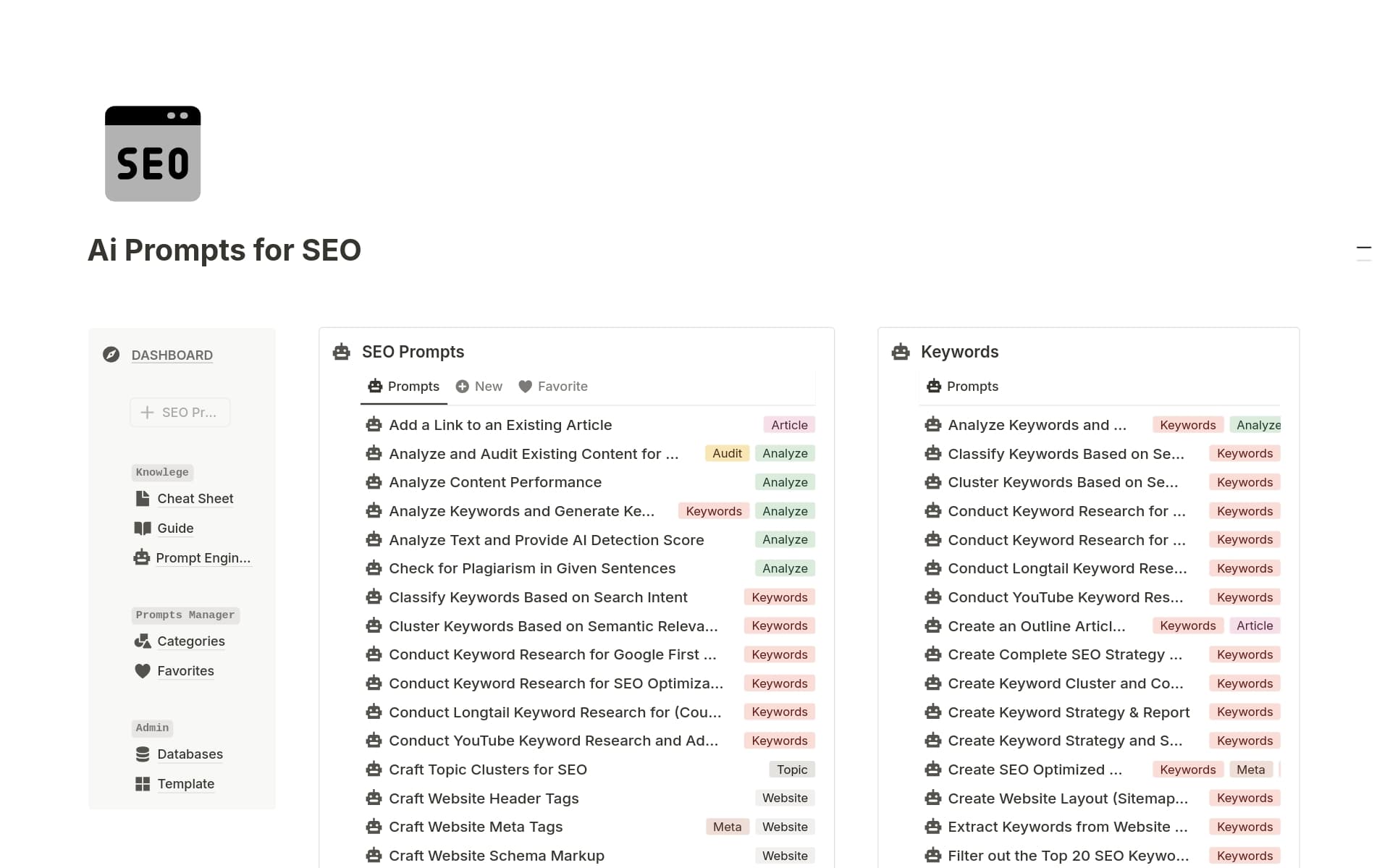
Not all templates are created equal, and the most successful SEO programs layer several types together. Below is a breakdown of the essential categories you can implement today, each with a distinct role in the content lifecycle.
1. AI‑Powered Keyword and Topic Cluster Templates
Gone are the days of exporting a flat CSV from a keyword tool. Modern templates use AI to group terms by user intent, map them to buyer journey stages, and highlight content opportunities you might otherwise miss. For instance, a keyword clustering template might ingest 5,000 raw keywords, run them through an embedding model, and output a visual cluster map with pillar page recommendations. The AI can even name the clusters based on dominant themes, cutting hours of manual spreadsheet work.
These templates often integrate with APIs from Ahrefs, Semrush, or DataForSEO to pull real‑time search volume and difficulty data. The result is a living document where the AI suggests not just what to target but also how to interlink pages to build topical authority. Advanced versions include “content decay” alerts, prompting you to refresh clusters whose rankings have declined.
2. SERP‑Informed Content Brief Templates
A great content brief does more than list a title and a few keywords. It reverse‑engineers the SERP to reveal exactly what Google considers comprehensive. AI SEO templates for content briefs scrape the top 10–20 results, extract common questions from People Also Ask boxes, analyze header structures, and identify media types (images, video, tables) that dominate the page. The template then synthesizes this into a structured brief: suggested H2/H3 hierarchy, recommended word count range, must‑include entities, and a content grade score benchmarked against competitors.
When paired with a writing AI, the template can even generate a first draft that already follows the outline, complete with placeholders for original data and internal links. This dramatically reduces research time while ensuring no critical subtopic is omitted. Teams using such templates often report that their content begins ranking for secondary keywords weeks earlier because the semantic foundation is already solid.
3. Meta Data and Structured Data Generation Templates
Title tags and meta descriptions remain a deceptively high‑leverage SEO element. AI templates here feed page content, target keywords, and brand guidelines into a model that returns dozens of variations optimized for click‑through rate and character limits. The template can enforce rules like “always include a power word,” “never use all caps,” or “append the brand name only for category pages.” This stops the common mistake of writing meta tags as an afterthought.
Similarly, structured data templates automate the creation of JSON‑LD markup for articles, products, FAQs, and local businesses. By connecting a CMS to an AI via a template, every new blog post can automatically receive Article schema with author, datePublished, and publisher fields correctly filled. For e‑commerce, the AI can scrape product information and generate valid Product markup, complete with price, availability, and review snippets, dramatically reducing manual errors that lead to rich result penalties.
4. Internal Linking and Information Architecture Templates
Internal linking is often the most neglected pillar of SEO because doing it well requires site‑wide awareness. AI templates solve this by ingesting a full site crawl (from Screaming Frog, Sitebulb, or a custom crawler) and outputting a prioritized link building plan. The template can identify orphan pages, suggest contextually relevant anchor text from surrounding content, and calculate the minimum number of internal links needed to distribute PageRank effectively.
Some advanced templates maintain a “link equity dashboard” where the AI forecasts the ranking uplift from implementing a specific set of internal links. They also detect cannibalization issues, proposing where to consolidate pages or add canonical tags. For large publications, a weekly automated report can flag new articles that need links from older authority posts, preserving the site’s topical mesh over time.
Benefits of Adopting AI SEO Templates Across Your Organization
The immediate draw is speed, but the long‑term payoff goes much deeper. Teams that institutionalize AI‑driven templates consistently see gains in consistency, scalability, and insight.
- Unmatched operational efficiency: Tasks that once took a strategist four hours—like building a complete keyword map—now take fifteen minutes. This frees senior talent to focus on high‑level strategy and testing instead of repetitive execution.
- Elimination of human bias and oversight: Even experienced SEOs can miss a critical LSI keyword or overlook a local intent modifier. AI templates treat every brief with the same exhaustive rigor, reducing “forgotten” elements to near zero.
- Data‑backed decision making at scale: Every template output is traceable to the data that informed it. If a content brief suggests covering a specific subtopic, you can see the SERP analysis that justifies it. This transparency builds trust with stakeholders and makes testing easier.
- Seamless onboarding and knowledge retention: When a key team member leaves, their mental playbook doesn’t walk out the door. The templates codify best practices, allowing new hires to produce work that meets the same standard from day one.
- Multi‑language and multi‑market agility: A well‑built template can switch target languages while preserving structural logic. The AI handles translation and localized entity extraction, letting you expand internationally without rebuilding processes.
- Template rigidity versus algorithmic shifts: A template built in January might not reflect Google’s March core update. Without regular reviews, the AI could keep producing content that aligns with outdated ranking signals. Teams must schedule quarterly template audits just like they audit content.
- Risk of cookie‑cutter content: Over‑reliance on templates can lead to a site full of pages that feel mechanically similar. Search engines are increasingly sensitive to content diversity and unique value. The template must include “differentiation” fields that prompt the AI to incorporate original research, expert quotes, or proprietary data.
- Data source quality: If the AI pulls from a static dataset that isn’t refreshed, your keyword volumes and competitor analysis become stale. The template is only as good as the APIs and databases it connects to. Validate your data connectors regularly.
- E‑E‑A‑T blind spots: AI models can simulate expertise but can’t inherently provide real‑world experience. Templates that generate “expertise” sections without human vetting risk publishing generic, unverifiable claims. Always flag sections that require hands‑on proof or credentials for human review.
- Blindly trusting AI‑generated word counts: AI models often suggest overly long content because that’s what they see in training data. Always cross‑reference with actual SERP word counts. A template should include a dynamic word count range based on the top 3 ranking URLs’ average length, not a fixed AI prediction.
- Skipping intent validation: A template might recommend an informational outline for a keyword with transactional intent because the SERP analysis missed the ad‑heavy results. Add an intent‑classification layer that classifies the keyword before generating the brief, using both AI and hard data like ad presence and shopping features.
- Ignoring E‑E‑A‑T signals for YMYL topics: For health, finance, or legal content, AI templates must prompt for author credentials, cited studies, and review steps. If the template doesn’t explicitly ask for these, the A Build a YMYL toggle that activates stricter guidelines.
- Using stale competitor data: Some templates scrape SERPs once and cache the results. Rankings change daily. Ensure the template fetches fresh data on each run or at least every 24 hours for competitive niches.
- Neglecting visual and interactive elements: AI text generation often overlooks the need for images, tables, calculators, or videos. The template should include a “multimedia requirements” section based on what’s common in top‑ranking results.
Recognizing the Limitations and Potential Pitfalls
For all their power, AI SEO templates are not a set‑and‑forget silver bullet. Misapplied, they can amplify mistakes at scale.
AI SEO Templates vs. Traditional Manual Templates
The table below highlights the practical differences that impact daily workflows and outcomes.
| Factor | Manual SEO Templates | AI SEO Templates |
|---|---|---|
| Research phase | Human manually gathers keyword data, reads SERPs, and notes competitors | AI ingests live SERP data, extracts entities, clusters keywords, and scores content automatically |
| Brief creation time | 45–90 minutes per brief | 5–15 minutes per brief after template setup |
| Consistency | Varies with team member skill and attention | High; follows predefined rules every time |
| Adaptability to change | Requires manual retraining and document updates | Can be recalibrated by adjusting prompts, data sources, or scoring weights |
| Personalization | Strong; easy to inject unique insights | Needs explicit “uniqueness” fields; otherwise risks generic output |
| Scalability | Linear; adding more output requires more hours | Non‑linear; a single template can generate thousands of variations |
The ideal approach merges both worlds. Use AI templates for the heavy lifting and data synthesis, then layer human creativity and subject matter authority on top.
How to Build Your First High‑Impact AI SEO Template
Creating a template isn’t about coding; it’s about formalizing a repeatable decision‑making loop. Here’s a step‑by‑step guide that works with tools like ChatGPT, Claude, or API calls to dedicated SEO AIs.
Step 1: Choose a High‑ROI Starting Point
Don’t try to template everything at once. Pick the task that consumes the most manual time yet produces measurable SEO impact. For most teams, this is either content brief creation or meta tag generation. Define the exact output you want—for a content brief, perhaps a document with a title, target keyword, secondary keywords, recommended headings, FAQs to answer, and an ideal audience persona snippet.
Step 2: Map the Data Inputs and AI Instructions
A great template starts with a crystal‑clear prompt or block of instructions. For a content brief AI, the prompt might include placeholders like {{main_keyword}}, {{target_country}}, {{competitor_urls}}. You then instruct the AI: “Analyze the top 5 search results for {{main_keyword}} in {{target_country}}. Extract all H2 and H3 headings used by at least two competitors. Identify the five most common People Also Ask questions. Suggest a content outline that covers all extracted topics, in a logical order, with recommended word count per section. Output in JSON with keys: title, meta_description, headings, faqs, estimated_length.” This structured prompt becomes the backbone of your template.
Step 3: Test, Refine, and Lock Guardrails
Run the template against 20 known keywords where you have excellent existing content. Compare the AI output to what your top‑ranking page actually contains. Adjust instructions to bridge any gaps. Add constraints: “Do not include competitor brand names,” “Always start with a definition if the keyword signals informational intent,” “Link to our existing resource on [topic] when it appears in the outline.” These guardrails prevent the template from drifting.
Step 4: Integrate Into Your Workflow
For ultimate efficiency, connect the template to your tech stack. Use no‑code tools like Make or Zapier to send a form submission (keyword + country) to an AI service, receive the generated brief, and push it to a Google Doc or your project management tool. Some teams embed the template directly into their CMS; when a writer opens a new post, the AI brief is already populated in the draft. This seamless experience is where AI SEO templates deliver their full value.
Common Mistakes When Using AI SEO Templates and How to Avoid Them
Important Notes for Long‑Term Success
The real power of AI SEO templates emerges when they are treated as living assets. Schedule a monthly performance review: compare the content produced via templates against your manually optimized control pages. Track metrics like average click‑through rate, time to first ranking, and conversion rate. If template‑driven pages underperform, revisit the prompts and data sources.
Document every template version. AI model updates can unpredictably alter outputs; having a changelog lets you roll back quickly. Keep a “human override” mechanism in place—no template output should go live without at least a spot check from a trained SEO editor, especially for pages that target high‑value keywords.
Be mindful of copyright and originality. AI models trained on broad web data can inadvertently reproduce phrases. Use plagiarism checks as a final step in your template pipeline, and always add unique insights that only your brand can provide.
Frequently Asked Questions About AI SEO Templates
What are AI SEO templates?
AI SEO templates are pre‑built frameworks that combine artificial intelligence with SEO best practices to automate tasks like keyword research, content brief creation, meta tag writing, and internal link planning. They leverage large language models and real‑time data to produce consistent, data‑driven outputs that scale across large websites.
Do AI SEO templates work for all types of websites?
Yes, but the template design must match the site’s goals. An e‑commerce store benefits heavily from product‑focused templates that automate structured data and category descriptions, while a news publisher uses templates optimized for freshness, entity extraction, and fast content brief generation. The key is customizing the input prompts and guardrails for each vertical.
Can AI SEO templates replace an SEO strategist?
No. AI SEO templates amplify a strategist’s capabilities but cannot replace strategic thinking, creative ideation, or real‑world experience evaluation. The strategist still defines the architecture, chooses which signals matter, reviews AI outputs for nuance, and adjusts templates as algorithms evolve.
Which tools support AI SEO template creation?
You can build templates using general‑purpose AI platforms like ChatGPT, Claude, and Gemini via custom prompts, or use specialized SEO platforms. SurferSEO offers a content editor that acts as a template, Frase provides automated briefs, MarketMuse has topic modeling templates, and NeuronWriter supplies NLP‑driven outlines. No‑code automation tools like Make and Zapier connect these services to your existing workflow.
How often should AI SEO templates be updated?
At minimum, review templates quarterly or immediately after a major Google algorithm update. Also update them whenever your content strategy shifts, when you enter a new market, or when the AI model you rely on receives a significant upgrade. Continuous monitoring of template‑generated content performance highlights when adjustments are needed.
Conclusion
AI SEO templates represent more than a productivity hack—they are the operational foundation for modern, scalable search optimization. By encoding your team’s collective expertise into intelligent, repeatable frameworks, you move from reactive firefighting to proactive, data‑driven growth. The templates handle the exhaustive research and formatting, leaving your talent free to inject the creativity, authority, and nuanced strategy that only humans can provide. Start with one high‑impact template, rigorously test it against real performance data, and expand from there. In an era where search rewards consistency and depth, AI SEO templates are the lever that turns good intentions into measurable, sustainable rankings.
Xem thêm:
- AI SEO Agent: How Autonomous AI Is Reshaping Search Engine Optimization
- AI SEO for Crypto: The Complete Guide to Dominating Search in 2025
- How to Use AI for SEO: A Complete Guide to Smarter Rankings
- AI SEO Extensions: The Smart Way to Automate and Supercharge Your Search Rankings
- AI SEO Information Architecture: The Complete Guide to Future-Proofing Your Website
Bài viết cùng chủ đề:

AI SEO SEO Automation with Make: The Complete Workflow Guide

AI SEO SEO Automation with Zapier: The Complete Workflow Guide

AI SEO SEO Automation with n8n: The Complete Workflow Guide
AI SEO SEO Automation with Gemini: The Complete Guide to Scaling Organic Growth

AI SEO SEO Automation with Claude: The Complete Guide to Scaling Content in 2025

AI SEO SEO Automation with ChatGPT: The Complete Playbook for 2025

AI SEO & SEO Automation for Affiliate Sites: The 2025 Playbook for Passive Income Growth
AI SEO & SEO Automation for Bloggers: The Complete Guide to Scaling Your Content

AI SEO & SEO Automation for Agencies: The Complete 2025 Playbook

AI SEO and SEO Automation for Ecommerce: The Complete Playbook for 2025

AI SEO & SEO Automation for WordPress: The Complete Playbook for 2025
AI SEO SEO Automation Strategy: The Complete Playbook for 2025

Mastering the AI SEO SEO Automation Process: A Complete Guide to Scaling Organic Growth
AI SEO SEO Automation System: The Complete Guide to Scaling Organic Growth in 2025
AI SEO SEO Automation Platform: The Complete Guide to Scaling Organic Growth in 2025
AI SEO SEO Automation Software: The Complete Guide to Scaling Organic Growth in 2025















