
No products in the cart.
The AI SEO Workflow for Agencies: A Complete Guide to Scaling Results With Smart Automation
29
Jul
Jul
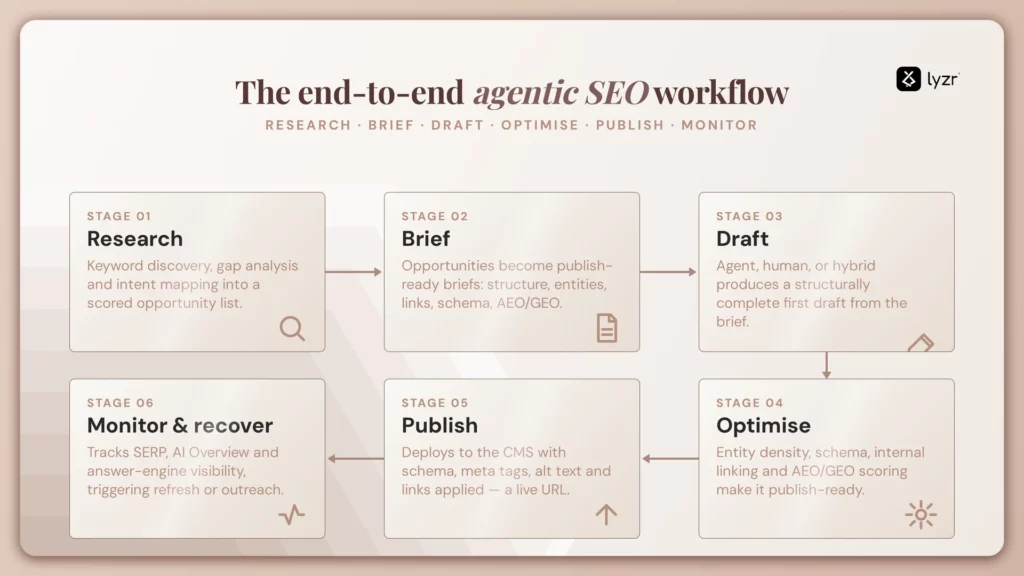
An AI SEO workflow for agencies is no longer a futuristic concept—it is the operational backbone for teams that want to deliver faster results while handling more clients without burning out. The core idea is straightforward: blend artificial intelligence tools into every stage of search engine optimization, from keyword discovery to performance reporting, so that repetitive tasks shrink and strategic thinking expands. Agencies that adopt a structured AI-driven process typically see a 40-60% reduction in time spent on manual audits and content briefs, while simultaneously improving output quality. This guide breaks down exactly how to build that workflow, which tools anchor each phase, and where human oversight remains irreplaceable.
What an AI SEO Workflow for Agencies Really Means
An AI SEO workflow is a sequence of interconnected processes where machine learning models handle data aggregation, pattern recognition, content generation, and technical diagnostics. For an agency, this goes beyond using a single AI writing tool. It means connecting platforms like natural language processing engines, predictive ranking tools, and automated crawlers into a production line. The output is not just content, but a full ecosystem: topic clusters mapped to buyer intent, code-level fixes flagged in real time, and dashboards that update without manual spreadsheet pulls.
The shift matters because agency economics depend on margins. When a strategist spends fifteen hours on a keyword gap analysis that a language model can summarize in twenty minutes, the cost structure breaks. A well-designed AI workflow reallocates that time toward interpreting insights and advising clients, which is exactly where an agency’s value proposition sharpens.
Why Agencies Need an AI-First SEO Process Now
Search engines are evolving faster than any human team can manually track. Google’s helpful content system, continuous core updates, and the rise of AI-generated overviews in search results demand a response that is both rapid and nuanced. Agencies that integrate AI into their daily operations gain three immediate advantages: speed of experimentation, consistency across client accounts, and the ability to tackle vast data sets that would otherwise remain buried in search console exports.
Consider the typical mid-size agency managing twenty to forty clients. Without AI, a technical audit for one mid-sized e-commerce site might consume two full days. With an AI crawler that understands page templates and prioritizes fixes by revenue impact, the same audit can be generated in under an hour, leaving time to discuss implementation with the client. This is the practical difference between a reactive agency and one that leads with proactive insights.
Core Components of an AI SEO Workflow
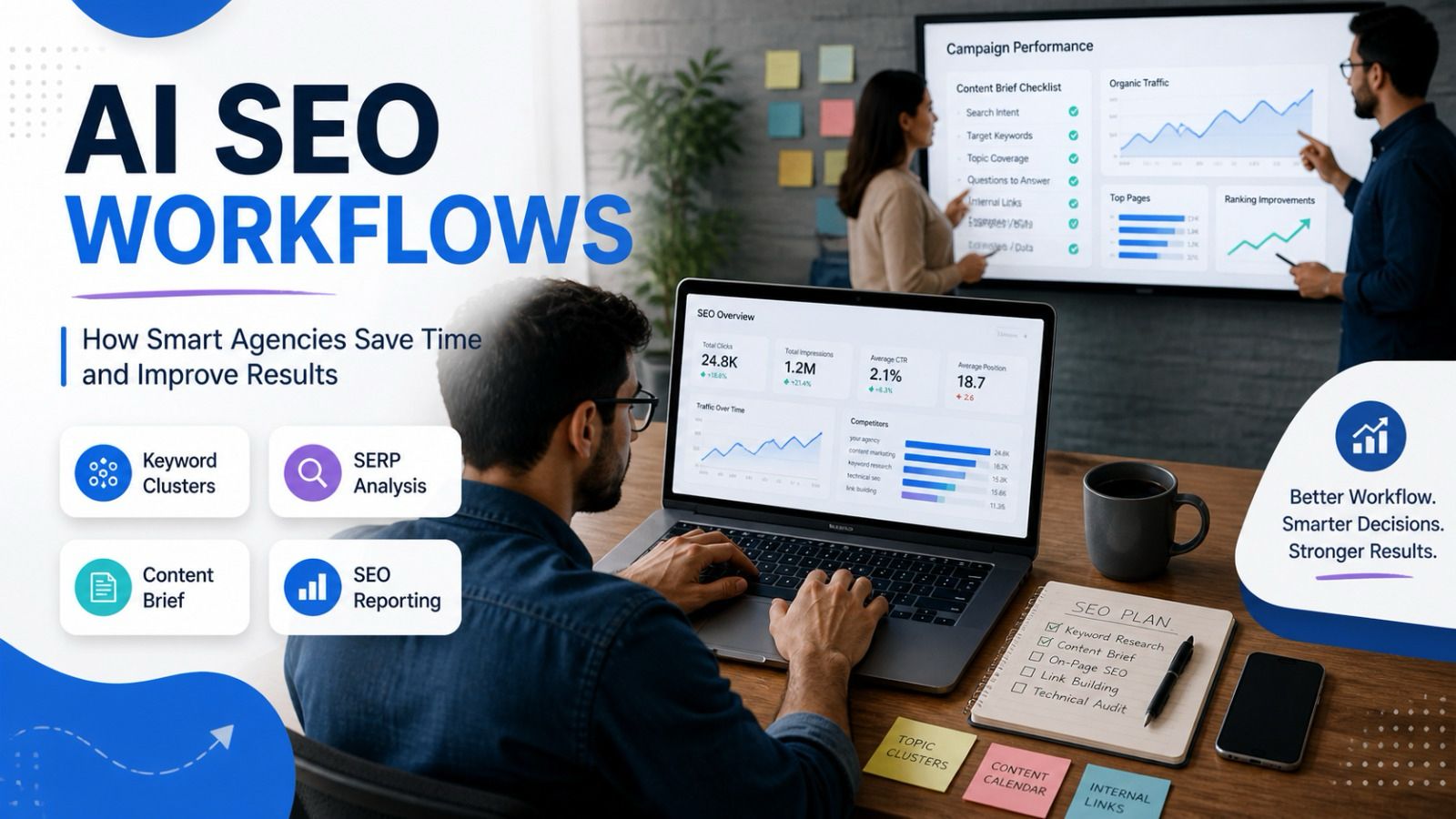
1. Intelligent Keyword Research and Topic Discovery
Manual keyword research often traps strategists in a loop of seed terms and endless spreadsheet scrolling. AI tools now cluster thousands of keywords into topical pillars within seconds, uncovering semantic relationships that are nearly impossible to spot by hand. Instead of simply gathering high-volume terms, an AI-driven process identifies intent gaps, question patterns, and emerging trends from real-time search data, Reddit threads, and competitor content analysis.
The workflow step here involves using large language models to generate initial topic maps, then validating them with actual search volume and difficulty metrics. Tools like Ahrefs, Semrush, or dedicated AI platforms feed data directly into a content planning calendar that prioritizes clusters based on business value, not just vanity metrics.
2. Automated Content Briefs That Preserve Strategy
One of the most fragile points in any agency workflow is the handoff between strategy and writing. Misaligned briefs lead to generic content that fails to rank. AI changes this by analyzing the top-performing pages for a given cluster and extracting the common entities, headings, question formats, and internal linking structures. The resulting brief contains not just a title and target word count, but a granular outline that reflects the exact pattern Google seems to reward for that query type.
An effective AI SEO workflow for agencies uses tools like Clearscope, Surfer, or MarketMuse to produce these briefs, then layers in human editorial guidelines about tone and unique insights. The brief becomes a living document that updates as SERP features change, ensuring the writer always works from current intelligence rather than a stale snapshot from three months ago.
3. AI-Assisted Content Creation and First-Draft Generation
Generative AI now writes drafts that often require 60-70% less editing than even a year ago. But the real workflow integration is not about pressing a button and publishing raw output. It is about training the model on brand voice, past performance data, and specific formatting rules. Advanced agencies fine-tune AI writing assistants using their own library of top-performing articles, so the generated text reflects proven patterns.
The process typically looks like this: the AI produces a structured first draft based on the optimized brief, incorporating target entities and NLP-friendly paragraph structures. A human editor then injects original data, client anecdotes, and brand-specific arguments. This hybrid model reliably cuts per-article creation time from eight hours to two or three, while often improving organic click-through rates because the foundational structure is aligned with search intent.
4. Automated On-Page Optimization and Internal Linking
On-page SEO has moved far beyond placing keywords in title tags. Modern AI SEO workflows automatically scan content for entity density, heading logic, image alt text gaps, and feature snippet eligibility. More importantly, they identify internal linking opportunities at scale—something practically impossible to manage manually across a site with thousands of URLs.
AI link tools crawl the entire domain, understand page context through natural language processing, and suggest anchor-rich connections between relevant pieces. For e-commerce clients, this can mean suggesting product-to-category links that boost indexing depth; for B2B SaaS, it means connecting thought leadership articles in a tightly woven topic cluster that signals expertise to search engines.
5. Real-Time Technical Auditing and Issue Prioritization
Technical SEO audits have historically been heavy reports that arrive too late. AI-driven crawlers now monitor a client’s site continuously, detecting not only crawl errors but also patterns like orphan pages, slow-loading template elements, or JavaScript rendering problems that block indexation. The key workflow improvement is triage: instead of a list of two hundred “errors,” the AI assigns a priority score based on estimated organic traffic impact.
This means an agency strategist receives a Monday morning notification: “Three pages in the /blog/ section lost 40% of their traffic due to an accidental noindex tag added Friday evening,” instead of discovering it during a quarterly audit. The speed of detection and resolution directly protects client revenue and builds trust that no manual monitoring can match.
6. Predictive Performance Dashboards and Client Reporting
Reporting is often where agencies lose hours and dilute their value. Manually pulling data from Google Search Console, Analytics, Ahrefs, and rank trackers into a slide deck is a high-effort, low-thinking activity. AI-driven dashboards now ingest all these sources, spot anomalies, and generate plain-language explanations for performance shifts. Some systems even forecast traffic changes based on Google algorithm update patterns and competitor movements.
In a mature AI SEO workflow, the strategist reviews an auto-generated report highlight reel, adds strategic commentary, and spends forty-five minutes preparing for the client call instead of five hours assembling charts. This transformation not only saves money but elevates the agency’s role from data provider to strategic advisor.
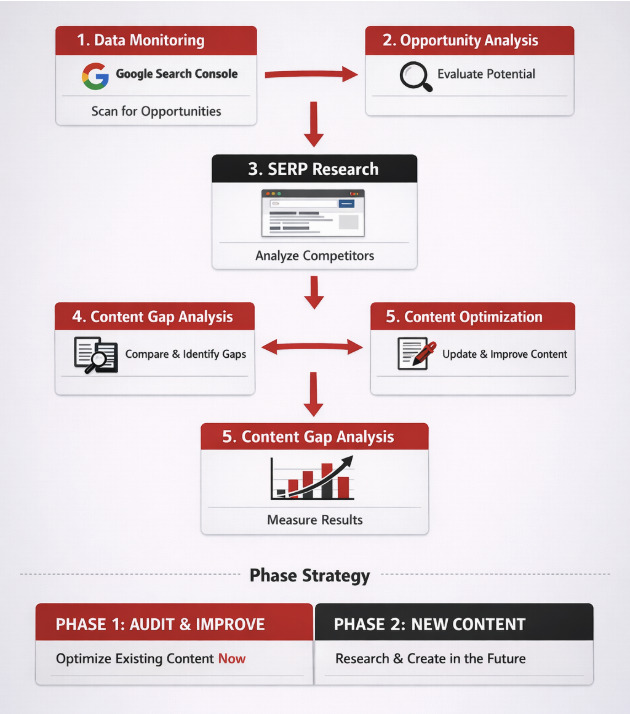
Building a Practical AI SEO Workflow: Step-by-Step Guide
Phase 1: Audit Your Current Bottlenecks
Before layering in AI, map out every task that consumes disproportionate time relative to its impact. For most agencies, these are keyword mapping, content formatting, backlink opportunity research, and performance report generation. Identify exactly where the team feels spread too thin, because AI works best when it removes friction, not when it is force-fit into a process that doesn’t need it.
Phase 2: Select and Connect Your Core Tools
The stack matters. An effective AI SEO workflow often relies on three to five tightly integrated platforms rather than twenty disconnected ones. A common configuration: an AI content intelligence tool (like NeuronWriter or Frase) for research and briefs; a generative AI interface (Claude, GPT) for drafting; an AI crawler (Screaming Frog with AI add-ons or Deepcrawl) for technical insights; and a reporting layer (Looker Studio with AI connectors) that pulls everything together. The goal is API-driven data flow, not copy-pasting between tools.
Phase 3: Create Standard Operating Procedures With AI Checkpoints
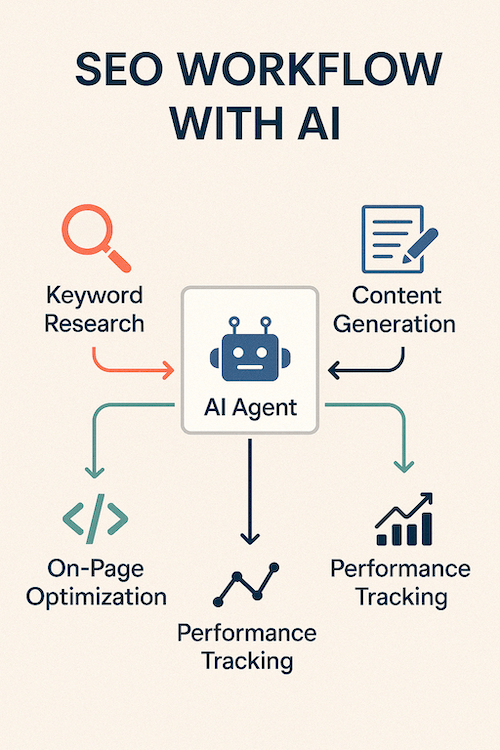
Document exactly where AI enters the workflow and where a human must sign off. For example: Keyword research → AI clusters topics → Strategist selects priority clusters → AI generates content brief → Strategist adds client-specific context → AI drafts article → Editor refines and adds unique data → AI checks on-page optimization → Editor publishes → AI monitors ranking changes. This clarity prevents over-reliance on automation and keeps the agency’s unique expertise central.
Phase 4: Train the AI on Client-Specific Data
Generic AI output undermines an agency’s value. The most successful teams build internal knowledge bases for each client—brand style guides, competitor positioning docs, past performance data, and customer interview transcripts—and feed those into the AI tools via custom instructions or retrieval-augmented generation (RAG) setups. Over time, the AI learns that Client A is a luxury brand that avoids aggressive CTAs, while Client B thrives on bold comparisons and statistics. This fine-tuning is what separates a premium agency from a content mill.
Phase 5: Set Up Quality Control Gates
An AI SEO workflow without quality gates will eventually produce embarrassing errors—factual hallucinations, off-brand phrasing, or content that feels hollow. Implement a mandatory human review stage for any AI output before it reaches a client. This includes fact-checking statistics, verifying that the article structure doesn’t parrot the competitor exactly, and ensuring the final piece contains at least one insight the AI could not have generated from its training data alone. The best agencies treat AI as a junior team member: immensely capable but needing supervision.
Benefits and Limitations of an AI SEO Workflow for Agencies
| Benefits | Limitations |
|---|---|
| Reduces repetitive research time by up to 70% | AI-generated content can feel templated without heavy editing |
| Enables consistent quality across many client accounts | Hallucinated facts require rigorous verification systems |
| Identifies technical issues before they harm rankings | Over-reliance may weaken creative differentiation |
| Scales content production without linear headcount growth | Tool costs rise quickly if not regularly evaluated for ROI |
| Provides data-backed insights for client strategy meetings | AI models do not understand niche industry nuance deeply |
Traditional SEO Agency Workflow vs. AI-Enhanced Workflow
| Task | Traditional Approach | AI-Enhanced Approach |
|---|---|---|
| Keyword research | Manual export from tools, filtering in sheets | AI clusters topics, identifies intent, recommends priority based on buyer journey |
| Content briefs | Handwritten outlines based on limited competitor review | AI extracts SERP patterns, generates entity-rich outline, updates automatically |
| Drafting | Writer produces full draft from scratch | AI generates structured draft, writer adds expert insights and edits for voice |
| Internal linking | Ad-hoc or ignored entirely | AI crawler suggests contextual links across thousands of pages |
| Technical audits | Quarterly manual crawl, overwhelming report | Continuous monitoring with prioritized fixes based on traffic impact |
| Client reporting | Hours assembling data manually | AI dashboards auto-explain performance shifts, strategist adds commentary |
Common Mistakes Agencies Make When Implementing AI SEO Workflows
- Treating AI output as publish-ready. Even the most advanced models lack context about a client’s unique value proposition. Publishing without human editing damages credibility and rankings over time.
- Ignoring tool integration. Using five disparate AI tools that don’t share data creates a fragmented workflow that wastes more time than it saves. Choose platforms that connect via API.
- Skipping training on client specifics. A generic AI workflow produces generic results. The agency’s edge comes from teaching the tools about the client’s market, voice, and past wins.
- Failing to track AI’s actual ROI. Many agencies adopt AI tools without measuring whether they reduce hours or improve rankings. Track time saved per task and organic traffic movements to validate the investment.
- Letting AI replace strategic thinking. AI excels at pattern matching; it does not decide which markets to enter or how to position a brand against a new competitor. Those decisions remain firmly in the human domain.
Important Notes for Sustaining an AI SEO Workflow
AI models evolve, and search engine guidelines shift. Agencies must review their workflow components quarterly. A content generation technique that worked in January might produce thin content by June if not recalibrated. Additionally, transparency with clients matters. Some clients feel uneasy knowing AI drafts their content. Frame the workflow honestly: AI handles data processing and initial drafting, but every piece is shaped and approved by experienced strategists who understand the brand.
Data privacy is another critical layer. When feeding client documents or performance data into AI tools, ensure the platforms have enterprise-grade data handling policies. Avoid uploading proprietary strategy documents to public-facing AI interfaces that may retain inputs for training.
Frequently Asked Questions
What is an AI SEO workflow for agencies?
An AI SEO workflow for agencies is a structured process that integrates artificial intelligence tools into every phase of search engine optimization—from keyword research and content creation to technical audits and performance reporting. It automates data-heavy tasks while keeping human strategists in control of creative and strategic decisions, enabling agencies to scale client work without sacrificing quality.
Can a small agency afford an AI SEO workflow?
Yes. Many AI SEO tools offer scalable pricing tiers, and even a combination of two or three affordable platforms can dramatically reduce manual hours. A small agency might start with an AI content intelligence tool for research and a reliable large language model for drafting, spending less than one hundred dollars per month in total while saving dozens of hours.
Will AI replace SEO strategists in agencies?
No. AI handles pattern recognition and repetitive tasks, but a strategist’s value lies in understanding client business goals, interpreting ambiguous data, and building relationships. The agencies that thrive use AI to free strategists for high-level work, not to eliminate the role. The human element—context, empathy, originality—is what clients pay a premium for.
How do I ensure AI-generated content ranks well?
AI-generated content ranks well when it follows a rigorous workflow: a data-backed brief informed by SERP analysis, a draft that incorporates relevant entities and proper heading hierarchy, and thorough human editing that adds unique insights, original research, or expert quotes. Content should always serve user intent better than what currently ranks, and AI alone rarely achieves that without human input.
What are the risks of over-relying on AI for SEO?
Over-reliance leads to formulaic content that lacks differentiation, potential factual errors from AI hallucinations, and a gradual erosion of the strategic thinking muscles within the team. T A well-balanced workflow keeps AI in a support role and humans in the decision-making seat.
Conclusion
An AI SEO workflow for agencies is a strategic asset, not just a collection of clever tools. When built correctly, it transforms how teams research, create, optimize, and report—turning weeks of manual work into hours of intelligent oversight. The agencies that lead in the coming years will not be those that use the most AI, but those that design workflows where human expertise and machine efficiency reinforce each other at every step. Start by auditing where your team loses the most time, integrate tools that speak to each other, train them on client specifics, and never skip the editorial human layer. That balance is what makes an AI-driven agency genuinely scalable and remarkably effective.
Xem thêm:
- AI Product Description Generator: Create Compelling Listings That Sell in Seconds
- AI SEO Software: How Artificial Intelligence Is Redefining Search Optimization in 2025
- AI SEO Myths Debunked: The Truth About Ranking in the Age of Algorithms
- How to Use Claude for SEO: A Complete Guide to Ranking Higher with AI Assistance
- AI Broken Link Building: How Artificial Intelligence Transforms Dead Links Into High-Authority Backlinks
Bài viết cùng chủ đề:

AI SEO SEO Automation with Make: The Complete Workflow Guide

AI SEO SEO Automation with Zapier: The Complete Workflow Guide

AI SEO SEO Automation with n8n: The Complete Workflow Guide
AI SEO SEO Automation with Gemini: The Complete Guide to Scaling Organic Growth

AI SEO SEO Automation with Claude: The Complete Guide to Scaling Content in 2025

AI SEO SEO Automation with ChatGPT: The Complete Playbook for 2025

AI SEO & SEO Automation for Affiliate Sites: The 2025 Playbook for Passive Income Growth
AI SEO & SEO Automation for Bloggers: The Complete Guide to Scaling Your Content

AI SEO & SEO Automation for Agencies: The Complete 2025 Playbook

AI SEO and SEO Automation for Ecommerce: The Complete Playbook for 2025

AI SEO & SEO Automation for WordPress: The Complete Playbook for 2025
AI SEO SEO Automation Strategy: The Complete Playbook for 2025

Mastering the AI SEO SEO Automation Process: A Complete Guide to Scaling Organic Growth
AI SEO SEO Automation System: The Complete Guide to Scaling Organic Growth in 2025
AI SEO SEO Automation Platform: The Complete Guide to Scaling Organic Growth in 2025
AI SEO SEO Automation Software: The Complete Guide to Scaling Organic Growth in 2025















