
No products in the cart.
AI SEO Myths Debunked: The Truth About Ranking in the Age of Algorithms
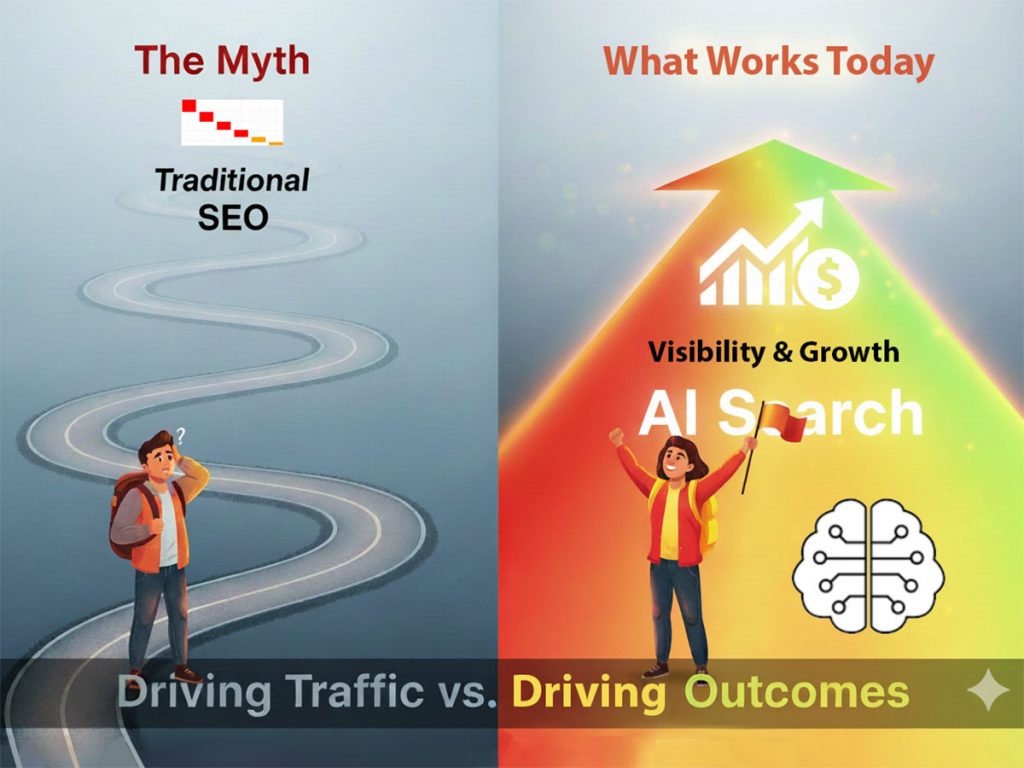
29
Jul
Jul
Introduction: Separating Fact from Fiction in AI-Driven Search Optimization
The conversation around AI SEO myths has become one of the most polarizing debates in digital marketing. With generative tools suddenly accessible to everyone, a flood of half-truths, outdated warnings, and outright falsehoods now circulates daily. Some marketers panic that AI content will tank their rankings, while others assume artificial intelligence has made traditional SEO obsolete overnight. Neither extreme is correct. This article cuts through the noise to examine which AI SEO myths persist, where they come from, and what actually matters for sustainable search performance right now.
Search engines have used machine learning for well over a decade. RankBrain, BERT, MUM — these are all Google algorithms built on artificial intelligence. Yet when the same technology reaches the content creator’s desk, suddenly it gets labeled as risky or forbidden. That contradiction alone exposes many AI SEO myths for what they are: misunderstandings of how search engines evaluate quality. The truth sits comfortably in the middle, anchored in Google’s own public statements and countless real-world case studies. What follows is a deep, practical breakdown.
What Exactly Are AI SEO Myths?
AI SEO myths refer to widely held but incorrect beliefs about how search engines treat content, strategies, or technical optimizations that involve artificial intelligence. These myths usually fall into two categories. The first covers the idea that using AI anywhere in your workflow invites a penalty. The second assumes AI is a magic wand that replaces every human SEO function, from keyword research to link building. Both directions overgeneralize and ignore the nuance Google has spent years codifying in its Helpful Content System and quality rater guidelines.
Understanding these myths requires looking at the source of the confusion. In late 2022 and early 2023, a wave of low-effort, purely AI-generated spam sites launched. Google responded with updates that targeted scaled content abuse, not AI usage per se. However, social media condensed that into “Google penalizes AI content,” and one of the most persistent AI SEO myths was born. The full picture matters because acting on myths wastes resources or exposes sites to genuine risk.
The Origin and Evolution of AI SEO Myths
The Spam Era That Started It All
When GPT-powered writing tools became publicly available, some publishers saw a shortcut. They pumped out hundreds of unedited, often factually inaccurate articles per day, purely to attract clicks. Google’s March 2024 core update explicitly targeted scaled content abuse, regardless of whether it was produced by humans, AI, or a combination. The takeaway for many was too simplistic: “AI content equals spam.” Google Search Liaison Danny Sullivan had to reiterate on social platforms that using AI is not against guidelines; producing content purely to manipulate rankings is.
That distinction never went viral. Instead, forum threads and LinkedIn posts amplified the simpler, scarier version. This created a fertile ground for dozens of AI SEO myths that continue to misdirect beginner and intermediate marketers alike. The evolution of these myths often follows a pattern: a grain of truth gets stretched until it breaks, and then it is repeated until it sounds like established fact.
How Google’s Helpful Content System Reacts to AI
Google’s systems evaluate content on multiple axes: expertise, experience, authoritativeness, trustworthiness (E-E-A-T). None of those signals ask whether a large language model was involved. What triggers demotion is content that demonstrates no original value, no real-world experience, and no genuine effort to help the reader. Many AI SEO myths conflate the tool with the output quality, yet a human can write thin, unhelpful content just as easily. The algorithm cares about the outcome, not the production method.
The 10 Most Damaging AI SEO Myths Experts Still Fight
Myths survive because they feel plausible. Below are the most common AI SEO myths, dismantled with what the search landscape actually shows in 2025.
Myth 1: Google Penalizes AI-Generated Content Across the Board
Reality: Google’s official documentation on AI-generated content explicitly states the focus is on content quality, not the tool used. Sites ranking with AI-assisted content include high-authority publications that simply use AI to draft first versions, which human editors then heavily revise. The penalty myth persists because sites that rely entirely on raw, unprompted AI output often violate quality thresholds — not because a bot wrote the words, but because those words lack substance.
Myth 2: AI Content Is Automatically Detectable and Devalued
Reality: AI detection tools are not used by Google as a ranking signal. Google has openly acknowledged that detection models are unreliable and produce false positives. An article written by a non-native English speaker can be wrongly flagged as AI, while polished AI output with human editing often passes as entirely human. The idea that search engines silently run a “GPT detector” and penalize based on its score is one of the most technically unfounded AI SEO myths in circulation.
Myth 3: AI Can Fully Replace Human SEO Strategists
Reality: AI excels at pattern recognition, data crunching, and content generation at scale, but it cannot understand brand voice nuance, make ethical judgment calls, or interpret unspoken user intent shifts. Strategy still requires humans who understand market positioning, audience psychology, and the evolving search landscape. The most effective SEO teams use AI as an accelerator, not a replacement. Treating it otherwise leads to generic, undifferentiated content that struggles to earn links or build authority.
Myth 4: Using AI for Keyword Research Produces the Same Results as Manual Analysis
Reality: AI can suggest keyword clusters and even predict intent based on existing data, but it lacks access to real-time, granular search volume, the context of recent algorithm updates, or proprietary data from client campaigns. It often generates plausible-sounding but invented metrics. Human analysts cross-reference multiple tools, study SERP feature layouts, and apply business context that no language model possesses. Relying solely on AI for keyword research is a shortcut that regularly leads to targeting the wrong queries.
Myth 5: AI-Generated Images and Videos Are Ignored by Search Engines
Reality: Google Images and Google Discover do not differentiate between AI-generated visuals and traditional ones. The ranking factors remain relevance, alt text, page context, and user engagement. AI-generated multimedia can rank well if it serves the searcher’s intent. Several publishers have successfully used AI-generated featured images without any drop in click-through rates. Treating AI media as inherently invisible is yet another of the unfounded AI SEO myths.
Myth 6: AI Content Cannot Build E-E-A-T Signals
Reality: E-E-A-T is about the author and the website, not the drafting tool. An article drafted by AI but clearly attributed to a credentialed expert, reviewed for accuracy, and supported by original research can demonstrate high E-E-A-T. Conversely, a human writer with no credentials claiming medical advice will fail E-E-A-T criteria. The source of the draft is irrelevant; the final presentation of authority and trust is what Google evaluates.
Myth 7: AI-Optimized Meta Tags Always Improve Click-Through Rates
Reality: AI can generate dozens of title tag and meta description variations, but it does not inherently understand emotional triggers, brand positioning, or the competitive SERP landscape in the moment. A/B testing tools still show that human-crafted titles often outperform AI versions because they tap into cultural references or urgency that a model cannot replicate without very specific prompting. Treating AI copy as automatically better is a subtle but costly variation of the broader AI SEO myths.
Myth 8: Google’s MUM and AI Models Mean Technical SEO No Longer Matters
Reality: MUM is about understanding complex queries across modalities, not about ignoring crawl budgets, broken internal links, or slow Core Web Vitals. Technical SEO remains the foundation that allows any content — AI-assisted or not — to be discovered and indexed. A site with excellent content but a non-crawlable structure will still fail. This myth seems to arise from a misunderstanding of what AI-powered algorithms actually do.
Myth 9: AI Content Tools Can Generate Perfectly Accurate Data Without Verification
Reality: Large language models hallucinate. They invent statistics, quote nonexistent studies, and mix up dates. Publishing AI content without rigorous fact-checking is one of the fastest ways to destroy user trust and attract manual actions if the misinformation is severe enough. This is not a reason to avoid AI entirely, but it directly contradicts the myth that AI-generated information is production-ready.
Myth 10: Once You Start Using AI for SEO, You Are Locked Into a Path of Low Quality
Reality: AI is a tool, not a destiny. Many premium publishers use AI for brainstorming topic clusters, summarizing competitor gaps, or generating structured data markup — tasks that carry zero quality risk. The outcome depends entirely on the workflow around the tool. Suggesting that any AI usage taints the entire site is a purity test that has no basis in Google’s documentation or ranking outcomes.
Why AI SEO Myths Persist: Psychological and Industry Factors
Several forces keep these myths alive. Fear-based marketing is one: agencies sometimes frame AI as dangerous to sell their own manual services. Confirmation bias also plays a role — a site owner who used AI lazily and got hit attributes it to the tool, not their lack of editing. Additionally, Google’s algorithmic updates often happen silently, and practitioners desperately look for a simple cause-and-effect narrative. “AI content penalty” is an easy story, even when the real cause was thin content, spammy links, or a technical SEO error.
The speed of technological change further complicates matters. Google’s guidance evolves, but not as fast as the rumor mill on X or Reddit. By the time an official clarification comes, a new batch of AI SEO myths has already taken root. Staying informed directly from Google’s Search Central blog and testing hypotheses on your own sites is the only sustainable approach.
The True Benefits of AI When Applied Correctly to SEO
Dispelling myths does not mean downplaying the genuine advantages. AI, used thoughtfully, transforms SEO workflows in measurable ways.
| SEO Task | Traditional Effort | AI-Assisted Approach | Realistic Gain |
|---|---|---|---|
| Content topic clustering | Hours of manual spreadsheet work | AI analyzes top-ranking pages and suggests clusters in minutes | 60-70% time reduction |
| First draft generation | Writer’s block, slow outlines | AI provides a structured draft for heavy human editing | 50% faster time to first meaningful draft |
| Schema markup creation | Manual coding, error-prone | AI generates and validates JSON-LD based on page content | Near-instant with high accuracy |
| Competitor gap analysis | Multiple tools, manual comparison | AI summarizes SERP patterns and missing subtopics | 30-40% faster insight generation |
These benefits are not theoretical. Established content teams routinely report that AI allows them to handle 2-3 times the number of high-quality pages without sacrificing editorial standards. The key is that AI handles the repetitive, pattern-based work while humans handle judgment, creativity, and nuance. This hybrid model elegantly sidesteps all the classic AI SEO myths because it never outsources the final say to a machine.
The Real Risks and Limitations No AI SEO Myth Prepared You For
While myths exaggerate certain risks, genuine concerns do exist. These are less about penalties and more about subtle declines in quality that accumulate over time.
- Content homogenization: When multiple sites in a niche use the same AI models with similar prompts, the output converges. Search results become a sea of indistinguishable pages. The risk is not a manual penalty but a collective drop in user engagement, as searchers cannot tell one result apart from another.
- Information cascade failures: AI models trained on web data that already contains AI-generated errors will compound those errors. Over time, factual accuracy degrades, and a site that does not catch this will lose E-E-A-T signals organically.
- Over-optimization blindness: AI can optimize for keyword density, readability scores, and semantic term inclusion so precisely that the content becomes unnatural. Human readers sense this “uncanny valley” style and bounce, sending negative engagement signals to Google.
- Legal and copyright gray areas: The training data of many models remains contested. While not an SEO ranking factor, legal challenges could theoretically lead to takedown requests that affect indexation. This risk is still evolving.
- Publishing raw AI output: Never click “publish” on unedited AI text. Even a cursory human review catches obvious errors and injects the necessary human signal.
- Ignoring the information gain score: Content that repeats only what the AI has seen in training data offers zero information gain. Google’s systems view that as redundant. Push AI to create novel structures, but always infuse original data.
- Automating at scale without oversight: The worst myth-causing disasters happen when someone builds a script that auto-publishes AI content across dozens of domains. This is the scaled content abuse scenario Google explicitly targets.
- Neglecting author bios and entity signals: Even the best AI-assisted article underperforms if the author page is a thin, anonymous stub. Clearly link to a credible author profile with relevant credentials.
Practical Guide: How to Use AI in SEO Without Falling for Myths
Implementing AI safely requires a framework that addresses the reality behind every myth. Follow these steps to build a workflow that search engines respect and readers find valuable.
Step 1: Separate AI Roles From Human Roles Explicitly
Define which tasks AI is allowed to perform without human oversight and which require review. For example, AI can generate meta description drafts, but a human must approve each one. AI can find internal linking opportunities, but a human must verify relevance. This clear division prevents the slippery slope of delegation that breeds the very quality issues fueling AI SEO myths.
Step 2: Establish a Fact-Checking Protocol
Every AI-generated statistic, date, name, or claim must be verified against a primary source. If the source cannot be confirmed, the statement must be removed. This protocol must be non-negotiable. It eliminates the hallucination risk that underpins the myth that all AI content is inaccurate.
Step 3: Add Human-Only Value to Every AI Draft
At minimum, add real examples, personal anecdotes, recent data, quotes from interviews, or case study insights that the AI could not have known. This not only enriches the content but also creates obvious E-E-A-T signals. Google’s systems increasingly look for content that goes beyond what is already indexed across thousands of sites. Adding unique human experience is the antidote to the myth that AI content is always derivative.
Step 4: Monitor Performance, Not AI Detection Scores
AI detection tool scores are a distraction. Instead, monitor real SEO metrics: organic traffic trends, average position for target queries, click-through rate, dwell time, and conversion rate. If these metrics hold steady or improve, the content is resonating with users and search engines, regardless of what a third-party “AI detector” claims.
Step 5: Audit AI Usage Regularly
Conduct quarterly audits to see which AI-assisted pieces performed well and which underperformed. Look for patterns. Did a certain prompt structure lead to thin content? Did a specific writer’s editing process correlate with higher rankings? Internal data will guide you far better than any sweeping statement about AI SEO myths.
Common Mistakes That Turn AI SEO into a Liability
Many practitioners unknowingly validate the worst myths because they stumble into predictable traps. Avoid these mistakes at all costs.
Critical Notes for Agencies and Enterprise SEO Teams
Agencies managing multiple client sites face additional scrutiny. One client hit by a quality update can blame AI, even if the real cause was elsewhere, and that story feeds the myth cycle. Document every step of the human review process. A clear paper trail showing that a subject-matter expert edited the work is a strong defense. For enterprise teams, governance is everything. Create a policy document that outlines approved AI use cases, prompts that have been tested, and mandatory review steps. This addresses the internal version of AI SEO myths before they lead to bad decisions.
Also understand that AI-generated content in YMYL (Your Money or Your Life) niches faces a higher bar. Google applies stricter E-E-A-T standards for health, finance, and legal content. In these spaces, AI can assist with research and outlining, but the final publishable text must be authored and reviewed by verifiable experts. Cutting corners here invites not just ranking drops but potential real-world harm.
Frequently Asked Questions About AI SEO Myths
Does Google have a specific penalty for AI content?
No. Google does not penalize content simply because it was created with AI. What triggers demotion is content that violates spam policies, such as being mass-produced without human review, containing misleading information, or lacking original value. The method of generation is not a ranking signal.
Can AI-written articles rank on the first page of Google?
Yes. Many AI-assisted articles rank on page one, often when human editors add unique insights, accurate data, and relevant examples. The ranking depends on the final content quality, not the initial drafting tool. Pure AI content without editing rarely sustains high rankings long-term because it tends to lack differentiation.
How can I tell if Google considers my AI content spammy?
Monitor Search Console for manual actions and watch for sudden traffic drops during confirmed algorithm updates. Also, honestly assess whether each page offers something unavailable elsewhere. If the page could have been written by anyone with access to an AI tool and no special knowledge, it likely sits in a gray area that future updates may target.
Does AI-generated content hurt my site’s E-E-A-T?
Only if the content lacks evidence of real expertise, experience, authoritativeness, or trustworthiness. You can build strong E-E-A-T on a page that used AI during drafting, provided the final version clearly attributes the information to a qualified author, includes original research or testimonials, and cites credible sources.
Is it true that AI detection scores affect my SEO?
No. Google has repeatedly confirmed that it does not use third-party AI detection tools as a ranking factor. Detection scores are notoriously inaccurate and should not guide your publishing decisions. Focus on user engagement metrics and search performance instead.
What is the safest way to use AI for SEO without falling for myths?
Treat AI as an assistant that speeds up research, outlines, and first drafts. Always have a subject-matter expert review, fact-check, and enhance every piece before publication. Never automate the publish button. This hybrid approach aligns with Google’s public guidance and sidesteps all common AI SEO myths.
Conclusion: Moving Beyond AI SEO Myths into Sustainable Strategy
The world of search optimization has always been plagued by myths, from keyword density formulas to the now-dead concept of PageRank sculpting. AI SEO myths are simply the latest chapter. They thrive on fear and oversimplification. The reality is far more nuanced: Google’s algorithms aim to reward content that helps users, regardless of how that content was created. The burden falls on publishers to ensure the final product demonstrates genuine value, accuracy, and a human touch that no raw AI output can replicate.
The marketers who will win in the coming years are not the ones who categorically reject AI out of fear, nor the ones who hand the reins to a language model entirely. They are the ones who cut through the noise, test their own hypotheses, and build workflows where AI handles the heavy lifting and humans provide the soul. That is the truth at the core of every AI SEO myth worth debunking.
Xem thêm:
- AI SEO Campaigns: The Blueprint for Data-Driven Organic Growth
- AI SEO Autonomous Agents: The Complete Guide to Hands-Free Search Optimization
- AI SEO Digital Authority: The Complete Playbook for Dominating Search in 2025
- AI Robots.txt: The Complete Guide to Controlling AI Crawlers on Your Website
- LLM SEO: The Ultimate Guide to Optimizing for Large Language Model Search
Bài viết cùng chủ đề:

AI SEO SEO Automation with Make: The Complete Workflow Guide

AI SEO SEO Automation with Zapier: The Complete Workflow Guide

AI SEO SEO Automation with n8n: The Complete Workflow Guide
AI SEO SEO Automation with Gemini: The Complete Guide to Scaling Organic Growth

AI SEO SEO Automation with Claude: The Complete Guide to Scaling Content in 2025

AI SEO SEO Automation with ChatGPT: The Complete Playbook for 2025

AI SEO & SEO Automation for Affiliate Sites: The 2025 Playbook for Passive Income Growth
AI SEO & SEO Automation for Bloggers: The Complete Guide to Scaling Your Content

AI SEO & SEO Automation for Agencies: The Complete 2025 Playbook

AI SEO and SEO Automation for Ecommerce: The Complete Playbook for 2025

AI SEO & SEO Automation for WordPress: The Complete Playbook for 2025
AI SEO SEO Automation Strategy: The Complete Playbook for 2025

Mastering the AI SEO SEO Automation Process: A Complete Guide to Scaling Organic Growth
AI SEO SEO Automation System: The Complete Guide to Scaling Organic Growth in 2025
AI SEO SEO Automation Platform: The Complete Guide to Scaling Organic Growth in 2025
AI SEO SEO Automation Software: The Complete Guide to Scaling Organic Growth in 2025















