
No products in the cart.
The Ultimate AI SEO Workflow: How to Automate Your Search Rankings from Research to Reporting
29
Jul
Jul
The way search engine optimization operates has shifted permanently. An AI SEO workflow combines machine intelligence with strategic oversight to execute tasks that once consumed entire days in a fraction of the time. Instead of replacing human expertise, a well‑designed AI‑driven process amplifies it — turning data into decisions, drafts into polished pages, and technical audits into actionable roadmaps. For teams handling dozens of campaigns or a single high‑stakes website, building a coherent AI SEO workflow is now the clearest path to sustainable organic growth.
This approach moves beyond isolated tool usage. It connects keyword discovery, content creation, on‑page optimization, technical health, link building, and performance reporting into a unified system where each phase feeds the next. The result is not a generic factory line of webpages, but a repeatable machine that respects Google’s quality guidelines while eliminating repetitive manual labor.
Understanding the AI SEO Workflow
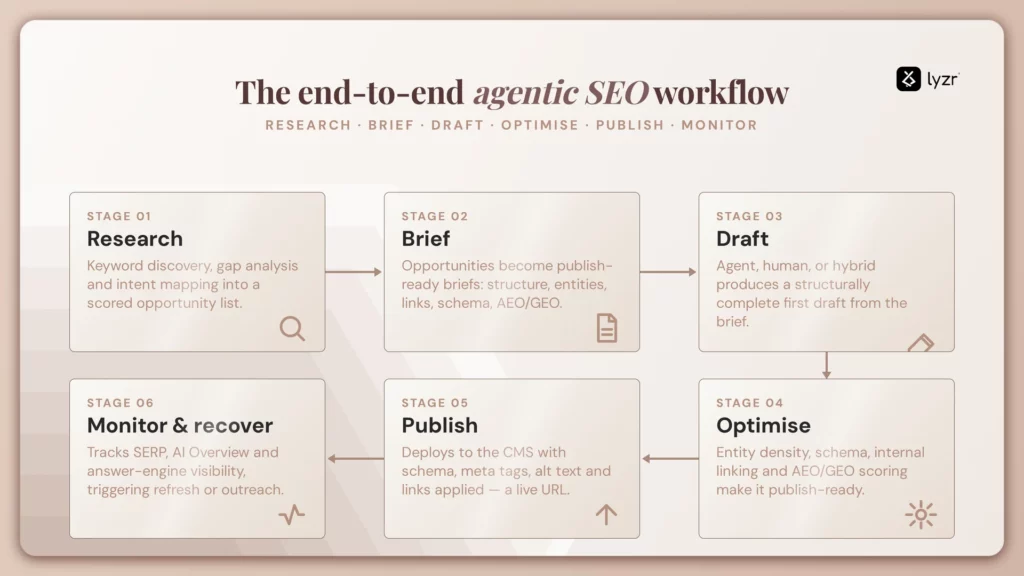
An AI SEO workflow is a structured sequence of SEO tasks where artificial intelligence tools perform, assist, or accelerate critical activities. Unlike ad‑hoc automation, the term refers to a deliberate pipeline that mirrors the classic SEO process — research, strategy, execution, measurement — but each stage is turbocharged by natural language processing, predictive algorithms, and generative models. The keyword AI SEO workflow itself signals a shift from using AI as a writing assistant to integrating it into the operational backbone of an SEO program.
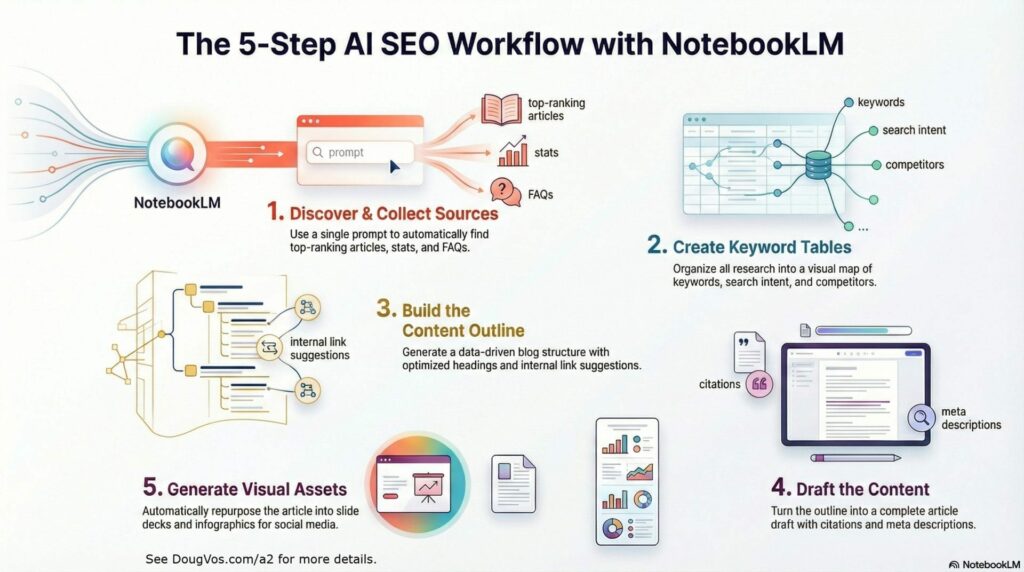
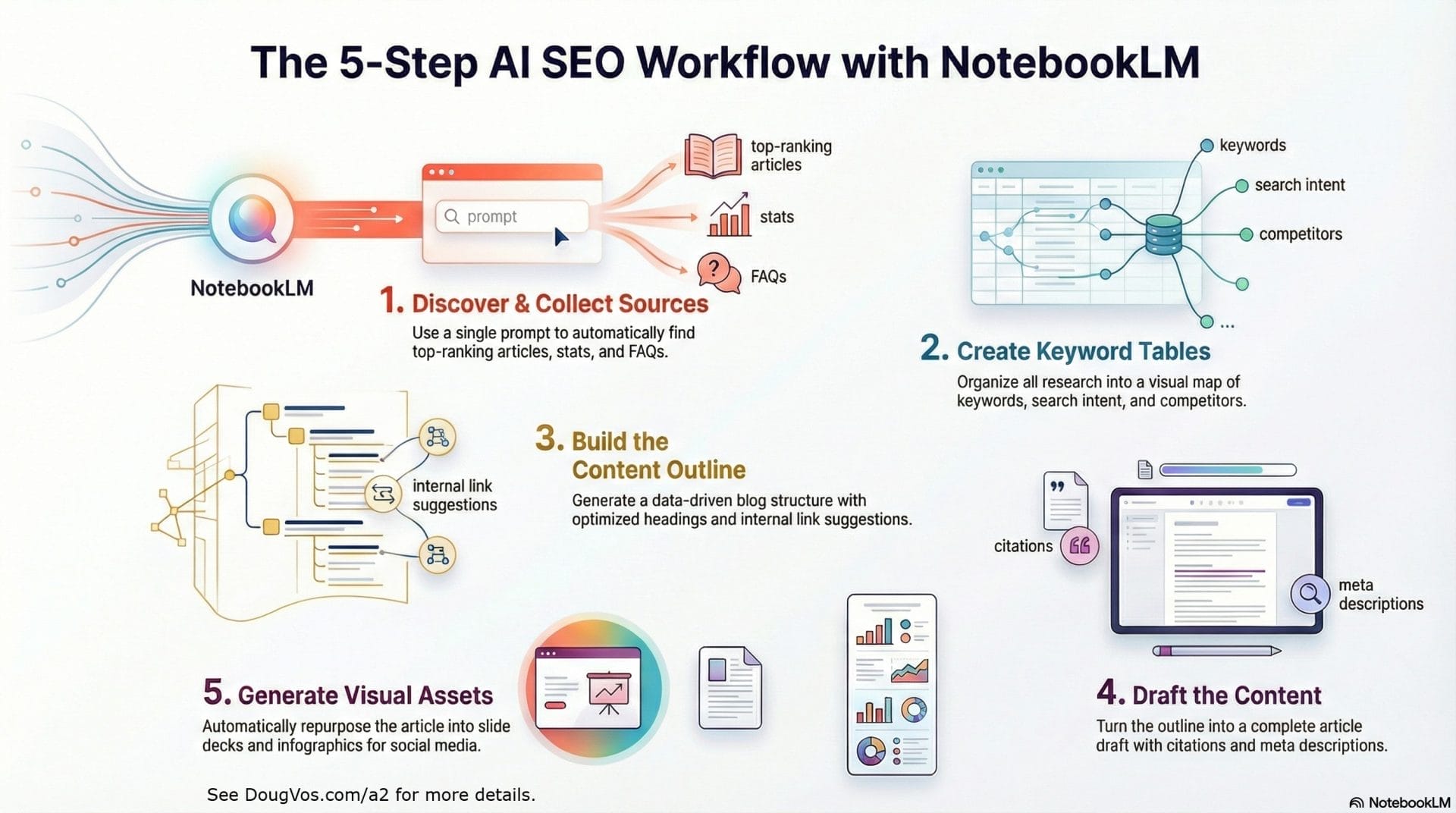
For many practitioners, the workflow begins with AI‑powered keyword research and topic modeling. It flows into content briefs and drafts shaped by semantic analysis. It continues through automated on‑page optimization checks, technical crawling, and even outreach personalization. Finally, it loops back with intelligent reporting that highlights what moved the needle. Throughout this chain, the core philosophy remains the same: let machines handle data‑heavy, repetitive tasks while humans direct strategy, validate accuracy, and infuse real‑world experience into the content.
What Is an AI SEO Workflow?
At its simplest, an AI SEO workflow is the integration of artificial intelligence into every standard stage of search engine optimization. It is not a single piece of software but a deliberate configuration of tools like large language models, machine‑learning‑based rank trackers, and automated auditors. The goal is to compress timelines, improve consistency, and extract insights that a manual approach would miss. Sophisticated workflows use custom prompts, API connections, and proprietary data to guide AI outputs, ensuring they align with a brand’s voice, target audience, and the latest search engine guidelines.
What separates a true workflow from scattered tool usage is the handoff between stages. For example, keyword clusters generated by AI can directly inform a content brief, which then seeds a first draft, which then passes through an optimization layer that suggests internal links and schema markup — all without human copy‑pasting. A well‑built AI SEO workflow reduces cognitive load and allows SEO strategists to operate at a higher level, focusing on creative differentiation and high‑level planning.
The Core Components of an AI‑Driven SEO Process
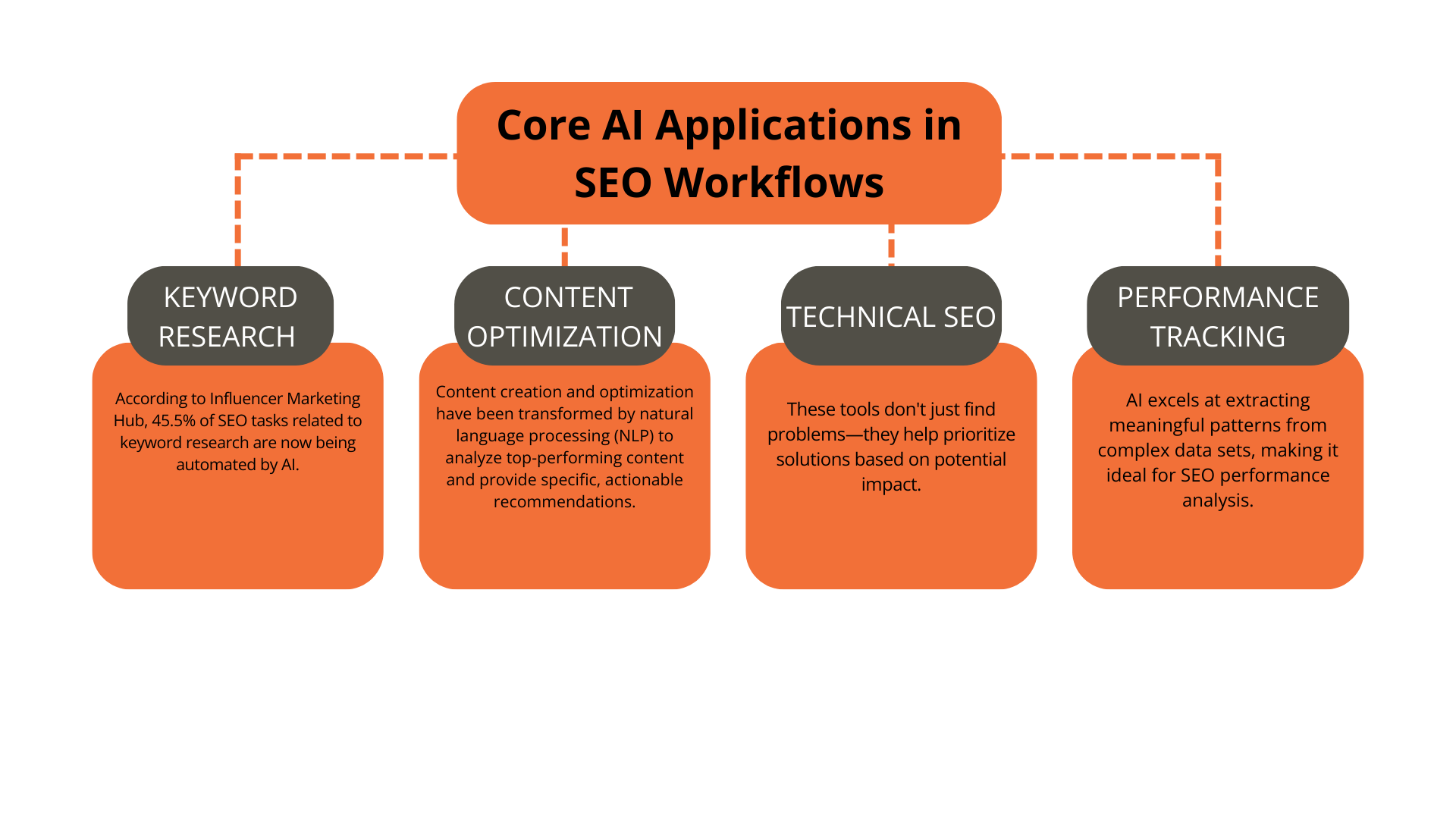
Mapping an AI SEO workflow requires breaking the classic SEO lifecycle into discrete components, then identifying where AI can create the most value. While every organization’s stack will differ, the following seven stages form the backbone of a robust system. Each component relies on a mix of generative AI, predictive models, and programmatic data processing.
1. Automated Keyword Research and Topic Clustering
Keyword research remains the foundation. AI transforms this stage by moving beyond simple volume metrics into intent classification, semantic grouping, and predictive trend analysis. Tools powered by machine learning can take a single seed keyword and generate thousands of related terms grouped by search intent — informational, commercial, navigational — and even predict which queries will gain traction in the coming months. The output is not a flat list but a topic map that reveals content gaps and pillar page opportunities.
Instead of manually tagging keywords in a spreadsheet, an AI SEO workflow uses natural language processing to cluster terms automatically. It can analyze competitor content landscapes, identify low‑competition gaps, and suggest topics where a site can realistically rank. This component alone can compress weeks of research into hours while surfacing non‑obvious semantic connections that fuel a more comprehensive content strategy.
2. AI‑Assisted Content Strategy and Brief Creation
Once topic clusters are defined, AI steps into planning mode. A strong workflow uses large language models to generate detailed content briefs that go far beyond a target keyword. These briefs include recommended word count, heading structure, questions to answer, entities to mention, and latent semantic keywords that reinforce topical authority. By ingesting top‑ranking pages, the AI can extract the common ground those pages cover and suggest angles that differentiate a new piece of content.
This stage prevents the “blank page” paralysis for writers and ensures every piece produced sits inside a strategic framework. Marketers can configure prompts to incorporate specific product features, regional nuances, or compliance requirements. The brief becomes the bridge between raw keyword data and creative execution, all while maintaining consistency across dozens of concurrent projects.
3. Generative AI for Drafting and Content Optimization
Drafting content with AI is the most visible part of the workflow. Modern large language models can produce complete, coherent articles, product descriptions, and meta tags when given a well‑structured brief. However, the true power in an AI SEO workflow is not the initial draft alone — it is the iterative optimization loop. AI can evaluate a draft against the top 20 search results, score its comprehensiveness, and suggest missing subheadings, data points, or expert quotes that would improve the entity footprint.
Tools that integrate content scoring, such as Surfer and Frase, use AI to compare on‑page elements and semantic richness with competitors. The workflow can automatically prompt a writer to expand sections where the draft falls short, and even rewrite paragraphs to improve readability and keyword distribution. At this point, human editors assert their authority by fact‑checking statistics, injecting original insights, and ensuring the piece reflects genuine experience — a crucial layer that Google’s helpful content system rewards.
4. On‑Page SEO Automation
On‑page optimization has always been detail‑intensive. An AI SEO workflow automates the creation of title tags, meta descriptions, and header tags that adhere to character limits and include primary and secondary keywords naturally. Beyond copy, AI can generate schema markup — Article, FAQ, Product, Review — directly from content, eliminating the need for manual JSON‑LD coding. Internal linking suggestions are another high‑impact automation: AI analyzes your entire site to recommend relevant anchor text and target pages, then can even implement those links within a CMS via API.
Image optimization also becomes smarter. AI‑driven alt text generation, compression, and structured data for images ensure that visual assets contribute to rankings rather than drag down page speed. The cumulative effect is a fully optimized page that would take a specialist hours to tune manually, now produced with minimal human nudging.
5. AI‑Powered Technical SEO Audits
Technical SEO has traditionally relied on crawlers like Screaming Frog that produce massive data dumps. Integrating AI changes the dynamic from data collection to intelligent diagnosis. A workflow can feed crawl results into a machine‑learning model trained to detect patterns like thin content clusters, inefficient internal linking, or indexation inefficiencies. Instead of sorting through thousands of rows, the system flags high‑priority issues and even writes human‑readable explanations of the problem and the fix.
Some platforms use predictive analysis to forecast how technical changes will impact organic traffic. For instance, an AI model can simulate the impact of reducing page load time by a certain percentage, or estimate the traffic lift from fixing a set of 404 errors. This prioritization ensures that developer resources are spent where they’ll generate the most return, making the entire technical pipeline more efficient.
6. Link Building and Outreach Automation
Link building remains one of the hardest SEO tasks to scale. An AI SEO workflow approaches it by automating prospect research, qualification, and personalized outreach drafting. AI can scrape and analyze domains for relevance metrics, social presence, and editorial quality, then assign a priority score. Generative models can craft outreach emails that reference specific content on the target site, increasing reply rates without sounding robotic.
For scalable content‑driven link building, AI can identify data‑driven or original research formats likely to attract backlinks and even help construct survey questions or data visualization ideas. While genuine relationship‑building still requires human warmth, the preparatory and repetitive work is entirely automatable within the workflow.
7. Performance Monitoring and Reporting with AI
The final loop of the workflow turns raw analytics into narratives. AI can connect ranking fluctuations and traffic changes to specific actions — a content refresh, a technical fix, a new backlink — and surface correlations that a data analyst might overlook. Natural language generation can then write an executive summary, complete with visualizations and actionable recommendations, delivered in a fraction of the time a manual report requires.
Advanced setups feed performance data back into the keyword research and content optimization modules, creating a continuous improvement cycle. Pages that underperform are flagged for rewriting, internal linking reinforcement, or merging. This self‑learning aspect elevates the AI SEO workflow from a static process to a dynamic growth engine.
Benefits and Limitations of an AI SEO Workflow
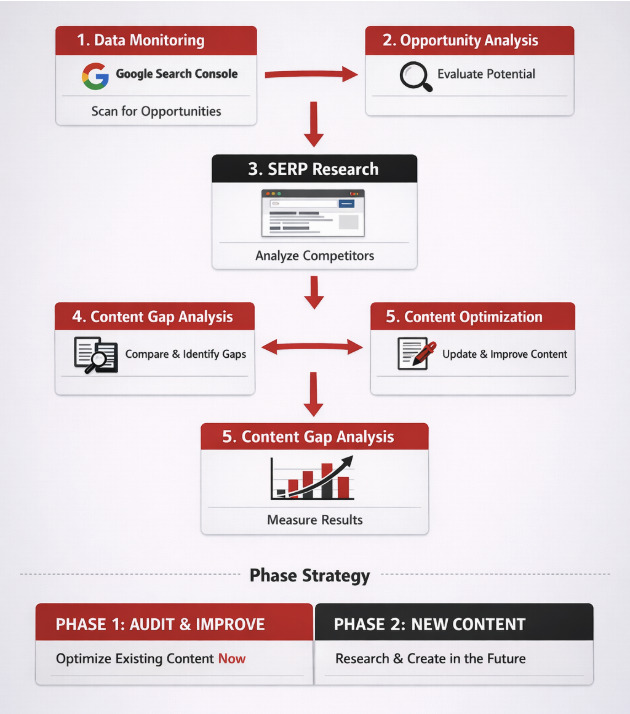
Adopting an AI SEO workflow offers transformative gains, but it also introduces risks that demand vigilant management. Understanding both sides is essential before investing heavily in automation.
Benefits:
- Speed: Tasks that took days — keyword clustering, content brief creation, technical audits — now complete in minutes.
- Scalability: Manage large‑scale campaigns across multiple regions and languages without linearly expanding headcount.
- Consistency: AI enforces brand tone, on‑page standards, and technical best practices uniformly across all pages.
- Data‑driven insights: Uncover patterns in search behavior and competitor strategy that would be impossible to spot manually.
- Reduced human error: Automated meta tag generation and link checks minimize typos and broken paths.
- Quality control: AI‑generated content can be factually wrong, superficially plausible but lacking depth, or repetitive.
- Over‑automation risk: Removing human oversight can result in thin, generic pages that fail E‑E‑A‑T standards.
- Model biases: Language models reflect the material they were trained on, sometimes propagating outdated or skewed information.
- Cost of tooling: Premium AI‑powered SEO platforms can be expensive, especially for smaller businesses.
- Algorithm sensitivity: Search engines penalize scaled content abuse; poorly implemented workflows can trigger manual actions.
- Blindly trusting AI output: Language models can fabricate statistics and attribute quotes to non‑existent sources. Always verify facts against primary data and authoritative references before publishing.
- Ignoring E‑E‑A‑T signals: Content that lacks genuine experience, expertise, authoritativeness, and trustworthiness will struggle. AI cannot replicate years of hands‑on industry work. Add author bios, case studies, and real‑world anecdotes manually.
- Over‑automating without quality gates: Publishing dozens of unedited AI pages daily often leads to index bloat and poor user signals. Set strict editing checkpoints and prioritize depth over volume.
- Using AI to spin content: Regurgitating competitor articles with rewording does not offer unique value and risks duplicate content filters. Command your AI to add original data, novel angles, or proprietary illustrations.
- Failing to update prompts for algorithm changes: Google’s guidelines evolve. An AI workflow built on last year’s assumptions may produce content that misses new ranking factors. Continuously review and refine your prompt library and compliance checks.
- Neglecting user intent: AI can optimize for keywords but misread why users search. Manually review the top search results for each target query to ensure your content matches the dominant intent.
Limitations:
Traditional SEO vs. AI SEO Workflow: A Comparative Look
The table below illustrates how a conventional manual SEO approach stacks up against a mature AI‑augmented workflow across critical dimensions.
| Aspect | Manual SEO | AI SEO Workflow |
|---|---|---|
| Time to complete keyword research | 10 – 20 hours for a mid‑sized site | 1 – 3 hours, with deeper intent analysis |
| Content production speed | 1 – 2 articles per writer per week | 5 – 10 polished articles per week with human edit |
| Accuracy of technical audits | Prone to human oversight errors | Machine‑precision with prioritized fixes |
| Scalability | Limited by team capacity | Near‑infinite scaling of foundational tasks |
| Cost | High labor cost over time | Upfront tool investment, lower marginal cost |
| Consistency | Varies by team member | Uniform output aligned with guidelines |
Step‑by‑Step Guide to Building Your Own AI SEO Workflow
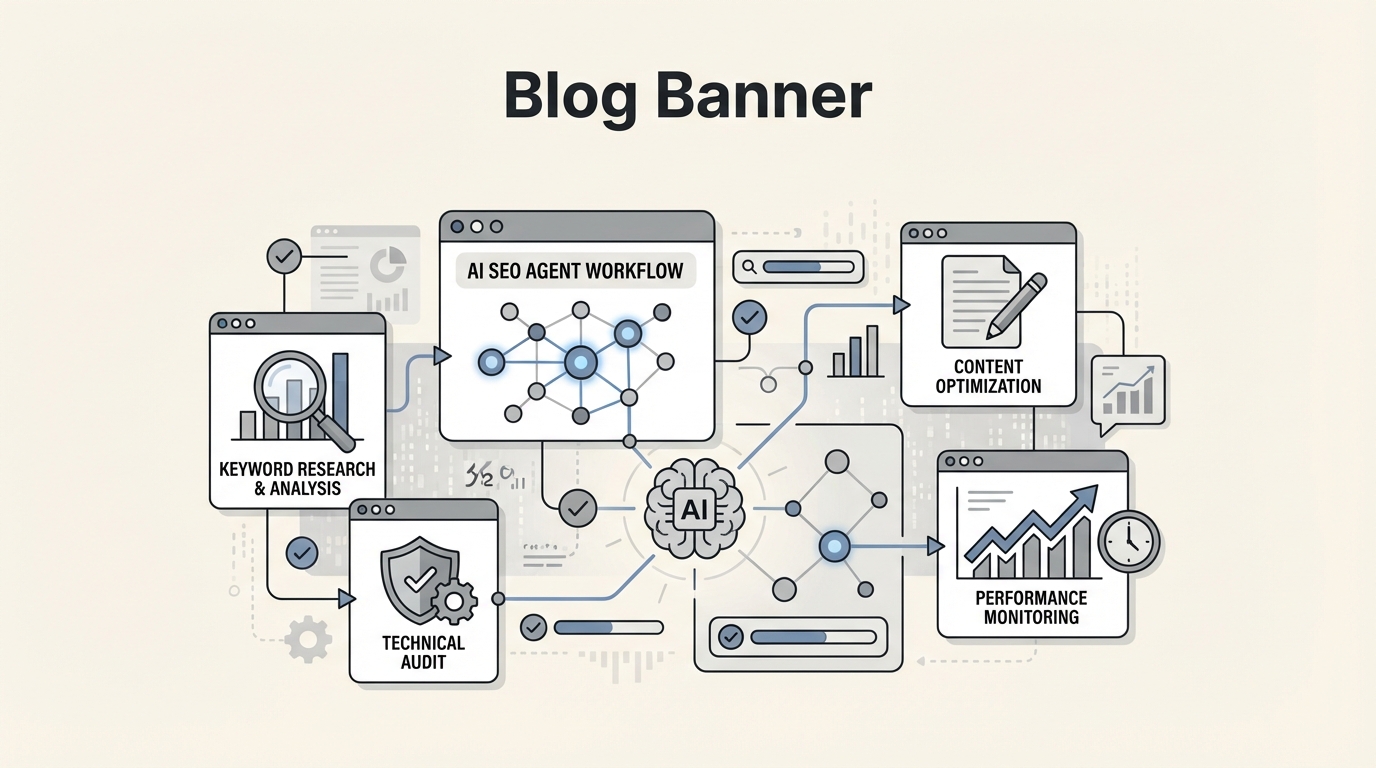
Constructing an AI SEO workflow does not require a complete overhaul overnight. The most effective implementations follow a phased roadmap, layering automation where it yields immediate improvements.
1. Define your SEO objectives and KPIs. Begin with clarity on what success looks like: organic traffic growth, lead generation, domain authority. Map KPIs like click‑through rate, average position, and conversion rate to each stage of the funnel. This up‑front work ensures the AI is optimizing for the right metrics and not just vanity outputs.
2. Select your AI tool stack. A realistic stack might combine a language model like GPT‑4 or Claude for drafts and briefs, a content optimization platform like SurferSEO, a technical crawler with AI integrations like Sitebulb or Screaming Frog’s machine‑learning features, an AI‑powered rank tracker like SE Ranking or Semrush, and a reporting layer that uses natural language generation. Start with interconnective tools that offer APIs or native integrations to reduce manual data transfer.
3. Build a central data repository. Whether via a shared spreadsheet, database, or cloud platform, all keyword research, content briefs, drafts, and performance data must feed into a single source of truth. This enables the AI to learn from previous iterations and prevents silos that break the workflow.
4. Create a content pipeline with a human‑in‑the‑loop checkpoint. Never let AI output go live without human review. The pipeline should enforce an editorial layer where experienced SEOs verify facts, inject unique experiences, and ensure the content genuinely helps users. This step is non‑negotiable for E‑E‑A‑T compliance.
5. Automate technical and on‑page checks. Set up scheduled crawls that feed into AI diagnostic tools. Configure alerts for sudden indexation drops, page speed regressions, and broken links. Implement auto‑generation of meta tags and schema within your CMS using AI‑based plugins.
6. Close the loop with AI‑driven reporting and iteration. Design reports that not only display numbers but also interpret them. A weekly AI digest might say: “The article on ‘AI SEO workflow’ climbed from position 9 to 4, likely driven by the internal links we added on Wednesday. Recommend refreshing the content with Q3 data to push toward position 1.” Use these insights to feed the next round of keyword research and optimization.
Common Mistakes When Adopting an AI SEO Workflow (and How to Avoid Them)
Even seasoned teams stumble when first embedding AI into SEO operations. Recognizing these pitfalls can save months of wasted effort and protect organic rankings.
Important Notes for Long‑Term Success
Sustaining gains with an AI SEO workflow means treating AI as an accelerator, not a replacement for strategic thinking. Keep human creativity at the center, using AI to handle the grind so that minds can focus on differentiation. Avoid the temptation to remove humans entirely from content sign‑off; Google’s algorithms are increasingly adept at detecting unoriginal, shallow material. Guard against duplicate content by ensuring each piece adds fresh value — AI can assist in identifying gaps, but the unique perspective must come from lived experience and subject‑matter expertise.
Transparency matters, too. While you do not need to label content as AI‑generated per se, never mislead users about who created it. Maintain editorial standards that align with journalistic integrity. Use AI for data‑heavy tasks like log file analysis, backlink profile auditing, and semantic gap identification, while reserving high‑stakes opinion pieces and thought leadership for human‑led creation. This balance is what builds domain authority and trust over time.
Frequently Asked Questions
What exactly is an AI SEO workflow?
An AI SEO workflow is a systematized sequence of search engine optimization activities where artificial intelligence tools perform or assist tasks such as keyword research, content creation, technical auditing, and performance analysis. It connects these stages into a coherent pipeline, reducing manual effort while maintaining strategic oversight.
Can AI completely replace human SEOs?
No. AI excels at data processing, pattern recognition, and repetitive generation, but it lacks genuine experience, contextual judgment, and the ability to build authentic relationships. Human SEOs remain essential for strategy, fact‑checking, editorial quality control, and injecting original insights that satisfy E‑E‑A‑T criteria.
Which AI tools are best for SEO automation?
The ideal stack depends on needs, but commonly used tools include large language models like ChatGPT and Claude for drafting; content optimization platforms like SurferSEO and Frase; technical auditors like Sitebulb; all‑in‑one suites like Semrush and Ahrefs with AI add‑ons; and reporting connectors like Looker Studio integrated with AI‑generated insights.
Will Google penalize AI‑generated content?
Google does not penalize content simply because AI assisted in its creation. Penalties arise from low‑quality, unhelpful, or spammy content, regardless of how it was produced. A properly managed AI SEO workflow that upholds quality standards and human review is consistent with Google’s guidelines.
How can I integrate AI into my existing SEO process without disruption?
Start small by automating one bottleneck — such as keyword clustering or meta description generation — and expand once the output proves reliable. Establish a clear review layer and measure the impact on efficiency and rankings before rolling AI into more sensitive areas like full content drafts.
Is an AI SEO workflow suitable for small businesses?
Yes. Small businesses can benefit immensely by using affordable AI tools to handle research, optimize existing pages, and generate content briefs without hiring additional staff. The key is to stay focused on high‑intent topics and use human editing to keep content authentic and locally relevant.
How do I measure the ROI of an AI SEO workflow?
Track time saved on routine tasks, increase in organic traffic, improvement in keyword rankings, and growth in qualified leads or revenue. Compare these metrics before and after implementing the workflow, while also monitoring content quality scores and user engagement metrics to ensure automation does not degrade experience.
Conclusion
An AI SEO workflow redefines what is possible in organic search. It transforms SEO from a series of painstaking manual tasks into a scalable, intelligent system that learns and adapts. The efficiency gains are undeniable — weeks of research compressed, content production multiplied, technical health continuously monitored — all while freeing human talent for high‑value creativity and strategy. Yet the path demands discipline. The winning formula couples AI’s speed and analytical firepower with rigorous human oversight, a commitment to factual accuracy, and an unwavering focus on user value. Organizations that embed this balanced approach will not only climb the rankings faster but will also build the kind of authentic authority that endures algorithm shifts and competitive pressures. The future of SEO is not about choosing between human and machine — it is about designing workflows where both thrive together.
Xem thêm:
- AI SEO Growth Strategy: The Complete Blueprint for Sustainable Organic Traffic in 2025
- AI SEO External Links: The Complete Guide to Smarter Link Building in 2025
- AI SEO Navigational Intent: The Complete Guide to Winning Brand Searches in 2025
- AI SEO Platform: The Definitive Guide to Automating Search Dominance
- AI SEO URL Generator: The Complete Guide to Automated Link Optimization
Bài viết cùng chủ đề:

AI SEO SEO Automation with Make: The Complete Workflow Guide

AI SEO SEO Automation with Zapier: The Complete Workflow Guide

AI SEO SEO Automation with n8n: The Complete Workflow Guide
AI SEO SEO Automation with Gemini: The Complete Guide to Scaling Organic Growth

AI SEO SEO Automation with Claude: The Complete Guide to Scaling Content in 2025

AI SEO SEO Automation with ChatGPT: The Complete Playbook for 2025

AI SEO & SEO Automation for Affiliate Sites: The 2025 Playbook for Passive Income Growth
AI SEO & SEO Automation for Bloggers: The Complete Guide to Scaling Your Content

AI SEO & SEO Automation for Agencies: The Complete 2025 Playbook

AI SEO and SEO Automation for Ecommerce: The Complete Playbook for 2025

AI SEO & SEO Automation for WordPress: The Complete Playbook for 2025
AI SEO SEO Automation Strategy: The Complete Playbook for 2025

Mastering the AI SEO SEO Automation Process: A Complete Guide to Scaling Organic Growth
AI SEO SEO Automation System: The Complete Guide to Scaling Organic Growth in 2025
AI SEO SEO Automation Platform: The Complete Guide to Scaling Organic Growth in 2025
AI SEO SEO Automation Software: The Complete Guide to Scaling Organic Growth in 2025















