
No products in the cart.
AI Shopify SEO: The Ultimate Guide to Dominating Search Rankings with Artificial Intelligence
29
Jul
Jul
In the competitive landscape of ecommerce, simply launching a Shopify store isn’t enough. You need a steady stream of organic traffic to scale profitably. This is where AI Shopify SEO comes into play — a fusion of artificial intelligence and proven search engine optimization strategies specifically built for the Shopify platform. By automating keyword research, content creation, technical audits, and competitor analysis, AI Shopify SEO empowers store owners to outrank competitors without hiring a large marketing team.
With Google’s algorithms becoming more sophisticated, traditional manual SEO tactics often fall short. AI-powered tools can process millions of data points, identify patterns, and implement optimizations at a speed and scale impossible for humans. This guide breaks down everything you need to know about leveraging AI for your Shopify store’s search performance — from foundational concepts to advanced implementation.
What Is AI Shopify SEO and How Does It Work?
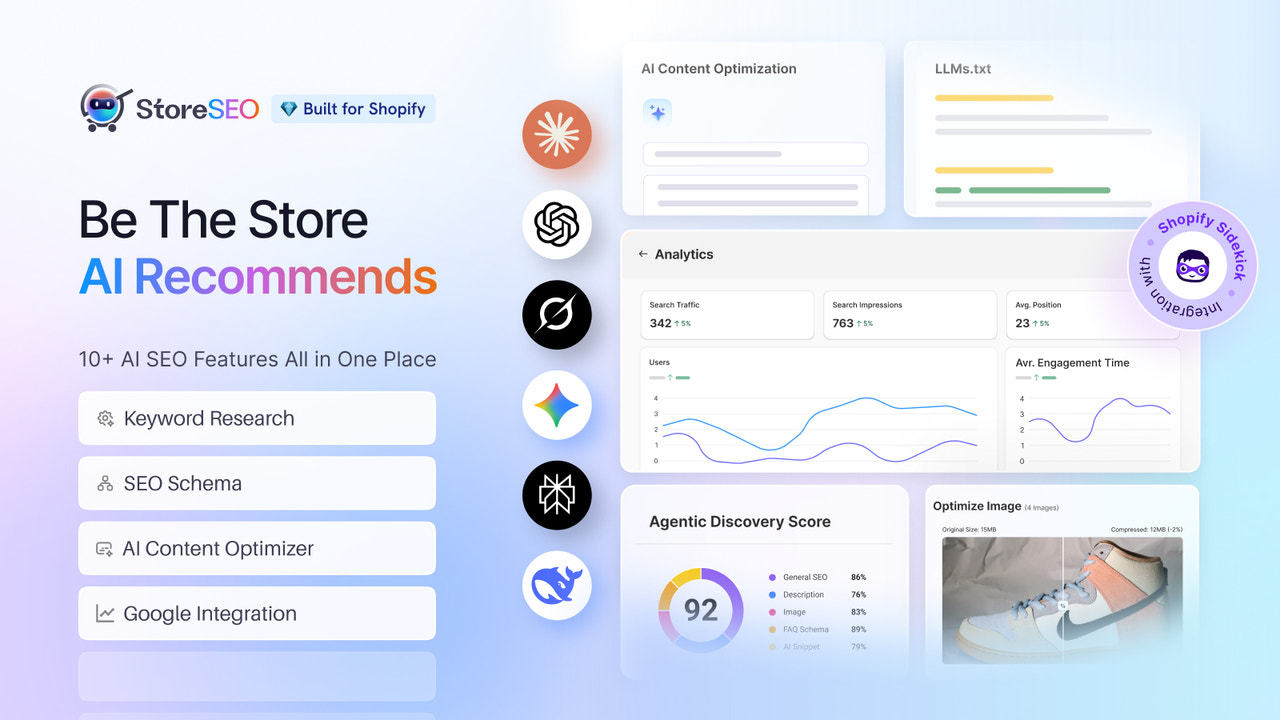
AI Shopify SEO refers to the application of machine learning, natural language processing, and automation to improve a Shopify store’s visibility in organic search results. Unlike generic SEO, this approach is tailored to Shopify’s specific architecture — handling product pages, collections, blog content, and the platform’s unique URL structure.
The core mechanism relies on AI algorithms that analyze search intent, semantic relevance, and hundreds of ranking factors. For instance, AI content tools can generate optimized product descriptions that match what Google looks for, while technical SEO crawlers instantly find duplicate content, broken links, or missing meta tags that would otherwise go unnoticed for months.
Typical AI Shopify SEO workflows include:
- Automated site audits that detect canonical tag issues, slow-loading pages, and mobile usability problems specific to Shopify themes.
- AI keyword clustering that groups thousands of product-related queries into topic clusters for siloed content strategies.
- Dynamic optimization of alt text, title tags, and meta descriptions based on real-time competitor data.
- Content gap analysis that reveals underserved search queries your store can dominate.
- Dramatic efficiency gains: Tasks that used to take weeks — like rewriting 500 product descriptions or fixing all broken internal links — can now be completed in hours with near-human quality.
- Data-driven decision making: Instead of guessing which keywords to target, AI provides exact traffic potential, difficulty scores, and conversion probability for each term, ensuring you invest in profitable search opportunities.
- Continuous adaptation to algorithm changes: AI tools monitor Google updates in real time and automatically adjust your store’s SEO posture, protecting rankings during core updates.
- Scalability without proportional cost increase: A store growing from 500 to 10,000 products doesn’t need to hire an army of SEO specialists; AI handles the increased workload seamlessly.
- Improved user experience: AI-driven site speed optimization and mobile enhancement directly improve Core Web Vitals, a confirmed ranking factor that also reduces bounce rates and increases conversions.
- Primary keyword in the H1 title and within the first 100 words.
- Semantically related terms sourced from top-ranking competitor pages.
- Internal links to relevant collection pages and complementary products.
- A compelling call-to-action that aligns with search intent.
- Publishing AI content without human editing: Raw output often lacks brand personality and can include factual inaccuracies. Always have a human review key pages.
- Neglecting site speed while optimizing content: Adding heavy AI widgets or oversized images to implement recommendations can tank Core Web Vitals. Use AI to compress images and defer non-critical scripts.
- Over-optimizing anchor text in internal links: AI tools may aggressively insert exact-match anchor text, which looks unnatural. Set rules for varied, descriptive linking.
- Ignoring product data feed optimization: Many AI tools consume your feed but if the feed itself has errors (e.g., missing GTINs), the AI’s output will be flawed. Clean your feed first.
- Focusing exclusively on Google: AI Shopify SEO should also target Bing, Pinterest, and YouTube depending on your niche. Diversify your approach.
Key Components of an AI Shopify SEO Strategy
A comprehensive AI-driven approach goes far beyond a single plugin. It integrates multiple layers of optimization, each supercharged by machine learning. Understanding these components is essential before you invest in any tool or service.
Automated Technical SEO for Shopify
Shopify’s templated system often creates duplicate product variants, thin category pages, and inefficient internal linking. AI crawlers like Botify or DeepCrawl can map your entire store structure and identify canonicalization errors, orphan pages, and index bloat. More advanced tools use predictive analytics to suggest which pages Google is likely to prioritize and which need immediate fixing.
AI also handles structured data markup automatically. Rich snippets for product reviews, pricing, and availability can be dynamically injected, improving click-through rates from search results. This level of automation ensures that every product variant receives schema markup without manual effort, something nearly impossible for stores with thousands of SKUs.
AI-Powered Keyword Research and Topic Modeling
Traditional keyword tools provide a static list of terms. In contrast, AI Shopify SEO tools analyze the entire search landscape for your niche, detecting trending queries, seasonal spikes, and long-tail opportunities with high commercial intent. They use neural networks to understand user intent behind each search, ensuring your content matches what shoppers actually want.
For example, AI might reveal that “buy organic cotton hoodie under $50” converts 3 times better than the generic keyword “cotton hoodie.” These insights allow you to prioritize product page optimizations and blog content that directly impacts revenue. Tools like ChatGPT’s API can even generate hundreds of long-tail keyword variants paired with buyer intent analysis.
AI Content Generation and On-Page Optimization
Content creation remains the most visible application of AI Shopify SEO. Today’s large language models can produce product descriptions, category page text, and blog posts that read naturally and follow SEO best practices. However, the true power lies in real-time on-page optimization. AI tools can analyze top-ranking competitors for any query and then recommend — or automatically implement — changes to your heading structure, internal links, and keyword density.
Some Shopify apps now integrate AI writing capabilities directly into the admin panel. Store owners can generate unique product descriptions in seconds, avoiding the duplicate content penalties that plague dropshipping stores. Advanced systems even A/B test different meta descriptions and titles, learning which variants achieve higher organic CTR.
Competitor Intelligence and Rank Tracking
AI doesn’t just track your rankings; it deciphers why competitors are outperforming you. By analyzing backlink profiles, content freshness scores, and on-page signals of the top 10 results for any keyword, AI can reverse-engineer Google’s ranking decisions. This competitive intelligence feeds directly into your optimization plan, highlighting exactly what you need to improve to leapfrog competitors.
Some AI platforms provide daily rank fluctuation alerts tailored to your Shopify store’s most valuable keywords. When a competitor publishes new content or gains a high-authority link, you receive actionable notifications rather than just data dumps.
Benefits of Integrating AI into Your Shopify SEO
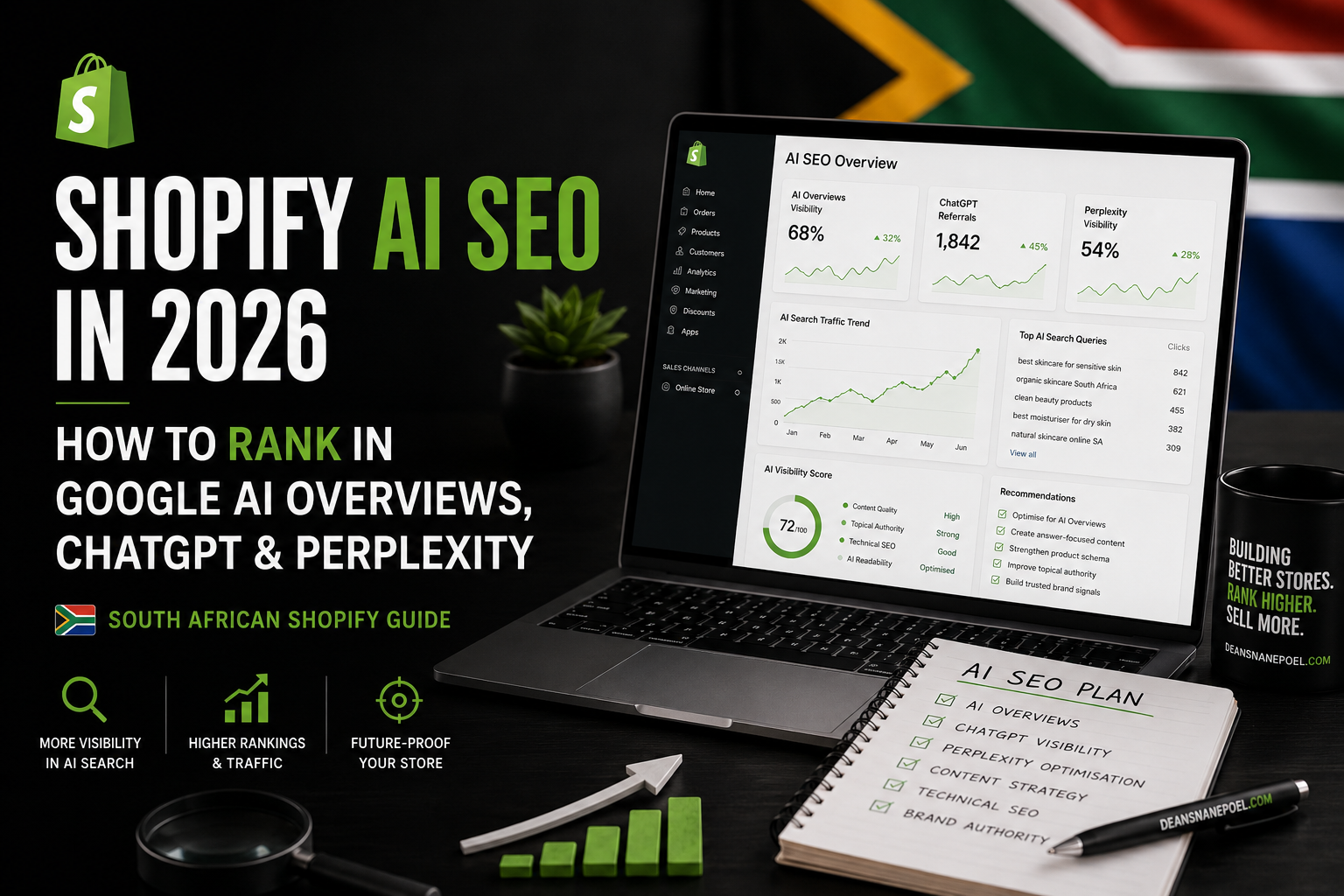
Adopting AI for Shopify SEO delivers measurable advantages that go far beyond time savings. Here are the core benefits experienced by real store owners who have made the shift.
Limitations and Potential Pitfalls to Watch For
While AI Shopify SEO offers immense potential, it is not a magic button. Over-reliance without human oversight can lead to significant issues. Understand these limitations to deploy AI responsibly.
The most common drawback is generic, low-value content. If you simply prompt an AI to “write a product description,” the output may lack brand voice, emotional persuasion, or unique selling points. Google’s helpful content system actively penalizes content written purely for search engines rather than for people. Always augment AI-generated text with original insights, customer reviews, and brand storytelling.
Another risk is technical misconfigurations. An AI might auto-generate canonical tags that inadvertently point to the wrong product variant, causing indexing problems. Similarly, aggressive automated internal linking can create link schemes that appear manipulative. A human audit layer is essential to catch these errors before they harm rankings.
Data privacy and security also matter. Some AI tools require access to your full store data and analytics. Ensure you use reputable platforms that comply with GDPR and do not share your proprietary business intelligence.
AI Shopify SEO vs. Manual Shopify SEO: A Detailed Comparison
The difference between manual execution and AI-augmented workflows is stark. The table below highlights how they compare across key SEO dimensions.
| SEO Task | Manual Approach | AI Shopify SEO Approach |
|---|---|---|
| Keyword Research | Spreadsheet-based, limited to 50–100 terms, often outdated within weeks. | Dynamic mining of thousands of keywords with real-time trend data and intent classification. |
| Product Page Optimization | Writing unique descriptions for each product takes days; easily duplicates content. | AI generates unique, optimized descriptions at scale while adjusting for keyword cannibalization. |
| Technical Audits | Quarterly crawls that provide static report; errors often fixed months later. | Continuous monitoring with instant alerts and automatic fixes for common Shopify issues. |
| Content Strategy | Guessing blog topics based on intuition or a handful of competitors. | AI identifies content gaps, clusters topics, and predicts traffic potential with high accuracy. |
| Rank Tracking | Weekly checks on 20–30 keywords; no insight into why ranks changed. | Daily tracking of thousands of keywords with correlation analysis against competitors’ moves. |
| Time Investment | 20–40 hours per week for a medium-sized store. | 5–10 hours per week, with most repetitive tasks fully automated. |
Practical Step-by-Step Guide to Implementing AI Shopify SEO
Getting started with AI-driven optimization doesn’t require a massive budget or technical background. Follow this structured plan to systematically upgrade your store’s SEO performance using AI tools available today.
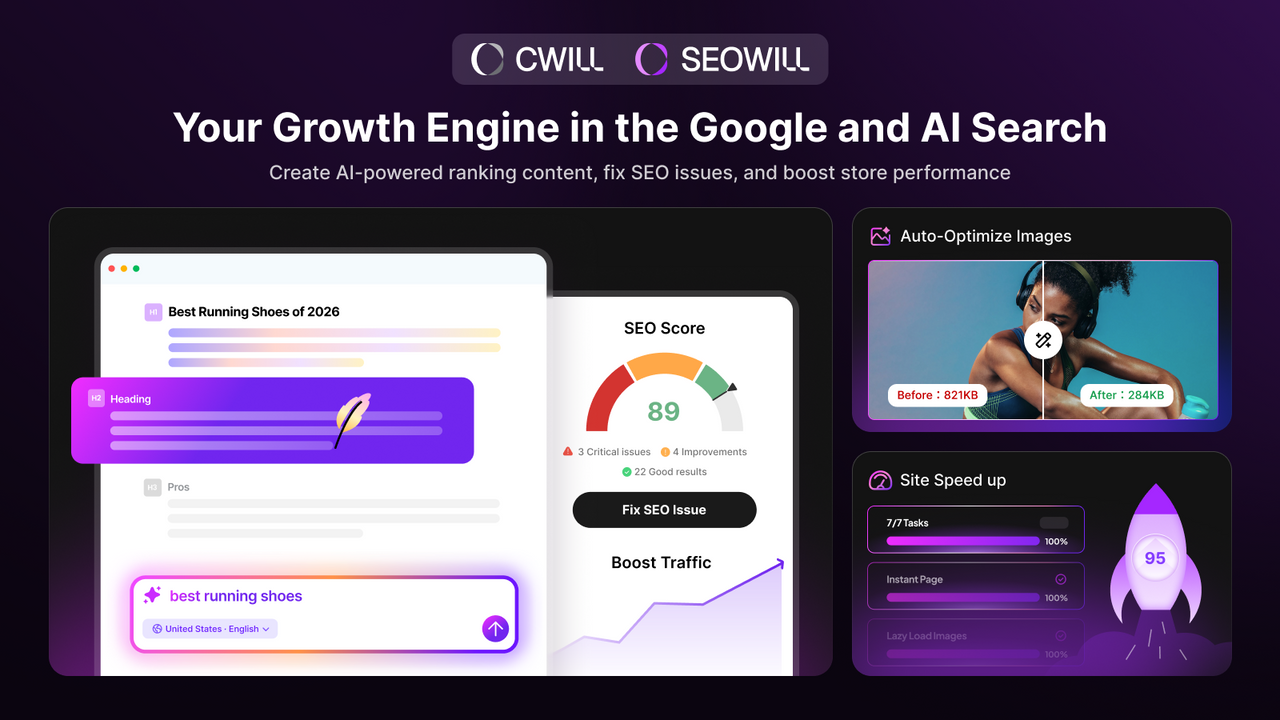
Step 1: Run a Full AI-Powered Site Audit
Begin by connecting your Shopify store to an AI audit tool such as Ahrefs, Semrush, or the specialized Shopify app “SEO Manager.” The A It will also prioritize fixes based on potential ranking impact. For example, a single broken canonical tag on a collection page might be hurting thousands of product variants. Address these critical issues first.
Step 2: Build an AI-Driven Keyword Universe
Export your product feed and feed it into an AI keyword research platform. The tool will automatically map your products to search queries, including long-tail variations like “size large red wool sweater for women” that are often ignored. Use intent filters to separate informational (“how to style a sweater”) from transactional (“buy red wool sweater”) keywords. This segmentation directs the right content type — blog posts for informational, product pages for transactional.
Step 3: Generate and Optimize High-Impact Content
For each high-priority keyword, use an AI writing assistant integrated with your Shopify CMS. Generate a first draft of product descriptions or blog posts, then layer in the following:
Publish the content and track its indexation using Shopify’s Google Search Console integration. AI tools can alert you if pages aren’t indexed within 48 hours, allowing immediate resubmission.
Step 4: Automate Technical SEO Maintenance
Set up recurring AI-driven crawls that automatically monitor broken links, redirect chains, and page speed regressions. Many modern tools can even auto-heal common Shopify technical issues — like correcting hreflang tags for multilingual stores — without manual intervention. Schedule weekly reports that highlight new errors, and ensure your AI tool sends instant notifications for critical failures like a drop in mobile usability score.
Step 5: Let AI Handle Schema Markup and Structured Data
Install an AI schema generator that dynamically adds Product, Organization, and BreadcrumbList structured data to every page. The tool should validate the markup against Schema.org standards and Google’s Rich Results Test. This automation ensures your product prices, availability, and review stars appear in search results, significantly boosting organic CTR.
Common Mistakes When Using AI for Shopify SEO and How to Avoid Them
Even sophisticated AI can lead you astray without proper guardrails. Avoid these frequent errors that store owners make.
Important Notes for Long-Term AI Shopify SEO Success
AI is a tool, not a replacement for a solid SEO foundation. Keep these principles in mind as you scale.
First, Google’s algorithms value expertise and authentic user experience. Use AI to amplify your unique insights — never to fabricate authority. Product pages should incorporate real customer testimonials, detailed sizing information, and original photography that AI alone cannot provide.
Second, track user engagement metrics tightly. If AI-optimized pages receive traffic but high bounce rates, the content isn’t meeting searcher needs. Pair AI optimization with user behavior analytics to fine-tune messaging.
Finally, the regulatory landscape around AI-generated content is evolving. Disclose AI usage where appropriate, and ensure your content meets the E-E-A-T guidelines — Experience, Expertise, Authoritativeness, and Trustworthiness — by attributing medical, financial, or legal advice to qualified professionals if your store sells in those verticals.
Frequently Asked Questions About AI Shopify SEO
Can AI completely replace a human SEO expert for Shopify?
AI can automate up to 80% of repetitive SEO tasks, but strategic planning, brand voice crafting, and complex troubleshooting still require human expertise. The best results come from human-in-the-loop workflows where AI handles volume and humans handle nuance.
Which AI tools are best for Shopify SEO?
The ideal stack varies by budget. For content generation, Jasper and ChatGPT integrated with Shopify apps like “AI Product Description” work well. For technical SEO and keyword research, Semrush, Ahrefs, and SurferSEO offer robust AI features. All-in-one Shopify SEO apps like Plug in SEO and Booster SEO now include AI-driven recommendations.
Does AI Shopify SEO work for new stores with no domain authority?
Yes. AI can accelerate the foundational optimization process, ensuring your site structure, on-page elements, and content are perfectly aligned with search intent from day one. This gives new stores a competitive edge by eliminating early technical debt that often plagues manual setups. However, link-building and authority growth still take time and human-led outreach.
Will using AI-generated content get my Shopify store penalized by Google?
Not if the content is helpful, original, and edited for quality. Google’s guidelines target content created primarily to manipulate rankings, not the tool used to create it. If AI content provides genuine value and meets E-E-A-T standards, it ranks just as well as human-written text. The key is substantial human review and value addition.
How fast can I see results from AI Shopify SEO?
Technical fixes and on-page optimizations can be implemented within days, and indexing improvements often show within 1–2 weeks. However, significant ranking improvements for competitive terms typically take 3–6 months. AI accelerates the groundwork, but SEO remains a long-term investment.
Is AI Shopify SEO suitable for stores with a small number of products?
Absolutely. Smaller stores benefit from hyper-targeted keyword identification and competitor analysis that AI provides. A 20-product store can still use AI to uncover niche queries and create in-depth category content that drives high-converting traffic.
Conclusion
AI Shopify SEO represents the new standard for ecommerce growth. It transforms search optimization from a manual, guesswork-heavy chore into a precise, data-backed science. By automating technical audits, content creation, and competitor monitoring, AI allows Shopify merchants of any size to compete effectively in organic search — without ballooning costs. The key to lasting success is combining AI’s efficiency with human creative judgment and strategic oversight. Start with a comprehensive audit, embrace iterative testing, and let AI handle the repetitive heavy lifting so you can focus on building a brand that resonates with real customers.
Xem thêm:
- How to Use Perplexity for SEO: The Ultimate Guide to AI-Powered Search Insights
- AI SEO Roadmap: The Complete 12-Month Strategy for 2025 and Beyond
- AI SEO Unlinked Mentions: The Complete Guide to Turning Brand Mentions into Backlinks
- AI SEO Keyword Intent: The Complete Guide to Search Intent Optimization in 2025
- AI SEO Reports: How Intelligent Automation Redefines Search Performance Analysis
Bài viết cùng chủ đề:

AI SEO SEO Automation with Make: The Complete Workflow Guide

AI SEO SEO Automation with Zapier: The Complete Workflow Guide

AI SEO SEO Automation with n8n: The Complete Workflow Guide
AI SEO SEO Automation with Gemini: The Complete Guide to Scaling Organic Growth

AI SEO SEO Automation with Claude: The Complete Guide to Scaling Content in 2025

AI SEO SEO Automation with ChatGPT: The Complete Playbook for 2025

AI SEO & SEO Automation for Affiliate Sites: The 2025 Playbook for Passive Income Growth
AI SEO & SEO Automation for Bloggers: The Complete Guide to Scaling Your Content

AI SEO & SEO Automation for Agencies: The Complete 2025 Playbook

AI SEO and SEO Automation for Ecommerce: The Complete Playbook for 2025

AI SEO & SEO Automation for WordPress: The Complete Playbook for 2025
AI SEO SEO Automation Strategy: The Complete Playbook for 2025

Mastering the AI SEO SEO Automation Process: A Complete Guide to Scaling Organic Growth
AI SEO SEO Automation System: The Complete Guide to Scaling Organic Growth in 2025
AI SEO SEO Automation Platform: The Complete Guide to Scaling Organic Growth in 2025
AI SEO SEO Automation Software: The Complete Guide to Scaling Organic Growth in 2025















