
No products in the cart.
AI Topic Clusters: The Smarter Way to Build Authority and Rank Higher With Semantic SEO
29
Jul
Jul
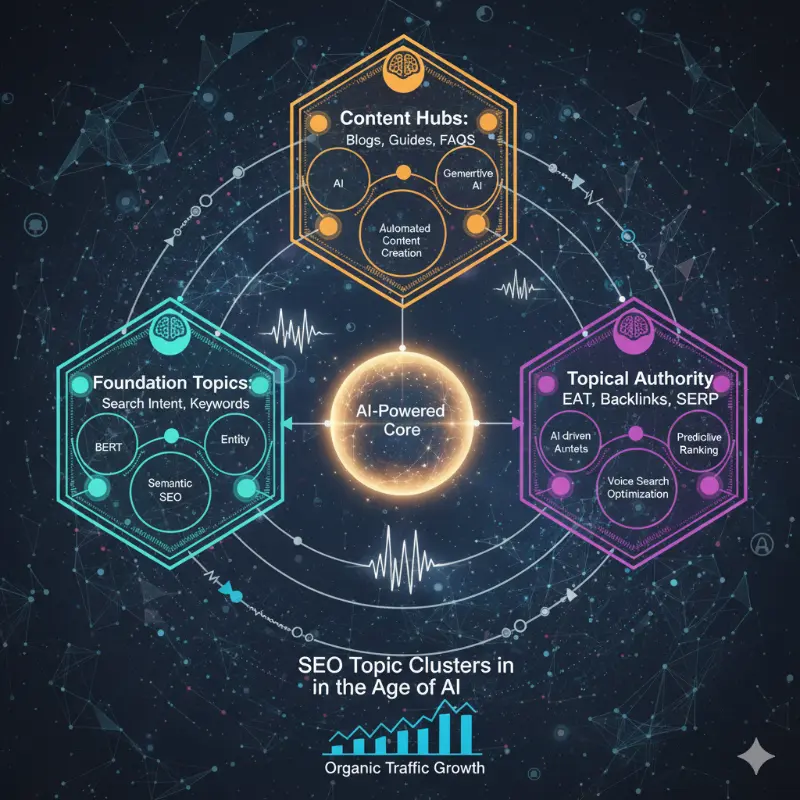
Content strategy has shifted dramatically over the last decade, drifting from isolated keyword targeting toward interconnected webs of meaning. At the heart of this evolution sits the concept of AI topic clusters — a methodology that uses artificial intelligence to intelligently group related content around a central pillar page. When search engines like Google prioritize topical authority and contextual depth, relying on manual keyword grouping simply can’t keep pace. AI topic clusters automate discovery, analyze search intent at scale, and surface content gaps that humans might miss, giving modern SEO teams a decisive competitive advantage. Understanding how to build and optimize these clusters means moving beyond a list of keywords and into a dynamic, machine-assisted content architecture that signals expertise to both users and algorithms.
What Are AI Topic Clusters?
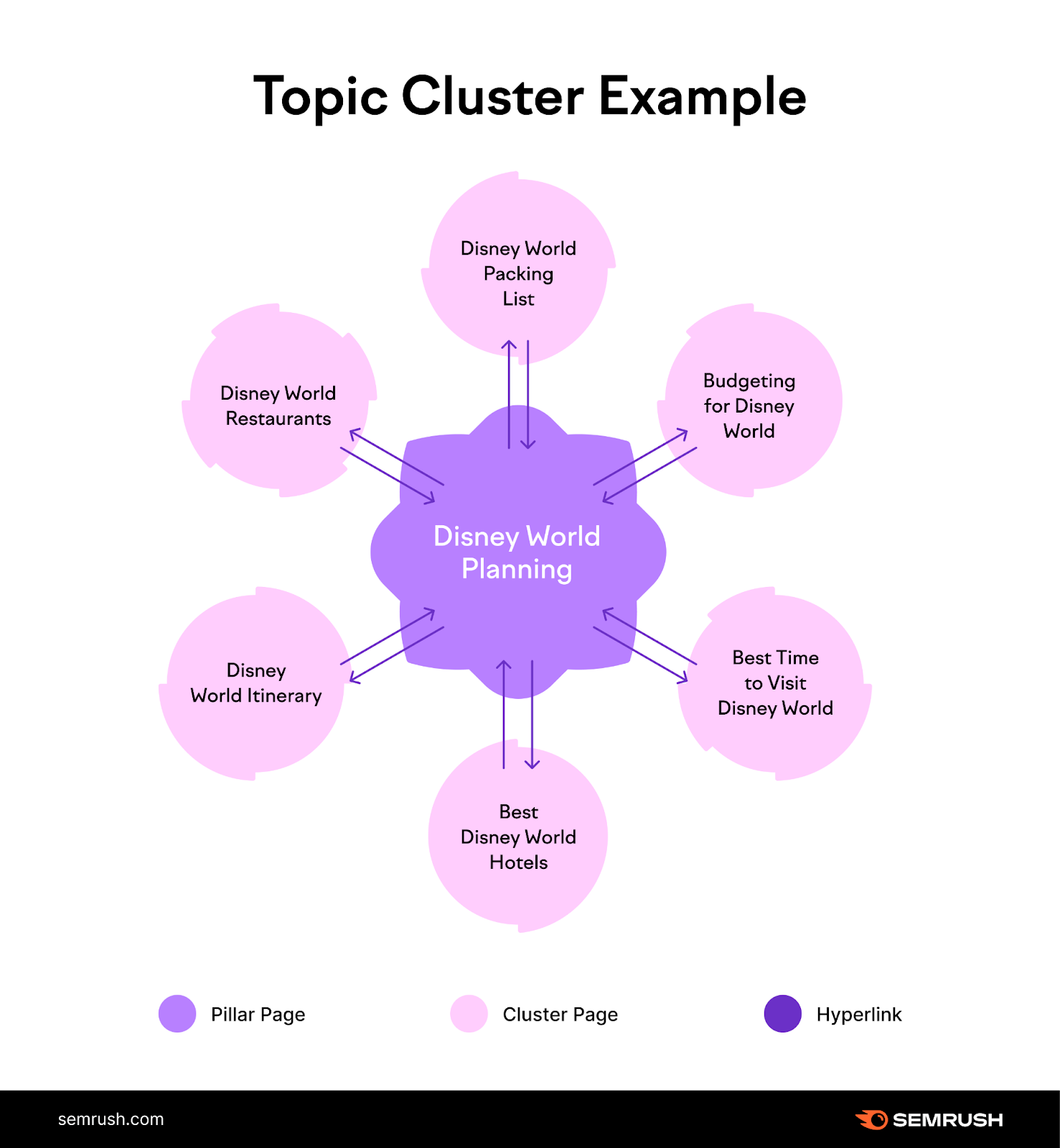
An AI topic cluster is a content framework built with the help of machine learning algorithms that model the relationship between a main pillar topic and all supporting subtopics. The pillar page covers a broad subject area in depth, and cluster pages dive into granular, intent-specific angles, all linked together with a strategic internal linking structure. Artificial intelligence transforms this traditional model by analyzing thousands of search queries, competitor pages, user behavior signals, and natural language patterns to identify the precise clusters that will improve organic visibility.
Instead of manually brainstorming blog post ideas, AI tools ingest SERP data, semantic relationships, and even entity recognition from Google’s own Knowledge Graph to suggest pillars and clusters that align with how modern search engines interpret authority. The AI doesn’t just group keywords; it maps out the entire topic universe, revealing subtopics that share the same user intent even when the phrasing differs. This approach ensures that your site covers a subject comprehensively, signaling to Google that you are a trustworthy source rather than a thin collection of loosely related articles.
How AI Powers Semantic Discovery
Traditional clustering relies heavily on human intuition and keyword research tools that look at phrase match and volume. AI topic clusters take a radically different approach by employing natural language processing (NLP) and deep learning models trained on vast corpora of web content. These models understand that “symptoms of dehydration” and “signs you need more water” are conceptually linked, even if they share no lexical overlap.
By analyzing top-ranking pages for a seed topic, AI identifies entities, questions, and NLP-friendly subtopics that Google itself considers relevant. For example, a human might cluster “digital marketing strategy” with “SEO tips” and “social media calendar,” but an AI model might surface “marketing operations framework,” “attribution modeling for small business,” and “content supply chain” as essential subtopics that competitors are covering and searchers are actively querying. This semantic richness is what pushes topic clusters from adequate to genuinely authoritative.
How AI Topic Clusters Work: The Underlying Process
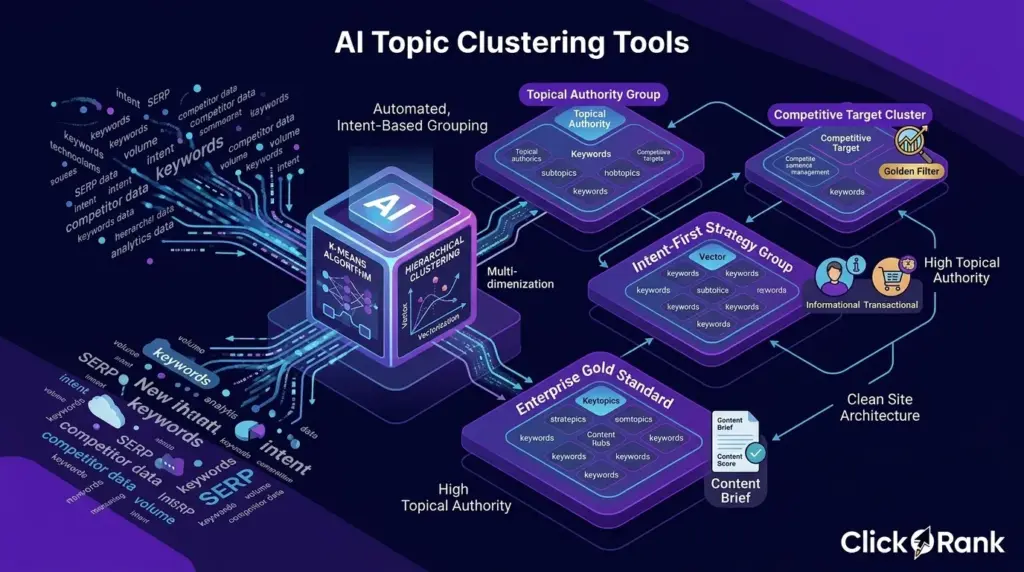
Building AI topic clusters isn’t magic — it’s a repeatable process powered by data. The typical workflow starts with a broad seed keyword or business objective. The AI engine scans search engine results pages, pulling everything from featured snippets and “People Also Ask” boxes to related searches and autocomplete suggestions. Simultaneously, it crawls competitor sites to map out their topical coverage and content depth.
Next, the AI applies clustering algorithms like k-means, hierarchical clustering, or more advanced transformer-based models such as BERT to group queries and topics by shared intent and semantic similarity. A visualization of topic clusters might show a central pillar surrounded by tightly connected nodes, each representing a high-value cluster page. The output is a detailed content brief: pillar page structure, list of cluster topics with target keywords, internal linking recommendations, and even an analysis of missing subtopics — content gaps that represent ranking opportunities nobody in your niche has addressed yet.
Real-World Data Intelligence in Action
Consider an e-commerce brand selling sustainable pet products. Manually, they might create a pillar page about “eco-friendly dog care” with clusters about biodegradable poop bags, organic dog food, and natural grooming. AI analysis, however, reveals that high-intent searchers are also asking about “compostable cat litter vs clay,” “carbon footprint of pet ownership calculators,” and “zero-waste pet stores near me.” None of those appeared in the initial keyword research. The AI surfaces these clusters because it understands the broader entity relationship — sustainable pet care includes litter, carbon impact, and local zero-waste retail. The brand then builds these pages, links them to the pillar, and suddenly covers a topic space far deeper than competitors, earning featured snippets and rapid ranking improvements.
The Core Components of an AI-Driven Topic Cluster Strategy
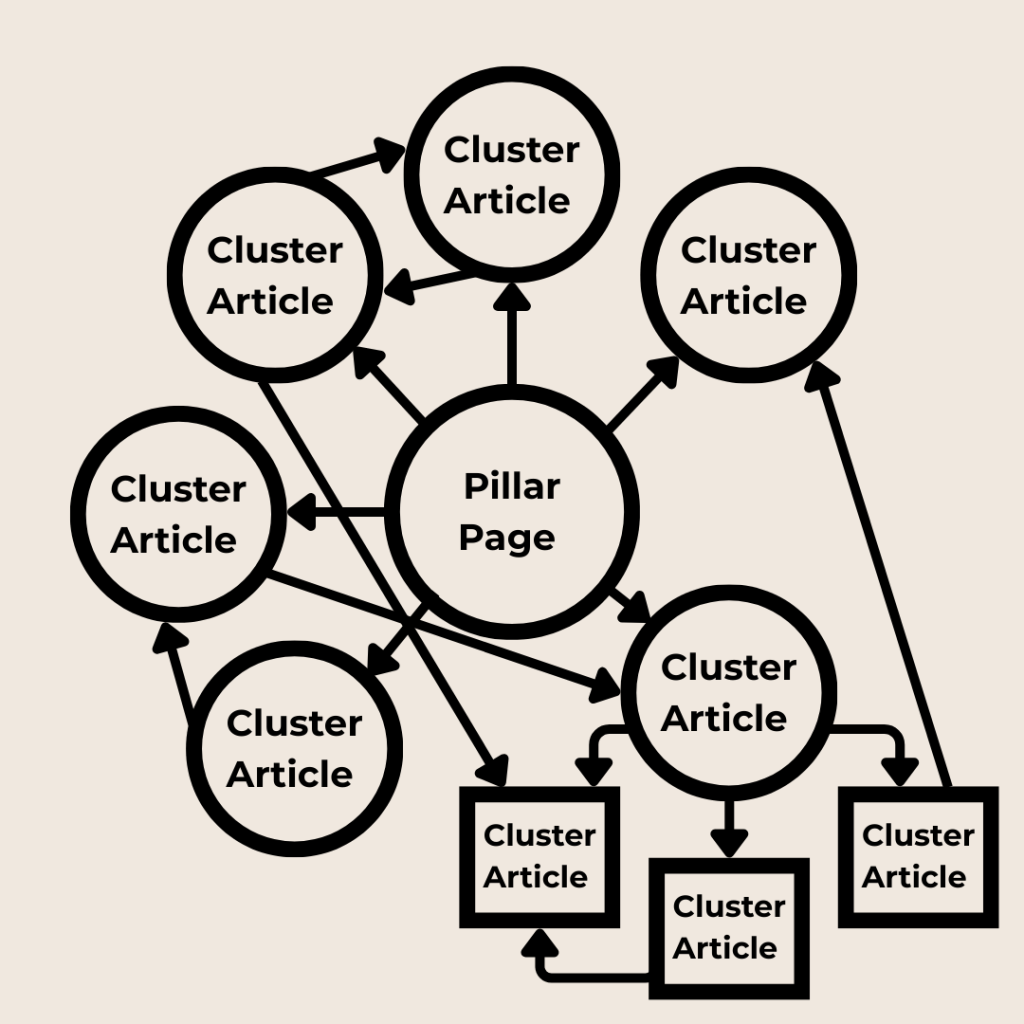
A robust AI topic cluster strategy rests on several non-negotiable components that form the backbone of your content ecosystem. Missing any one of these weakens the entire model.
- Pillar Page Optimization: The central asset must be comprehensive, updated regularly, and structured for scannability with clear H2/H3 headings that mirror the clusters it links to. AI can suggest the exact length and structure based on top-performing competitors.
- Intent-Based Cluster Pages: Each cluster page targets a narrow, high-intent query. AI helps determine whether the intent is informational, commercial, navigational, or transactional, ensuring content format matches what users expect.
- Strategic Internal Linking: AI tools analyze the optimal link graph, recommending which cluster pages should link back to the pillar and to each other, distributing PageRank and reinforcing topical relevance.
- Content Gap Analysis: AI compares your existing content against the entire topic universe to highlight missing assets. This includes identifying long-tail questions, comparison queries, and alternative phrasings your competitors rank for but you don’t.
- Authority Signals: Incorporating original research, expert quotes, data visualizations, and up-to-date statistics that AI tools can help source. This elevates the cluster’s E-E-A-T (Experience, Expertise, Authoritativeness, Trustworthiness).
- Scalable Topic Discovery: AI processes millions of data points in seconds, uncovering hundreds of viable cluster ideas that no human team could realistically brainstorm. This is especially critical for enterprise sites with tens of thousands of pages.
- Precision in Search Intent Matching: By analyzing SERP features and click-through patterns, AI eliminates guesswork. It can determine whether a keyword like “project management software” should warrant a comparison pillar or a features list, preventing mismatched content.
- Dynamic Adaptability: As Google updates its algorithms and user behavior shifts, AI models continuously retrain on fresh data. Your topic clusters remain aligned with current ranking factors, while static keyword maps quickly become outdated.
- Reduced Content Overlap and Cannibalization: AI maps each cluster’s unique angle, reducing the risk of publishing multiple pages competing for the same exact query. This sharpens your site’s overall authority rather than diluting it.
- Improved Content ROI: When every piece of content is strategically linked within a cluster that covers a full topic with surgical intent alignment, each page supports the others. Organic traffic compounds rather than remaining siloed.
- Ignoring Search Intent Nuances Within Clusters: AI may group queries like “best CRM” and “CRM features” together, but the former needs a comparison list while the latter needs a feature breakdown. Always manually review the top-ranking pages to confirm content format, not just topic.
- Creating Too Many Thin Cluster Pages: Chasing every cluster suggestion without sufficient depth dilutes quality. A better approach is to combine several closely related low-volume topics into one comprehensive cluster page that satisfies multiple intents.
- Neglecting the Pillar Page Quality: The pillar is the hub; if it’s outdated or shallow, the entire cluster suffers. Dedicate resources to keep pillars evergreen and refreshed with new data and expert insights.
- Broken Internal Linking or Orphan Pages: Cluster pages that aren’t properly linked back to the pillar lose the semantic connection. Use automated crawling tools to detect orphan pages and fix them immediately.
- Over-Automation Without Human Editorial Oversight: Relying solely on AI for content briefs can produce generic, soulless pages. Infuse every cluster with unique insights, case studies, and brand perspective that AI simply cannot replicate.
Benefits of Using AI for Topic Clusters
Shifting from manual clustering to AI-powered topic clusters delivers measurable advantages that go beyond saving time. Marketers who adopt this approach often see faster indexing, higher organic traffic, and a drastic reduction in content cannibalization.
Limitations and Challenges of AI Topic Clusters
Despite the powerful benefits, treating AI as a silver bullet leads to disappointment. The technology has clear boundaries that demand human oversight and strategic governance.
Data Quality Dependency: AI models are only as good as the data they train on. If your seed input is too broad or the tool scrapes outdated SERP information, the recommended clusters may be irrelevant. Low-quality competitor pages or thin content can skew suggestions. Human validation remains essential to filter out noise.
Lack of Brand Context and Nuance: AI cannot intrinsically understand your unique brand voice, product differentiators, or audience psychographics. It might suggest a cluster about “DIY home renovation on a budget,” but if your brand targets luxury homeowners, that cluster wastes resources. Strategy needs a human layer to align AI output with business goals.
Over-Optimization Risk: When AI tools suggest an exhaustive list of related subtopics, the temptation is to build all of them. But bloated clusters without sufficient quality or differentiation can trigger thin content penalties. Prioritization based on revenue potential and audience need is still a human decision.
Technical Integration Complexity: Implementing AI-driven clustering often requires connecting multiple platforms — SEO tools, content management systems, analytics software, and internal linking plugins. For smaller teams, this setup can be daunting without proper technical SEO support.
AI Topic Clusters vs Traditional Topic Clustering
A side-by-side comparison clarifies why AI-assisted methods are rapidly becoming the standard for competitive content teams.
| Factor | Traditional Topic Clustering | AI Topic Clusters |
|---|---|---|
| Topic Discovery | Manual keyword research, brainstorming sessions, limited SERP observation | Automated scraping of SERPs, competitor content, NLP analysis, “People Also Ask” mining |
| Intent Interpretation | Assumptions based on keyword modifier (best, how, near me) and personal judgment | Intent classifiers trained on SERP layout, user engagement patterns, and query semantics |
| Scalability | Slow, manual, often results in 10–20 cluster ideas per campaign | Hundreds to thousands of interlinked cluster suggestions generated within minutes |
| Content Gap Detection | Ad-hoc checks against top competitor pages, often weeks behind | Real-time gap analysis and prioritized recommendations based on competitor coverage changes |
| Internal Linking Strategy | Editor decides which pages link together, often inconsistently | AI suggests optimal link graph based on authority flow, page similarity, and crawl budget efficiency |
| Adaptation to Algorithm Updates | Reactionary, requires manual SERP re-analysis | Continuous model retraining picks up new ranking patterns and updates cluster recommendations |
Practical Application: Step-by-Step Guide to Building AI Topic Clusters
Implementing AI topic clusters becomes straightforward when broken into manageable phases. This workflow works for small blogs scaling to authority sites as well as enterprise content operations.
Step 1: Define Your Business Objectives and Core Topics
Start with a list of 3–7 high-level pillars that align directly with your product lines, services, or audience pain points. Avoid generic terms like “marketing.” Instead, use “B2B SaaS lead generation for healthcare.” Feed these into your chosen AI topic clustering tool as seed inputs. The goal is to let the AI expand each into a full cluster universe.
Step 2: Run AI-Powered SERP and Competitor Analysis
Using tools like MarketMuse, Clearscope, Frase, or Surfer SEO, run a comprehensive analysis of the top 20 search results for your pillar term. The A Export the full cluster map, which typically includes a pillar brief and dozens of cluster page suggestions categorized by intent and importance score.
Step 3: Prioritize Clusters Based on Business Value
Not every AI-suggested cluster deserves immediate attention. Apply a simple prioritization matrix: high search volume + high business relevance gets top priority. Low volume but high relevance gets secondary priority for long-tail authority building. High volume but low relevance can be deprioritized or scrapped. Add a column for content difficulty to ensure you’re not chasing impossible rankings.
Step 4: Build or Optimize the Pillar Page
The pillar page must become the most comprehensive resource on the web for that topic. Incorporate all the main entity types the AI identified. Structure it with clear sections that preview and link to each major cluster page. Include original data, expert commentary, and multimedia. The pillar should never be a thin overview; it should make a user feel they have a complete understanding after reading.
Step 5: Create the Cluster Content With Surgical Intent Alignment
For each cluster page, the A Write content that perfectly matches the search intent. If the AI indicates a “how-to” intent, produce a step-by-step guide with visuals. If it’s a comparison intent, provide a detailed table and analysis. Ensure every cluster page links back to the pillar (using the same anchor text variation) and to other relevant cluster pages where natural.
Step 6: Implement an Internal Linking Framework
Use the AI-generated link graph to guide your internal links. Tools like InLinks or Link Whisper can partially automate this process. The pillar links out to all clusters, clusters link back to the pillar and to sibling clusters that are contextually adjacent. This reinforces the topical silo and helps search engines crawl the relationship. Regularly audit your internal links as you add new cluster content.
Step 7: Monitor Performance and Iterate
AI-assisted clustering is not a one-time project. Track organic traffic, keyword rankings, and engagement metrics for the entire cluster. AI tools can re-analyze your cluster against the ever-changing SERP and suggest new content gaps to fill. Every quarter, revisit top pillars and add fresh cluster pages to maintain topical freshness and authority growth.
Common Mistakes When Implementing AI Topic Clusters and How to Avoid Them
Important Notes for SEO Success With AI Topic Clusters
Success with AI topic clusters extends beyond content creation into the technical and strategic layers of SEO. Pay close attention to these critical factors to avoid common pitfalls and maximize long-term results.
First, always align cluster architecture with your site’s information hierarchy. The pillar page should be accessible within 2–3 clicks from the homepage, and cluster pages should be logically nested in URL structure where relevant. For e-commerce sites, a template like /category/pillar/ for the pillar and /category/pillar/specific-cluster/ helps search engines understand the relationship.
Second, utilize schema markup to reinforce topical connections. Adding BreadcrumbList schema, Article schema, and even FAQ schema on cluster pages can enhance SERP visibility. While schema isn’t a direct ranking factor, the improved click-through rates and richer search appearance absolutely help cluster performance.
Third, never forget content freshness. AI can flag which cluster pages are losing rankings because new competitors have published updated content. Use these alerts to refresh statistics, add new sections, and maintain your authority edge.
Finally, be patient. AI topic clusters are a long-term asset. Unlike a single blog post that might spike and fade, a well-built cluster gains momentum over months, with each internal link and new piece of content strengthening the entire topic hub. Expect 3–6 months before seeing full ranking impact, though many sites report noticeable improvements within weeks for long-tail cluster queries.
Frequently Asked Questions About AI Topic Clusters
What exactly is an AI topic cluster?
An AI topic cluster is a group of interlinked web pages built around a central pillar, where artificial intelligence analyzes search data, user intent, and semantic relationships to identify the pillar topic and all supporting subtopics. This ensures comprehensive topical coverage aligned with how search engines understand and rank authority.
How does AI improve traditional topic clustering?
AI automates the discovery of related queries, content gaps, and intent nuances at a scale impossible for humans. It uses NLP and machine learning to cluster topics based on semantic similarity rather than just keyword overlap, resulting in more accurate, comprehensive, and search-engine-aligned content silos.
Which AI tools are best for building topic clusters?
Leading tools include MarketMuse for deep topical authority analysis, Clearscope for content optimization and cluster suggestions, Surfer SEO for SERP-driven content briefs, and Frase for question-based topic discovery. Many SEO practitioners combine these with clustering platforms like Keyword Insights AI or ClusterAi for dedicated visualization.
Can AI topic clusters help with E-E-A-T signals?
Yes, indirectly. By ensuring a site thoroughly covers a topic with expert-level depth and proper internal linking, AI topic clusters demonstrate Experience, Expertise, Authoritativeness, and Trustworthiness. The structure signals that the site is a go-to resource, which aligns with Google’s quality rater guidelines. Supplement cluster content with author bios and original research for maximum impact.
Do AI topic clusters work for small websites?
Absolutely. A small blog can dominate a micro-niche by using AI to identify every relevant subtopic and covering them comprehensively, thereby outranking larger, less-focused sites. The clustering approach creates a natural authority moat that big generalist sites rarely achieve in narrow domains.
How often should I update my AI topic clusters?
Conduct a full cluster audit every quarter. Monitor cluster pages for ranking drops and refresh them with new data, examples, and internal links. AI tools can continually monitor competitor changes and alert you to emerging subtopics, allowing real-time expansion of your clusters to maintain topical leadership.
Conclusion
AI topic clusters represent the intersection of advanced machine intelligence and strategic content architecture. They move SEO teams away from chaotic, one-off publishing toward a disciplined methodology that builds genuine topical authority. The power lies not just in the efficiency AI provides — sifting through millions of data points to surface the precise clusters you need — but in the depth of understanding it brings to search intent and semantic relevance. By adopting an AI-driven approach, brands can construct content ecosystems that satisfy users instantly, earn trust from search engines, and compound organic visibility over time. The future of content strategy belongs to those who can harness AI to map the ever-expanding universe of topics, turning information into structured, authoritative knowledge hubs that dominate the modern SERP. Start with one core pillar today, let AI guide your cluster expansion, and watch your digital authority rise.
Xem thêm:
- AI SEO Automated SEO Audit: The Complete Guide to Continuous Optimization
- Gemini vs ChatGPT for SEO: Which AI Tool Truly Elevates Your Search Rankings
- The Ultimate AI SEO Workflow: How to Automate Your Search Rankings from Research to Reporting
- AI SEO Content Gaps: The Complete Guide to Finding and Filling What Your Competitors Miss
- AI Topic Clusters: The Smarter Way to Build Authority and Rank Higher With Semantic SEO
Bài viết cùng chủ đề:

AI SEO SEO Automation with Make: The Complete Workflow Guide

AI SEO SEO Automation with Zapier: The Complete Workflow Guide

AI SEO SEO Automation with n8n: The Complete Workflow Guide
AI SEO SEO Automation with Gemini: The Complete Guide to Scaling Organic Growth

AI SEO SEO Automation with Claude: The Complete Guide to Scaling Content in 2025

AI SEO SEO Automation with ChatGPT: The Complete Playbook for 2025

AI SEO & SEO Automation for Affiliate Sites: The 2025 Playbook for Passive Income Growth
AI SEO & SEO Automation for Bloggers: The Complete Guide to Scaling Your Content

AI SEO & SEO Automation for Agencies: The Complete 2025 Playbook

AI SEO and SEO Automation for Ecommerce: The Complete Playbook for 2025

AI SEO & SEO Automation for WordPress: The Complete Playbook for 2025
AI SEO SEO Automation Strategy: The Complete Playbook for 2025

Mastering the AI SEO SEO Automation Process: A Complete Guide to Scaling Organic Growth
AI SEO SEO Automation System: The Complete Guide to Scaling Organic Growth in 2025
AI SEO SEO Automation Platform: The Complete Guide to Scaling Organic Growth in 2025
AI SEO SEO Automation Software: The Complete Guide to Scaling Organic Growth in 2025















