
No products in the cart.
Can AI Replace SEO? Why Human Strategy Still Dominates the Future of Search
29
Jul
Jul
The idea that artificial intelligence could single-handedly replace search engine optimization has become a burning question in digital marketing circles. With tools like ChatGPT, Bard, and a wave of AI content generators, many wonder whether the human SEO professional is heading toward obsolescence. The truth is far more nuanced. AI can automate repetitive tasks, analyze data at scale, and even generate content outlines, yet the core of effective SEO—understanding user intent, building genuine authority, and crafting creative strategy—remains profoundly human. This article explores exactly where AI fits into SEO, where it falls short, and why the question “can AI replace SEO” misses the real opportunity: using AI to amplify a human-led SEO process.
The Evolution of SEO in the Age of Artificial Intelligence
Search engine optimization has always been a moving target. From the early days of keyword stuffing and link farms to today’s emphasis on E-E-A-T (Experience, Expertise, Authoritativeness, Trustworthiness), the discipline has continually adapted to how search engines evaluate content. Google’s algorithms, increasingly powered by machine learning models like RankBrain and BERT, are themselves a form of AI designed to understand natural language and user intent. So when we ask can AI replace SEO, we are really asking whether a machine can replicate the strategic, empathetic, and analytical work that goes into ranking content in an AI-driven search environment.
AI has been part of SEO for years. Tools such as SEMrush, Ahrefs, and SurferSEO use machine learning to identify content gaps, analyze competitors, and suggest optimizations. What changed in late 2022 was the rise of generative AI that could produce complete articles, meta descriptions, and even schema markup with minimal human input. This led to a rush of speculation that the days of human SEOs were numbered. Yet the more these tools are used, the clearer it becomes that raw AI output still requires significant human oversight to meet quality thresholds and avoid penalties.
Understanding What “Can AI Replace SEO” Really Means
To answer this question, we must separate SEO into two layers: the technical, data-driven layer and the strategic, creative layer. The technical aspects—crawling, indexing, log file analysis, structured data implementation, and bulk keyword research—are increasingly AI-assisted, sometimes fully automated. The creative layer—building topical authority, storytelling, brand differentiation, link earning through relationships, and adapting to nuanced algorithm shifts—still demands human judgment. When marketers ask can AI replace SEO, they often envision a future where a single button press delivers optimized content that ranks. That vision overlooks the messy, context-rich reality of search behavior.
Search engines do not rank content solely because it is grammatically correct or keyword-optimized. They reward pages that demonstrate real-world experience, unique insights, and the ability to satisfy complex user journeys. AI models, trained on existing data, are inherently backward-looking; they repurpose information already on the web. True authority comes from original research, firsthand case studies, and fresh perspectives—none of which a language model can generate from scratch without human input.
How AI Tools Are Reshaping the SEO Process
Rather than outright replacement, AI is reshaping SEO workflows into faster, more efficient versions of themselves. Understanding this transformation helps clarify why the answer to “can AI replace SEO” is no, but “can AI change SEO forever” is a definite yes.
Keyword Research and Topic Clustering
AI-powered platforms can scan millions of search queries, group them into semantic clusters, and predict emerging topics based on trend data. This drastically reduces the time spent on manual spreadsheet work. However, interpreting which clusters align with business goals, audience pain points, and conversion paths still requires a strategist who understands the brand’s unique value proposition.
Content Briefing and Outlining
Generative AI can produce detailed outlines that mirror the top-ranking pages for a given query, suggesting headings, questions to answer, and even competitor gaps. This gives writers a solid starting point. What AI lacks is the ability to inject proprietary data, brand voice, and the subtle emotional hooks that differentiate an article from a sea of similar posts. The human SEO or content strategist pulls these elements together, ensuring the final piece serves both the reader and the search engine.
On-Page Optimization at Scale
Tools like Clearscope and MarketMuse use natural language processing to compare a draft against top-performing content and recommend semantic keywords, readability improvements, and internal linking opportunities. These suggestions can be implemented quickly, but deciding which suggestions actually enhance user experience versus those that simply chase a score is a distinctly human call. Over-optimization remains a risk when AI recommendations are followed blindly.
Technical Auditing and Monitoring
Site crawlers powered by AI can detect broken links, duplicate content, slow-loading pages, and indexing issues far faster than a manual audit. Some platforms even suggest fixes or automate pull requests. Still, interpreting the business impact of a technical issue—such as whether a noindex tag is accidental or a legacy SEO choice—requires human investigation. The machinery behind the question can AI replace SEO is powerful, but it is not yet wise.
Benefits and Limitations of Using AI in SEO
Evaluating both sides of the coin provides a clear-eyed view of where AI can be trusted and where human intervention remains critical.
Key Benefits
- Speed and Scalability: AI processes thousands of keywords, pages, or backlink profiles in minutes, enabling rapid analysis that would be impossible manually.
- Data-Driven Insights: Machine learning models spot patterns and correlations that might escape even experienced analysts, surfacing hidden opportunities.
- Consistency: Automated reporting and monitoring ensure that technical SEO hygiene is maintained without human error or fatigue.
- Idea Generation: Generative AI breaks creative blocks by suggesting angles, titles, and content structures, acting as a brainstorming partner.
- Lack of Original Thinking: AI regurgitates existing information. It cannot conduct an interview, run a survey, or develop a proprietary methodology that produces unique data.
- Risk of Shallow Content: Without careful prompting and editing, AI-generated text tends to meander, offer generic advice, and lack the depth Google’s helpful content system rewards.
- Algorithm Blindness: Language models do not understand Google’s ranking criteria in real time. They can produce content that inadvertently violates best practices, such as factual errors or outdated statistics.
- Brand Voice Dilution: Mass-produced AI content often sounds homogenous, eroding the distinct personality that builds trust and loyal audiences.
- Zero-Click Searches Will Increase: AI-generated answers at the top of results reduce click-through rates for traditional organic listings. SEO will need to focus on brand visibility within these AI snapshots and on queries where deep content still wins.
- Author Entities Will Gain Importance: As AI floods the web with average content, Google will place even more weight on verified author credentials, real-world experience, and transparent ownership. SEO teams will need to build personal brands alongside domain authority.
- Dynamic Content Optimization Becomes Standard: A Human strategists will design the logic; A The ability to architect such systems will be a premium SEO skill.
- Ethical Boundaries Must Be Set: The temptation to let AI generate thousands of low-quality pages to capture long-tail queries is a short-term tactic with long-term penalty risk. Sustainable SEO disciplines will guard against AI misuse.
- Continuous Learning is Non-Negotiable: SEO practitioners who resist A The winning approach blends deep understanding of search principles with the amplification AI offers.
Notable Limitations
A Side-by-Side Comparison: AI Automation vs. Human SEO Expertise
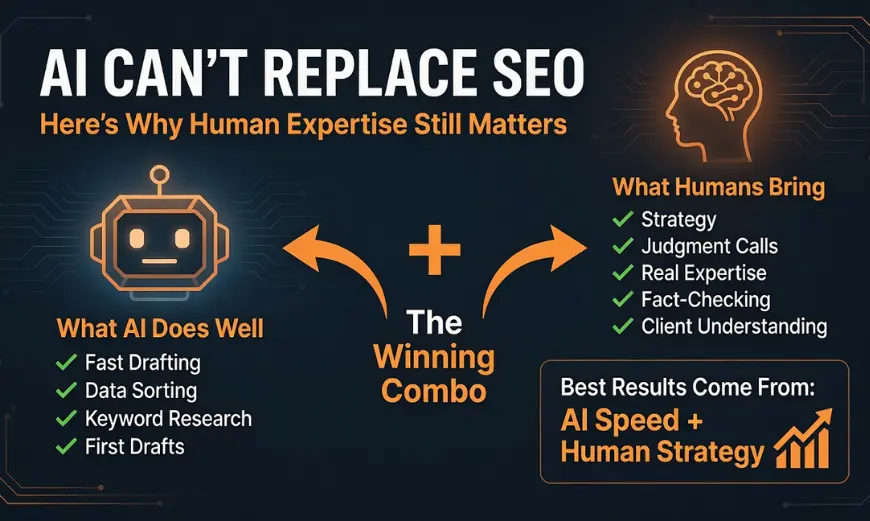
To ground the discussion of can AI replace SEO, a direct comparison of core SEO activities reveals where each excels.
| SEO Activity | What AI Can Do | What Humans Provide |
|---|---|---|
| Keyword Research | Identify high-volume, low-competition keywords; group by topic clusters; predict seasonality. | Align keywords with buyer personas, sales funnel stages, and brand messaging goals. |
| Content Creation | Generate drafts, outlines, meta tags, and summarizations rapidly. | Inject original examples, expert quotes, case studies, and a brand-specific storytelling angle. |
| Link Building | Prospect discovery via patterns in backlink profiles; automate outreach templates. | Build genuine relationships, negotiate guest posts, and earn editorial links through reputation and networking. |
| Technical SEO | Crawl sites, detect errors, generate XML sitemaps, deploy structured data templates. | Diagnose complex indexing problems, architect site hierarchies for user experience, and prioritize fixes by business impact. |
| Strategy Development | Analyze competitor data, simulate ranking scenarios, suggest quarterly targets. | Define brand positioning, adapt to market shifts, manage stakeholder expectations, and balance SEO with broader marketing goals. |
This comparison makes it clear that AI is an accelerator, not a replacement. The phrase “can AI replace SEO” implies a binary outcome, but the reality is a symbiotic relationship where human judgment steers AI output toward meaningful business results.
Practical Application: Integrating AI Into Your SEO Strategy Without Losing the Human Touch
The smartest organizations treat AI as a junior analyst or a tireless assistant, not as the final decision-maker. Below is a step-by-step approach to blending AI with expert oversight.
1. Start With a Human-Led Content Strategy
Define your topical authority map, audience personas, and conversion goals before touching any AI tool. When the strategic foundation is solid, AI-generated suggestions become a menu of possibilities, not a substitute for direction. The question can AI replace SEO never arises when the strategy remains firmly in human hands.
2. Use AI for Data Gathering, Not Final Copy
Let AI handle the heavy lifting of pulling together statistics, competitor headings, and content gap analyses. Then, a subject matter expert reviews, fact-checks, and augments the material with proprietary insights. This layered approach ensures the final article meets the depth standards Google expects.
3. Apply Editorial Rigor to AI Drafts
Train editors to look for telltale signs of AI content: repetitive phrasing, lack of specific anecdotes, and overuse of transitional phrases. Rewrite sections to reflect firsthand experience. For instance, if an AI draft discusses a marketing tactic, an editor should add a real campaign result or a lesson learned from a client project—information no AI model could know.
4. Automate Monitoring, but Humanize Responses
Set up AI alerts for ranking fluctuations, site errors, or new competitor content. When a significant change occurs, a human practitioner should investigate context: was there a Google update? Did a competitor publish a massive resource? What is the underlying user need that shifted? AI flags the symptom; humans diagnose and treat the cause.
5. Continuously Train Your AI Tools
Many AI SEO platforms learn from user feedback. When the tool suggests a poor keyword or an awkward phrase, mark it as irrelevant. Over time, the model becomes more aligned with your brand’s standards. This feedback loop exemplifies why “can AI replace SEO” is the wrong question—the real inquiry is how well you teach your AI to serve your SEO goals.
Common Mistakes When Using AI in SEO and How to Avoid Them
Even experienced marketers fall into traps that undermine the value AI can bring. Recognizing these mistakes reinforces why the human element remains irreplaceable.
Publishing AI Content Without Human Review
The most damaging error is treating raw AI output as production-ready. Google’s guidelines emphasize helpful, people-first content. AI drafts, left unchecked, often contain factual inaccuracies, may plagiarize passages, and lack the E-E-A-T signals needed for competitive queries. Always process AI content through a skilled editor who verifies sources and strengthens arguments.
Over-Reliance on AI Keyword Scores
Content optimization tools assign scores based on keyword density or vector similarity. Chasing a perfect score leads to unnatural text stuffed with synonyms, harming readability. Human SEOs know that a page ranking at number one often breaks the tool’s ideal profile because it prioritizes user engagement above mathematical perfection. Trust your audience’s behavior data—bounce rate, time on page, conversions—over a dashboard number.
Ignoring Brand Voice and Differentiation
When every competitor uses the same AI tool, search results flood with structurally identical articles. To stand out, infuse every piece with unique brand assets: original graphics, recorded expert commentary, proprietary frameworks, or data visualizations. These are impossible for AI to replicate without explicit human creation.
Automating Link Building Outreach Entirely
AI can send emails at scale, but it cannot replicate the warmth of a personalized note referencing a recent podcast episode or a shared professional connection. Spammy, templated outreach damages domain reputation and reduces response rates. Use AI to identify prospects, but craft outreach messages individually, referencing specific content on the recipient’s site.
Important Notes on the Future of AI and SEO
As search engines continue to integrate AI directly into SERP features—such as Google’s Search Generative Experience—the roles of SEO will evolve, not vanish. Here are critical considerations for anyone pondering can AI replace SEO in the coming years.
Frequently Asked Questions About AI and SEO
Can AI completely replace human SEO specialists?
No. AI cannot replicate the strategic thinking, creativity, and relationship-building that underpin successful SEO. While AI automates data-heavy tasks, humans provide the vision, ethical judgment, and unique insights required to build lasting authority.
Will Google penalize AI-generated content?
Google does not ban AI content outright, but it penalizes low-quality, unhelpful content regardless of how it was created. If AI-generated text lacks expertise, originality, or user value, it risks being demoted by algorithms designed to surface trustworthy information. Human editing and substantive additions are essential safeguards.
What SEO tasks are safest to automate with AI?
Technical audits, bulk data analysis, competitor gap identification, schema markup generation, and regular rank monitoring are all well-suited to automation. These tasks benefit from speed and precision while requiring minimal subjective judgment.
How does AI impact local SEO?
AI enhances local SEO by automating citation management, review monitoring, and localized content suggestions. However, genuine community engagement, local link building, and understanding neighborhood-specific customer needs remain human-centric activities.
Is it worth investing in AI SEO tools for a small business?
Yes, when used wisely. Small businesses can leverage affordable AI tools to handle keyword research, content planning, and technical health checks that would otherwise consume hours. The time saved allows the owner or marketer to focus on creating unique content and nurturing customer relationships, which AI cannot do.
What skills should an SEO professional develop to stay relevant alongside AI?
Professionals should sharpen their prompt engineering abilities, data interpretation, editorial judgment, storytelling, and understanding of E-E-A-T. Strategic consulting, conversion optimization, and the ability to connect SEO metrics to business outcomes will always require a human touch.
Conclusion
The debate captured by “can AI replace SEO” ultimately distracts from a more productive reality. AI is not a replacement for SEO; it is the most powerful assistant the industry has ever seen. It accelerates research, exposes hidden patterns, and frees skilled practitioners to concentrate on the high-level strategy that moves the needle. The future of search belongs to those who wield AI with discernment—blending machine efficiency with human empathy, creativity, and ethical rigor. To ask whether AI can replace SEO is to misunderstand both technologies. To ask how AI can elevate human-led SEO is to step into the next chapter of digital marketing with eyes wide open.
Xem thêm:
- Mastering AI SEO Prompts: The Ultimate Guide to Supercharging Your Search Strategy
- OpenAI SEO: The Ultimate Guide to AI-Powered Search Optimization
- AI SEO Semantic Architecture: The Complete Blueprint for Modern Search Dominance
- AI SEO Ecommerce Content Generator: The Complete Guide to Scaling Product Pages in 2025
- AI SEO Smart Search: The Complete Guide to Future-Proofing Your Organic Traffic
Bài viết cùng chủ đề:

AI SEO SEO Automation with Make: The Complete Workflow Guide

AI SEO SEO Automation with Zapier: The Complete Workflow Guide

AI SEO SEO Automation with n8n: The Complete Workflow Guide
AI SEO SEO Automation with Gemini: The Complete Guide to Scaling Organic Growth

AI SEO SEO Automation with Claude: The Complete Guide to Scaling Content in 2025

AI SEO SEO Automation with ChatGPT: The Complete Playbook for 2025

AI SEO & SEO Automation for Affiliate Sites: The 2025 Playbook for Passive Income Growth
AI SEO & SEO Automation for Bloggers: The Complete Guide to Scaling Your Content

AI SEO & SEO Automation for Agencies: The Complete 2025 Playbook

AI SEO and SEO Automation for Ecommerce: The Complete Playbook for 2025

AI SEO & SEO Automation for WordPress: The Complete Playbook for 2025
AI SEO SEO Automation Strategy: The Complete Playbook for 2025

Mastering the AI SEO SEO Automation Process: A Complete Guide to Scaling Organic Growth
AI SEO SEO Automation System: The Complete Guide to Scaling Organic Growth in 2025
AI SEO SEO Automation Platform: The Complete Guide to Scaling Organic Growth in 2025
AI SEO SEO Automation Software: The Complete Guide to Scaling Organic Growth in 2025















