
No products in the cart.
Does AI Content Rank in Google? The Real Truth About AI-Generated SEO (2025 Update)
29
Jul
Jul
Marketers and business owners ask one question relentlessly: does AI content rank on search engines, or is it a shortcut to a penalty? The short answer is that AI-generated text can indeed rank – sometimes exceptionally well – but the path is far more nuanced than many assume. Google’s algorithms do not automatically punish content just because a machine wrote it. The ranking potential hinges entirely on quality, usefulness, and how the final piece aligns with the search engine’s mission to reward original, people-first information.
What “Does AI Content Rank” Actually Means in Today’s SEO
When people ask does AI content rank, they often wonder whether articles written by tools like ChatGPT, Claude, Jasper, or Gemini can appear on the first page of Google. Historically, early automated content was synonymous with gibberish and spun articles. Today’s large language models produce remarkably coherent text, blurring the line between human and machine output. The real question is no longer about surface-level grammar – it’s about whether AI content meets the ever-rising bar of helpfulness, experience, and trust.
Google has repeatedly clarified that the focus is on content quality, not the production method. The Search Central documentation states that automation has long been used to create useful content, like sports scores, weather forecasts, and transcripts. The problem arises when AI is used to manipulate rankings and churn out low-value pages without genuine analysis. Thus, does AI content rank depends on how you deploy it, not on any blanket ban.
How Google Evaluates AI Content: Helpful Content and E-E-A-T
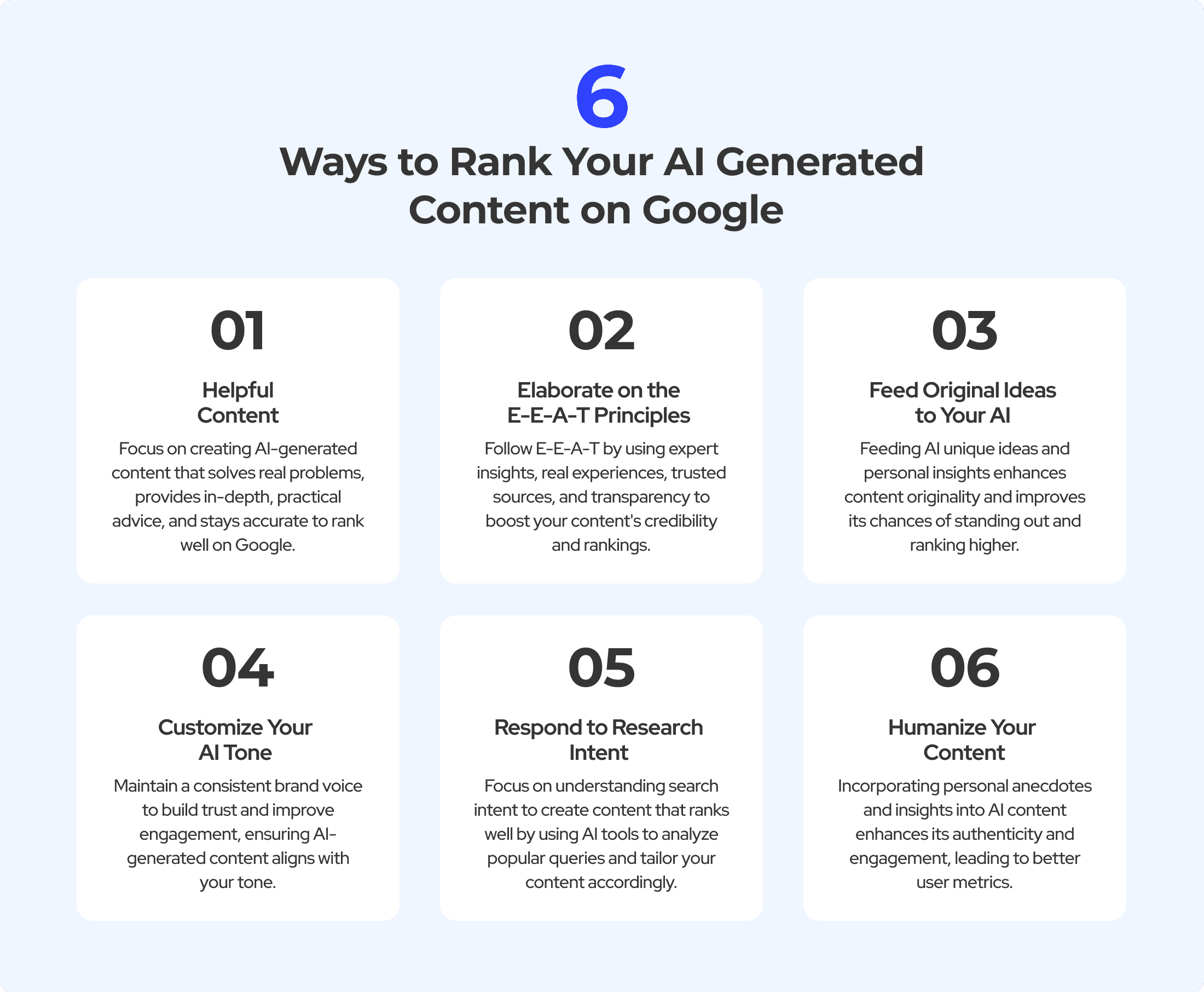
Understanding whether AI content ranks requires a deep dive into Google’s quality rater guidelines and ranking systems. The Helpful Content System, refined in the September 2023 and March 2024 updates, is designed to surface pages that satisfy visitors and demonstrate first-hand expertise. This system operates site-wide; if a substantial portion of your content is deemed unhelpful, even human-written pages may suffer.
E-E-A-T – Experience, Expertise, Authoritativeness, Trustworthiness – is the lens through which human quality raters assess content. A machine can replicate expertise from training data, but it cannot inherently possess lived experience. When AI generates a product review without having touched the item, or a travel guide without visiting the destination, the lack of authentic experience becomes a red flag. So, does AI content rank for YMYL (Your Money or Your Life) topics like health, finance, or legal advice? It can, but only if it’s heavily edited, fact-checked, and supplemented with human experience that the raw AI output could never provide.
The Role of Originality and Information Gain
Modern SEO rewards content that brings something new to the table – a concept often called information gain. If your AI-generated article simply rehashes what the top ten results already say, it adds no value. Search engines can detect this near-duplicate pattern. To make AI content rank, you must inject unique data, proprietary case studies, expert interviews, or novel angles that the model could not produce on its own. Without that human layer, even the most fluent AI text risks being classified as shallow aggregator content.
Does Google Penalize AI Content? Debunking the Myths
One persistent myth is that using AI detectors will trigger a manual action. Google does not use AI detection tools as a direct ranking factor. The search quality team focuses on the substance of the page. Automated content is simply content – no different in algorithmic eyes until it violates spam policies. The key is avoiding mass-produced, low-effort pages designed to rank for clicks without genuine utility. When we ask does AI content rank well despite being machine-written, the evidence says yes, as long as it isn’t spam.
However, there’s a subtle risk: Google’s systems are excellent at pattern recognition. If thousands of pages suddenly use nearly identical phrasing, structure, and lack of unique insights, those domains can be flagged. Recent core updates have targeted “scaled content abuse,” regardless of whether a human or machine was behind the keyboard. So the threat isn’t a penalty for using AI; it’s a penalty for producing unhelpful content at scale.
Real Case Studies: AI Content That Ranks – and AI Content That Tanked
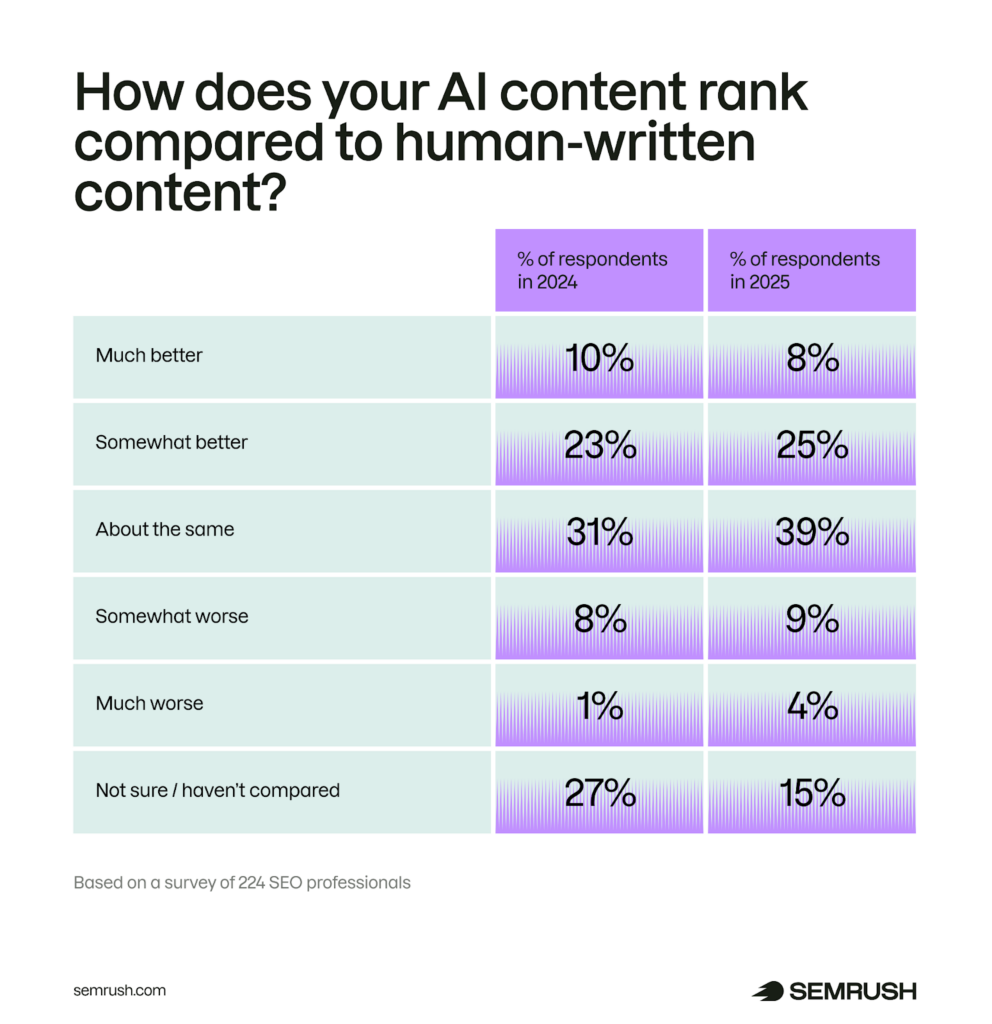
To answer does AI content rank with data, several independent SEO experiments have surfaced. In one controlled test, a site published purely AI-written, unedited blog posts on a fresh domain. The content had a surface-level answer structure with no personal stories. After initial indexing, traffic plateaued at near zero, and many pages never broke into the top 50. By contrast, another experiment involved an established site that used AI as a draft generator, then had subject-matter experts add proprietary data, unique analogies, and first-hand tips. Those hybrid pages ranked for hundreds of long-tail keywords within months.
A well-documented scenario from the March 2024 helpful content update involved a tech review site that outsourced entire content production to raw AI output. The site lost 80% of its organic traffic almost overnight. Competitors that used AI sparingly – for outlines or summaries but heavily rewrote the text – saw gains. This pattern reveals that AI content ranks only when it crosses the threshold of being genuinely helpful, original, and infused with human oversight.
Key Factors That Determine AI Content Ranking Success
| Factor | Impact on Ranking | Notes |
|---|---|---|
| Human editing and value addition | Critical | Raw AI text often lacks unique perspective; rewriting with expertise signals improves E-E-A-T. |
| Factual accuracy | Very High | AI can hallucinate. Fact-checked, updated content is more likely to earn links and trust. |
| Content structure and readability | High | AI can produce organized structure, but must be refined for user intent, logical flow, and scannability. |
| Topical authority | High | A single AI post won’t rank in a vacuum; comprehensive topical coverage with internal linking helps. |
| User engagement signals | Moderate | If AI content satisfies the query quickly, dwell time and CTR improve, indirectly boosting rankings. |
| Indexing eligibility | Gatekeeper | Thin AI pages may be excluded from index if perceived as low value. |
When building a strategy around does AI content rank, treat this table as a checklist. Merely publishing AI outputs and waiting for rankings is a recipe for disappointment. The sites that win combine machine efficiency with human insight.
Comparing AI Content vs Human-Written Content for Rankings
It’s helpful to compare the strengths and weaknesses of each approach, because the debate around does AI content rank often frames them as opponents. In reality, a hybrid model often outperforms both extremes.
| Aspect | Pure AI Content | Human-Written Content | Hybrid (AI + Human) |
|---|---|---|---|
| Original thought / personal experience | Low – can’t create genuine memories or unique case studies | High – can include stories, anecdotes, field insights | High – humans inject unique angle after AI draft |
| Factual accuracy | Medium – may hallucinate, uses outdated data if not connected to live search | High if researched; can still err | High – human verifies statistics, citations |
| Writing fluency | High – grammatically clean, coherent | Variable – depends on skill | High – AI fluency polished by human nuance |
| Speed and scalability | Extremely Fast | Slow, expensive | Moderate – faster than pure human, slower than pure AI |
| Ranking potential (when guidelines followed) | Low to Moderate; risky without editing | High if E-E-A-T is strong | Highest – combines efficiency with authority |
The data points to a clear conclusion: asking does AI content rank is the wrong framing. The real question is, “how much human refinement does AI content need to rank well?” The answer: a meaningful amount, especially in competitive niches.
How to Make AI Content Rank: A Practical Step-by-Step Workflow
1. Start with a Thorough Search Intent Analysis
Before generating a single word, manually analyze the top results for your target query. Determine the dominant intent (informational, commercial, transactional) and the content format winning (list posts, step-by-step guides, comparisons). AI tools often miss nuance – for example, a query may show a desire for video content, but an AI might craft a text-heavy essay. Aligning with intent is non-negotiable for does AI content rank success.
2. Use AI for Research and Outline, Not Final Draft
Prompt the AI to create a comprehensive outline based on your intent findings. Ask it to suggest subheadings, key questions, and a logical flow. This saves hours. Then, manually collect unique data: original statistics, expert quotes, screenshots, or personal process walkthroughs. Never let the AI generate the entire body without these proprietary inputs. The raw draft is just scaffolding.
3. Inject First-Hand Experience and Expert Citations
Edit every section to include proof of experience. A sentence like “In my 10 years of email marketing, I’ve found that personalized subject lines boost open rates by 29%” cannot be authentically written by AI. Add real examples from your work, client case studies, or interviews with practitioners. Link to credible external sources that support claims. This immediately adds the “Experience” and “Trustworthiness” layers that make the difference when AI content ranks or fails.
4. Fact-Check Ruthlessly and Update Data
Large language models have knowledge cut-offs and can fabricate statistics that sound plausible. Verify every number, name, date, and claim. Cross-reference with reputable, current sources. Update outdated information. Google’s systems prioritize freshness, especially for trending topics. A single hallucination in a YMYL article can erode trust and sink rankings.
5. Enhance Content with Original Visuals and Media
Don’t stop at text. Create custom charts, infographics, or diagrams that visualize your unique data. Record a short video summarizing the key points and embed it. These elements signal original value that cannot be auto-generated. They also increase dwell time and generate backlinks, reinforcing the ranking signals that answer does AI content rank with a yes.
6. Apply On-Page SEO Best Practices
Optimize title tags, meta descriptions, header hierarchy, and internal links. Use the target keyword “does AI content rank” and its variations naturally. Compress images, ensure mobile-friendliness, and improve page speed. Even the most valuable content needs technical polish to compete.
7. Publish, Monitor, and Iterate
After publishing, track rankings in Google Search Console. If a page doesn’t rank within a few weeks, revisit it. Add more unique insight, update outdated sections, or improve the reading experience. Continuous improvement is the signature of people-first content – a signal that algorithms recognize.
Common Mistakes That Prevent AI Content From Ranking
- Publishing raw, unedited AI output. The most frequent error. Without human oversight, content remains generic and shallow.
- Ignoring content freshness. AI may reference outdated stats or events; stale content loses ranking ground quickly.
- Neglecting internal linking and topical clusters. Even great standalone posts need context. AI tools often produce islands of content without connecting them to your site’s hub pages.
- Over-optimizing for keywords. Some AI tools stuff keywords when prompted too aggressively. This triggers spam filters and harms user experience.
- Using AI to generate deceptive content at scale. Creating thousands of pages that offer no real value – like programmatic location pages with spun text – is a direct violation of Google’s scaled content abuse policy.
- Assuming AI detectors influence rankings. Worrying about GPTZero or Originality.ai scores can lead to awkward rewriting that doesn’t improve actual quality. Focus on value, not detector evasion.
Important Considerations When Relying on AI for Content at Scale
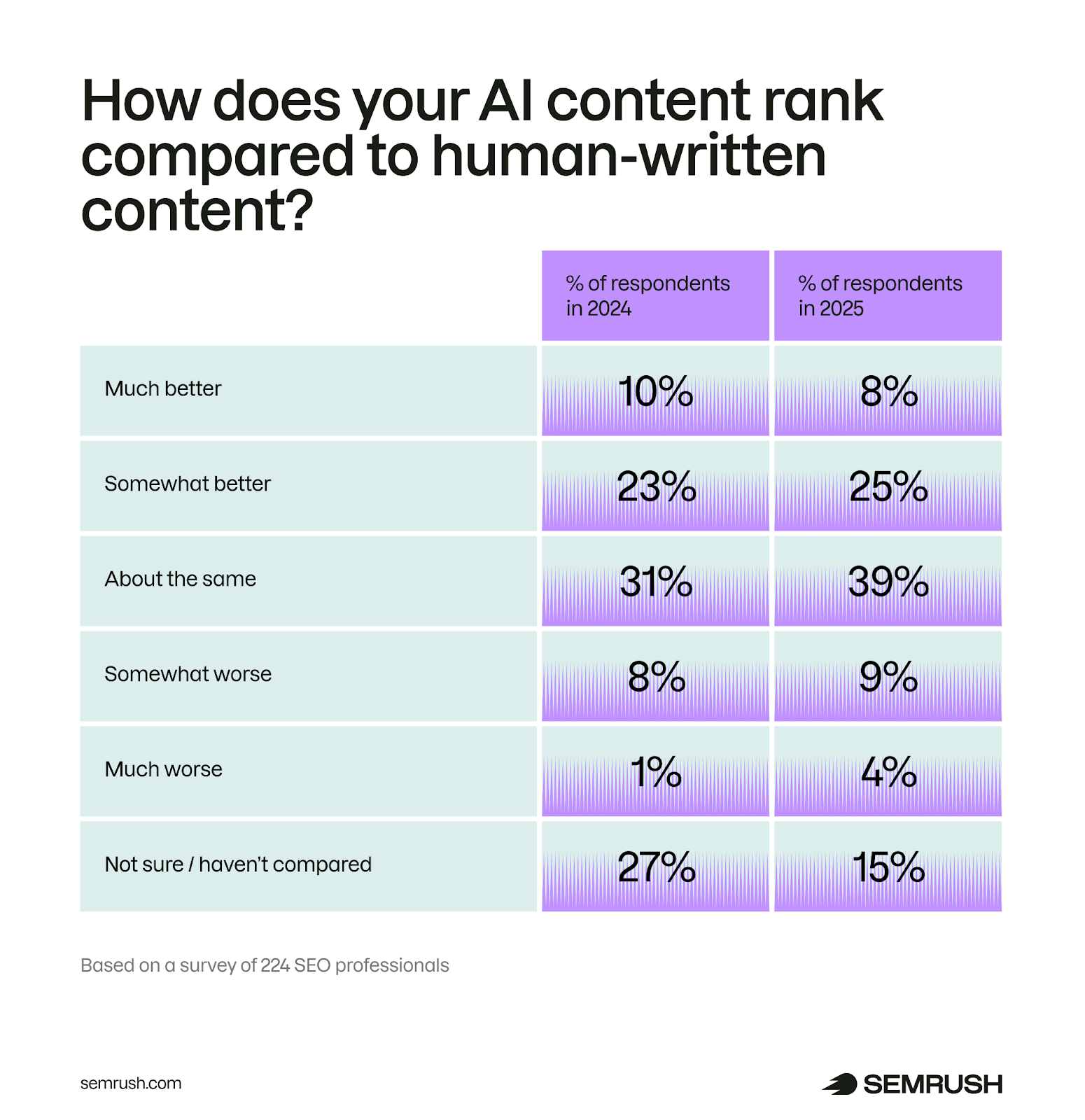
Even if you’ve proved that AI content ranks in your experiments, sustainability depends on several guardrails. First, maintain a human editorial calendar that prioritizes quality over quantity. Publishing 100 AI-assisted posts per month without adequate review can dilute your site’s authority signals. Second, ensure your AI usage aligns with your brand voice and audience expectations. A conversational AI style might not fit a formal legal blog, no matter how helpful the information is.
Third, stay updated with search engine guidelines. Google’s stance on AI is evolving. As tools become more sophisticated, the threshold for “highly original” content may rise. Invest in genuine expertise – hire or collaborate with specialists who can add the experiential layer that machine learning cannot replicate. Long-term ranking success will always belong to the most helpful, trustworthy sources.
Frequently Asked Questions
Does AI content rank on Google in 2025?
Yes, AI-generated content can rank on Google in 2025 as long as it meets the same quality standards as human-written content. Google’s systems evaluate helpfulness, originality, and E-E-A-T, not who wrote the text. However, raw AI output without human editing is unlikely to rank competitively for meaningful keywords. The hybrid approach – AI as a draft, human for expertise – delivers the best results.
Can Google detect AI-generated content?
Google’s algorithms can identify patterns consistent with machine-generated text, such as repetitive phrasing or lack of personal insight, but do not use AI detectors as a ranking signal. The company is more concerned with whether the content is spammy or low-value. Detection is indirect; if your AI content behaves like thin, mass-produced material, it will struggle to rank regardless of its origin.
Will my site be penalized for using AI content?
A penalty is not automatic. A manual action or algorithmic demotion occurs only if you use AI to manipulate search rankings with unhelpful, duplicated, or deceptive content. Producing valuable, people-first articles with the assistance of AI is perfectly acceptable. The key is to avoid using automation to generate content that violates Google’s spam policies.
How can I make AI blog posts rank higher?
To improve AI content ranking, add unique personal experience, expert quotes, and original data. Fact-check every statement, update statistics for freshness, structure for featured snippets, and build internal links to related topics. Most critically, rewrite sections to reflect a distinct point of view that a generic AI model cannot produce. Think of AI as a research assistant, not a final writer.
Does AI content rank for YMYL niches like health and finance?
It can, but the bar is extremely high. YMYL topics demand strong E-E-A-T, particularly author trustworthiness. AI drafts must be heavily reviewed and signed off by credentialed experts. The published content must demonstrate real-world experience and cite authoritative, current sources. Without visible author expertise and transparent fact-checking, AI content in these niches rarely sustains rankings.
What is the biggest mistake when using AI for SEO content?
The biggest mistake is assuming that fluent text equals quality content. Many site owners publish raw AI articles without adding unique insight, resulting in shallow pages that fail to provide information gain. This not only prevents the content from ranking but can also cause a site-wide helpful content demotion if done at scale.
Conclusion: Does AI Content Rank? Only When You Lead, Not the Machine
The question does AI content rank has evolved from a yes/no debate into a nuanced conversation about craft. AI writing tools have demolished the old barrier of production speed, but the true differentiator remains human judgment. The pages that win in search today aren’t the ones generated on autopilot; they are the ones where human experience shapes, polishes, and elevates the machine’s raw material. Embrace AI as an accelerator, but never outsource your voice, your expertise, or your originality. That combination – human-led, AI-assisted – is the formula that turns the query “does AI content rank” into a confident, sustainable yes.
Xem thêm:
- AI SEO Product Reviews: The Complete Guide to Smarter Buying Decisions
- AI SEO Best Examples: How Leading Brands Use Artificial Intelligence to Conquer Search Rankings
- AI SEO SOP: The Definitive Guide to Systemizing Your Search Growth Workflow
- AI SEO Dashboards: The Complete Guide to Data-Driven Search Optimization in 2025
- AI SEO Brand Signals: The Complete Guide to Building a Future-Proof Digital Presence
Bài viết cùng chủ đề:

AI SEO SEO Automation with Make: The Complete Workflow Guide

AI SEO SEO Automation with Zapier: The Complete Workflow Guide

AI SEO SEO Automation with n8n: The Complete Workflow Guide
AI SEO SEO Automation with Gemini: The Complete Guide to Scaling Organic Growth

AI SEO SEO Automation with Claude: The Complete Guide to Scaling Content in 2025

AI SEO SEO Automation with ChatGPT: The Complete Playbook for 2025

AI SEO & SEO Automation for Affiliate Sites: The 2025 Playbook for Passive Income Growth
AI SEO & SEO Automation for Bloggers: The Complete Guide to Scaling Your Content

AI SEO & SEO Automation for Agencies: The Complete 2025 Playbook

AI SEO and SEO Automation for Ecommerce: The Complete Playbook for 2025

AI SEO & SEO Automation for WordPress: The Complete Playbook for 2025
AI SEO SEO Automation Strategy: The Complete Playbook for 2025

Mastering the AI SEO SEO Automation Process: A Complete Guide to Scaling Organic Growth
AI SEO SEO Automation System: The Complete Guide to Scaling Organic Growth in 2025
AI SEO SEO Automation Platform: The Complete Guide to Scaling Organic Growth in 2025
AI SEO SEO Automation Software: The Complete Guide to Scaling Organic Growth in 2025















