
No products in the cart.
How to Optimize for AI Search: A Comprehensive Guide to Generative Engine Optimization
29
Jul
Jul
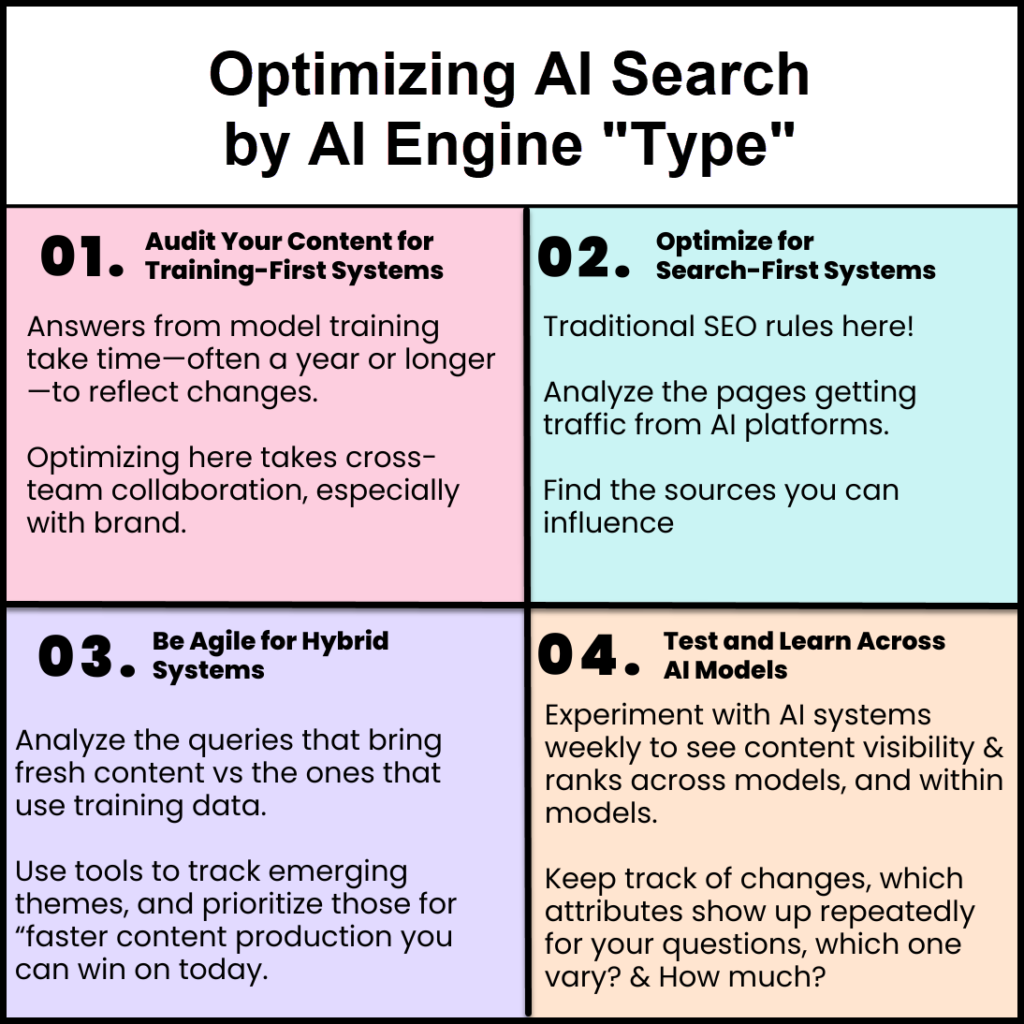
The way people find information online is undergoing a dramatic transformation. Large language models and generative AI are now powering search experiences that deliver direct answers, conversational summaries, and curated snapshots instead of a simple list of blue links. Learning how to optimize for AI search has become a critical skill for anyone who wants their content to remain visible and influential in this new era. This shift, often called Generative Engine Optimization (GEO) or Answer Engine Optimization (AEO), requires a blend of time‑tested SEO fundamentals and brand‑new strategies designed specifically for AI‑driven discovery.
Search engines like Google with its AI Overviews, Bing with Copilot, and standalone tools like Perplexity are reshaping user behavior. They pull information from across the web, synthesize it, and present it in a cohesive answer. For publishers, marketers, and businesses, that means your content no longer needs to just rank; it needs to be the most trustworthy, clearly structured, and citable source that these AI models rely on. This guide walks you through every aspect of how to optimize for AI search, from rethinking your content architecture to implementing technical signals that generative engines prioritize.
What AI Search Optimization Really Means
AI search optimization is the practice of making digital content more likely to be selected, cited, and surfaced by artificial intelligence–powered search engines and answer engines. Unlike traditional SEO, which focuses on obtaining a high position in a ranked list of web pages, AI search optimization targets inclusion in the AI‑generated answer itself. When a user asks a question, the model scours a vast corpus of indexed content, evaluates relevance, authority, and clarity, then synthesizes information into a direct response—often with explicit citations or source links.
This means the rules of visibility are changing. A page that ranks number one in classic organic results may not appear at all in an AI Overview if its content isn’t structured in a way the model can confidently extract and verify. AI search optimization, therefore, involves aligning with how these models read, understand, and trust content. It touches everything from entity‑rich writing and schema markup to topical authority and content freshness.
Understanding the retrieval‑augmented generation (RAG) process that many AI search systems use is helpful. The model retrieves a set of potentially relevant documents, then generates an answer grounded in that retrieved information. Your goal is to be among those retrieved documents and to be the one the model finds most dependable for factual, well‑organized information.
Why Learning How to Optimize for AI Search Matters Now
The adoption of AI‑generated search results is accelerating. Google’s AI Overviews are now a standard part of the search experience for billions of queries, and Bing’s deep integration of Copilot has made conversational search mainstream. Studies by research firms have found that AI‑generated answers already occupy significant real estate above the fold, pushing traditional organic results further down the page. If your content doesn’t appear inside these AI snapshots, your organic traffic can decline dramatically even if your classic rankings hold steady.
Beyond traffic, AI search optimization builds brand authority in a landscape where being cited as a source acts as a powerful trust signal. Users see your brand name attached to the AI’s answer, which reinforces your credibility. Moreover, voice assistants and smart devices increasingly rely on the same AI models, so optimizing for AI search also future‑proofs your content for on‑the‑go, screenless queries.
Early adopters who understand how to optimize for AI search are already capturing market share in visibility, while those sticking to old playbooks risk fading into the static list of links that fewer users click. The window of opportunity is wide open right now, as best practices are still solidifying.
The Core Pillars of AI Search Optimization
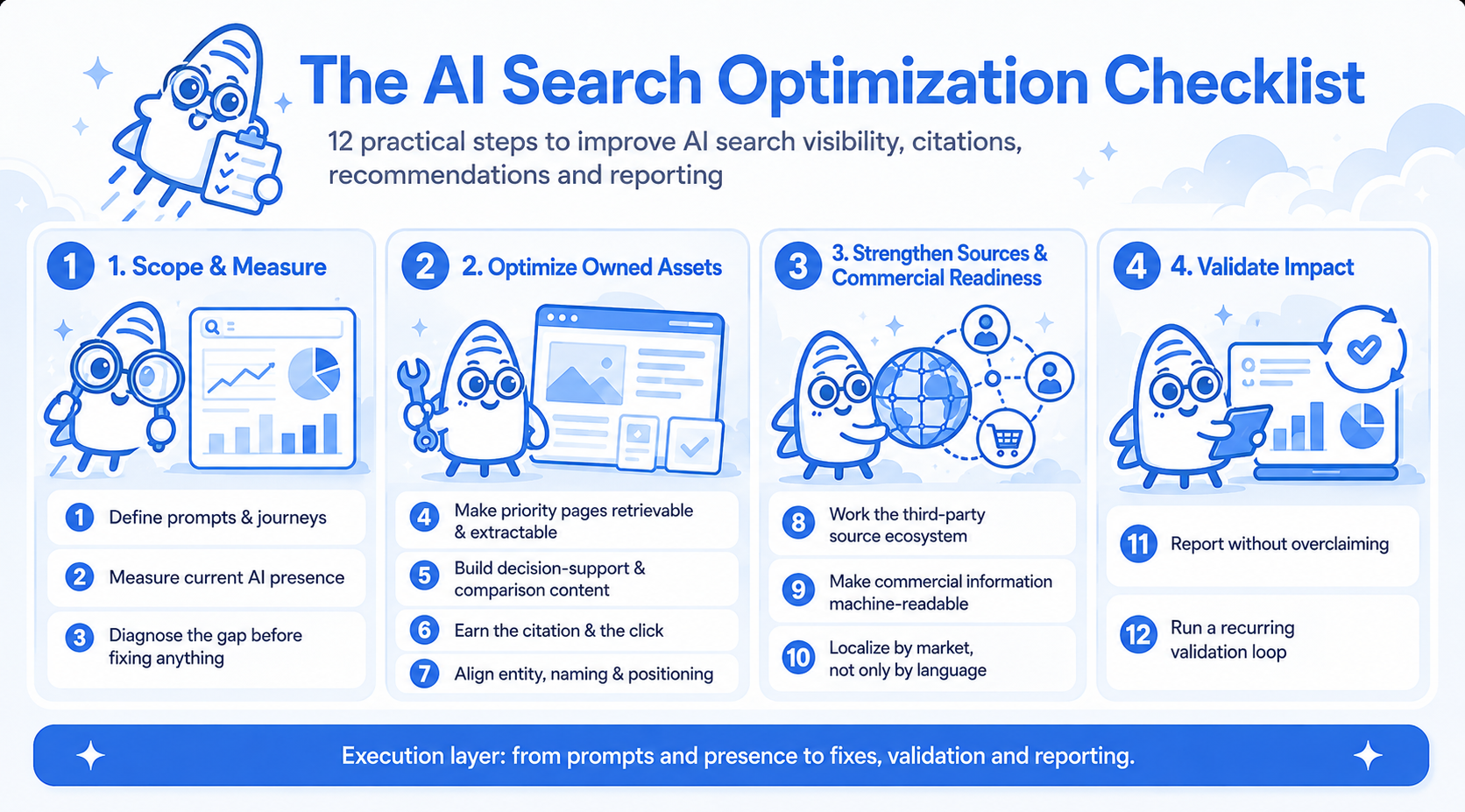
To effectively tap into generative engine results, you need to address multiple layers of your content and website. These pillars form a holistic framework that mirrors how AI models evaluate and cite sources.
1. Entity‑First Content and Semantic Richness
AI search engines understand the world through entities—people, places, things, concepts—and the relationships between them. Rather than matching exact keyword strings, they parse meaning. This makes entity‑based optimization essential. Every piece of content should clearly define the main entities it discusses, connect them to related entities, and reinforce those connections with factual context.
Use tools like Google’s Natural Language API or Schema.org’s vocabulary to identify the key entities in your topic space. Then weave those entities naturally into your headers, body text, and structured data. For example, if you write about electric vehicles, ensure your content explicitly links to manufacturers, battery technologies, charging standards, and relevant regulations—not just repeating the phrase “electric vehicles.”
2. Structured Data and Schema Markup
Structured data is one of the most direct signals you can send to search crawlers about what your content contains. Schema.org markup helps AI models parse articles, FAQs, how‑tos, product information, reviews, and more. When you implement FAQ schema, HowTo schema, Article schema, and Organization schema, you give the retrieval system a machine‑readable blueprint of your content.
For AI search optimization, certain types of structured data are particularly powerful. FAQ schema, for instance, can directly populate the question‑and‑answer pairs that AI Overviews often display. HowTo schema neatly breaks down step‑by‑step instructions that generative models love to summarize. Always ensure your schema markup is accurate, current, and exactly matches the visible content on the page. An AI model will reject dishonest or mismatched markup.
3. Authoritative, Trustworthy Content (E‑E‑A‑T)
Experience, Expertise, Authoritativeness, and Trustworthiness (E‑E‑A‑T) have long been central to Google’s quality raters’ guidelines, and they are even more important for AI search. AI models are designed to avoid misinformation, so they heavily favor content from recognized authorities. This means your content must demonstrate real‑world experience, cite credible external sources, include author biographies with verifiable credentials, and be housed on a site with a strong, clean backlink profile.
For YMYL (Your Money or Your Life) topics, such as health, finance, and legal advice, AI search engines are especially stringent. Content without transparent authorship, peer‑reviewed references, or institutional backing is unlikely to be selected. Even on non‑YMYL topics, showcasing original research, case studies, and data that can be independently confirmed dramatically boosts citation‑worthiness.
4. Crystal‑Clear Content Architecture
AI models thrive on well‑organized content. Use a logical hierarchy with clear H1, H2, and H3 tags that break your topic into digestible sections. Lead with concise summaries that encapsulate the answer in two to three sentences—these serve as perfect extractable snippets. After the summary, provide deeper explanation, examples, and supporting data. Tables, bulleted lists, and ordered steps all help a language model distil the essential information without confusion.
Each section should stand almost independently while linking back to the core topic. This modular style allows an AI model to pull a precise paragraph or list as a direct answer, even if the rest of the page isn’t used. Think of your content as a library of self‑contained, fact‑checked modules rather than a long‑form narrative that must be read in order.
Traditional SEO vs. AI Search Optimization: A Side‑by‑Side Comparison
| Aspect | Traditional SEO | AI Search Optimization |
|---|---|---|
| Primary goal | High ranking in a list of web links | Inclusion and citation in AI‑generated answers |
| Keyword focus | Exact and variant keyword matching | Entity and topic coverage, semantic relevance |
| Content structure | Long‑form, often narrative | Modular, summary‑led, heavily formatted with lists and tables |
| Technical signals | Page speed, mobile‑friendliness, crawlability | Structured data, semantic HTML, clear content hierarchy + classic technical health |
| Authority signals | Backlinks, domain authority | E‑E‑A‑T, entity association, citation by trusted sources, author credentials |
| Measurement | Click‑through rate, organic rankings | Impression and citation share in AI snapshots, still largely experimental to track |
Proven Tactics: How to Optimize for AI Search Step by Step
Translating the pillars into action requires a systematic approach. Apply these specific tactics across your content portfolio to maximize your chance of being the source an AI model chooses.
1. Conduct an Entity Gap Analysis
Map the core entities in your niche using tools like Wikipedia, Wikidata, and Google’s Knowledge Graph. For each topic you cover, list all related entities and check whether your existing content mentions them in context. Fill any gaps by adding explanatory sentences, structured data, and internal links to relevant pages that expand on those entities.
2. Rewrite Key Pages with a Summary‑First Format
Identify the pages that target high‑volume informational queries. Restructure them so that immediately after the H1, a concise paragraph of 40 to 60 words provides the direct answer. For example, a page about “best project management software” should open with a two‑sentence summary naming the top picks and the criteria used. Follow that with the full, detailed analysis. AI models feast on such ready‑made snippets.
3. Deploy Advanced Schema Across Your Site
Implement FAQ schema on any page that contains question‑and‑answer content. Use HowTo schema for instructional content, and Article schema with author and date details for news and blog posts. Validate all markup with Google’s Rich Results Test. Also consider using Speakable schema to designate text that is ideal for text‑to‑speech results, which align closely with AI‑driven voice answers.
4. Strengthen Topical Authority Through Content Clusters
Instead of isolated blog posts, build interconnected clusters around pillar pages. Each supporting page should link back to the pillar and to other cluster pages where relevant. This signals a deep, comprehensive treatment of a subject, which AI models interpret as authority. For example, a pillar page on “digital marketing strategy” should link to detailed pages on SEO, social media, email marketing, and analytics, all interlinked with clear anchor text.
5. Publish Original Data, Surveys, and Proprietary Insights
Nothing captures the attention of an answer engine like unique information that isn’t available elsewhere. Conduct original surveys, compile industry statistics into downloadable reports, or publish first‑party case studies. When your data becomes the primary source, AI models are compelled to cite you because no alternative exists. Always present the data in a table or a simple bulleted list with clear labels, making extraction effortless.
6. Optimize for Conversational and Long‑Tail Queries
AI search often excels at natural‑language questions, such as “What’s the best way to reduce churn in a SaaS business?” Include these full‑question phrases as H2 or H3 headings and then answer them directly in the following paragraph. This practice not only helps traditional featured snippets but also dramatically improves your match rate for the conversational queries that flow through AI assistants.
7. Keep Content Fresh and Factually Accurate
Outdated statistics and stale information are a fast track to being ignored by AI models that prioritize recency for many topics. Set a review cadence for your important pages, update any numbers or references, and visibly note the “last updated” date. Freshness is a documented factor in retrieval for many AI systems, so a page revised in the last month will often edge out an older, equally authoritative one.
Common Mistakes That Sabotage AI Search Visibility
- Neglecting structured data entirely. Without schema, you miss the most explicit format for telling AI models what your content is about. This is the single most avoidable mistake.
- Over‑optimizing for exact‑match keywords. Stuffing old‑school keyword phrases makes content sound unnatural and erodes semantic richness, causing AI models to ignore it.
- Hiding the answer deep in the page. If your core insight is buried in the seventh paragraph, an AI extractive model may never see it. Lead with the answer.
- Ignoring author and brand signals. Publishing content without visible author names, bios, and links to professional profiles undermines trust and greatly reduces the likelihood of citation.
- Using only text‑heavy, unstructured formats. A wall of text without subheadings, lists, or tables forces the AI to work harder to distill meaning. The model may simply move on to a better‑structured source.
- Copying generic, widely available information. AI models will cite the most original source. If your page is just a reworded version of existing content, you add no unique value and won’t be chosen.
How to Measure Success in AI Search
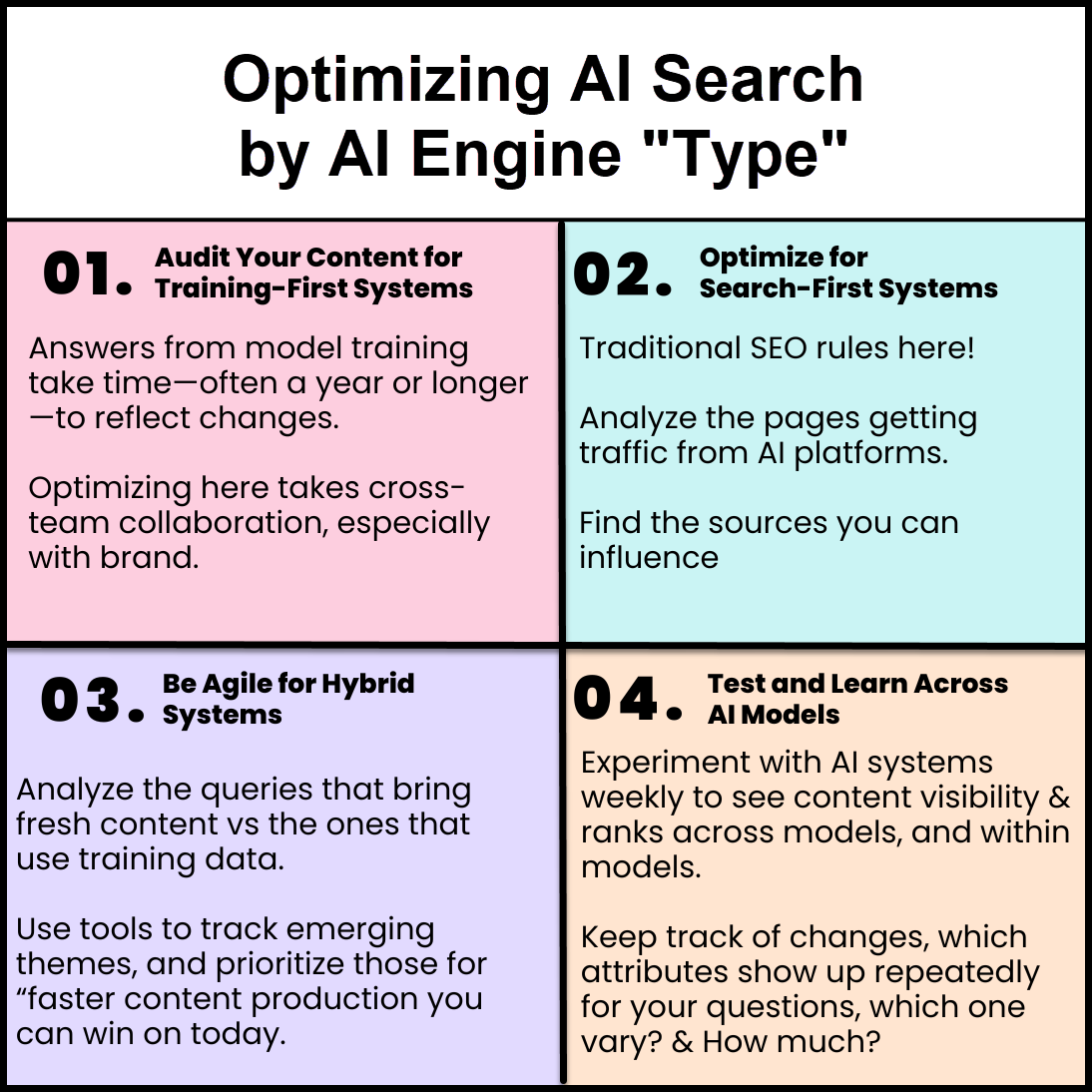
Measuring AI search performance is still evolving, but several indicators can help you gauge progress. First, monitor impressions and clicks from sources labeled as “AI Overviews” in Google Search Console when that data becomes available. Some third‑party tools now track brand mentions inside generative results for tracked keywords. Keep an eye on referral traffic from domains like perplexity.ai or search engines that display your citation URL.
Qualitative analysis is equally important. Manually test top queries by performing them in AI‑powered search engines and note which sources are cited. Document changes over time and correlate them with your optimization efforts. If you see your brand appearing more frequently as a source, that’s a direct signal your AI search optimization is working.
Because the technology changes rapidly, treat measurement as an ongoing experiment. Set baselines now, even if they are imperfect, and refine your tracking as platforms release more detailed reporting.
Important Considerations When Optimizing for AI Search
AI search optimization doesn’t replace traditional SEO; it extends it. Fast loading times, mobile responsiveness, secure connections, and a logical internal linking structure remain foundational. An AI model won’t cite a page that its crawler cannot access or that delivers a poor user experience, because technical health underpins trust.
Expect fluctuations. AI‑generated answers can change overnight as models update or competitors release fresher content. Diversifying your traffic sources—through email lists, social media, and direct‑to‑brand channels—mitigates the risk of over‑reliance on any single AI search platform. Finally, stay ethically grounded. Trying to manipulate AI models with cloaked text, keyword‑stuffed hidden layers, or false authority signals violates search engine guidelines and can result in being removed from the retrieval index entirely.
Frequently Asked Questions
What is the difference between AI search optimization and traditional SEO?
Traditional SEO focuses on improving a page’s rank in a list of web results, primarily through keywords, backlinks, and technical signals. AI search optimization targets inclusion and citation in AI‑generated answers. It emphasizes entity‑rich content, structured data, clear summary formats, and E‑E‑A‑T to make content easily extractable and trustworthy for large language models.
How do I make my content more likely to appear in Google’s AI Overviews?
To increase your chances, follow these steps: start with a brief, self‑contained answer near the top of the page; implement FAQ and HowTo schema; build topical authority through thorough, interlinked content clusters; showcase verified author credentials; and back up claims with original data or trusted sources. Structure your content with clear headings, lists, and tables so the AI can easily parse it.
Does schema markup really help with AI search?
Yes, schema markup is one of the strongest signals you can send. It explicitly tells AI crawlers the type of content on a page—whether it’s a how‑to guide, an FAQ, a product review, or a news article. When a large language model retrieves data, it weighs well‑structured, schema‑tagged content more favorably because the information is precisely defined and less ambiguous.
Will AI search optimization reduce my organic traffic?
In many cases, appearing as a cited source in an AI answer can boost brand visibility and authority, even if click‑through rates change. However, zero‑click searches may reduce traffic to pages that only served a simple answer. To adapt, create deeper, harder‑to‑summarize content that encourages users to click through for full details, and optimize for AI citation as a gateway to your more comprehensive resources.
How often should I update my content for AI search?
High‑value pages should be reviewed and updated every three to six months, or sooner if new statistics, research, or industry shifts emerge. AI models increasingly prioritize freshness for time‑sensitive topics. A regularly updated page with a visible revision date signals ongoing relevance and trustworthiness, giving it an edge over static, outdated alternatives.
Can small websites compete in AI search results?
Absolutely. AI models often value originality, niche expertise, and clear presentation over sheer domain authority. A small site that publishes a unique survey, presents data in a well‑structured table, and crisply answers a specific question can outrank a massive publisher that offers only generic reworded information. Focus on depth, authenticity, and formatting to stand out.
The Future of AI Search and Your Next Steps
The shift toward AI‑powered search is not a temporary trend; it represents a fundamental evolution in how information is accessed and presented. As language models improve, they will become even better at evaluating source credibility, synthesizing multi‑step answers, and personalizing results. The web will favor content that is meticulously organized, factually bulletproof, and built for machines as much as for humans.
Taking action now gives you a significant first‑mover advantage. Audit your site for structured data opportunities. Rewrite your most important informational pages with a summary‑first layout. Invest in original research that only you can provide. Train your team to think in terms of entities and relationships rather than just keywords. These steps are not difficult, but they require a deliberate shift in mindset from chasing rankings to becoming the most citable source.
Mastering how to optimize for AI search is about embracing clarity, authority, and technical precision. The content that wins in the age of generative answers is the content that respects the user’s need for immediate, accurate information while inviting deeper engagement. Start implementing these strategies today, and you’ll build a resilient, future‑ready digital presence that thrives no matter how search technology evolves.
Xem thêm:
- Mastering AI SEO Prompt Engineering: A Complete Guide to Smarter Content Strategies
- AI Conclusion Generator: Generate Powerful Closing Paragraphs in Seconds
- AI SEO Mobile SEO: The Complete Guide to Dominating Search in 2025
- AI SEO Topic Clustering: The Complete Guide to Building Topical Authority in 2025
- AI SEO Seasonal Content: The Complete Playbook for Year-Round Organic Growth
Bài viết cùng chủ đề:

AI SEO SEO Automation with Make: The Complete Workflow Guide

AI SEO SEO Automation with Zapier: The Complete Workflow Guide

AI SEO SEO Automation with n8n: The Complete Workflow Guide
AI SEO SEO Automation with Gemini: The Complete Guide to Scaling Organic Growth

AI SEO SEO Automation with Claude: The Complete Guide to Scaling Content in 2025

AI SEO SEO Automation with ChatGPT: The Complete Playbook for 2025

AI SEO & SEO Automation for Affiliate Sites: The 2025 Playbook for Passive Income Growth
AI SEO & SEO Automation for Bloggers: The Complete Guide to Scaling Your Content

AI SEO & SEO Automation for Agencies: The Complete 2025 Playbook

AI SEO and SEO Automation for Ecommerce: The Complete Playbook for 2025

AI SEO & SEO Automation for WordPress: The Complete Playbook for 2025
AI SEO SEO Automation Strategy: The Complete Playbook for 2025

Mastering the AI SEO SEO Automation Process: A Complete Guide to Scaling Organic Growth
AI SEO SEO Automation System: The Complete Guide to Scaling Organic Growth in 2025
AI SEO SEO Automation Platform: The Complete Guide to Scaling Organic Growth in 2025
AI SEO SEO Automation Software: The Complete Guide to Scaling Organic Growth in 2025















