
No products in the cart.
Mastering AI SEO Prompt Engineering: A Complete Guide to Smarter Content Strategies
29
Jul
Jul
AI SEO prompt engineering is the art and science of crafting precise instructions that guide artificial intelligence tools to generate search-optimized content, perform keyword research, and automate technical SEO tasks. As generative AI reshapes how marketers approach search engine optimization, the ability to engineer effective prompts has become a core competency. Without a well-designed prompt, even the most advanced language models will produce generic, unoptimized, or factually questionable output. This comprehensive guide unpacks the entire process—from foundational concepts to advanced techniques—to help you harness AI for measurable SEO gains.
What Is AI SEO Prompt Engineering?
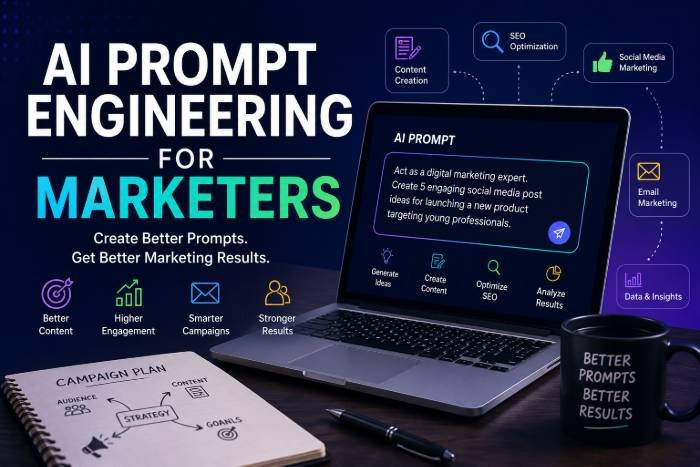
AI SEO prompt engineering combines traditional SEO knowledge with the strategic design of natural language inputs. Instead of writing code or running manual reports, you communicate with large language models (LLMs) like ChatGPT, Claude, or Gemini using structured prompts that incorporate target keywords, user intent, content formats, and on-page SEO requirements. The goal is to instruct the AI to act as an SEO specialist: to analyze search queries, suggest content outlines, optimize meta tags, and even produce full articles that align with Google’s E-E-A-T guidelines.
The concept emerged from the broader field of prompt engineering, which gained traction with the release of GPT-3 and later models. SEO professionals quickly realized that by feeding the right context—such as desired word count, heading hierarchy, semantic keywords, and readability parameters—they could dramatically improve the relevance and ranking potential of AI-generated content. Today, AI SEO prompt engineering is a hybrid discipline that blends creative copywriting, technical SEO, and machine learning intuition.
The Core Components of an SEO-Optimized Prompt
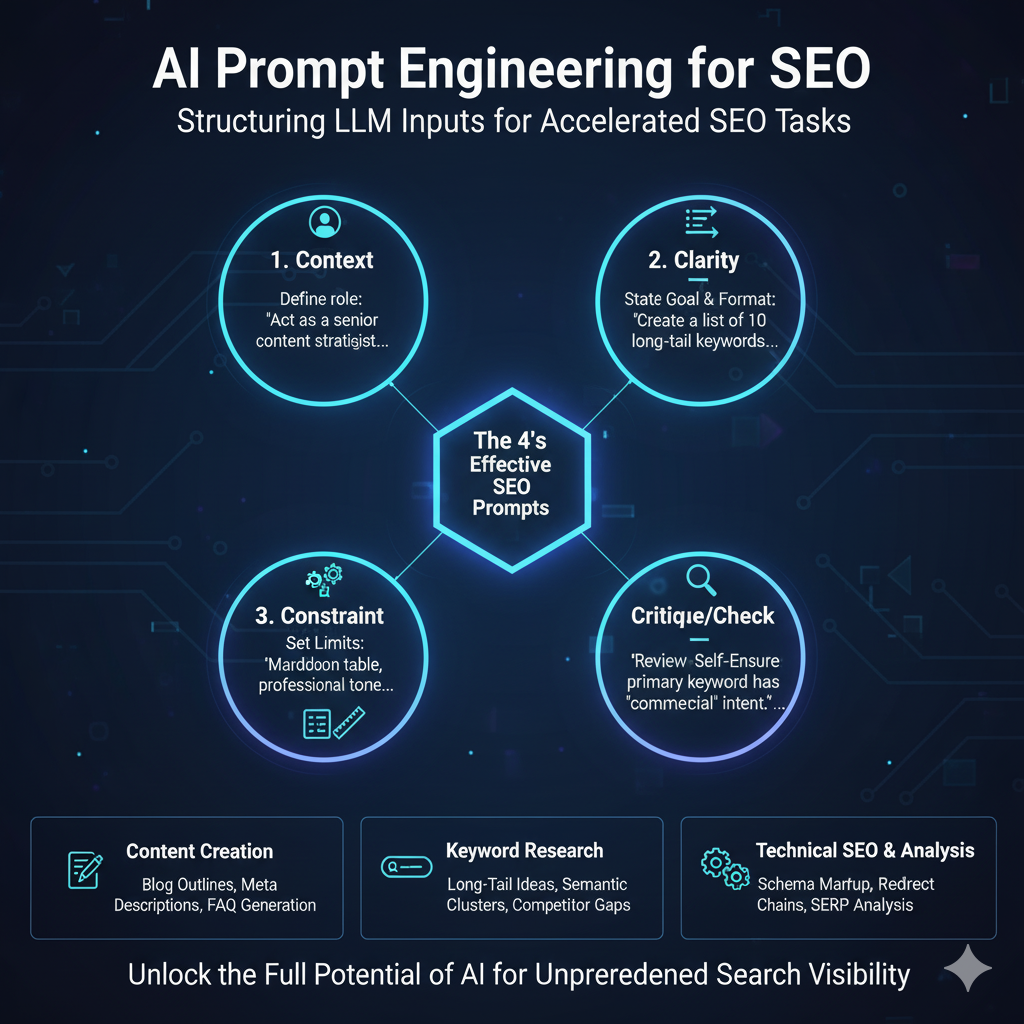
An effective prompt for SEO purposes is never a single-line request. It acts as a mini-brief that leaves no room for ambiguity. The most successful prompts contain several key elements, each addressing a different facet of search performance.
1. Role Definition and Persona Setting
Begin by assigning the AI a specific role: “You are a senior SEO content strategist with 15 years of experience in digital marketing.” This framing immediately shifts the model’s output style toward authoritative, jargon-appropriate language. When the AI adopts an expert persona, it is more likely to include relevant terms, logical argument structures, and a confident tone—all signals that align with high-quality content standards.
2. Clear Search Intent Mapping
Every prompt must specify the user’s search intent: informational, navigational, commercial, or transactional. For instance, “The user wants a step-by-step tutorial on creating SEO-friendly content with AI” guides the model to produce instructional material rather than a sales pitch. Aligning the output with intent drastically reduces bounce rates and improves dwell time, two indirect ranking factors.
3. Keyword and Topic Framework
Include the primary keyword and a list of secondary semantic keywords. A strong prompt might say: “Integrate the main keyword ‘AI SEO prompt engineering’ exactly three times, and weave in related terms such as ‘LLM content optimization,’ ‘semantic search,’ and ‘generative AI for SEO’ naturally throughout the text.” Avoid keyword stuffing cues; instead instruct the model to maintain a density of 1-2% and prioritize readability.
4. Structural and Formatting Guidelines
Specify heading levels (H1, H2, H3), paragraph length, use of bullet points, and even the inclusion of a comparison table. For example: “Structure the article with an H1 title, four H2 sections, and an FAQ with H3 questions. Each paragraph should contain no more than four lines.” Structuring prompts this way ensures the raw AI output requires minimal editing before publication.
5. Tone, Voice, and E-E-A-T Requirements
Describe the desired tone—professional yet conversational, empathetic, or technical. To reinforce E-E-A-T, include instructions such as: “Cite only verifiable concepts, avoid speculation, and reflect first-hand experience by mentioning real-world examples of AI tools used in SEO campaigns.” This pushes the model to produce credible, trustworthy content that Google’s quality raters would evaluate positively.
How AI SEO Prompt Engineering Differs From Traditional SEO Writing

Traditional SEO writing relies on a human writer’s ability to research, outline, and draft while manually checking keyword density and readability scores. AI SEO prompt engineering shifts the heavy lifting to the initial prompt design. The human’s role becomes that of an editor and strategist rather than a first-draft creator. A skilled prompt engineer can generate ten unique article drafts in the time it takes a traditional writer to outline one.
Moreover, prompt engineering allows for rapid experimentation with content angles. By tweaking a single sentence in the prompt—changing the target audience from “small business owners” to “enterprise SEO directors”—the entire output adapts instantly. This velocity is impossible with manual processes. However, the human touch remains essential for fact-checking, adding original insights, and ensuring the content passes plagiarism and AI detection checks if necessary.
Benefits of AI SEO Prompt Engineering for Content Teams
- Massive time savings: A well-crafted prompt can produce a 1500-word draft in under a minute, reducing the content creation cycle from days to hours.
- Consistent brand voice: By embedding tone guidelines into every prompt, teams maintain a uniform voice across hundreds of pages, even with multiple contributors.
- Enhanced topic coverage: Prompts can be designed to automatically generate semantically rich content that covers “People Also Ask” queries and related subtopics, improving topical authority.
- Scalability: Prompt templates become reusable assets. Once perfected, a single template can generate localized pages, product descriptions, or blog posts at scale with minimal adjustments.
- Data-driven optimization: Advanced prompts can instruct the AI to analyze existing top-ranking pages and extract structural patterns, then mimic those successful formats.
- Hallucinated facts and statistics: LLMs may invent research data, quotes, or case studies. Every factual claim must be verified against authoritative sources.
- Repetitive or templated phrasing: Without meticulous prompt tuning, AI output can sound generic, filled with overused phrases like “in today’s digital landscape.”
- Lack of true originality: AI generates content by predicting the most probable next token, which can result in derivative, uninspired material that struggles to earn backlinks or social shares.
- Over-optimization penalties: If prompts overemphasize keyword usage, the model may produce spammy text that triggers Google’s helpful content algorithms.
- Model knowledge cutoff: LLMs have fixed training data, so real-time events, algorithm updates, or new statistics may be missed unless explicitly provided in the prompt.
Limitations and Risks to Consider
Despite its potential, AI SEO prompt engineering is not a plug-and-play solution. Several limitations require careful mitigation:
Practical Guide: How to Engineer AI SEO Prompts Step by Step
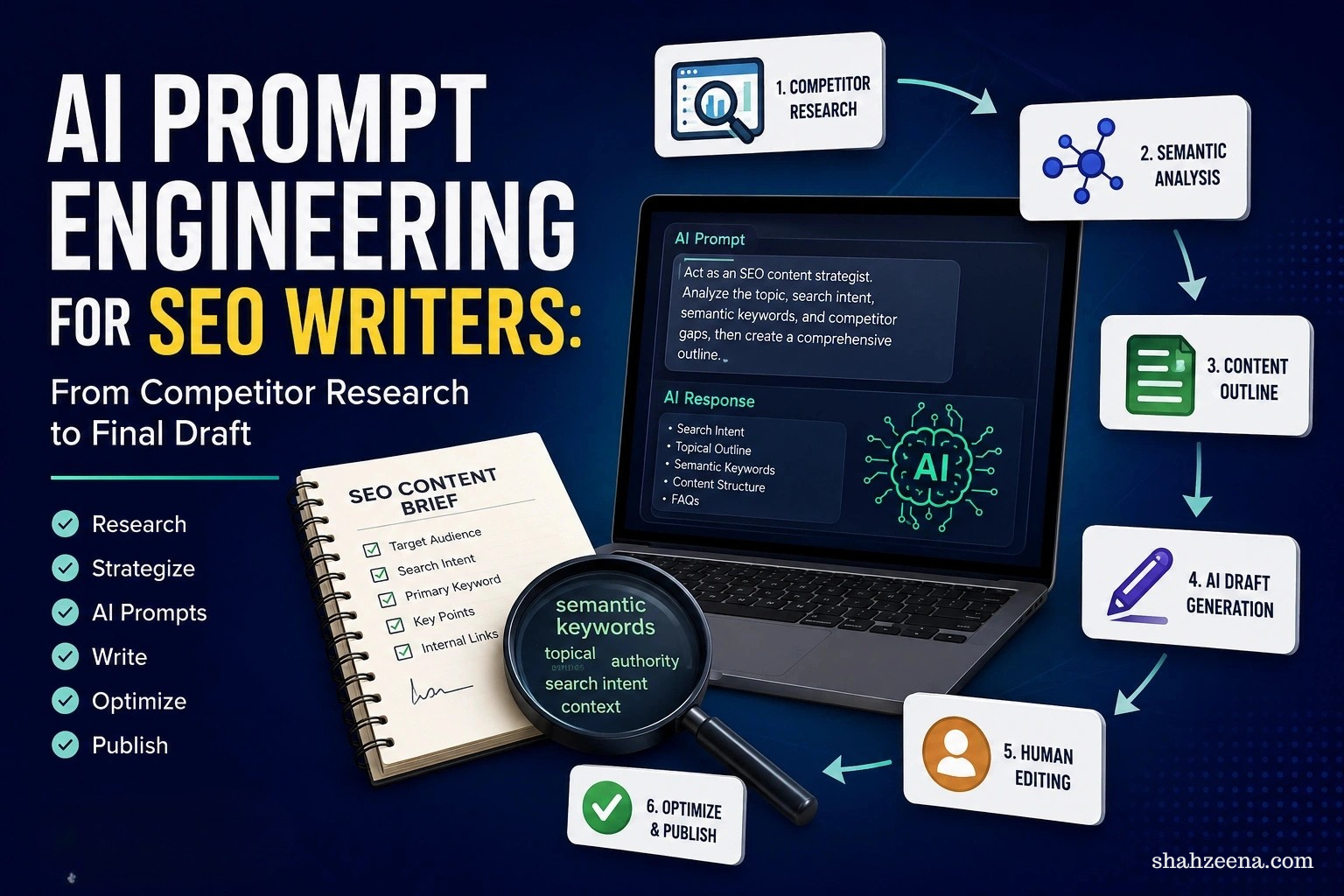
Step 1: Define the Content Objective and KPIs
Before typing a single word, clarify what the piece should achieve. Is it a landing page meant to convert visitors, a long-form guide targeting informational queries, or a product comparison designed to capture commercial intent? Align the prompt’s call-to-action and structure with that objective. For example: “This article should educate users about AI SEO prompt engineering and encourage them to download a free checklist at the end.”
Step 2: Conduct Thorough Keyword and SERP Analysis
Use tools like Ahrefs or Semrush to identify your primary keyword, its search volume, and the top-ranking pages. Manually review the SERP to understand the dominant content format, common headings, and featured snippet opportunities. Feed the AI a summarized SERP analysis within the prompt: “The top three pages for ‘AI SEO prompt engineering’ include a definition section, a list of best practices, and a step-by-step tutorial. Follow this structure.”
Step 3: Craft the Prompt Using the “Role-Context-Instruction-Constraint” Framework
One of the most reliable prompt engineering frameworks for SEO is RCIC: Role, Context, Instruction, Constraints. Here’s a concrete example:
Role: You are an expert SEO content writer specializing in AI and digital marketing. Context: The target audience is mid-level marketers who want to integrate AI into their SEO workflows. Instruction: Write a 2000-word guide on ‘AI SEO prompt engineering’ that covers definition, benefits, a step-by-step process, and common mistakes. Constraints: Use an engaging, authoritative tone. Incorporate the keyword exactly in the H1, first paragraph, and two H2 headings. Add a comparison table between manual SEO writing and AI-assisted writing. Avoid fluff and jargon.
Step 4: Iterate and Refine With Follow-Up Prompts
Rarely does the first output meet all requirements. Use follow-up prompts to refine sections: “Expand the section on limitations with two more points and include a brief real-world example of a brand that over-relied on AI content and saw a traffic drop.” This iterative approach polishes the draft while keeping the overall structure consistent. Over time, you build a library of micro-prompts for common SEO tasks like meta description generation, internal linking suggestions, or schema markup creation.
Step 5: Human Editing and Value Addition
The final step remains irreplaceable: human review. Check facts, improve flow, and inject unique insights from your own experience. Add proprietary data, customer stories, or expert quotes that no AI can replicate. This layer of originality is what separates AI-assisted content that ranks well from automated spam that gets ignored.
Common Mistakes in AI SEO Prompt Engineering and How to Avoid Them
| Mistake | Why It Hurts SEO | Solution |
|---|---|---|
| Vague instructions (“write a good article”) | Produces shallow, unfocused content that doesn’t satisfy user intent | Always include format, depth, and keyword guidance |
| Ignoring prompt length limits | AI may cut off mid-thought, leaving incomplete sections | Request a specific word count and use follow-up prompts if needed |
| Relying solely on AI for factual claims | Hallucinated statistics erode credibility and trustworthiness | Fact-check every claim; provide verified data points in the prompt |
| Over-optimized keyword instructions | Triggers keyword stuffing, harming readability and risking Google penalties | Ask for natural keyword integration and set a max frequency (e.g., 5-7 times for a 2000-word piece) |
| No tonal or audience guidance | Output may not resonate with target readers, increasing bounce rate | Define the ideal reader persona and desired tone explicitly |
| Skipping SERP context | Content may miss crucial subtopics that competitors cover, reducing topical completeness | Analyze top-ranking pages and summarize the expected content format in the prompt |
Advanced Techniques for AI SEO Prompt Engineering
Once you master the basics, these advanced strategies can elevate your output to near-human quality and further improve search performance.
Prompt Chaining for Complex Workflows
Instead of one monolithic prompt, break the task into a chain. For a complete SEO campaign, you might have a first prompt to generate a topic cluster, a second to draft the pillar page, and subsequent prompts for cluster articles, internal link mapping, and meta descriptions. Each output feeds into the next, maintaining thematic consistency and reinforcing internal linking structures.
Leveraging Few-Shot Examples
Include 1-2 examples of your ideal content style directly in the prompt. For instance: “ Write the new article intro in a similar tone and structure.” Few-shot learning dramatically improves style alignment and reduces the number of revision rounds.
Injecting Real-Time Data via API Integration
Advanced users connect LLMs to live data sources. You can design a prompt that instructs the AI to incorporate current search volume figures, trending keywords, or the latest Google algorithm update names that you paste into the prompt. This keeps content fresh and signals to search engines that you are on top of industry changes.
Using Negative Prompts and Exclusions
Tell the model what not to do. “Do not use the phrase ‘unlock the secrets,’ avoid passive voice, and do not mention outdated SEO tactics like keyword density percentages.” Negative constraints are highly effective at filtering out AI clichés and ensuring your brand voice remains distinctive.
Measuring the Impact of AI SEO Prompt Engineering on Rankings
To justify the effort, track specific metrics before and after implementing AI-assisted content. Key performance indicators include organic click-through rate, average position for target keywords, time on page, and conversion rates. Use Google Search Console to monitor impressions and clicks for pages created using prompt-engineered drafts.
A practical approach is to run a split test: publish 10 manually written pages and 10 AI-assisted pages (with human editing) on similar topics over the same period. Compare their performance after 90 days. Many teams report a 30-40% reduction in production time for AI-assisted pages while maintaining equal or better ranking positions, provided the prompts are carefully designed.
Important Notes for Sustainable AI SEO Prompt Engineering
Google’s guidelines are clear: content created primarily to manipulate rankings violates its policies. However, using AI as a tool to assist human writers is perfectly acceptable. The key is to always add substantial human value. Treat AI-generated drafts as a starting point, not the finished product. Disclose AI usage if your audience expects transparency, though it is not an SEO requirement. Stay updated on model capabilities—each new model release improves factual accuracy and stylistic range, so your prompt library should evolve continuously.
Also, remember that prompt engineering is an experimental discipline. What works for one niche or keyword may flop for another. Maintain a testing log where you document prompt variations, output quality scores, and eventual ranking outcomes. This data becomes your proprietary competitive advantage.
Frequently Asked Questions
What is AI SEO prompt engineering?
AI SEO prompt engineering is the practice of designing precise, context-rich instructions that guide artificial intelligence tools to produce content and insights optimized for search engines. It involves combining keyword research, user intent, and structural SEO rules into natural language prompts so that the AI generates content that can rank well.
Can AI-generated content rank on Google?
Yes, AI-generated content can rank if it demonstrates expertise, authority, and trustworthiness and provides genuine value to users. Google evaluates content quality, not the production method. However, AI content that is unedited, factually incorrect, or created solely for manipulation is likely to perform poorly or be penalized.
How do I write a good prompt for SEO content?
A good SEO prompt includes the target keyword, a clear description of the intended audience and search intent, content structure (headings, word count), tone of voice, and any specific on-page SEO elements you want included. Adding negative constraints and an expert persona also improves the output quality significantly.
What are the best tools for AI SEO prompt engineering?
Popular tools include ChatGPT (GPT-4 or later), Claude, Google Gemini, and specialized platforms like Jasper and Writesonic that offer built-in SEO modes. Many SEO professionals also use API integrations to embed prompt engineering directly into their content management workflows.
Is prompt engineering a necessary skill for SEO professionals?
Increasingly, yes. As AI becomes embedded in content creation, technical SEO, and data analysis, the ability to communicate effectively with language models directly impacts productivity and content quality. SEO professionals who master prompt engineering gain a significant competitive edge in scalability and innovation.
Conclusion
AI SEO prompt engineering represents a fundamental shift in how search-optimized content is conceived and produced. By translating SEO strategy into structured, context-rich prompts, marketers can unlock unprecedented speed and consistency without sacrificing the human insight that search engines reward. The practice demands a blend of creativity, analytical thinking, and continuous experimentation—but those who invest in mastering it will find themselves at the forefront of a rapidly evolving digital landscape. Start with the foundations outlined in this guide, build a library of proven prompts, and remember that the ultimate goal is not to replace human judgment but to amplify it.
Xem thêm:
- Mastering AI SEO Techniques: How Artificial Intelligence Transforms Search Optimization
- AI SEO Blog Post Generator: The Complete Guide to Automated Content That Ranks
- AI SEO Hosting Optimization: The Complete Guide to Faster Rankings in 2025
- AI SEO Generative Engine Optimization Tools: The Complete Guide to Ranking in the Age of Answer Engines
- AI SEO Tag Optimization: The Complete Guide to Smarter Metadata in 2025
Bài viết cùng chủ đề:

AI SEO SEO Automation with Make: The Complete Workflow Guide

AI SEO SEO Automation with Zapier: The Complete Workflow Guide

AI SEO SEO Automation with n8n: The Complete Workflow Guide
AI SEO SEO Automation with Gemini: The Complete Guide to Scaling Organic Growth

AI SEO SEO Automation with Claude: The Complete Guide to Scaling Content in 2025

AI SEO SEO Automation with ChatGPT: The Complete Playbook for 2025

AI SEO & SEO Automation for Affiliate Sites: The 2025 Playbook for Passive Income Growth
AI SEO & SEO Automation for Bloggers: The Complete Guide to Scaling Your Content

AI SEO & SEO Automation for Agencies: The Complete 2025 Playbook

AI SEO and SEO Automation for Ecommerce: The Complete Playbook for 2025

AI SEO & SEO Automation for WordPress: The Complete Playbook for 2025
AI SEO SEO Automation Strategy: The Complete Playbook for 2025

Mastering the AI SEO SEO Automation Process: A Complete Guide to Scaling Organic Growth
AI SEO SEO Automation System: The Complete Guide to Scaling Organic Growth in 2025
AI SEO SEO Automation Platform: The Complete Guide to Scaling Organic Growth in 2025
AI SEO SEO Automation Software: The Complete Guide to Scaling Organic Growth in 2025















