
No products in the cart.
Perplexity SEO: How to Rank in AI‑Powered Search Engines and Get Cited

29
Jul
Jul
Perplexity SEO is the discipline of tuning your web content so that it becomes a trusted, frequently cited source inside Perplexity AI’s answer engine. Think of it as shifting from chasing blue links to earning a spot in direct, synthesized replies. When a user asks Perplexity a question, the platform pulls real‑time information from across the web and stitches together a concise answer with numbered citations. Those citations are the new ranking positions. Mastering Perplexity SEO means understanding how this AI model picks its sources, what signals matter, and how to build the kind of authority that demands inclusion.
What Is Perplexity AI and Why It Matters for SEO
Perplexity AI is a conversational search engine that blends large language models with live web indexing. Instead of returning a list of blue links, it generates a plain‑English answer, complete with footnotes linking to the original web pages it used. Users can drill down, ask follow‑up questions, and save threads. For marketers and content creators, this represents a fast‑growing referral channel. The citations Perplexity displays are not random. They are chosen algorithmically, weighing authority, freshness, relevance, and the clarity of the information. Ignoring Perplexity SEO today is like ignoring Google in 2002.
Real‑world figures highlight the shift. As of early 2025, Perplexity answers billions of queries per month with a rapidly expanding user base. A single citation can drive hundreds to thousands of high‑intent visitors, especially in fields like health, finance, technology, and travel. More importantly, appearing in an AI answer builds brand trust, because the platform itself acts as a validator of your content.
How Perplexity AI Selects and Cites Sources
Understanding Perplexity’s selection process is the foundation of Perplexity SEO. The engine does not have a traditional crawler like Googlebot. Instead, it performs real‑time searches across multiple indexes—often leveraging Bing’s API, proprietary crawls, and direct fetch when a query demands the latest information. An LLM then reads the top results, extracts factual snippets, synthesizes an answer, and cites the pages it found most authoritative and directly relevant to the question.
Several factors determine which page earns the citation. The engine favors sources with a strong reputation, clearly attributed authorship, and factual density. It prefers content that directly answers the implied intent rather than rambling introductions. Freshness is paramount for time‑sensitive topics. It also places high value on pages that themselves link to primary data, scientific studies, or official reports. Essentially, Perplexity’s citation algorithm mirrors the principles of E‑E‑A‑T (Experience, Expertise, Authoritativeness, Trustworthiness) that Google uses, but with an even stronger emphasis on immediate answer extraction and source transparency.
Traditional SEO vs. Perplexity SEO: A Side‑by‑Side Comparison

The objectives, signals, and outcomes differ significantly between conventional search engine optimization and optimizing for Perplexity. The table below maps these differences so you can adjust your strategy accordingly.
| Factor | Traditional SEO (Google/Bing) | Perplexity SEO |
|---|---|---|
| Primary goal | Rank as a clickable blue link in SERPs | Get cited as a source inside an AI-generated answer |
| Key signals | Backlinks, keywords, page speed, Core Web Vitals, domain authority | Factual accuracy, source credibility, answer clarity, structured content, reference links, freshness |
| Format preference | Long-form, keyword-rich, with meta titles and descriptions | Concise, scannable, fact-dense paragraphs with well-labeled sections |
| User outcome | Clicks through to website; information discovered on-site | Answer consumed inside Perplexity; citation click is optional but valuable |
| Measurement | Organic traffic, impressions, CTR, average position | Citation appearances, referral traffic via Perplexity’s UTM links, brand mentions |
The Core Principles of Perplexity SEO
Authoritative Content and E‑E‑A‑T
Perplexity places immense weight on the credibility of the source. A page that displays clear author bylines, expert credentials, and references to reputable institutions is far more likely to be cited. For YMYL (Your Money, Your Life) topics such as health or finance, the engine almost exclusively selects pages from recognized medical journals, government health agencies, or seasoned financial analysts. Merely rewriting existing web content without adding genuine expertise will not earn a citation. Build author pages, link to original research, and show why your voice deserves trust.
Structured Data and Clear Formatting
Although Perplexity does not explicitly require Schema markup, well‑structured HTML greatly improves parsability. Use clear heading hierarchies, definition lists for glossaries, and table‑based comparisons where appropriate. Break concepts into digestible sub‑sections so the extraction model can pinpoint the exact chunk that answers a query. Ask yourself: could a machine pull a standalone, factual answer from any single section of your article? If not, reorganize. Implementing FAQPage schema, HowTo schema, and Article schema still helps because it signals content type to Bing’s index, which Perplexity often leans on.
Answering User Queries Concisely
Perplexity thrives on direct answers. The most cited pages open with a succinct, one- to two‑sentence definition or statement, then expand. For example, if you are writing about “Perplexity SEO,” lead with a tight definition: “Perplexity SEO is the set of practices designed to increase the likelihood that web content is chosen as a citation in Perplexity AI’s synthesized answers.” Then layer in context. Avoid burying the core answer in lengthy storytelling. AI models extract more accurately from pages where the key claim is immediately visible and supported by evidence right after.
Leveraging High‑Quality External Citations
A strong indicator of trustworthiness is how well you cite your own sources. When your content links to original studies, official data releases, or established encyclopedic entries, Perplexity’s retrieval model notices. It can cross‑reference your claims with those primary sources. If they align, your page gains a credibility bonus. Never rely solely on internal links. A well‑researched piece citing a relevant.gov or.edu domain signals that your content is built on a verifiable foundation, aligning with Perplexity’s anti‑hallucination design.
How to Optimize Your Content for Perplexity
Moving from theory to practice, a systematic workflow dramatically increases your chances of being cited.
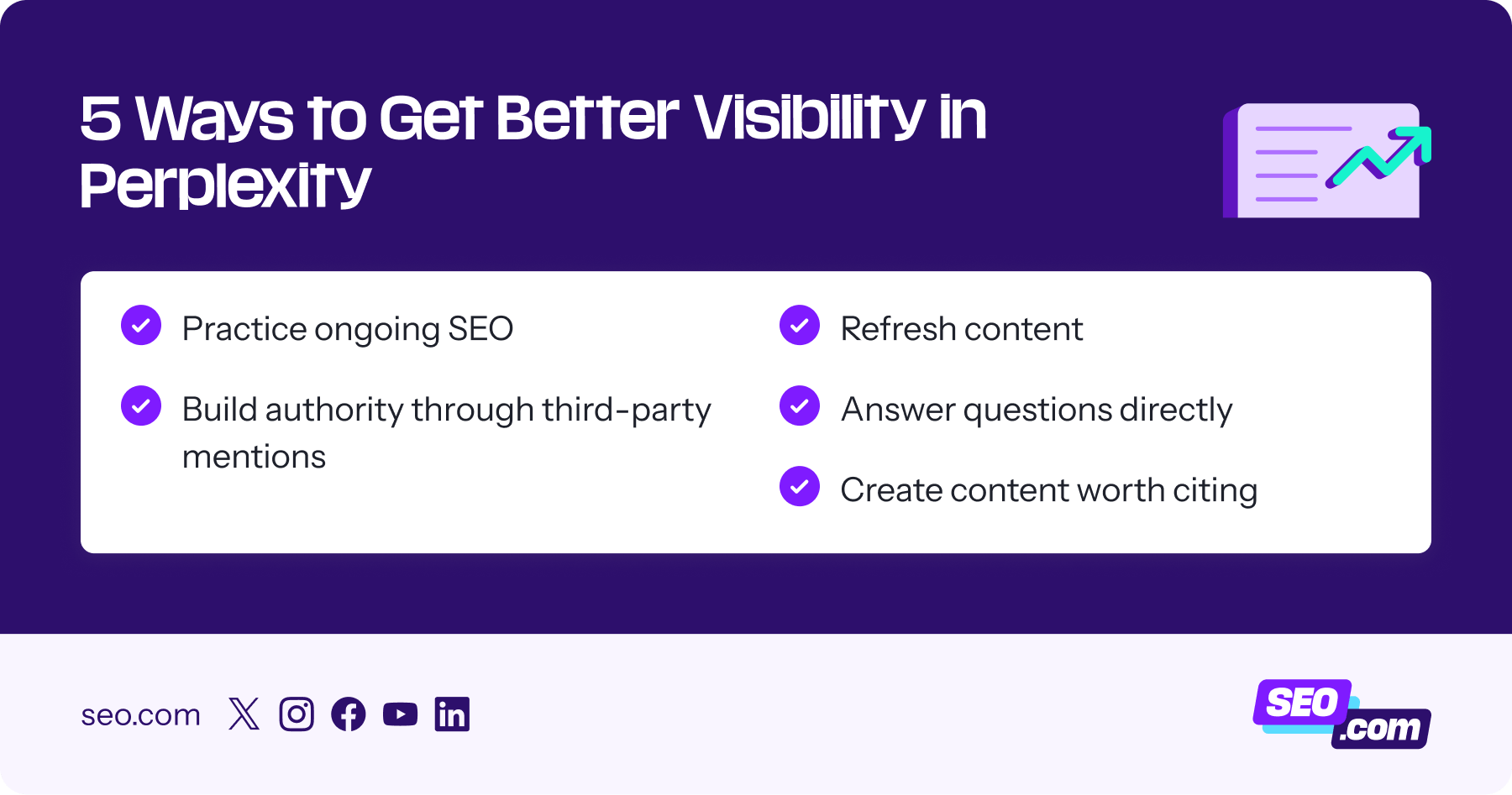
- Identify citation‑worthy topics. Monitor what Perplexity already cites for your niche. Run queries manually and note the types of pages appearing. Look for gaps where your unique data or perspective can fill a missing piece.
- Create skimmable, fact‑forward pages. Structure pages with a clear H1 that matches a common question, followed by an exact answer in the first paragraph. Use H2s for supporting arguments, each containing a blend of data and concise explanation.
- Back claims with named sources. Hyperlink to original research papers, official statistics, or expert statements. Perplexity’s synthesis often checks whether supporting evidence exists externally.
- Keep content fresh. Update pages whenever new studies or data emerge. Perplexity favors recent publication or “last updated” dates, especially in fast‑moving verticals like technology and stock markets.
- Pursue recognition on high‑authority sites. Being cited by Wikipedia, major news outlets, or academic repositories amplifies your brand’s authority footprint across the indices Perplexity searches.
- Add descriptive alt text and transcripts. Media content is only useful if the engine can read it. Accurate alt text and full transcripts allow Perplexity to absorb information embedded in images, videos, and podcasts.
- Chasing keywords over intent. Stuffing “Perplexity SEO checklist” variations without delivering factual, source‑rich content backfires. Perplexity evaluates the knowledge depth, not keyword density.
- Thin, opinion‑only content. Purely speculative articles without references rarely get cited. Always ground your narrative in verifiable data.
- Ignoring technical crawlability. Even though Perplexity fetches pages in real time, it still relies on standard HTTP accessibility. Blocking crawling via robots.txt or delivering broken pages removes you from the candidate pool.
- Neglecting mobile and load speed. A slow, cluttered page may still be fetched, but if the content is fractured by heavy scripts, the extractor can misinterpret or skip critical sections.
- Assuming one citation is enough. Perplexity’s model updates continuously. Consistency across multiple high‑quality pages builds a network of trust, making your domain a go‑to source for a range of related queries.
Perplexity Pages and the New Content Ecosystem
Perplexity recently introduced Pages, a feature that lets users transform threads into shareable, web‑accessible articles hosted on Perplexity’s own domain. These pages are indexable and can themselves become citation sources. For brands, publishing a well‑researched Perplexity Page based on a deep‑dive Q&A session provides a dual benefit: it feeds directly into the Perplexity ecosystem and can rank on traditional search engines. However, the underlying content must still be anchored in citable, authoritative sources. Think of Pages as a new surface where your expertise can be discovered without requiring users to leave the Perplexity environment.
Common Perplexity SEO Mistakes and How to Avoid Them

Many content creators treat Perplexity the same as Google and see poor results. Recognizing the pitfalls helps you steer clear of wasted effort.
Measuring Success in Perplexity SEO
Traditional organic dashboard metrics do not fully capture the value of being cited. You need a tailored measurement stack.
First, tag the URLs you publish with specific UTM parameters when they are shared through internal links, newsletters, or social media. Perplexity itself often appends its own referral parameters, so review your analytics for traffic sources containing “perplexity.” Segment this referral traffic by landing page to see which articles generate the most citations. Use brand monitoring tools to track mentions of your domain alongside “according to” or “source” in AI‑generated summaries that people screenshot and share on social platforms. Engagement metrics such as time‑on‑site and scroll depth for visitors coming from Perplexity tell you whether the cited content satisfies deeper user curiosity.
For a more proactive approach, set up a weekly manual check: pose a defined list of queries to Perplexity and record which domains appear. This competitive intelligence reveals whether your optimization is pushing you ahead of rival publications.
Important Notes for Future‑Proofing Your Perplexity SEO Strategy
Perplexity is still rapidly evolving, and so is the way it selects sources. The core of a durable strategy lies in building genuine topical authority. Publishing original research, data‑driven reports, and expert interviews creates assets that are difficult for AI‑generated competitors to replicate. Diversify your web presence so your brand appears on multiple trusted platforms—Wikipedia, academic databases, news sites, and community hubs like Stack Exchange. Perplexity’s retrieval model cross‑references these surfaces, and a consistent footprint multiplies your chances of being the chosen citation.
Keep an eye on Perplexity’s official API and any developer documentation they release. Understanding the technical nuances of their indexing pipeline will allow you to adjust schema, sitemaps, and freshness signals accordingly. Finally, remember that citation‑based search engines reward transparency. Always mark your content with visible publication dates, author bios, and links to original sources. The more you help Perplexity verify your information, the more it trusts you.
Frequently Asked Questions About Perplexity SEO
What exactly is Perplexity SEO?
Perplexity SEO is a specialized branch of search engine optimization that focuses on getting your web pages cited as sources inside Perplexity AI’s answer engine. It shifts the goal from earning a click on a search results page to being the authoritative reference that the AI uses to compose its response. This requires a blend of factual depth, credible sourcing, and content structure that makes information easy for the AI to extract and attribute.
How does Perplexity choose which websites to cite?
The engine evaluates a mix of topical authority, freshness, factual alignment with other trusted sources, and the clarity of the answer embedded in the page. It performs real‑time searches across multiple indexes, reads the top candidate pages, and scores them on relevance and trustworthiness. Pages that link to primary data, show expert authorship, and present concise answers directly below the heading have a clear advantage.
Can I submit my website directly to Perplexity?
Perplexity does not offer a manual submission tool akin to Google Search Console. The engine discovers content through its real‑time search capabilities. The most reliable way to get indexed is to ensure your site is crawlable, included in Bing’s index (since Perplexity often relies on Bing’s API), and frequently updated. Building backlinks from authoritative sites also increases the likelihood of rapid discovery.
Is backlinking still important for Perplexity SEO?
Yes, but the nature of backlinks has evolved. Rather than raw link volume, Perplexity appears to use links as proxy signals of a source’s reputation. Being referenced by highly trusted domains—such as government sites, universities, and established news media—boosts your authority in the eyes of the AI. Internal links between your own deep content pieces also help, but they must connect in a way that demonstrates expertise and a cohesive knowledge base.
How can I track traffic coming from Perplexity?
Monitor your web analytics for referral traffic with “perplexity” in the source string. Perplexity typically sends clicks with a URL parameter like ?utm_source=perplexity or similar. Set up a custom channel grouping in Google Analytics or your preferred tool to isolate this traffic. Analyzing landing pages, session duration, and conversion rates from Perplexity visitors reveals which content earns citations and drives meaningful engagement.
Do I need to create Perplexity Pages to rank?
Not at all. Perplexity Pages is an additional distribution channel, not a ranking factor for traditional web content. Creating high‑quality Pages can expand your reach inside the Perplexity ecosystem, but your standard website content can still earn citations if it meets the authority and clarity thresholds. Treat Pages as a complementary asset, not a replacement for your core site optimization.
Conclusion
Perplexity SEO signals a fundamental shift toward citation‑driven visibility. It rewards websites that function like living libraries—well‑organized, meticulously sourced, and instantly useful. By embracing authoritative content, clear structure, and transparent referencing, you position your brand not just for clicks but for the role of a trusted informant inside AI answers. As more users adopt Perplexity and similar answer engines, the ability to be the chosen source will define the next decade of organic search success. Start auditing your content with a citation‑first mindset, and the foundation you build today will pay dividends as AI‑powered discovery reshapes the entire web.
Xem thêm:
- AI Site Audit: The Complete Guide to Smarter, Faster Website Analysis for 2025
- AI SEO Statistics 2025: Data-Driven Insights Every Marketer Must Know
- AI SEO Brand Mentions: The Complete Guide to Digital PR in the Age of Algorithms
- The 2024 AI SEO Glossary: 50+ Must-Know Terms for Search Professionals
- AI Paragraph Generator: The Complete Guide to Writing Faster, Smarter, and Better in 2025
Bài viết cùng chủ đề:

AI SEO SEO Automation with Make: The Complete Workflow Guide

AI SEO SEO Automation with Zapier: The Complete Workflow Guide

AI SEO SEO Automation with n8n: The Complete Workflow Guide
AI SEO SEO Automation with Gemini: The Complete Guide to Scaling Organic Growth

AI SEO SEO Automation with Claude: The Complete Guide to Scaling Content in 2025

AI SEO SEO Automation with ChatGPT: The Complete Playbook for 2025

AI SEO & SEO Automation for Affiliate Sites: The 2025 Playbook for Passive Income Growth
AI SEO & SEO Automation for Bloggers: The Complete Guide to Scaling Your Content

AI SEO & SEO Automation for Agencies: The Complete 2025 Playbook

AI SEO and SEO Automation for Ecommerce: The Complete Playbook for 2025

AI SEO & SEO Automation for WordPress: The Complete Playbook for 2025
AI SEO SEO Automation Strategy: The Complete Playbook for 2025

Mastering the AI SEO SEO Automation Process: A Complete Guide to Scaling Organic Growth
AI SEO SEO Automation System: The Complete Guide to Scaling Organic Growth in 2025
AI SEO SEO Automation Platform: The Complete Guide to Scaling Organic Growth in 2025
AI SEO SEO Automation Software: The Complete Guide to Scaling Organic Growth in 2025















