
No products in the cart.
The Ultimate AI Content Brief: How to Write Smarter, Rank Faster, and Outperform Every Competitor
29
Jul
Jul
Marketers who rely on guesswork lose time, money, and rankings. The AI content brief replaces scattered notes, vague instructions, and endless revision loops with a precise, data-backed blueprint every writer or AI tool can execute perfectly. In the next few minutes, you will understand exactly what an AI content brief is, why it fixes the biggest content production bottlenecks, and how to build one that consistently drives search visibility and conversions.
What Is an AI Content Brief? A Clear Definition
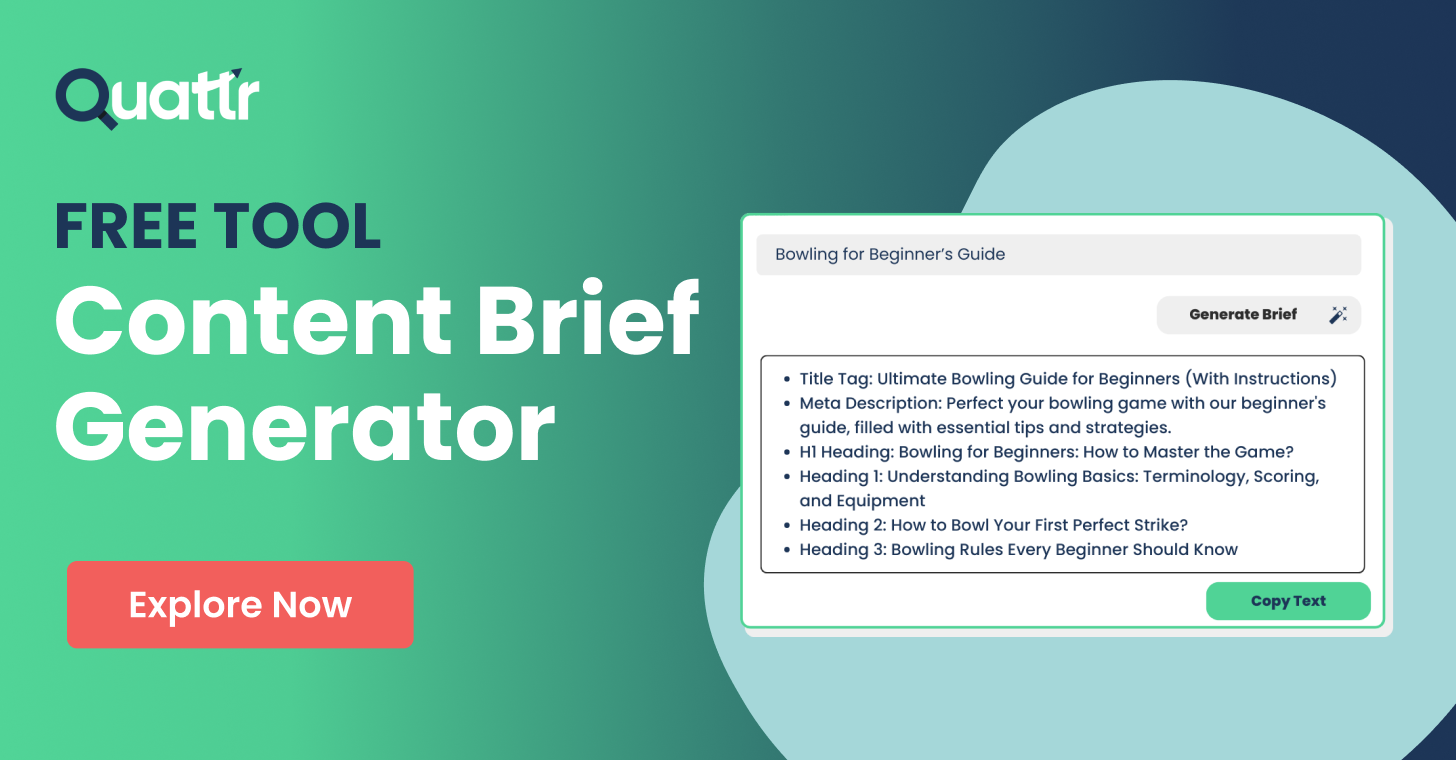
An AI content brief is a structured document—generated, enriched, or optimized by artificial intelligence—that defines every critical element a writer or AI writing assistant needs to produce a high-performing piece of content. Unlike a simple topic suggestion or a keyword list, a true AI content brief pulls data from search engine results pages, competitor analysis, user intent signals, and on-page SEO requirements. It translates raw data into actionable guidance: the exact primary keyword, secondary terms, content structure, target word count, questions to answer, internal linking opportunities, and tone of voice.
When people search for “AI content brief,” they often want to know whether it is just another buzzword. In practice, it is the operational backbone of a modern content workflow. Instead of drafting a brief manually and guessing what might rank, the AI content brief analyzes the top-performing pages for a query, extracts patterns that Google rewards, and delivers a content plan engineered from the start for search success. It moves the decision-making from intuition to evidence, which makes production faster and outcomes more predictable.
Why a Traditional Content Brief No Longer Works
Manual briefs usually contain a headline idea, a few bullet points, and maybe a primary keyword. They fail because they ignore the full landscape of the SERP: featured snippets, “People Also Ask” boxes, related searches, and the semantic depth required to satisfy modern algorithms. Writers are left to fill gaps without knowing what gaps actually exist. Editors waste hours rewriting. Stakeholders wonder why traffic does not arrive.
An AI-driven approach closes that gap by surfacing exactly what Google already rewards. The brief becomes a mirror of search intent—not what you think people want, but what the data says they need. That shift alone can double organic traffic in competitive niches because every piece of content starts with a proven architecture rather than assumptions.
Core Components of Every Effective AI Content Brief
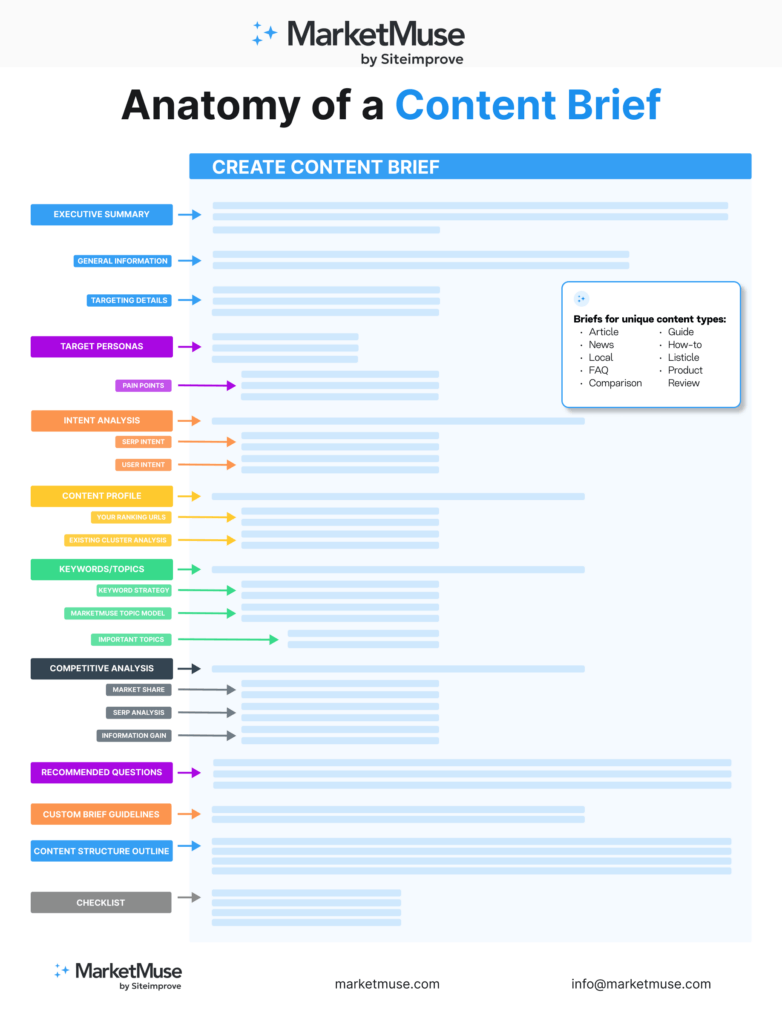
Not all briefs are equal. A superficial AI-generated outline without depth fails the same way a manual brief does. The strongest AI content briefs contain several mandatory layers. Each layer answers a question the writer must resolve before the first sentence is written.
Primary Keyword and Intent Mapping
The brief must name the main keyword and classify intent—informational, commercial, transactional, or navigational. AI tools analyze the SERP to confirm that classification. Without it, you risk producing a product page when the user wants a guide, or vice versa. This mapping also identifies the content type needed: a listicle, a how-to guide, a comparison post, a landing page, or an opinion piece.
Semantic Keyword Clusters and Entities
Search engines rely on entity recognition and topic coverage. A brief assembled by AI extracts related terms, subtopics, and co-occurring phrases from top-ranking competitors. Instead of keyword stuffing, the brief recommends where to place “AI content brief,” “automated content planning,” “SERP-driven briefs,” and entity-related terms such as “content workflow,” “search intent analysis,” and “on-page optimization.” The result is a document that speaks the language of both the reader and the ranking algorithm.
Competitive Content Structure Analysis
AI scans the headers, paragraph patterns, media usage, and interlinking strategies of pages in positions one through ten. It then recommends a heading hierarchy that matches or outperforms what exists. This might mean adding an FAQ section, a data table, video embeds, or a specific number of H2 and H3 tags. The brief does not just guess—it models success.
Questions and Subtopics to Cover
Extracted directly from “People Also Ask” boxes, featured snippets, and forum discussions, this list ensures your content answers the precise questions users type into Google. An AI content brief might include questions like “How does an AI content brief save time?” or “Which tools generate AI-powered briefs?” Answering these in dedicated sections can capture multiple SERP features and voice search queries.
Technical SEO Specifications
Meta title templates, meta description drafts, recommended URL slug, alt text guidelines, and internal link suggestions all belong in the brief. AI can generate these in seconds, aligning them with keyword data and competitive gaps. This makes post-publication optimization almost automatic.
How AI Generates a Content Brief: The Step-by-Step Process
Understanding the mechanics helps you trust the output and tweak it for your business. The typical AI content brief generator follows a repeatable sequence.
- Seed keyword input. You provide the main term or topic, such as “AI content brief.”
- SERP crawl and data extraction. The system pulls HTML, meta tags, headings, content length, and link data from the top-ranking URLs.
- Natural language processing (NLP) analysis. AI identifies patterns in vocabulary, sentiment, topic depth, and content formatting.
- Gap detection. Missing subtopics, unanswered questions, and weak points in competitor content are flagged.
- Brief assembly. All findings are compiled into a structured document with recommendations for headings, word count, multimedia, and keywords.
- Export or integration. The brief is pushed directly into a content management system, Google Docs, or a writing tool like a GPT-powered editor.
The entire process often takes under a minute, which frees strategists to focus on creativity and nuance rather than manual research.
Benefits of Using AI Content Briefs in a Production Workflow
Adopting AI content briefs delivers measurable improvements across quality, speed, and team alignment. Teams that switch typically report a 30–50% reduction in briefing time and a noticeable drop in revision cycles.
Higher First-Draft Accuracy
When a writer receives an exhaustive brief, the first draft aligns with search intent from the opening paragraph. T This alone can cut content production time by 20% or more.
Scalable SEO Consistency
With AI briefs, every piece of content follows a data-informed playbook, regardless of the writer’s experience level. Junior team members produce work that rivals senior strategists because the brief eliminates guesswork. Brand voice and SEO standards remain uniform across hundreds of pages.
Stronger SERP Feature Capture
By baking in answer targets, FAQ schemas, and structured headings, AI briefs increase the likelihood of winning featured snippets, image packs, and “People Also Ask” placements. This can boost click-through rates even without a higher ranking position.
Collaboration Without Bottlenecks
Editors, subject matter experts, and content managers all work from the same source of truth. The brief becomes the shared contract for what the content must deliver. Misunderstandings drop, and approvals accelerate.
Limitations and Risks You Should Not Ignore
No technology is flawless. Relying on AI content briefs without oversight introduces specific risks that can undermine content quality.
- Data freshness. AI tools may base recommendations on outdated SERPs. If a topic evolves rapidly, the brief could miss new entities or shifting user intent.
- Over-optimization tendency. Some AI-generated briefs push excessive keyword density or rigid structures. Content that blindly follows a template feels sterile and fails to engage human readers.
- Missing brand nuance. AI cannot capture your unique tone, proprietary data, or customer stories. The brief must be enhanced with human insight to avoid generic output.
- Tool dependency. Treating the brief as final without vetting can create a false sense of security. Google algorithm updates may require adjustments that no AI tool can predict autonomously.
- Privacy and data security. Feeding proprietary content strategies into public AI tools requires caution. Always review terms of service and consider enterprise-grade solutions with data isolation.
Traditional Brief vs. AI Content Brief: A Direct Comparison
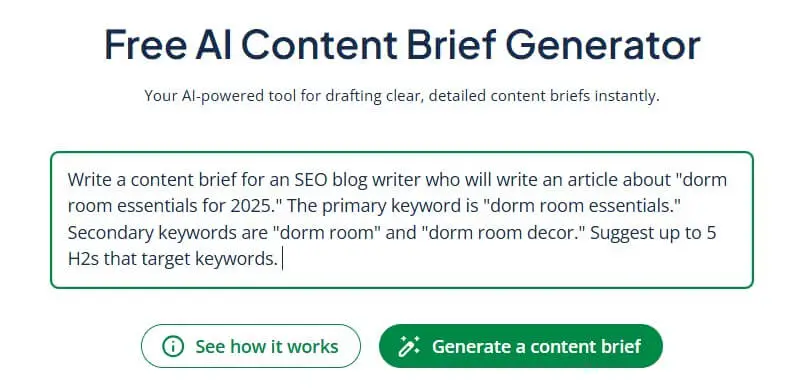
The difference between the old way and the new way is stark. The table below highlights why AI content briefs are rapidly becoming standard.
| Criterion | Traditional Brief | AI Content Brief |
|---|---|---|
| Research time | 2–5 hours manual SERP review | Under 2 minutes automated analysis |
| Keyword integration | Often limited to one or two terms | Full semantic cluster with entities |
| Intent alignment | Based on intuition or limited data | Data-confirmed from SERP features |
| Competitive structure | Guessed from browsing top pages | Systematically extracted heading and format patterns |
| Scalability | Hard to maintain across dozens of briefs | Easily replicated for entire content calendars |
| Human expertise required | High; heavy reliance on strategist skill | Moderate; human oversight still essential for tone and nuance |
How to Build a High-Performing AI Content Brief: A Practical Guide
You do not need to be a data scientist to create briefs that rank. Follow this repeatable workflow using readily available tools and your own editorial judgment.
Step 1: Define the Core Topic and Business Goal
Start with clarity. Decide whether the content aims to educate, generate leads, or support a product launch. A brief for a top-of-funnel “What is an AI content brief” article will look different from a comparison piece targeting buyers. Clearly state the primary keyword and conversion goal inside the brief itself.
Step 2: Gather SERP Intelligence with AI
Use a specialized AI content brief tool or a multi-purpose SEO platform that offers brief generation. Input your primary keyword. Let the AI analyze page titles, headers, word count ranges, and content gaps. Extract the top 10–15 semantic keywords, related entities, and the most frequently answered questions. Save this data as your raw research layer.
Step 3: Structure the Brief Like an Editor
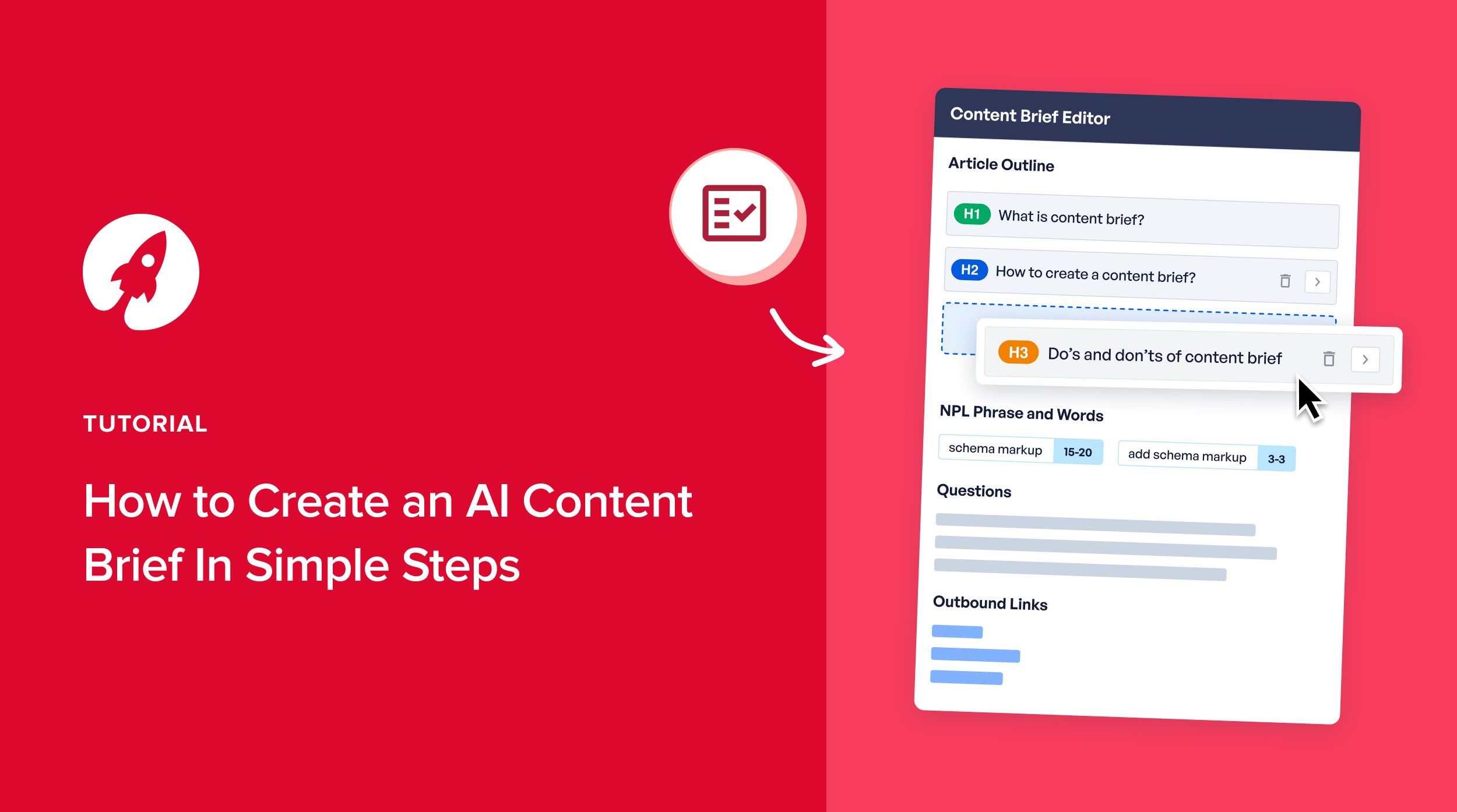
Translate the AI data into a scannable document. A strong brief template contains:
- Target audience persona: one sentence describing the reader.
- Primary keyword and search intent: clearly stated.
- Recommended H1 title and meta description: three variations each.
- Header hierarchy: H2s, H3s, and even some H4s with notes on what each section must cover.
- Word count range: based on competitor averages and topic complexity.
- Questions to answer: pulled directly from the SERP.
- Internal links to include: at least three relevant URLs.
- Tone and style notes: e.g., authoritative but conversational, no jargon.
Step 4: Inject Original Insights and Human Perspective
AI can surface what already exists. It cannot produce your proprietary data, customer survey results, or firsthand experience. Add a section to the brief that requires the writer to include original examples, case studies, or unique angles. This step separates average content from content that earns backlinks and trust.
Step 5: Include Multimedia and Formatting Instructions
Specify image types, infographics, video placements, or custom graphics. Briefs that ignore visual elements miss engagement signals. If competitor pages use comparison tables, note that in the brief and provide a structure or data source.
Step 6: Add Compliance and Review Checklists
For regulated industries, embed legal disclaimers, citation requirements, or fact-checking protocols directly into the brief. This keeps the entire team aligned and reduces compliance risk.
Common Mistakes When Using AI Content Briefs and How to Avoid Them
Even experienced teams fall into predictable traps. Recognizing these mistakes will save months of underperforming content.
- Blindly copying competitor structures. If every page says exactly the same thing, no one stands out. Use AI-suggested headers as a starting point, then improve upon them with a unique angle or deeper analysis.
- Ignoring search intent drift. A keyword might have informational intent today but shift toward commercial intent over time. Always revalidate the SERP if the brief is more than a month old.
- Stuffing the brief with every possible keyword. Including 50 semantic terms forces unnatural writing. Prioritize 5–10 high-impact terms and let the writer use them naturally.
- Skipping writer onboarding. If the writer does not understand how to read and apply an AI brief, the investment is wasted. Provide a 15-minute walkthrough of your brief template and expectations.
- Neglecting performance feedback loops. Once content is published, measure rankings and engagement. Feed that data back into your brief generation process so each iteration gets smarter.
Important Notes for Enterprise and Agency Teams
Large-scale operations require additional governance around AI content briefs. Establish clear ownership: who generates the brief, who approves it, and who updates it based on performance. Store briefs in a centralized system so they become a reusable knowledge base. Over time, you will accumulate a library of high-performing brief models for different content types—tutorials, listicles, landing pages, and news articles.
Be mindful of AI tool limitations regarding localized search results. If you operate in multiple countries, run separate briefs for each target location. A brief built for U.S. SERPs will not perfectly fit UK or Australian audiences. Always verify local intent and competitor sets.
Finally, invest in training that blends AI literacy with editorial excellence. The best AI content brief in the world still needs a skilled human to turn data into compelling narrative. Treat the brief as the architect’s blueprint and the writer as the builder who brings warmth, voice, and persuasion into the final piece.
Frequently Asked Questions About AI Content Briefs
What exactly does an AI content brief include?
An AI content brief typically includes the primary keyword, search intent classification, a tailored heading structure, semantic keyword clusters, questions to answer, recommended word count, meta data drafts, and internal link suggestions. Advanced briefs also highlight competitor gaps and multimedia requirements.
Is an AI content brief only useful for SEO content?
No. While SEO content benefits significantly, AI briefs are also valuable for sales pages, email sequences, social media campaigns, and video scripts. Any asset that requires alignment with audience intent and competitive positioning can be briefed more effectively with AI-driven data.
Can I create an AI content brief without expensive tools?
Yes. You can combine free tools—such as Google Search “People Also Ask,” a keyword research extension, and a language model like ChatGPT—to manually assemble a data-informed brief. However, dedicated platforms save hours per brief and offer deeper SERP analysis.
How often should I update an AI content brief?
For evergreen topics, review briefs every three to six months. For fast-moving niches, revalidate the SERP every 30 days. Any significant Google algorithm update should also trigger a review of active briefs to ensure they still align with ranking factors.
Does using an AI content brief guarantee higher rankings?
No brief guarantees rankings. An AI content brief dramatically increases the probability of ranking by aligning content with proven SERP patterns and user needs. Execution quality, domain authority, backlinks, and user engagement signals still play decisive roles.
Bringing the AI Content Brief into Your Daily Workflow
The shift from scattered notes to structured, AI-powered briefs represents one of the most underrated efficiency levers in content marketing. It bridges the gap between raw search data and publishable content that serves real users. Every article, landing page, and guide starts with a single document—the brief. When that document is built on evidence instead of assumption, the entire production line runs cleaner, faster, and with far fewer wasted resources.
Start small. Pick one upcoming piece of content, generate an AI content brief, and compare it to how you normally brief writers or tools. Measure the difference in writing time, revisions, and initial ranking performance. Once the pattern proves itself, standardize the process. In a landscape where content saturation is only growing, the brief is your primary competitive advantage—and AI makes it sharper than ever.
Xem thêm:
- AI SEO Pillar Content: The Complete Blueprint for Dominating Search Rankings in 2025
- AI SEO for Startups: The 2025 Playbook for Explosive Organic Growth
- How to Find Keywords with AI: The Modern Marketer’s Blueprint for Smarter Research
- AI Semantic SEO: Mastering the Next Evolution of Search Engine Optimization
- AI SEO Autonomous Agents: The Complete Guide to Hands-Free Search Optimization
Bài viết cùng chủ đề:

AI SEO SEO Automation with Make: The Complete Workflow Guide

AI SEO SEO Automation with Zapier: The Complete Workflow Guide

AI SEO SEO Automation with n8n: The Complete Workflow Guide
AI SEO SEO Automation with Gemini: The Complete Guide to Scaling Organic Growth

AI SEO SEO Automation with Claude: The Complete Guide to Scaling Content in 2025

AI SEO SEO Automation with ChatGPT: The Complete Playbook for 2025

AI SEO & SEO Automation for Affiliate Sites: The 2025 Playbook for Passive Income Growth
AI SEO & SEO Automation for Bloggers: The Complete Guide to Scaling Your Content

AI SEO & SEO Automation for Agencies: The Complete 2025 Playbook

AI SEO and SEO Automation for Ecommerce: The Complete Playbook for 2025

AI SEO & SEO Automation for WordPress: The Complete Playbook for 2025
AI SEO SEO Automation Strategy: The Complete Playbook for 2025

Mastering the AI SEO SEO Automation Process: A Complete Guide to Scaling Organic Growth
AI SEO SEO Automation System: The Complete Guide to Scaling Organic Growth in 2025
AI SEO SEO Automation Platform: The Complete Guide to Scaling Organic Growth in 2025
AI SEO SEO Automation Software: The Complete Guide to Scaling Organic Growth in 2025















