No products in the cart.
AI SEO NLP Keyword Analysis: The Complete Guide to Smarter Search Rankings

10
Aug
Aug
AI SEO NLP keyword analysis has transformed how digital marketers understand search intent and content optimization. Natural Language Processing (NLP) allows search engines to interpret queries contextually rather than relying solely on exact-match keywords. This shift demands a new approach to keyword research, one that leverages machine learning to decode semantic relationships, entity relevance, and user intent. This comprehensive guide explores how AI-driven NLP tools are reshaping keyword strategies, offering practical steps to implement these technologies for measurable ranking improvements.
Understanding AI SEO NLP Keyword Analysis
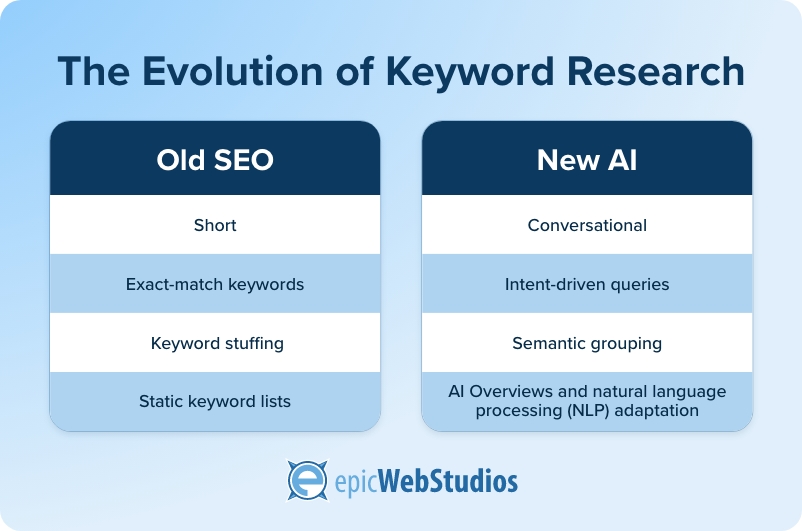
AI SEO NLP keyword analysis refers to the process of using artificial intelligence and natural language processing algorithms to evaluate, categorize, and optimize keywords based on semantic meaning and contextual relevance. Unlike traditional keyword tools that count search volume and density, NLP-powered systems analyze the linguistic structure of queries, identifying entities, relationships, and sentiment behind user searches.
Search engines like Google have moved beyond simple keyword matching. Their algorithms now use neural networks like BERT and MUM to understand the nuance of language. When you perform AI SEO NLP keyword analysis, you are essentially reverse-engineering these algorithms to align your content with how machines comprehend human language.
How NLP Differs from Traditional Keyword Research
Traditional keyword research focuses on metrics like search volume, keyword difficulty, and cost-per-click. It treats keywords as isolated data points. NLP keyword analysis, however, examines the entire query structure. It breaks down a phrase into its grammatical components, identifies the main entity, and determines the relationship between words. This allows marketers to uncover topics and subtopics that a purely volume-based approach would miss.
For example, the keyword “best running shoes” might have high volume. An NLP analysis would further identify related entities like “pronation control,” “heel drop,” and “cushioning type.” These are not just synonyms; they are semantic concepts that users frequently associate with the primary query. Content optimized with these NLP-derived terms tends to rank higher because it covers the full spectrum of user intent.
The Core Components of AI SEO NLP Keyword Analysis
To effectively utilize this technology, it is essential to understand its core components. Each element plays a distinct role in interpreting and optimizing for search queries.
Entity Recognition and Disambiguation
NLP algorithms identify entities—people, places, brands, or concepts—within a query. For instance, “Apple” could refer to the fruit or the technology company. AI SEO NLP keyword analysis uses context to disambiguate these entities. This ensures your content targets the correct meaning, preventing wasted effort on ambiguous terms.
Semantic Search and Topic Clusters
Semantic search focuses on the meaning behind words rather than the literal string. NLP tools group keywords into topic clusters based on shared concepts. Instead of targeting “car insurance” and “auto insurance” separately, the analysis recognizes them as part of the same semantic field. This allows you to create comprehensive pillar pages that address multiple related queries naturally.
Intent Classification
NLP categorizes queries into intent types: informational, navigational, transactional, or commercial investigation. AI SEO NLP keyword analysis goes deeper by analyzing the linguistic cues that signal intent. Words like “how to,” “best,” “buy,” or “review” trigger different classifications. This precision enables content creators to match their format and tone to what the user actually wants.
Sentiment and Modifier Analysis
Modifiers such as “cheap,” “premium,” “for beginners,” or “near me” significantly alter search intent. NLP algorithms detect these modifiers and adjust keyword difficulty and content requirements accordingly. A query with the modifier “best” implies a comparison, while “definition” implies a need for a concise explanation. Understanding these nuances prevents content mismatch.
How AI Algorithms Process Keyword Data
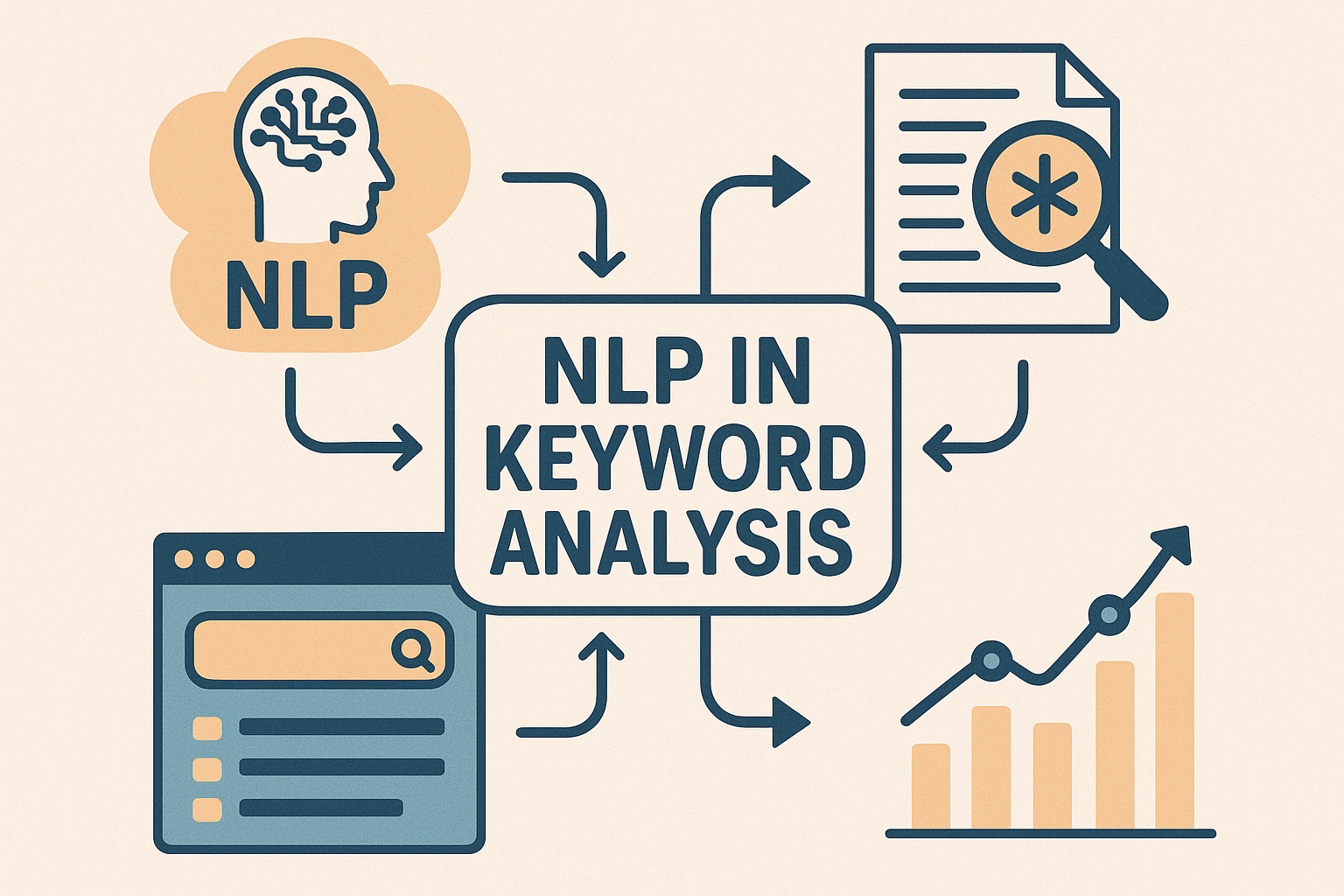
The technical process behind AI SEO NLP keyword analysis involves several stages of machine learning. Understanding this pipeline helps you appreciate why certain keywords are recommended over others.
Tokenization and Lemmatization
First, the algorithm breaks down a query into tokens (individual words or phrases). Then, lemmatization reduces words to their base form. For example, “running” becomes “run.” This normalization allows the system to match queries with content that uses different grammatical forms of the same root word.
Vectorization and Word Embeddings
Words are converted into numerical vectors that represent their meaning in a multi-dimensional space. Word embeddings like Word2Vec or GloVe place semantically similar words close together. AI SEO NLP keyword analysis uses these vectors to find related terms that are not obvious synonyms but appear in similar contexts. This is how the system discovers latent semantic indexing (LSI) keywords.
Transformer Models and Contextual Understanding
Modern NLP relies on transformer models like BERT (Bidirectional Encoder Representations from Transformers). These models read a query in both directions to understand context. For instance, in the query “can you book a flight for a book club,” the model distinguishes between the verb “book” and the noun “book.” This contextual processing is critical for accurate keyword analysis.
Benefits of Using AI SEO NLP Keyword Analysis
Adopting this advanced approach offers tangible advantages over conventional methods. The benefits extend beyond rankings to overall content strategy and user experience.
Improved Search Intent Matching
By understanding the semantics of a query, you can create content that precisely answers what the user seeks. This reduces bounce rates and increases dwell time, both of which are positive signals to search engines. Content that satisfies intent is more likely to earn featured snippets and position zero results.
Discovery of Long-Tail Opportunities
NLP analysis uncovers long-tail keywords that have lower competition but high conversion potential. These are often phrased as full questions or conversational sentences. Because they are highly specific, they attract users who are further along in the buying cycle.
Enhanced Content Structuring
NLP tools often provide recommendations for headings, subheadings, and related questions to include. This helps you structure content logically, making it easier for search engine crawlers to parse and for users to navigate. A well-structured article that covers multiple semantic angles is viewed as authoritative.
Competitive Gap Analysis
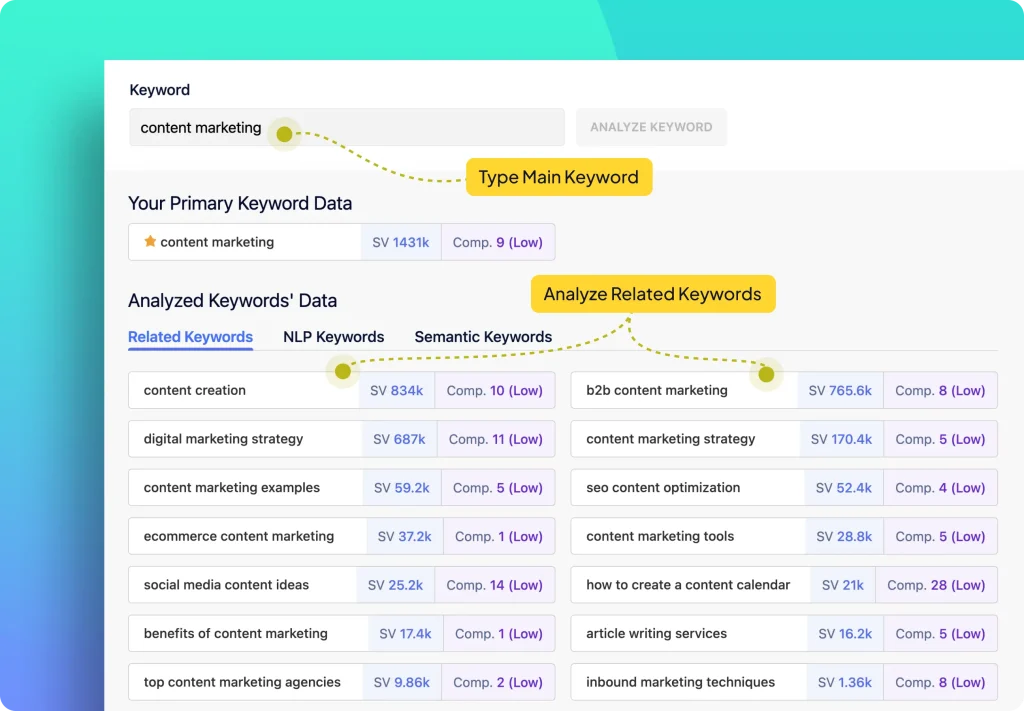
AI SEO NLP keyword analysis can compare your content against top-ranking pages. It identifies semantic terms that competitors cover but you do not. This gap analysis reveals exactly what you need to add to your page to surpass them in relevance.
Limitations and Challenges of NLP Keyword Analysis
While powerful, this technology is not without its challenges. Being aware of these limitations helps you set realistic expectations and avoid common pitfalls.
Data Quality and Training Bias
NLP models are trained on vast datasets. If these datasets contain biases, the analysis will reflect them. For example, certain industries may have skewed data that leads to incorrect entity associations. Always cross-reference AI recommendations with manual review.
Over-Reliance on Automation
AI tools provide suggestions, but they cannot replace human judgment. A tool might recommend a keyword that is semantically relevant but commercially irrelevant to your specific audience. Human oversight is necessary to filter out noise and align suggestions with business goals.
Complexity of Multilingual SEO
NLP models perform differently across languages. A model trained primarily on English data may struggle with the nuances of other languages, leading to inaccurate keyword analysis. If you operate in multiple markets, you need localized NLP models.
AI SEO NLP Keyword Analysis vs. Traditional Tools: A Comparison
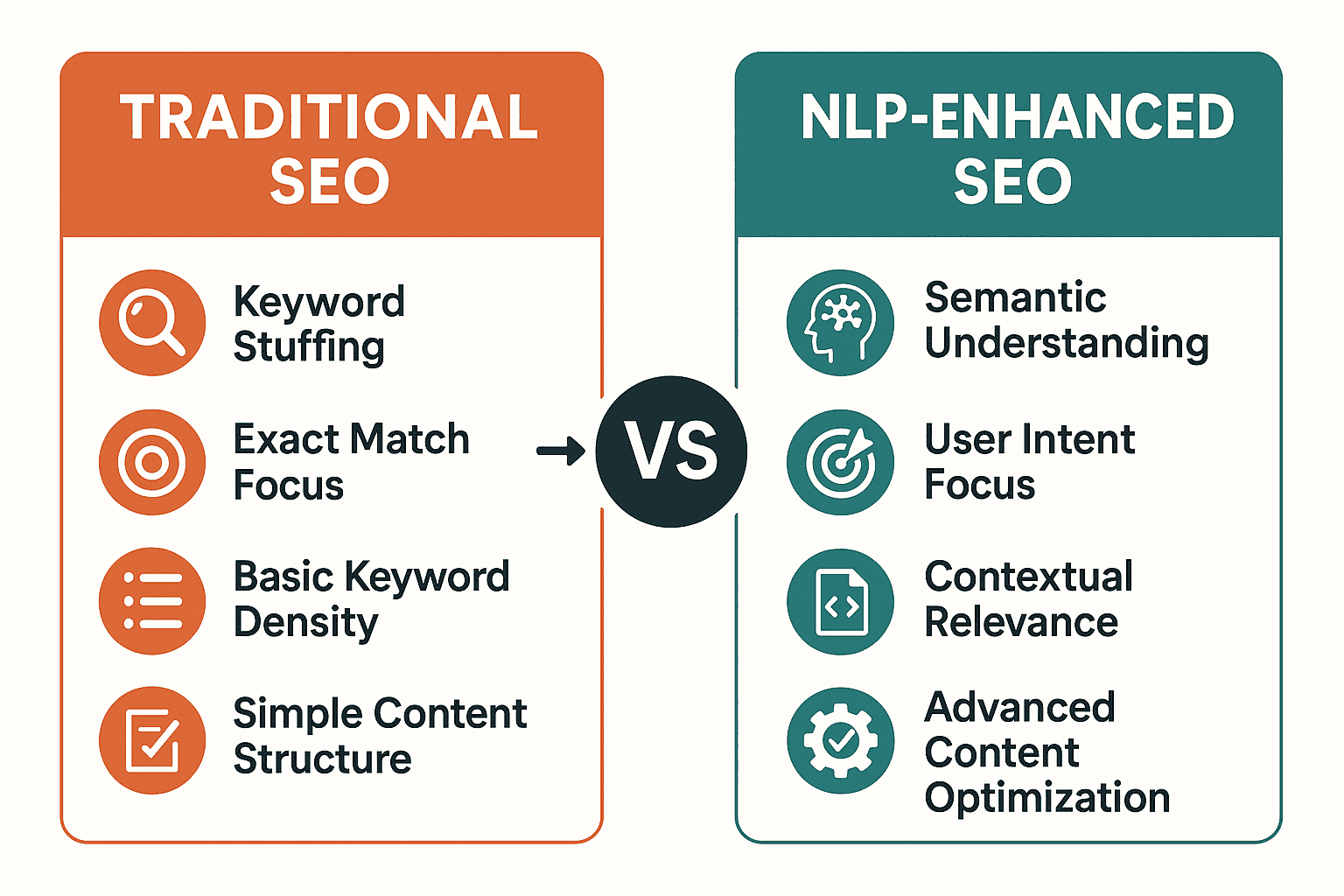
To understand the value proposition, it helps to compare the two approaches directly. The table below highlights the key differences.
| Feature | Traditional Keyword Tools | AI SEO NLP Keyword Analysis |
|---|---|---|
| Data Focus | Search volume, CPC, density | Semantic meaning, entity relevance |
| Query Understanding | Exact-match and phrase-match | Contextual and intent-based |
| Keyword Suggestions | Synonyms and variations | Related concepts and subtopics |
| Content Optimization | Keyword placement in title and meta | Topic coverage and semantic depth |
| Competitor Analysis | Backlink and domain authority | Content gap and semantic overlap |
| Adaptability | Slow to reflect language changes | Learns and updates continuously |
Traditional tools are still useful for gauging search volume and commercial value. However, AI SEO NLP keyword analysis provides the strategic depth required to compete in modern search environments where user intent is paramount.
Practical Guide: How to Perform AI SEO NLP Keyword Analysis
Implementing this strategy requires a systematic approach. The following steps outline a practical workflow that combines AI tools with manual expertise.
Step 1: Gather Seed Keywords
Start with a list of core keywords relevant to your business. These can come from your website analytics, customer feedback, or industry knowledge. Enter these seeds into an NLP-powered keyword tool such as Clearscope, MarketMuse, or Surfer SEO. These platforms use AI to generate a comprehensive list of related terms and concepts.
Step 2: Analyze the Semantic Map
Examine the output from the tool. Look for terms that are not just synonyms but represent distinct subtopics. For example, if your seed keyword is “digital marketing,” the semantic map might include “content calendar,” “email automation,” and “conversion rate optimization.” These are entities that form a complete topic cluster.
Step 3: Classify Search Intent
For each identified keyword or phrase, determine the dominant search intent. Use the following classification:
- Informational: User seeks knowledge (e.g., “what is NLP”)
- Navigational: User seeks a specific site or page
- Commercial: User researches before buying (e.g., “best NLP tools”)
- Transactional: User intends to complete an action (e.g., “buy NLP software”)
This classification dictates the content format. Informational queries suit blog posts and guides, while transactional queries require product pages or landing pages.
Step 4: Map Keywords to Content Structure
Create an outline that incorporates the primary keyword in the H1 and title tag. Distribute secondary keywords and NLP-derived terms across H2 and H3 headings. Ensure that each section addresses a specific semantic angle. This creates a logical flow that search engines can easily interpret.
Step 5: Optimize for Entities, Not Just Words
Include relevant entities such as brand names, people, and places naturally within the content. Use structured data markup (schema.org) to help search engines identify these entities. This strengthens the topical authority of your page.
Step 6: Validate with SERP Analysis
After publishing, analyze the top-ranking pages for your target keyword. Use an NLP tool to compare their semantic coverage with yours. Identify any terms they use that you missed and update your content accordingly. This iterative process is key to maintaining rankings.
Common Mistakes in AI SEO NLP Keyword Analysis
Even with advanced tools, marketers often make errors that undermine their efforts. Recognizing these mistakes is the first step to avoiding them.
Ignoring User Context
Focusing solely on the keyword without considering the user’s location, device, or search history can lead to irrelevant content. NLP analysis should incorporate contextual data to tailor content appropriately. For example, “best coffee” has different meanings for a home brewer versus a commercial café owner.
Keyword Stuffing with Semantic Terms
Some marketers over-optimize by forcing every NLP-recommended term into the content, resulting in unnatural prose. This harms readability and can trigger search engine penalties. Use semantic terms only where they fit naturally within the narrative.
Neglecting Content Refresh
Language and search behavior evolve. A keyword analysis performed six months ago may be outdated. NLP models are continuously updated, so your content should be too. Schedule regular audits to refresh your semantic coverage.
Overlooking Entity Relationships
NLP is not just about individual words; it is about how entities relate to each other. Failing to establish clear relationships between concepts in your content makes it harder for search engines to understand your expertise. Use clear transitions and logical connections between sections.
Important Notes for Effective Implementation

To maximize the effectiveness of your AI SEO NLP keyword analysis, consider these critical notes.
Combine AI with Human Creativity
AI tools are excellent at processing data, but they lack the creative intuition to craft compelling narratives. Use the data to inform your strategy, but rely on human writers to create engaging, original content that resonates with readers.
Monitor Performance Metrics
Track not only rankings but also user engagement metrics like time on page, pages per session, and conversion rates. These metrics indicate whether your semantic optimization is translating into real user satisfaction.
Integrate with Overall SEO Strategy
NLP keyword analysis should not exist in a silo. Integrate the findings with your technical SEO, link building, and content marketing efforts. A holistic approach ensures that your optimized content is also crawlable, indexable, and authoritative.
Frequently Asked Questions (FAQ)
What is the difference between LSI keywords and NLP keywords?
LSI (Latent Semantic Indexing) keywords are conceptually related terms found through co-occurrence analysis. NLP keywords go further by using deep learning models to understand the grammatical structure and context of a query. NLP analysis can identify entities and relationships that LSI cannot, making it more accurate for modern search engines.
How does AI SEO NLP keyword analysis improve voice search optimization?
Voice searches are typically longer and more conversational. NLP analysis excels at parsing natural language patterns and question-based queries. By optimizing for the semantic structure of voice queries, you can capture traffic from smart speakers and mobile voice assistants.
Can small businesses benefit from AI SEO NLP keyword analysis?
Yes. While enterprise tools can be expensive, many affordable NLP-powered platforms offer tiered pricing. Small businesses can use these tools to find niche long-tail keywords with low competition, allowing them to compete effectively against larger brands in specific areas.
Is AI SEO NLP keyword analysis the same as using ChatGPT for SEO?
No. ChatGPT is a generative AI that can produce text based on prompts. AI SEO NLP keyword analysis is a specialized application that uses NLP models to analyze search data and provide structured keyword recommendations. While ChatGPT can assist with content creation, dedicated NLP analysis tools provide the data-driven insights needed for strategic optimization.
How often should I update my NLP keyword analysis?
It depends on your industry. Fast-moving sectors like technology or fashion may require monthly updates. Stable industries like legal or accounting might only need quarterly reviews. Monitor your search performance and competitor activity to determine the optimal frequency.
Conclusion
AI SEO NLP keyword analysis represents a fundamental shift from keyword-centric optimization to intent-centric optimization. By leveraging natural language processing, marketers can decode the semantic layers of user queries, uncover hidden topic clusters, and create content that genuinely satisfies search intent. The benefits are clear: improved rankings, higher engagement, and a stronger topical authority signal to search engines.
However, technology is only a tool. The most successful strategies combine the analytical power of AI with the creative and strategic judgment of experienced marketers. By understanding the components, benefits, and limitations of NLP analysis, and by following a structured implementation workflow, you can position your content to thrive in an increasingly sophisticated search landscape. Start integrating these techniques today to build a semantic advantage that competitors will find difficult to replicate.
Xem thêm:
- AI SEO Content Updates: The Complete Guide to Staying Ahead in 2025
- AI SEO Content Production: The Complete Guide to Scaling Your Rankings in 2025
- Gemini vs ChatGPT for SEO: Which AI Tool Truly Elevates Your Search Rankings
- AI SEO Claude Search Optimization: The Complete Guide to Ranking in the Age of Conversational AI
- AI SEO Natural Language SEO: The Complete Guide to Search in 2025
Bài viết cùng chủ đề:

AI SEO SEO Automation with Make: The Complete Workflow Guide

AI SEO SEO Automation with Zapier: The Complete Workflow Guide

AI SEO SEO Automation with n8n: The Complete Workflow Guide
AI SEO SEO Automation with Gemini: The Complete Guide to Scaling Organic Growth

AI SEO SEO Automation with Claude: The Complete Guide to Scaling Content in 2025

AI SEO SEO Automation with ChatGPT: The Complete Playbook for 2025

AI SEO & SEO Automation for Affiliate Sites: The 2025 Playbook for Passive Income Growth
AI SEO & SEO Automation for Bloggers: The Complete Guide to Scaling Your Content

AI SEO & SEO Automation for Agencies: The Complete 2025 Playbook

AI SEO and SEO Automation for Ecommerce: The Complete Playbook for 2025

AI SEO & SEO Automation for WordPress: The Complete Playbook for 2025
AI SEO SEO Automation Strategy: The Complete Playbook for 2025

Mastering the AI SEO SEO Automation Process: A Complete Guide to Scaling Organic Growth
AI SEO SEO Automation System: The Complete Guide to Scaling Organic Growth in 2025
AI SEO SEO Automation Platform: The Complete Guide to Scaling Organic Growth in 2025
AI SEO SEO Automation Software: The Complete Guide to Scaling Organic Growth in 2025