No products in the cart.
AI Content vs Human Content: Choosing the Right Approach for Trust, Engagement, and Search Rankings
29
Jul
Jul
Every marketer, publisher, and business owner eventually faces a critical decision: should you invest in AI content vs human content? The explosion of generative AI tools has made it possible to create blog posts, product descriptions, and social captions in seconds. Yet behind the speed lies a more complex reality. While machines can string words together impressively, they often miss the nuance, lived experience, and emotional intelligence that human writers bring. Understanding where each excels—and where each fails—is the key to building content that both search engines and real people trust. This analysis breaks down the strengths, weaknesses, practical applications, and common pitfalls of both approaches so you can make informed choices without sacrificing quality or authenticity.
Understanding the Core Nature of AI Content and Human Content
Before comparing the two, it helps to define what each truly represents. AI-generated content is text produced by large language models trained on vast datasets of existing online material. These models predict likely word sequences, resulting in coherent paragraphs that mimic human writing. Human content, on the other hand, originates from a person’s research, expertise, creativity, and personal perspective. It carries the fingerprints of individual thought—flawed, emotional, and often more memorable.
The line between them is blurring. Many human writers now use AI for outlines or first drafts, while pure AI content increasingly passes superficial reading tests. However, the fundamental difference remains: AI remixes patterns it has seen, while humans can introduce genuinely new ideas, lived anecdotes, and cultural awareness that no training data fully captures. Recognizing this distinction is essential for evaluating the output you publish under your brand’s name.
The Key Differences Between AI Content and Human Content
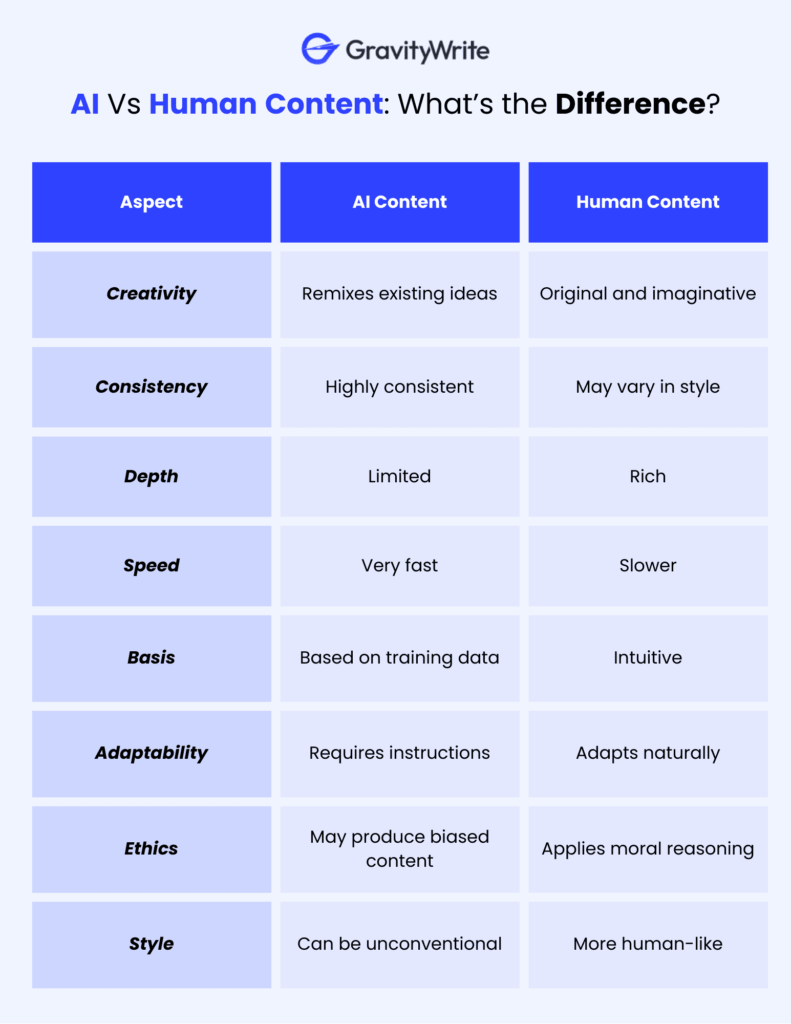
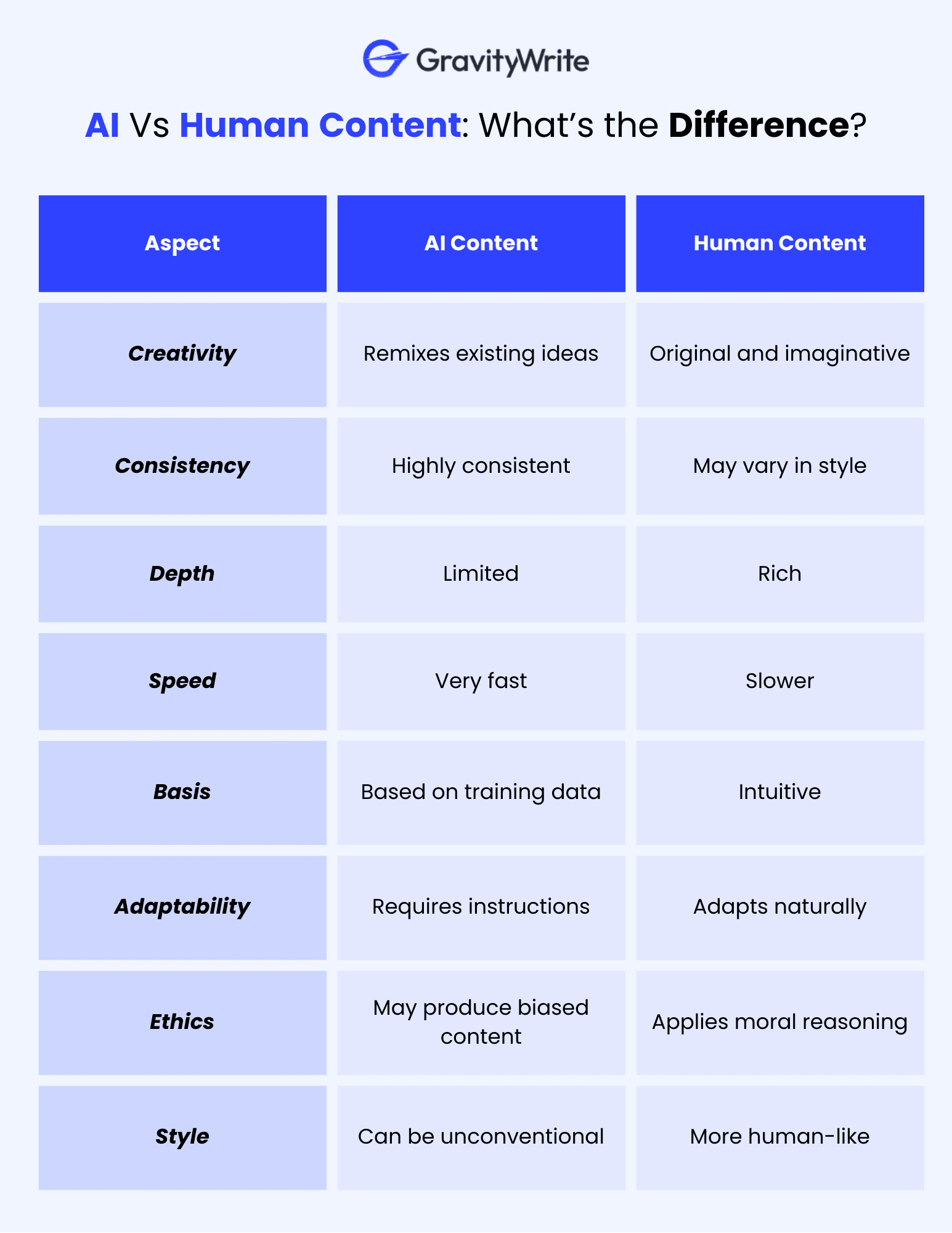
A side-by-side comparison reveals where each source shines and struggles. The table below summarizes the most impactful differentiators across factors that directly affect user experience, SEO performance, and brand credibility.
| Factor | AI-Generated Content | Human-Written Content |
|---|---|---|
| Speed and Scalability | Produces thousands of words in minutes; easily scales for large websites and product catalogs. | Slower production; limited by writer availability and creative energy. Not ideal for massive volume without a team. |
| Cost Efficiency | Extremely low per-word cost after tool subscription; reduces staffing needs. | Higher cost due to freelance rates, salaries, editing, and revision cycles. |
| Originality and Uniqueness | Recombines existing patterns; often lacks true novelty. May produce generic or derivative text. | Can offer fresh angles, original research, and unique voice based on personal insight. |
| Factual Accuracy | Prone to hallucinated facts, outdated data, and confident inaccuracies without verification. | Can cite real experience and updated knowledge, though still requires fact-checking for statistics. |
| Emotional Resonance | Often reads as sterile, lacking genuine empathy, humor, or vulnerability unless heavily prompted. | Naturally weaves in storytelling, tone shifts, and emotional nuance that connect with readers. |
| SEO Compliance | Can be optimized for keywords structurally, but risks thin content flags if not edited for usefulness. | Easier to align with E-E-A-T signals when backed by author expertise and first-hand experience. |
| Adaptability to Brand Voice | Requires extensive prompt engineering and editing to match nuanced brand guidelines consistently. | Skilled writers absorb brand tone and deliver cohesive messaging naturally. |
| Risk of Plagiarism | May inadvertently reproduce memorized passages; output can sometimes fail plagiarism checks. | Original drafting minimizes risk, though ethical writers still check for accidental duplication. |
These differences don’t make one option universally better. Instead, they point toward a balanced strategy where strengths are leveraged and weaknesses mitigated through human oversight.
Benefits and Limitations of AI-Generated Content
Where AI Content Delivers Clear Advantages
- Massive throughput for data-driven pages: E-commerce sites with thousands of product descriptions can populate pages rapidly, maintaining consistency in format and key selling points.
- Structuring repetitive content types: AI excels at generating meta descriptions, alt text, and template-based announcements where creativity is secondary to completeness.
- Overcoming writer’s block: A quick AI draft provides a starting point that human editors can shape, saving hours of staring at a blank screen.
- Multilingual expansion: Many tools can produce translations or content in multiple languages at a fraction of the cost of native writers, though review remains essential.
- Consistency in tone and terminology: Once a model is conditioned, it can churn out uniform messaging across dozens of pages, useful for technical documentation or SOPs.
- Lack of lived experience: AI cannot share a customer success story, a founder’s journey, or a hands-on product test. That absence erodes trust on YMYL (Your Money or Your Life) topics like health or finance.
- Hallucination and fabrication: Language models confidently invent statistics, quotes, and even sources. Relying on raw AI without verification damages credibility and can trigger Google penalties.
- Generic, surface-level advice: Much AI content reads like a textbook summary—accurate in its broad strokes but missing the nuance that expert practitioners provide.
- Search engine skepticism: Google’s guidelines now emphasize helpful content. Mass-produced AI articles with no added value risk being classified as spam, especially after algorithm updates targeting scaled content abuse.
- Repetitive sentence structures: Even well-prompted AI tends to favor certain transitions and phrasing, making longer articles feel monotonous unless heavily reworked.
- Authentic storytelling and credibility: Readers connect with personal anecdotes, case studies, and honest opinions. These elements build the trust signals that search engines reward through E-E-A-T.
- Contextual intelligence: Humans understand nuance, satire, cultural references, and current events in real time. A writer can adjust tone for a sensitive topic or capitalize on a trending moment without needing a prompt update.
- Original research and data: Surveys, interviews, and proprietary experiments generate unique content that cannot be replicated by scraping the web. This is a powerful differentiator for SEO.
- Better alignment with brand identity: A skilled writer internalizes a company’s mission and voice, producing content that feels cohesive and intentional across all channels.
- Editorial judgment: Humans can decide what to leave out, how to fact-check conflicting sources, and when to challenge conventional wisdom—nuances that AI currently misses.
- High cost and slow turnaround: Quality human writing is expensive. For startups or agencies managing large content pipelines, scaling purely with writers can become unsustainable.
- Inconsistent quality among writers: Not every human writer produces excellent work. Managing a team means dealing with varying skill levels, missed deadlines, and turnover.
- Subjectivity and bias: Personal perspectives are valuable but can also introduce unintended bias or tone inconsistencies that require careful editing.
- Limited availability: Specialized writers in fields like legal tech or medical devices are scarce, leading to bottlenecks that slow down content operations.
- Thought leadership articles and opinion editorials
- Medical, financial, or legal advice pages (YMYL)
- Case studies and customer success stories
- Landing pages for high-ticket products or services
- Investigative journalism and original research reports
- Product descriptions for large inventories (with human review for top sellers)
- Internal reports summaries and first drafts
- Social media post variations from a core message
- Frequently Asked Questions based on structured data
- Meta titles and descriptions at scale
- Publishing AI content without human review: Typos, factual errors, and off-brand messaging slip through when no one reads the output before hitting publish. Always have a second set of eyes.
- Over-optimizing for keywords without substance: Some tools prioritize keyword density over readability, producing robotic text that repels both users and search engines.
- Ignoring Google’s guidelines on scaled content: Using AI to mass-produce pages solely for search traffic—without adding value—can lead to manual actions and ranking drops.
- Failing to disclose AI use where appropriate: While not always required, certain platforms and audiences expect transparency. A sudden shift in writing style can erode trust if unexplained.
- Assuming one model fits all: Different AI tools have different strengths. A generic one-size-fits-all prompt yields mediocre results; customizing the model for your industry and voice is essential.
- Neglecting fact-checking of statistics and dates: AI pulls figures from outdated sources or invents numbers. Every claim must be verified against a reliable, current reference.
The Hidden Weaknesses of Pure AI Output
Benefits and Limitations of Human-Written Content
The Enduring Power of Human Craft
Drawbacks That Push Teams Toward Automation
Real-World Applications: When to Choose AI Content vs Human Content
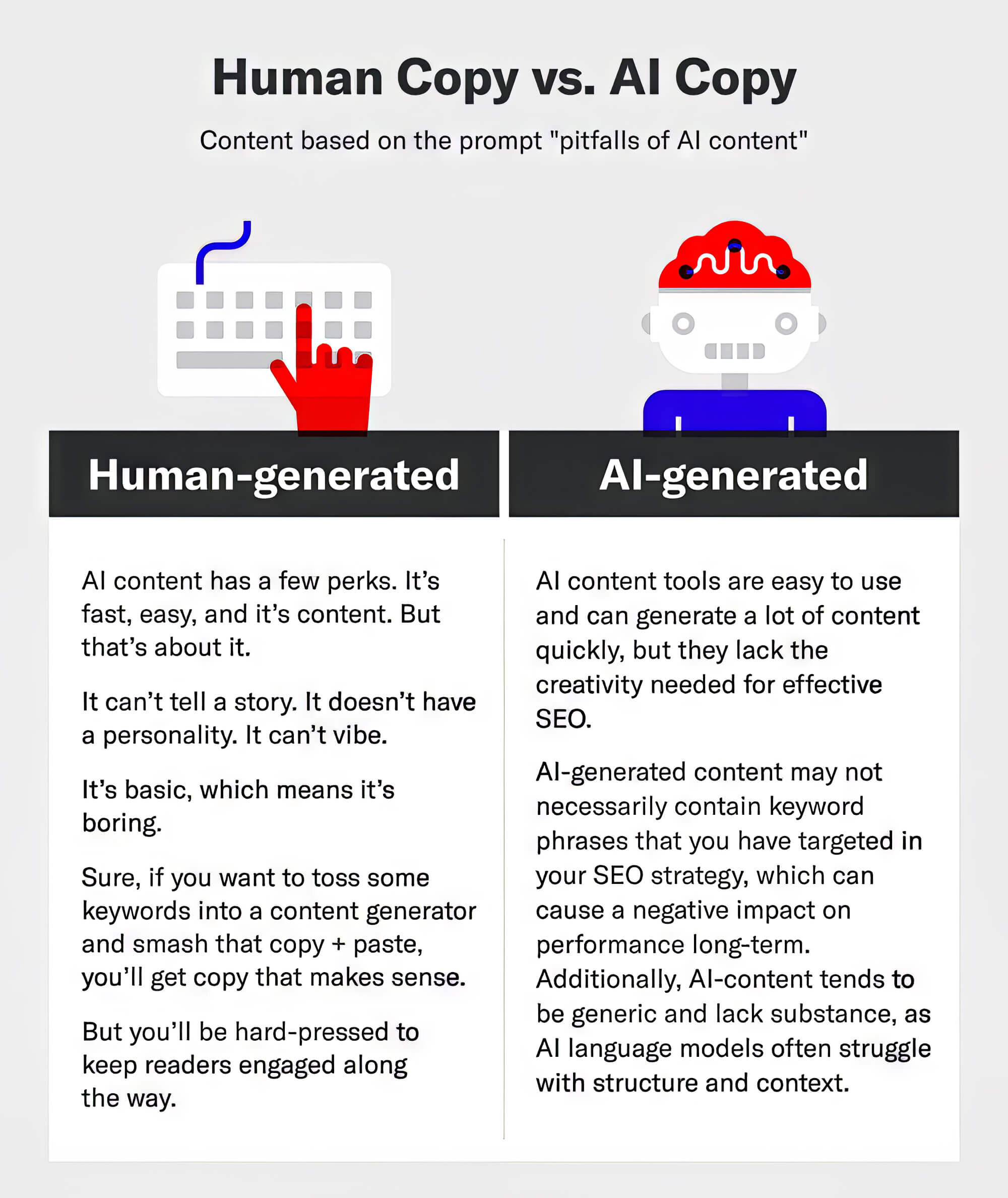
Rather than treating this as an either-or dilemma, successful content strategists assign tasks based on the nature of the piece. Here are scenarios where each approach—or a hybrid—makes the most sense.
High-Stakes Content That Demands Human Expertise
Content Types Where AI Adds Efficiency Without Sacrificing Quality
In many organizations, the sweet spot is a collaborative process: an AI tool generates a rough structure and initial paragraphs, a subject matter expert rewrites thin sections and injects unique insights, and an editor refines the final piece for brand consistency and SEO. This approach cuts production time by up to 40% while maintaining high editorial standards.
Common Mistakes When Blending AI and Human Content
Even with the best intentions, teams fall into traps that dilute the effectiveness of their content. Recognizing these pitfalls saves you from costly rework and credibility damage.
Important Notes for Content Creators and Marketers
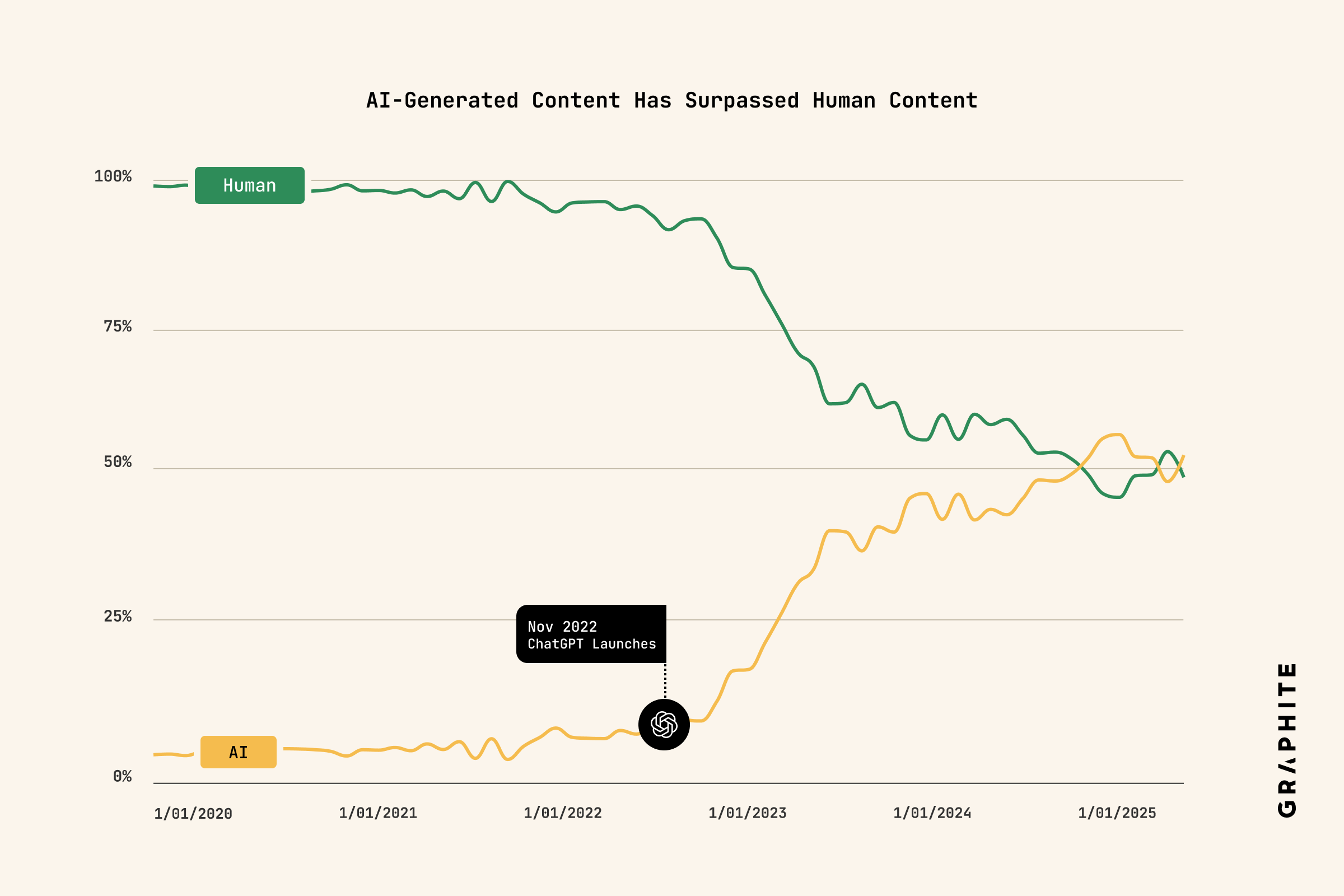
As you navigate the AI content vs human content landscape, a few principles can guide you toward sustainable success. Search engines have grown remarkably adept at assessing content helpfulness. They consider not just what words appear on the page, but signals like author expertise, page experience, and user engagement metrics. A purely AI-generated blog post that visitors bounce from within seconds does little for your rankings.
Additionally, brand reputation takes years to build and minutes to damage. One widely shared article with glaring inaccuracies can spark negative commentary that outlasts any temporary traffic boost. When using AI, establish a clear workflow: prompt, generate, fact-check, humanize, edit, and then publish. That simple chain protects your brand while letting you enjoy the efficiency gains that automation offers.
Finally, keep in mind that AI tools continue to evolve. The gap between machine and human writing will narrow in terms of coherence and factual retrieval. However, the gap in authentic experience, emotional depth, and original insight is likely to persist. Content that wins in the long run will harness AI’s speed to amplify human wisdom, not replace it.
Frequently Asked Questions
Is AI content as good as human content for SEO?
AI content can rank well if it provides accurate, helpful information and is edited for quality. However, for topics that require depth, trustworthiness, and original expertise, human content typically performs better over time because it aligns more naturally with Google’s E-E-A-T signals. Pure AI output often lacks the first-hand experience and nuanced perspective that differentiate top-ranking pages.
Can Google detect AI-generated content?
Google’s algorithms look for patterns associated with scaled, low-value content rather than specifically identifying AI authorship. If the content is useful, well-written, and demonstrates expertise, Google does not penalize it simply for being AI-assisted. That said, poor-quality, mass-produced AI articles that offer little original value are increasingly flagged through systems like the helpful content update.
How can I make AI content sound more human?
To humanize AI content, integrate personal anecdotes, specific examples from your experience, and a conversational tone. Vary sentence length and structure, remove overused transitions, and inject your brand’s unique vocabulary. The most effective technique is to treat the AI draft as a skeleton and layer your own insights, humor, and storytelling on top of it during the editing phase.
What are the biggest risks of using only AI for content creation?
Relying exclusively on AI exposes you to factual inaccuracies, plagiarism-like issues, reputational harm from low-quality posts, and potential search engine demotions. Without human oversight, you may publish contradictory information, miss cultural sensitivities, and fail to build a genuine connection with your audience. Over time, readers and search engines alike will recognize the lack of depth and trustworthiness.
When should I avoid AI content altogether?
Avoid unedited AI content for critical pages where accuracy and trust are paramount, such as medical advice, financial guidance, legal interpretations, or deeply personal brand narratives. Any content that represents your voice during a crisis, a sensitive announcement, or a high-stakes negotiation should be entirely human-written and reviewed by multiple stakeholders.
Final Thoughts on the AI Content vs Human Content Equation
The question is not which side wins, but how intelligently you can combine both. AI content brings unprecedented speed and scalability to the table. Human content brings the soul, the credibility, and the nuance that ultimately earn long-term audience loyalty. The brands that thrive treat technology as a powerful assistant—an accelerator, not a replacement—and invest in human talent to produce the thoughtful, experience-rich material that stands out in an ocean of automated text. By matching the tool to the task, verifying every claim, and never sacrificing the human touch where it matters most, you create a content engine that satisfies algorithms and, more importantly, the real people you aim to serve.
Xem thêm:
- AI SEO Topic Cluster Generator: The Complete Guide to Building Authority Pages That Rank
- AI SEO Content Scoring: The Complete Guide to Data-Driven Content Optimization
- AI NLP SEO: The Complete Guide to Optimizing Content for the Age of Intelligent Search
- AI SEO Performance Monitoring: The Complete Guide to Data-Driven Search Optimization
- 12 AI SEO Mistakes That Will Crash Your Rankings (And How to Avoid Them)
Bài viết cùng chủ đề:

AI SEO SEO Automation with Make: The Complete Workflow Guide

AI SEO SEO Automation with Zapier: The Complete Workflow Guide

AI SEO SEO Automation with n8n: The Complete Workflow Guide
AI SEO SEO Automation with Gemini: The Complete Guide to Scaling Organic Growth

AI SEO SEO Automation with Claude: The Complete Guide to Scaling Content in 2025

AI SEO SEO Automation with ChatGPT: The Complete Playbook for 2025

AI SEO & SEO Automation for Affiliate Sites: The 2025 Playbook for Passive Income Growth
AI SEO & SEO Automation for Bloggers: The Complete Guide to Scaling Your Content

AI SEO & SEO Automation for Agencies: The Complete 2025 Playbook

AI SEO and SEO Automation for Ecommerce: The Complete Playbook for 2025

AI SEO & SEO Automation for WordPress: The Complete Playbook for 2025
AI SEO SEO Automation Strategy: The Complete Playbook for 2025

Mastering the AI SEO SEO Automation Process: A Complete Guide to Scaling Organic Growth
AI SEO SEO Automation System: The Complete Guide to Scaling Organic Growth in 2025
AI SEO SEO Automation Platform: The Complete Guide to Scaling Organic Growth in 2025
AI SEO SEO Automation Software: The Complete Guide to Scaling Organic Growth in 2025