
No products in the cart.
Mastering the AI Listicle Generator: A Complete Guide to Automated List Content
29
Jul
Jul
The growing hunger for scannable, shareable content has placed the AI listicle generator at the very center of modern content strategy. These intelligent systems can transform a handful of keywords or a simple brief into a fully structured, reader-ready list article in a matter of seconds. What once demanded hours of brainstorming, research, and formatting can now be initiated with a single prompt. Yet the real power of these tools unfolds only when creators understand both their mechanics and their limitations. This guide walks through every layer of what makes an AI listicle generator tick, how to use it for maximum effect, and where the human touch remains irreplaceable.
What Is an AI Listicle Generator?
An AI listicle generator is a content creation tool that uses natural language processing and machine learning to automatically produce list-based articles. A listicle, short for “list article,” is any piece structured around numbered or bullet points—think “7 Ways to Boost Productivity” or “10 Must-Try Vegan Recipes.” The generator takes a topic, analyzes patterns from millions of existing listicles, and assembles a coherent, titled list with descriptive entries.
These generators are built on large language models (LLMs) such as GPT-4, Claude, or proprietary alternatives. They have been fine-tuned to recognize the listicle format: a clickable headline, an engaging introduction, a numbered sequence of items, and a crisp conclusion. Advanced tools also interweave search engine optimization (SEO) meta data, readability scores, and even tone adjustments.
The result is a first-draft listicle that mirrors the structure readers expect. But it’s crucial to remember that the generator doesn’t “know” facts the way a human researcher does. It predicts the next plausible word based on its training corpus, which means the output is a simulation of a well-written listicle, not a guaranteed truth source. Understanding this distinction is the first step toward using an AI listicle generator wisely.
How AI Listicle Generators Work Behind the Scenes
The pipe from input to polished listicle combines several NLP processes. When a user enters a prompt—say, “write a listicle on home office ergonomics”—the system first encodes the request into a mathematical representation. It then searches its vast parameter space for patterns associated with listicle structures, ergonomic keywords, and helpful advice.
Next, it generates text token by token, calculating probabilities at each step. For listicle generation, the model has often been explicitly instructed to produce a numeric heading, followed by a subheading and a short explanatory paragraph. Many tools layer on rule-based checks to ensure a consistent number of items, proper numbering, and a logical flow from introduction to conclusion.
Some generators also run an SEO module that scores headings for keyword relevance, suggests related semantic terms, and checks readability. After the raw text emerges, a post-processing phase might remove redundant phrases, verify basic grammar, and format the list with HTML tags ready for a CMS. All of this occurs within seconds, giving content teams an immediate working draft.
Key Features of a Quality AI Listicle Generator
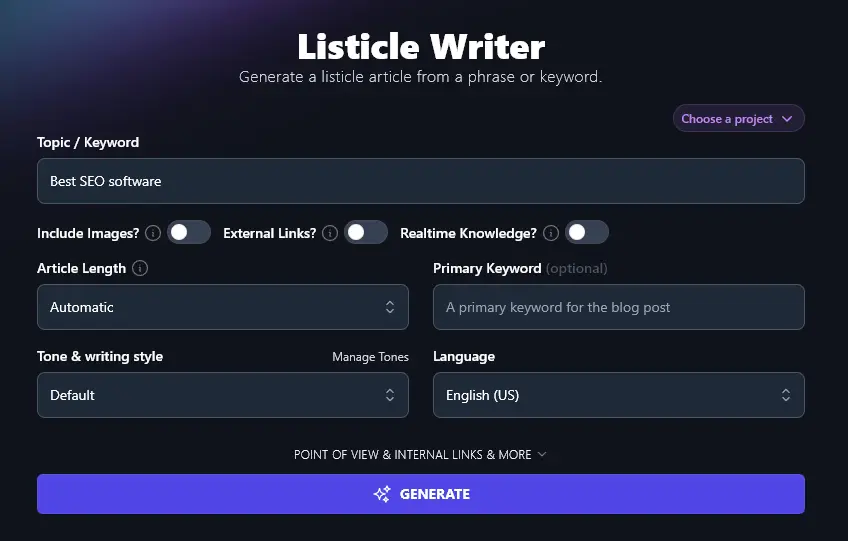
Not all listicle generators are built equal. The most effective ones share a set of capabilities that go beyond simple text spitting. Here are the features to look for when evaluating a tool:
- Context-aware title generation: The AI crafts headlines that balance curiosity, keyword inclusion, and emotional triggers—without veering into clickbait territory.
- Flexible tone and style controls: Users can switch between professional, conversational, humorous, or authoritative voices to match their brand guidelines.
- SEO integration: Built-in suggestions for meta descriptions, slug optimization, internal linking, and LSI keywords help the listicle rank faster.
- Multilingual support: The best tools generate listicles in multiple languages while preserving local cultural references and idioms.
- Plagiarism detection: A real-time checker flags sections that overlap too closely with existing web content, protecting originality.
- Custom formatting output: The ability to export in Markdown, HTML, or plain text streamlines integration with WordPress, Medium, or other platforms.
- Feedback loops: Some platforms allow users to rate an item, and the model adjusts subsequent generations based on that history.
- Publishing without human review: An AI draft can look polished at a glance, but closer inspection often reveals inaccuracies, awkward phrasing, or illogical sequencing. Always have a human editor read every line.
- Ignoring brand voice: Without explicit instruction, the generator defaults to a neutral, sometimes bland tone that may clash with a brand’s distinctive personality. Feed it style guidelines and sample copy.
- Neglecting internal linking opportunities: AI focuses on the article at hand, not your site architecture. A human editor should add relevant internal links to cornerstone content and related articles.
- Chasing keyword density: Forcing the AI to hit an exact keyword density leads to unnatural prose. Instead, prioritize topic coverage and let keywords appear organically.
- Using outdated data: If the generator’s training data stops at a certain year, it may cite old statistics as if they are current. Verify every date-sensitive claim.
- Relying on the same prompt template repeatedly: Over time, the AI can fall into predictable patterns. Vary your prompts, introduce unexpected constraints, and occasionally start with a different structure.
A tool that bundles these capabilities transforms the AI listicle generator from a novelty into a true editorial assistant. The aim is not to remove the writer but to remove repetitive scaffolding so the writer can concentrate on nuance, storytelling, and verification.
Why Use an AI Listicle Generator? Benefits and Advantages
Content teams that adopt an AI listicle generator often see a sharp uplift in output volume without a proportional increase in headcount. But sheer volume is only the surface benefit. The deeper advantages touch quality consistency, idea generation, and strategic agility.
Speed to first draft: A 1,500-word listicle that might take a human four hours can be drafted in under a minute. That acceleration allows teams to react to trending topics before the conversation moves on.
Busting writer’s block: Staring at a blank page is one of the most cited pain points among writers. A generator provides a menu of angles, item ideas, and even compelling introductions that spark human creativity.
Structural consistency: Listicles follow a formula, and AI is brilliant at formulas. The generator ensures each item follows a parallel grammatical structure, uses consistent punctuation, and maintains a uniform abstract length—details that editors often spend hours correcting.
Scalable SEO plays: When a site needs twenty listicles for a new product category, AI can draft all twenty in a day, each wrapped around a unique keyword cluster. The human team can then audit, enhance, and schedule them, dramatically improving time-to-index.
Multichannel repurposing: A well-structured listicle can become a podcast outline, a video script, or a social media carousel. Because the AI output is inherently segmented, repurposing is faster and cleaner.
Limitations and Common Pitfalls of AI-Generated Listicles
For all its speed, the AI listicle generator introduces risks that an unwary publisher can stumble into. Acknowledging these pitfalls early prevents damaged credibility and search penalties.
Factual hallucinations: Language models can fabricate statistics, misattribute quotes, or invent product features. Without meticulous fact-checking, a listicle can spread misinformation that erodes trust.
Surface-level depth: AI often describes what, but rarely explores why with genuine insight. The entries can read like a collection of dictionary definitions rather than expert analysis.
Repetitive phrasing: Because the model leans on high-probability word sequences, it may repeat sentence starters (“Another great way is…”, “One more tip is…”) until the article feels robotic.
Generic examples: Without specific instruction, the generator pulls from broad, safe examples that lack the concrete detail readers crave. A human case study or anecdote always outperforms a generic placeholder.
Over-optimization: Some AI tools force keywords into headings so aggressively that the copy reads as stilted, triggering negative user signals that harm rankings instead of helping them.
These limitations don’t discredit the tool; they simply define the boundaries of its usefulness. A responsible workflow treats the AI draft as raw clay, never as the finished sculpture.
AI Listicle Generators vs. Human Writers: A Detailed Comparison
To decide how heavily to lean on an AI listicle generator, it helps to stack its strengths against those of a professional human writer. The table below breaks down the key performance dimensions.
| Factor | AI Listicle Generator | Human Writer |
|---|---|---|
| Speed | Produces a full draft in seconds to minutes | Hours to days, depending on research depth |
| Original Insights | Limited; remixes existing patterns | Can contribute unique experiences, interviews, and analysis |
| Factual Accuracy | Requires verification; prone to hallucinations | Can be verified through primary sources, though still subject to error |
| SEO Integration | Automated keyword placement, but may over-optimize | Manual, but can be more nuanced and natural |
| Creativity | Excellent at format variety, weak at deep narrative | Builds emotional arcs, humor, and unexpected connections |
| Cost | Fraction of a cent per word | Can range from $0.10 to $1+ per word |
| Consistency | Extremely uniform, rarely deviates from brief | Variable; dependent on fatigue, expertise, and mood |
| Factual Recency | Limited by training data cutoff (unless connected to search) | Can incorporate today’s news or latest research |
The picture is clear: AI excels at drafting, formatting, and scaling repetitive content, while human writers bring credibility, originality, and emotional resonance. The best content operations use both in tandem, allowing the AI to build the skeleton and the human to add flesh, blood, and soul.
How to Get the Most Out of Your AI Listicle Generator
Turning the AI listicle generator into a reliable partner requires deliberate prompt crafting and a disciplined editing ritual. A systematic approach pays off in higher quality and less rework.
1. Write a detailed creative brief. Instead of a topic word, feed the tool a full brief that includes target audience, desired tone, word count, number of list items, SEO primary and secondary keywords, and any specific examples to include. For instance: “Write a listicle titled ‘8 Morning Routines of Highly Productive People’ for busy professionals aged 25-40. Use an encouraging tone. Each item should include a practical tip, an optional tool recommendation, and a one-sentence case study.”
2. Set the tone explicitly. Tone descriptors like “authoritative but warm,” “data-driven,” or “conversational” give the model a clear direction. Some platforms allow uploading a style guide or sample text to calibrate the voice.
3. Use the tool for outlining, not just full drafts. Ask the AI to generate a list of potential items first. Review, reorder, and enrich that skeleton before asking it to flesh out each point. This keeps human oversight where it matters most—at the structural level.
4. Request source suggestions. Advanced AI listicle generators can be prompted to note where a statistic might come from or suggest a type of source. This speeds up the fact-checking process without fully relying on the AI’s own figures.
5. Layer in personal stories afterward. AI cannot recount your experience. After the draft emerges, comb through each item and ask: “Where can I insert a real anecdote, a client success story, or a lesson learned?” These touches make the content unmistakably human.
6. Optimize headings for humans and search engines. Run a final pass where you tweak the AI-generated headlines for emotional appeal and keyword balance. Tools often produce correct but boring titles; a human editor can inject power words, numbers, and curiosity gaps.
Common Mistakes When Using AI Listicle Generators
Even experienced teams can slip into habits that undermine the value of the AI listicle generator. Recognizing these mistakes early saves both time and reputation.
By treating the generator as a starting point—never the finished product—teams can avoid these traps and consistently publish listicles that perform well.
How to Choose the Right AI Listicle Generator for Your Needs
The market now teems with options, from standalone tools to integrated platform features. Selecting the right one depends on your specific workflow, technical skill, and content volume.
Assess the underlying language model. The sophistication of the AI engine directly impacts output quality. Tools that connect to GPT-4 or similarly advanced models generally produce more nuanced text and better handle complex instructions.
Evaluate customization depth. Can you save custom prompt templates? Does the tool remember your brand voice across sessions? Look for features that reduce repetitive setup work.
Check integration capabilities. If you use WordPress, HubSpot, or a custom CMS, an API or plugin that pushes formatted drafts directly into your system removes friction. Similarly, integration with SEO tools like SurferSEO or Clearscope can refine keyword usage.
Consider collaboration features. For teams, multi-user access, comment workflows, and version histories ensure that the AI output moves through a proper approval chain before publication.
Examine the pricing structure. Some tools charge per word, others per generation or via a monthly subscription. Match the model to your expected output to avoid bill shock.
Test with a real project. Most vendors offer a free trial or limited free tier. Run the same brief through two or three tools and compare the output for clarity, accuracy, and editing time required. The fastest generator is not always the best if it doubles the editing burden.
Important Notes for Maximizing Content Quality
Beyond the immediate mechanics of using an AI listicle generator, a few overarching principles separate high-performing listicles from the disposable noise flooding the web.
Always add unique data. Whether it’s an original survey, an internal company insight, or a curated expert quote, one exclusive piece of data per listicle can transform it into a backlink magnet and a trust signal.
Refresh regularly. Listicles can become outdated. Set a calendar reminder to revisit AI-drafted posts every six months. Update statistics, swap out obsolete examples, and check that all outbound links still work.
Design for scan-first reading. Use bold subheadings, short paragraphs, and visual breaks. The AI output will already lean scannable, but a human designer can further enhance it with custom graphics, pull quotes, or comparison tables.
Maintain ethical transparency. If a tool generates a significant portion of a piece, some publishers choose to disclose AI assistance. While not universally required, it can build audience trust, especially in sensitive niches like health or finance.
Invest in prompt engineering skills. The output quality of an AI listicle generator directly correlates with the quality of the input. Teams that dedicate time to learning prompt patterns, experimenting with constraints, and documenting successful prompts see huge productivity gains over time.
Frequently Asked Questions About AI Listicle Generators
What exactly is an AI listicle generator?
An AI listicle generator is a software tool that uses artificial intelligence, typically large language models, to automatically produce list-style articles. It structures content around numbered points with titles and descriptive paragraphs, turning a simple prompt into a ready-to-edit draft.
Can an AI listicle generator produce a ready-to-publish article?
Rarely without human intervention. While the output can look complete, it often contains factual errors, generic phrasing, or missed brand nuances. Human editing for accuracy, tone, and originality is strongly recommended before publishing.
Is content from an AI listicle generator SEO-friendly?
Many generators are designed with SEO in mind and can include relevant keywords, meta descriptions, and header tags. However, over-optimization is a risk. A human SEO review remains essential to ensure natural language, appropriate keyword distribution, and alignment with search intent.
Do I need technical skills to use an AI listicle generator?
Most modern tools feature simple interfaces where you type a topic or brief and receive the listicle. No coding is required. Some advanced customization, like API integration, may need technical help, but basic usage is accessible to anyone comfortable with a web browser.
How much does an AI listicle generator cost?
Pricing varies widely. Some platforms offer free tiers with limited generations per month, while professional plans range from $30 to over $500 monthly depending on usage volume, model quality, and team features. Pay-as-you-go options are also common.
Will AI listicle generators replace human writers?
They are more likely to shift the writer’s role toward editing, strategy, and storytelling. Routine drafting can be offloaded to AI, but the need for critical thinking, emotional connection, and factual investigation keeps human writers essential for high-quality content.
What types of listicles work best with AI generation?
AI excels at formulaic listicles such as “top tips,” “best tools,” “common mistakes,” and “step-by-step guides.” These formats have clear patterns that the model can replicate reliably. Highly opinionated or deeply researched investigative listicles benefit more from a human-led approach.
Conclusion
The AI listicle generator has matured from a curious experiment into a dependable content engine for those who understand its strengths and boundaries. It democratizes speed, removes the friction of starting from scratch, and empowers small teams to publish with the frequency of a large editorial staff. At the same time, its output alone rarely satisfies readers hungry for genuine expertise, fresh angles, and trustworthy data.
The winning formula combines the machine’s efficiency with the human’s judgment. Craft deliberate prompts, edit with a critical eye, inject real-world stories, and keep SEO principles balanced. When these elements converge, the result is list content that not only ranks but resonates—delivering exactly what the reader clicked for. As language models continue to improve, the bar for what constitutes a good listicle will rise, and those who master the hybrid workflow of human-plus-A
Xem thêm:
- AI SEO URL Structure: The Complete Guide to Optimizing for Machine Learning Search Engines
- AI SEO HARO Alternatives: 10 Powerful Platforms to Secure High-Authority Backlinks in 2025
- AI Semantic Analysis: Unlocking Human-Like Understanding from Text Data
- AI Rewrite Tool: The Ultimate Guide to Rewriting Content with Artificial Intelligence
- AI SEO Competitor Rankings: The Complete Guide to Outranking in the Age of Artificial Intelligence
Bài viết cùng chủ đề:

AI SEO SEO Automation with Make: The Complete Workflow Guide

AI SEO SEO Automation with Zapier: The Complete Workflow Guide

AI SEO SEO Automation with n8n: The Complete Workflow Guide
AI SEO SEO Automation with Gemini: The Complete Guide to Scaling Organic Growth

AI SEO SEO Automation with Claude: The Complete Guide to Scaling Content in 2025

AI SEO SEO Automation with ChatGPT: The Complete Playbook for 2025

AI SEO & SEO Automation for Affiliate Sites: The 2025 Playbook for Passive Income Growth
AI SEO & SEO Automation for Bloggers: The Complete Guide to Scaling Your Content

AI SEO & SEO Automation for Agencies: The Complete 2025 Playbook

AI SEO and SEO Automation for Ecommerce: The Complete Playbook for 2025

AI SEO & SEO Automation for WordPress: The Complete Playbook for 2025
AI SEO SEO Automation Strategy: The Complete Playbook for 2025

Mastering the AI SEO SEO Automation Process: A Complete Guide to Scaling Organic Growth
AI SEO SEO Automation System: The Complete Guide to Scaling Organic Growth in 2025
AI SEO SEO Automation Platform: The Complete Guide to Scaling Organic Growth in 2025
AI SEO SEO Automation Software: The Complete Guide to Scaling Organic Growth in 2025















