
No products in the cart.
AI SEO Agents: The Future of Automated Search Optimization
29
Jul
Jul
Search engine optimization has always demanded a blend of technical rigor, creative strategy, and relentless analysis. In recent years, a new category of tools has emerged to handle the overwhelming data and repetitive tasks that define modern SEO: AI SEO agents. These intelligent systems go far beyond simple automation scripts. They can interpret ranking fluctuations, generate high-quality content briefs, audit entire websites, and even make autonomous decisions based on live performance data. As search algorithms grow more complex, AI SEO agents represent a paradigm shift, enabling marketers to scale efforts without sacrificing precision. This article unpacks everything you need to know about AI SEO agents, from foundational concepts to real-world implementation and the pitfalls to avoid.
What Are AI SEO Agents?
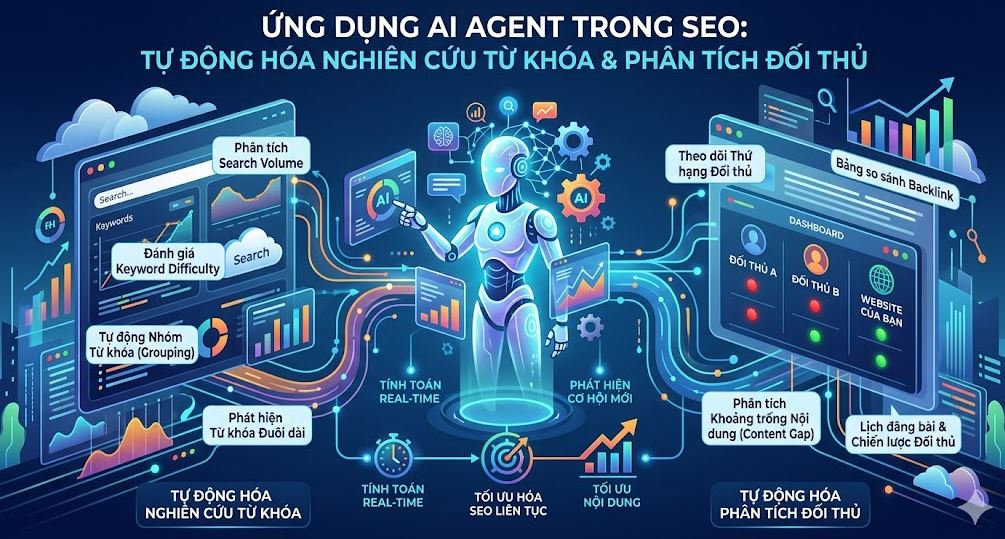
An AI SEO agent is a software entity that uses artificial intelligence—typically large language models, machine learning, and natural language processing—to perform SEO tasks with minimal human intervention. Unlike traditional SEO tools that require manual configuration and analysis, AI agents can plan, execute, and refine optimization strategies dynamically. They ingest vast datasets from search consoles, analytics platforms, competitor sites, and SERPs, then translate that data into actionable steps.
The core distinction lies in autonomy and adaptivity. A conventional rank tracker tells you a keyword moved from position 7 to 12. An AI SEO agent detects that drop, cross-references it with a recent algorithm update, analyzes the now-ranking pages, identifies a missing semantic entity in your content, and recommends a specific paragraph rewrite—all within minutes. The best agents can even implement the fix if granted appropriate permissions.
How AI SEO Agents Differ from Traditional Automation
Traditional SEO automation follows rigid, rule-based logic: if keyword density is below X, insert more instances. AI SEO agents operate on probabilistic reasoning and contextual understanding. They recognize search intent, user journey stages, and the subtle nuances that separate a helpful page from a spammy one. This leap from deterministic scripts to intelligent agents is what makes them uniquely valuable.
Key differentiators include the ability to handle unstructured data (such as user reviews or forum discussions), generate original content that aligns with brand voice, and predict future ranking trends using time-series forecasting. While a scheduled crawler might simply report status codes, an AI agent can interpret that a cluster of 404s on high-authority pages requires immediate 301 redirects to preserve link equity, and prioritize the fix accordingly.
Core Components of AI SEO Agents
To understand how these agents work, it helps to break them into four interconnected layers. First, a data ingestion layer pulls information from Google Search Console, Bing Webmaster Tools, analytics suites, rank trackers, backlink databases, and social listening platforms. The second layer is a semantic understanding engine that maps entities, topics, and user intent. The third layer is a strategic reasoning core that sets goals, allocates tasks, and evaluates trade-offs. Finally, an action layer executes optimizations—whether updating meta tags, publishing content, or restructuring internal links.
Underpinning all of this is a feedback loop that continuously learns from outcomes. Every performance metric becomes training data, refining the agent’s future recommendations. Over time, an AI SEO agent essentially builds a custom model of what works for a specific site in its specific niche.
Types of AI SEO Agents
Not all AI SEO agents are built the same. They range from narrowly focused assistants to fully autonomous strategic planners. Understanding the spectrum helps you choose the right fit for your organization.
- Content Optimization Agents: These specialize in improving existing content or generating new drafts. They analyze top-ranking pages, extract common topics and questions, and suggest content structures and keyword usage that match search intent.
- Technical SEO Agents: Crawling, log file analysis, structured data validation, and page speed optimization fall into this category. They detect anomalies like crawl budget waste, orphan pages, or hreflang errors, often fixing them automatically.
- Link Building Agents: These identify prospecting opportunities, evaluate domain authority and relevance, and personalize outreach. Some can even manage follow-ups and track earned links.
- Full-Stack Autopilot Agents: The most advanced agents oversee the entire SEO lifecycle. They coordinate content, technical, and off-page efforts, balancing short-term wins with sustainable growth. They often integrate with project management tools and assign tasks to human team members when needed.
Benefits of Using AI SEO Agents
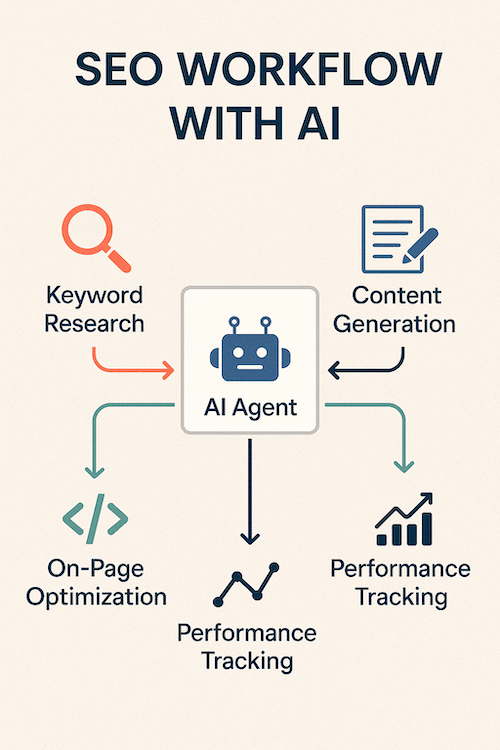
Adopting AI SEO agents brings tangible advantages that directly impact revenue, efficiency, and competitive positioning. The most immediate benefit is a dramatic reduction in manual labor. Keyword research that once took days now happens in minutes, complete with clustering and intent analysis. Content audits that required painstaking spreadsheets are delivered as prioritized action plans.
Scalability is another major gain. An enterprise with thousands of product pages can maintain optimized titles, meta descriptions, and internal linking at a granularity impossible for human teams alone. Real-time monitoring and response provide a safety net against traffic drops; agents can alert you to schema markup issues the moment Google crawls a page. Moreover, AI SEO agents reduce the cost of experimentation. They can simulate the impact of title tag changes or content adjustments before deployment, minimizing risk.
From a strategic perspective, these agents enable SEO professionals to focus on high-level thinking—audience understanding, brand storytelling, and conversion optimization—rather than getting buried in spreadsheets.
Limitations and Risks to Consider
While powerful, AI SEO agents are not infallible. One critical limitation is the reliance on historical data; if an algorithm update introduces completely new ranking factors, the agent’s predictions may falter until it accumulates fresh data. T
Data privacy and security demand careful attention. Granting an agent access to your search console, analytics, and CMS means a single compromise could expose sensitive performance data or allow malicious content modifications. Additionally, autonomous agents might make changes that conflict with broader marketing campaigns if not properly siloed. Human oversight remains essential to catch context-blind decisions, such as replacing a high-converting landing page headline with one that ranks better but converts poorly.
AI SEO Agents vs. Traditional SEO Tools: A Comparison
| Dimension | Traditional SEO Tools | AI SEO Agents |
|---|---|---|
| Decision-making | Human-driven; tool provides data | Agent analyzes data and recommends or executes actions |
| Adaptability | Static rules and alerts | Dynamic learning from outcomes |
| Content creation | Basic suggestions or templates | Context-aware drafting aligned with brand voice and SERP analysis |
| Integration depth | Often siloed (rank tracking, auditing, etc.) | Unified across technical, content, and off-page signals |
| Scalability | Limited by human bandwidth | Near-infinite, handles thousands of pages autonomously |
| Cost structure | Monthly subscriptions per tool | Often usage-based, can be higher initially but reduces labor costs |
Practical Applications: Where AI SEO Agents Shine
Real-world deployments of AI SEO agents span every aspect of organic search. In enterprise e-commerce, they manage dynamic meta tags and structured data for inventory that changes daily. For news publishers, agents analyze trending topics and automatically suggest or even produce initial drafts of timely articles, ensuring rapid indexing. In local SEO, AI agents optimize Google Business Profiles at scale, responding to reviews and updating hours across hundreds of locations.
Content teams use AI SEO agents to maintain evergreen hubs. The agent monitors ranking volatility, identifies pages losing traffic, and recommends content refreshes with updated statistics, examples, and internal links. Technical specialists deploy agents to continuously audit for Core Web Vitals regressions, and prioritize fixes based on potential traffic impact. Agency professionals leverage white-label AI SEO agents to deliver comprehensive reports and on-the-fly optimizations for multiple clients simultaneously.
Guide to Getting Started with AI SEO Agents
Implementing an AI SEO agent requires a structured approach to avoid chaos. Begin with a clear audit of your current SEO stack and processes. Identify the most time-consuming, repetitive tasks that follow logical patterns—these are prime targets for agent delegation. Next, define the agent’s scope. Starting with content optimization for a specific site section delivers quick wins and builds confidence before expanding to technical and off-page functions.
Data integration is critical. Ensure the agent has secure, read-only access initially to your Google Search Console, analytics, and CMS. Establish a staging environment where the agent’s proposed changes can be reviewed before going live. Invest time in prompt engineering and custom instructions. The more detailed you are about your brand voice, target audience, and business goals, the more aligned the agent’s output will be. Finally, implement a governance framework: who reviews AI decisions, what changes require human approval, and how performance is measured.
Common Mistakes When Deploying AI SEO Agents
Even seasoned professionals stumble when introducing autonomous agents into their SEO workflow. The most frequent mistake is treating the agent as a set-and-forget solution. Without regular calibration, the agent’s model drifts, leading to generic or outdated recommendations. Another pitfall is neglecting to set boundaries. An unfettered agent might publish content that is factually incorrect or misaligned with brand messaging simply because it predicts a ranking benefit.
Relying on AI-generated content without human editorial review can trigger “scaled content abuse” flags from search engines. Google’s guidelines are clear: AI use is acceptable if it creates helpful, people-first content, but publishing raw, unedited AI output risks manual actions. Also, beware of optimizing for short-term metrics at the expense of long-term trust. An agent might aggressively insert keywords into meta descriptions, boosting CTR temporarily but reducing brand credibility. Always anchor the agent’s goals to holistic KPIs like conversions and engagement, not just rankings.
Important Notes on E-E-A-T and Search Engine Compliance
Experience, Expertise, Authoritativeness, and Trustworthiness (E-E-A-T) remain the bedrock of sustainable SEO. AI SEO agents can assist in demonstrating these qualities, but they cannot inherently possess them. The human behind the agent must ensure that content reflects genuine experience—first-hand insights, case studies, and original research. If an agent writes a product review, a human must verify that the product was actually tested. For YMYL (Your Money or Your Life) topics, the stakes are even higher; medical, financial, or legal content generated by AI should always be reviewed by qualified experts.
Search engines are increasingly sophisticated at detecting purely synthetic content signals. The safest approach is to position the AI agent as a supercharged assistant. Use it for data analysis, drafting, and pattern recognition, but retain human editorial control for the final layer. This hybrid model maximizes efficiency while protecting your site’s authority.
The Future Landscape of AI SEO Agents
Looking ahead, AI SEO agents will become more agentic, engaging directly with search engine APIs (where available) to fetch real-time data and even submit updates. We will see tighter integration with marketing automation platforms, enabling coordinated cross-channel campaigns. Personalization will deepen; agents will tailor optimization strategies to individual user segments, leveraging first-party data to serve different content variations based on search behavior.
Regulation and transparency standards will also evolve. Users may come to expect disclosure of AI-generated content, and search engines could introduce algorithmic preferences for human-verified information. Forward-thinking organizations are already establishing internal “AI SEO ethics” guidelines to navigate this emerging territory. Those who master the synergy between human creativity and AI analytical power will dominate the SERPs of tomorrow.
Frequently Asked Questions
What exactly does an AI SEO agent do?
An AI SEO agent automates and optimizes search engine optimization tasks. It can conduct keyword research, audit technical health, generate content briefs, monitor ranking changes, fix broken links, and even suggest internal linking strategies. Unlike static tools, it learns from outcomes and adapts its approach to improve performance over time, often operating continuously in the background.
How is an AI SEO agent different from ChatGPT for SEO?
While ChatGPT and similar chatbots can assist with SEO writing and answer questions, they are general-purpose and lack persistent memory, integration with search console data, and autonomous action capabilities. An AI SEO agent is specialized, purpose-built to connect with your analytics, crawl your site, track competitors, and execute multi-step campaigns without constant human prompting.
Can an AI SEO agent replace human SEO specialists?
AI SEO agents augment rather than replace human expertise. They handle repetitive analysis and execution at scale, but strategy, brand storytelling, creative content direction, and nuanced industry knowledge remain human domains. The most effective teams combine AI agents for data-heavy tasks with skilled professionals who interpret findings and make high-level decisions.
Is content written by AI SEO agents penalized by Google?
Google does not penalize AI-generated content solely because it is AI-generated. The focus is on quality, helpfulness, and originality. Content that is unedited, factually incorrect, or created solely to manipulate rankings can violate spam policies. When an AI SEO agent drafts content, it should undergo human review to add expertise, experience, and trustworthiness before publication.
What data access do AI SEO agents require?
Typically, agents need read access to Google Search Console, Google Analytics, and your website’s CMS. Some also integrate with backlink monitors, rank trackers, and log file analyzers. To execute changes, write-level access to the CMS may be required, but this should be granted cautiously, ideally through a staging environment with approval workflows.
Are AI SEO agents suitable for small businesses?
Yes, many AI SEO agents offer tiered pricing or lightweight versions that are accessible for small businesses. They can dramatically reduce the time spent on SEO basics, allowing small teams to compete with larger enterprises. Focus on agents that excel at one core function—like local SEO optimization or content briefing—rather than full-stack enterprise platforms that may be cost-prohibitive.
Conclusion
AI SEO agents represent a significant evolutionary step in how digital visibility is built and maintained. By merging machine intelligence with search expertise, they compress months of manual effort into days—while uncovering opportunities that human analysis might miss. The key to successful adoption lies not in replacing human judgment but in creating a collaborative workflow where agents handle the data deluge and humans infuse strategy, creativity, and ethical oversight. As search engines continue to evolve, the competitive gap will widen between those who embrace AI-driven optimization and those who remain stuck in manual, reactive processes. Now is the time to understand, evaluate, and integrate AI SEO agents into a future-proof organic growth engine.
Xem thêm:
- AI SEO for Local Businesses: The Complete Guide to Dominating Local Search in 2025
- AI SEO Automated SEO Reports: The Complete Guide to Smarter Reporting in 2025
- AI SEO for Beginners: A Practical Guide to Boosting Your Rankings with Artificial Intelligence
- AI SEO Internal Link Generator: The Complete Guide to Automating Your Link Strategy
- AI SERP Analysis: Unleashing the Power of Artificial Intelligence to Decode Search Results
Bài viết cùng chủ đề:

AI SEO SEO Automation with Make: The Complete Workflow Guide

AI SEO SEO Automation with Zapier: The Complete Workflow Guide

AI SEO SEO Automation with n8n: The Complete Workflow Guide
AI SEO SEO Automation with Gemini: The Complete Guide to Scaling Organic Growth

AI SEO SEO Automation with Claude: The Complete Guide to Scaling Content in 2025

AI SEO SEO Automation with ChatGPT: The Complete Playbook for 2025

AI SEO & SEO Automation for Affiliate Sites: The 2025 Playbook for Passive Income Growth
AI SEO & SEO Automation for Bloggers: The Complete Guide to Scaling Your Content

AI SEO & SEO Automation for Agencies: The Complete 2025 Playbook

AI SEO and SEO Automation for Ecommerce: The Complete Playbook for 2025

AI SEO & SEO Automation for WordPress: The Complete Playbook for 2025
AI SEO SEO Automation Strategy: The Complete Playbook for 2025

Mastering the AI SEO SEO Automation Process: A Complete Guide to Scaling Organic Growth
AI SEO SEO Automation System: The Complete Guide to Scaling Organic Growth in 2025
AI SEO SEO Automation Platform: The Complete Guide to Scaling Organic Growth in 2025
AI SEO SEO Automation Software: The Complete Guide to Scaling Organic Growth in 2025















