
No products in the cart.
AI SEO for Beginners: A Practical Guide to Boosting Your Rankings with Artificial Intelligence
29
Jul
Jul
You have probably heard that artificial intelligence is reshaping search engine optimization. For anyone starting out, the idea of using machine learning to climb Google rankings can feel overwhelming. Yet AI SEO for beginners is not about mastering complex algorithms overnight. It is about learning how smart tools can speed up keyword discovery, help craft people-first content, and fix technical flaws without requiring a developer’s mind. This guide breaks down everything a beginner needs to know—from the core concepts to a clear step-by-step workflow—so you can start using AI to save time and get real organic traffic.
What Is AI SEO?
AI SEO refers to the use of artificial intelligence technologies—like natural language processing, machine learning, and generative models—to plan, execute, and monitor search engine optimization activities. Instead of manually analyzing spreadsheets or writing meta descriptions one by one, you let AI software handle repetitive cognitive tasks. The machines are trained on massive datasets of search behavior, content patterns, and Google’s quality guidelines. They then provide suggestions or automated actions that align with what search engines value.
At its core, AI SEO is not about tricking algorithms. It is about efficiency and data-driven precision. Beginners often confuse it with “set and forget” automation. In reality, the best approach keeps a human editor making final decisions while AI surfaces insights a person would likely miss—such as semantic gaps in content or low-hanging technical errors that drag down Core Web Vitals.
Why AI Matters for SEO Beginners Right Now
Google itself relies on AI systems like RankBrain and BERT to understand search intent. That means the playing field has changed. Old-school tactics like keyword stuffing or cheap link schemes are dead. Beginners who embrace AI have a chance to compete with bigger brands because AI tools can level the resource gap. A solo blogger can now audit a site, generate a content outline, and optimize internal linking in the same time it once took a small team. This speed allows newcomers to publish high-quality, intent-matching content faster.
AI also reduces the guesswork. You no longer need to wonder whether a topic will resonate; predictive analysis tools can estimate traffic potential and difficulty before you write a single word. For anyone learning SEO, that kind of instant feedback shortens the learning curve dramatically. It turns abstract best practices into concrete, actionable steps you can repeat.
Key Components of AI-Powered SEO
Understanding the building blocks helps you pick the right tools and apply them correctly. AI SEO is not a single software button. It is a combination of techniques spread across several areas.
AI-Driven Keyword Research
Traditional keyword tools show search volume and competition. AI platforms go deeper. They group keywords by real user intent, spot trending topics before they peak, and suggest question-based long-tail phrases from forums, social media, and voice search data. Tools like SEMrush or Ahrefs now incorporate AI clustering to group thousands of keywords into semantic topic clusters automatically, saving hours of manual mapping.
AI Content Generation and Optimization
This is the most visible area for beginners. Generative AI can produce first drafts, meta titles, or product descriptions. More importantly, AI content optimizers analyze the top-ranking pages and tell you which entities, subtopics, and NLP-friendly phrases to include. The goal is not to copy but to match depth and relevance. The human writer then refines the output, adding original insights, experience, and tone that a machine cannot replicate.
Automated Technical SEO Audits
Crawling hundreds of pages, detecting broken links, duplicate tags, slow-loading resources, or accessibility flaws is tedious. AI-powered crawlers simulate how Googlebot sees your site and highlight critical issues. They even prioritize fixes based on potential ranking impact. For beginners, this means you can launch a site and quickly patch crawl budget waste or rendering problems without hiring a technical expert.
AI for Link Building and Outreach
Finding relevant link prospects manually is time-consuming. AI tools scan the web to identify sites that link to similar content, discover unlinked brand mentions, and even analyze the link profile quality of competitors. Some platforms use machine learning to predict the likelihood of a response from an outreach target, so beginners can focus efforts where they count.
Rank Tracking and Predictive Analytics
AI-enhanced rank trackers do not just show position changes. They correlate ranking fluctuations with algorithm updates, competitor moves, and your own changes. More advanced systems project future traffic based on trends and seasonal patterns, helping you allocate time to high-impact tasks.
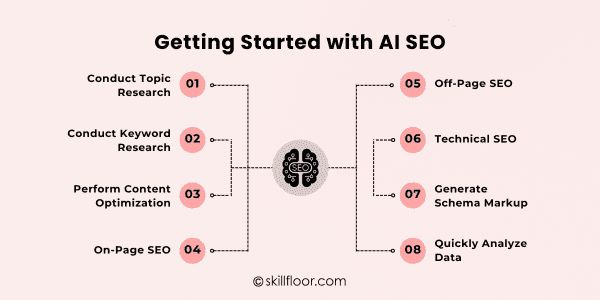
Step-by-Step AI SEO Guide for Beginners
This practical workflow moves from research to measurement. Each step assumes you have a basic website already live, but most tips apply even if you are starting from scratch.
Step 1: Build a Topic Strategy with AI Keyword Clusters
Start with a broad seed topic, like “indoor gardening.” Use an AI research tool to generate semantically related phrases. You will likely get clusters such as “best low-light plants,” “indoor watering systems,” and “common houseplant diseases.” Map these into a content calendar where each cluster becomes a pillar page supported by sub-articles. AI helps you prioritize topics with the best balance of volume and low difficulty—essential for a beginner who lacks domain authority.
Step 2: Create People-First Content with AI Assistance
For each chosen topic, let an AI assistant produce a content brief that includes target word count, must-mention subtopics, and questions to answer. Then use a generative model to draft the article. Treat the draft as raw material. Infuse your personal experience, case studies, photos, and expert quotes. Run the final piece through an AI optimizer to check for semantic completeness and readability. Always edit for a natural flow.
Step 3: Automate On-Page Elements
Feed your final text into an AI tool that suggests title tags, meta descriptions, and header structures. These elements often get neglected by beginners. AI can generate multiple variations so you can A/B test click-through rates in search results. Also, use plugins or cloud-based AI solutions to automatically add schema markup (FAQ, HowTo, Article) where appropriate. Structured data helps Google display rich snippets, increasing visibility.
Step 4: Fix Technical Hurdles Immediately
Run a full site audit with an AI crawler. Address critical issues first: missing SSL certificates, mobile usability glitches, slow server response, broken internal links, and duplicate content. Beginners should set up automatic weekly scans. The A Keeping technical health clean ensures your good content gets indexed and ranked.
Step 5: Use AI for Smart Link Building
Look for high-quality resource pages in your niche using backlink analysis tools that employ AI algorithms. You can also identify broken links on authoritative sites and suggest your content as a replacement. Some tools can draft personalized outreach emails. Always customize the message; AI-generated templates feel hollow if you do not add a human touch. As a beginner, aim for a handful of relevant, authoritative backlinks per month instead of chasing volume.
Step 6: Monitor and Iterate with AI Analytics
Connect your site to Google Search Console and an AI-powered reporting platform. Set up alerts for sudden traffic drops, new keyword opportunities, or content decay. The AI can detect pages that used to rank well but have slipped, then recommend updates based on currently ranking competitors. This closed-loop process turns SEO from a one-time project into a continuous improvement system.
Top AI SEO Tools for Beginners
| Tool | Primary Function | Beginner-Friendly | Pricing Model |
|---|---|---|---|
| ChatGPT / Claude | Content drafting, idea generation, outlines | Very high | Free tier available |
| Frase / SurferSEO | Content optimization, NLP analysis | High, guided interface | Starting $15–$49/mo |
| SEMrush / Ahrefs | All-in-one SEO suite with AI features | Moderate learning curve | $129–$99/mo |
| Alli AI | Bulk on-page SEO automation | High, set-and-optimize | From $99/mo |
| RankMath PRO (WordPress) | Schema, internal link suggestions, content AI | Extremely high | $5–$20/mo |
| Google’s AI-Powered Search Console Insights | Content performance analysis | Built-in, free | Free |
Start with one tool that solves your biggest bottleneck. A common beginner mistake is subscribing to five platforms at once and using none well. Master a content optimizer and Google Search Console first, then expand.
Benefits and Limitations of AI SEO
Advantages
- Time savings: Automates research, audits, and initial drafting, freeing hours for strategy.
- Data-driven decisions: Removes guesswork by surfacing patterns you would overlook.
- Scale: A solo beginner can manage a site of 50 pages with the efficiency of a small agency.
- Better content quality: AI ensures you cover semantic topics comprehensively, aligning with Google’s helpful content standards.
- Accessibility: No coding or deep technical background needed for many tasks.
- Over-reliance danger: Publishing raw AI content without human editing leads to generic, sometimes inaccurate information that erodes trust.
- Cost: The best AI tools require subscriptions that may strain a new blogger’s budget.
- Google’s scrutiny: Search algorithms may penalize low-value AI spam. E-E-A-T signals (experience, expertise, authoritativeness) still demand human touch.
- False confidence: AI suggestions are not always correct. Optimization scores can become a vanity metric if you ignore real user needs.
- Implementation gap: Knowing a technical fix is one thing. Applying it across a messy CMS often still requires human troubleshooting.
- Publishing AI content without human editing. Search engines can detect thin, repetitive text. Always add original examples, data, or personal stories.
- Chasing arbitrary AI optimization scores. A content score of 90 does not guarantee a top ranking. Relevance, backlinks, and domain strength matter more.
- Ignoring search intent. AI can suggest keywords, but you must verify whether the user wants to buy, learn, or compare. Mismatched intent leads to high bounce rates.
- Over-automating link building. Automated spam comments or mass directory submissions will hurt. Use AI for prospecting only, never for cheap link schemes.
- Assuming AI is static. Google updates happen frequently. Re-audit your site with AI tools after major updates to catch newly flagged issues.
- Neglecting local and voice search. Beginners often focus on text-based desktop queries. Use AI to mine conversational long-tail phrases people speak into phones.
Drawbacks
AI SEO vs Traditional SEO: A Quick Comparison
| Aspect | Traditional SEO (Manual) | AI SEO (Modern) |
|---|---|---|
| Keyword Research | Manual Excel lists, basic volume metrics | Intent clustering, trend prediction, competitor gap analysis |
| Content Creation | Write from scratch, guess topic depth | AI drafts, content briefs, real-time SERP analysis |
| Technical Audits | Manual crawling with separate tools, hours of filtering | Automated, prioritized issue lists with fix guides |
| On-Page Optimization | Rule-of-thumb keyword placement | Entity-based optimization, dynamic schema generation |
| Link Prospecting | Manual search queries, spreadsheets | AI-driven backlink gap, predictive outreach success |
| Speed | Slow, linear | Exponential; one person can handle multiple projects |
The two approaches are not mutually exclusive. Smart beginners blend the best of both: traditional strategic thinking guided by AI’s analytical power.
Common AI SEO Mistakes Beginners Should Avoid
Important Notes for Sustainable AI SEO Success
Transparency matters. If you use AI extensively, consider mentioning it to build trust with readers—especially on YMYL (Your Money or Your Life) topics. Google’s evaluators look for clear authorship and demonstrated expertise. A generic AI-written medical article without a qualified reviewer will struggle.
Regularly run content audits. Even well-optimized pages can decay. AI analytics tools can flag when a page’s click-through rate drops or when a competitor overtakes you. Then you can update the content with fresh information, new statistics, and improved readability—all accelerated by AI suggestions.
Always prioritize user experience. AI can cram keywords and entities into a page, but if the font is tiny, ads overwhelm, and the layout breaks on mobile, rankings will slip. Use AI to monitor Core Web Vitals and accessibility scores, but test real user interactions. No machine perfectly replicates human patience.
Treat AI as a co-pilot, not the pilot. The most successful beginner SEO practitioners use AI to handle repetitive analysis so they can focus on creative strategy, relationship building, and brand voice—elements that machines cannot authentically replicate. Search engines reward sites that demonstrate real-world authority, not just algorithmic perfection.
Keep learning the fundamentals. Even if AI does the heavy lifting, understanding how title tags, redirects, and internal link equity work remains invaluable. When a tool fails or gives a strange recommendation, that foundational knowledge will save you from costly errors.
Frequently Asked Questions
What exactly does AI SEO mean for a complete beginner?
AI SEO for beginners means using artificial intelligence tools to make search engine optimization faster and less technical. Instead of manually finding keywords, writing every meta description, or scanning for broken links, you rely on software that analyzes data and suggests actions. It does not replace your creativity—it handles the repetitive tasks so you can focus on building great content and user experiences.
Can AI do all my SEO work automatically?
No single tool can fully automate SEO end-to-end. AI excels at research, drafting, and technical audits, but you still need human oversight to verify facts, add unique perspective, and ensure content meets Google’s E-E-A-T standards. Search engines penalize sites that publish entirely machine-generated low-value content. Think of AI as a highly skilled assistant, not a replacement for your judgment.
Is it safe to publish AI-generated content on my website?
Yes, if you heavily edit and enhance the output. Google’s guidelines focus on content quality, not the method of creation. Publish AI-assisted articles that demonstrate real experience, include expert quotes, and serve user intent clearly. Avoid publishing raw AI drafts verbatim; those are often shallow and may contain factual errors that hurt your credibility and rankings.
Which free AI SEO tools can I start with today?
You can begin with ChatGPT’s free tier for outlines and first drafts, Google Search Console for performance data, and Bing Webmaster Tools for additional insights. RankMath’s free WordPress plugin offers AI-powered SEO suggestions while Google’s own NLP API demo helps you analyze entity recognition. These free resources let you test workflows before investing in premium platforms like SurferSEO or SEMrush.
How long does it take to see results from AI SEO?
Results depend on your niche’s competition, domain age, and content quality. AI accelerates the process of finding optimal topics and optimizing pages, but SEO remains a medium to long-term strategy. You might see improvements in crawl efficiency within days. Meaningful traffic changes typically take three to six months of consistent publishing and technical maintenance. AI helps you execute faster, but patience is still required.
Will Google penalize my site for using AI in SEO?
Google does not penalize AI usage outright. It penalizes manipulative practices and low-quality content. If AI enables you to produce helpful, well-researched pages that satisfy users, your rankings can improve. Problems arise when people use AI to mass-produce keyword-stuffed, unoriginal articles. Stick to quality guidelines, disclose AI involvement where relevant, and always add human value to avoid any risk.
Bringing It All Together
AI SEO for beginners is not a futuristic concept—it is a practical, accessible way to build a solid foundation in search optimization. By combining the analytical speed of artificial intelligence with your own insight and creativity, you can compete effectively even without a large team. Start small, master one tool at a time, and never let the technology override genuine user empathy. Those who learn to balance automation with authentic human expertise will be the ones who thrive as search engines become smarter every day.
Xem thêm:
- AI SEO User Signals: The Complete Guide to Ranking in the Age of Machine Learning
- AI SEO for Beauty: The Complete Guide to Dominating Search in 2025
- AI SEO Ecommerce Content Generator: The Complete Guide to Scaling Product Pages in 2025
- AI SEO Image Titles: The Complete Guide to Boosting Your Visual Search Rankings
- AI SEO AI Content Audit Tool: The Complete Guide to Automated Content Optimization
Bài viết cùng chủ đề:

AI SEO SEO Automation with Make: The Complete Workflow Guide

AI SEO SEO Automation with Zapier: The Complete Workflow Guide

AI SEO SEO Automation with n8n: The Complete Workflow Guide
AI SEO SEO Automation with Gemini: The Complete Guide to Scaling Organic Growth

AI SEO SEO Automation with Claude: The Complete Guide to Scaling Content in 2025

AI SEO SEO Automation with ChatGPT: The Complete Playbook for 2025

AI SEO & SEO Automation for Affiliate Sites: The 2025 Playbook for Passive Income Growth
AI SEO & SEO Automation for Bloggers: The Complete Guide to Scaling Your Content

AI SEO & SEO Automation for Agencies: The Complete 2025 Playbook

AI SEO and SEO Automation for Ecommerce: The Complete Playbook for 2025

AI SEO & SEO Automation for WordPress: The Complete Playbook for 2025
AI SEO SEO Automation Strategy: The Complete Playbook for 2025

Mastering the AI SEO SEO Automation Process: A Complete Guide to Scaling Organic Growth
AI SEO SEO Automation System: The Complete Guide to Scaling Organic Growth in 2025
AI SEO SEO Automation Platform: The Complete Guide to Scaling Organic Growth in 2025
AI SEO SEO Automation Software: The Complete Guide to Scaling Organic Growth in 2025















