
No products in the cart.
The Ultimate AI SEO Checklist: 25 Steps to Rank Higher in 2025

29
Jul
Jul
The landscape of search engine optimization is shifting faster than ever, and artificial intelligence sits at the heart of that change. An AI SEO checklist is the structured bridge between human expertise and machine efficiency, ensuring you harness AI’s power without sacrificing quality, originality, or trust. Search engines now reward content that demonstrates real experience, deep authority, and genuine helpfulness. A well-crafted checklist keeps your strategy aligned with these signals while automating repetitive tasks and surfacing insights no manual analysis could catch in time. This guide walks through every critical checkpoint—from keyword discovery to performance monitoring—so you can build a repeatable, AI-enhanced workflow that actually moves the needle.
What Is an AI SEO Checklist and Why Every Modern Marketer Needs One
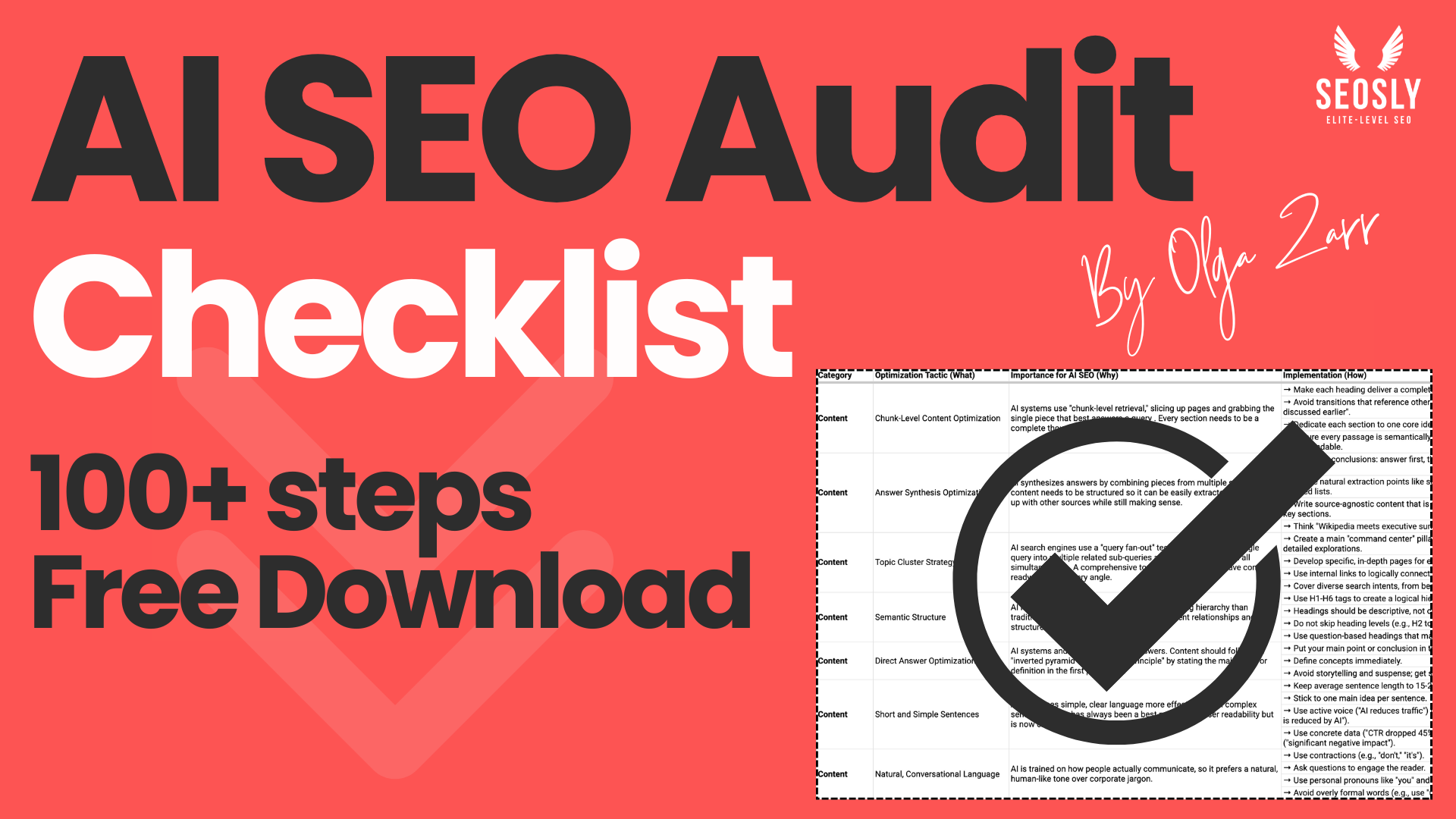
An AI SEO checklist is a systematic, step-by-step guide that integrates artificial intelligence tools into every stage of search optimization. It’s not about handing the reins over to a bot. It’s about using AI to accelerate research, generate drafts, audit technical health, and predict content gaps while a human strategist validates, edits, and refines the output. Without a checklist, teams often misuse AI—generating bland, thin content, missing technical errors, or ignoring Google’s quality guidelines. A documented AI SEO checklist ensures consistency across projects and keeps you focused on what actually influences rankings: relevance, expertise, page experience, and backlink authority.
The Evolution from Manual SEO to AI-Assisted Workflows
Traditional SEO relied on manual keyword research in spreadsheets, laborious competitor audits, and gut-feel content briefs. The emergence of large language models, natural language processing APIs, and dedicated AI SEO platforms has transformed that. Today, an AI tool can cluster thousands of keywords into topic pillars in minutes, generate a first-draft article outline that matches search intent, and even suggest internal links based on semantic relationships. The checklist formalizes this process so that regardless of who executes the task, the same high standards apply.
Strategic Foundation: Aligning Your AI SEO Checklist with Business Goals
Before diving into tool-specific prompts and audits, the first section of any effective AI SEO checklist must tie directly to business outcomes. Rank without purpose is just vanity. Aligning with goals ensures your AI-driven efforts translate into leads, sales, or audience growth.
1. Define Target Audiences and Their Search Intent Clusters
Use AI to analyze customer interviews, support tickets, and social listening data to extract real language and pain points. Feed these into a tool like ChatGPT or a specialized SEO platform to group queries into intent buckets: informational, commercial, navigational, and transactional. The checklist should prompt you to map every target piece of content to one primary intent cluster before creation begins. Intent mismatch is the fastest way to burn crawl budget and lose trust.
2. Set Measurable KPI Benchmarks with Predictive AI Insights
Instead of guessing traffic potential, integrate AI-driven forecasting tools that use historical domain data, seasonality, and competitor trends. Your checklist must require a specific traffic estimate and conversion value for each content asset, then track actual performance against that forecast. This closes the loop and proves ROI.
Keyword and Topic Research Phase: AI-Powered Discovery Without the Noise
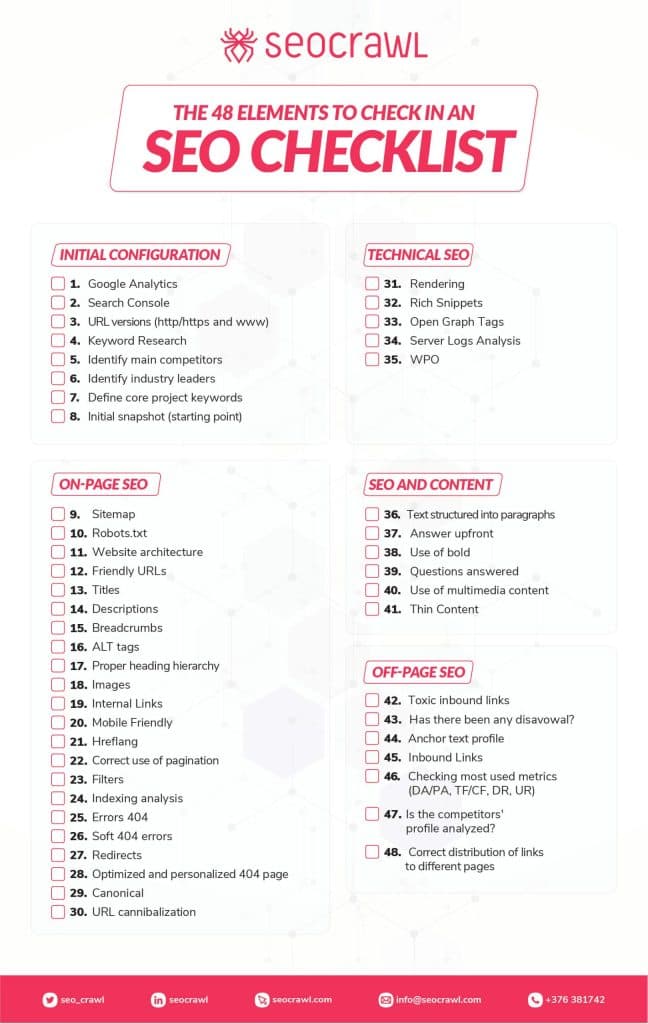
The research phase is where AI SEO checklist items prevent the common trap of chasing high-volume, low-relevance terms. Machine speed needs human critical thinking to filter the signal from the noise.
3. Generate a Comprehensive Seed Keyword Map Using AI Clustering
Start with three to five core business topics. Input them into an AI keyword clustering tool. The algorithm groups semantically related long-tail variations, questions, and comparison terms. Your task, as dictated by the checklist, is to manually review each cluster and label it with a content pillar name. This labeling connects machine output to your editorial strategy.
4. Run Competitor Gap Analysis Through AI Content Analyzers
Point an AI SEO tool at a competitor’s domain to extract their top-performing pages by organic traffic and the keywords they rank for that you don’t. The checklist must include a step to categorize those gaps by “content needed,” “content improvement,” and “authority deficit.” Not every gap is fillable just because AI revealed it. Sometimes the competitor’s domain authority is the real barrier, and the checklist should flag that.
5. Validate Topic Worthiness with Real-Time Trend Data
Integrate AI trend analysis directly into the checklist. Tools can overlay Google Trends data, seasonality, and even news cycle relevance onto your keyword list, automatically deprioritizing decaying topics. The checklist should demand a freshness score for each target keyword before briefing any writer or AI content generator.
Content Creation and Optimization: The Core of the AI SEO Checklist
This is where most checklists fall apart. AI can write, but it cannot experience. The intersection of generation and human oversight defines content that ranks and converts.
6. Craft Detailed AI Content Briefs with Entity and E-E-A-T Markers
Use an AI assistant to build a brief that includes target entities (people, places, concepts), required subheadings, semantic keywords, and specific experience signals to include. For example, if writing about a medical procedure, the brief must specify the inclusion of a credentialed reviewer and real-world outcome data. The checklist then forces a human sign-off on the brief before any generation begins.
7. Generate a First Draft with Trained, Brand-Voice AI
Feed the brief into a generative AI model that you’ve primed with brand style guides and previous high-performing content. The checklist should limit this to a first draft only. Mark the output clearly as “AI-Generated Draft — Requires Human Editing.” This step is about speed, not final quality.
8. Inject Original Data, Examples, and Unique Experience
No AI can replicate your proprietary data, customer stories, or hands-on tests. The checklist must have a mandatory section where the human editor adds at least two unique data points or anecdotes to every piece. This could be an internal survey result, a screenshot of a test, or a case study snippet. That addition directly reinforces E-E-A-T.
9. Optimize for On-Page Elements with AI-Assisted Scoring
Run the edited draft through an on-page SEO grader. The checklist should specify exact thresholds: keyword in the first 100 words, H1 matching title tag intent, semantic keyword density within a healthy range, and internal link suggestions implemented. AI tools can instantly flag missing alt text or overly long paragraphs, and the checklist ensures you act on every flag.
Technical SEO Audit: An AI Checklist for a Healthy Search Foundation
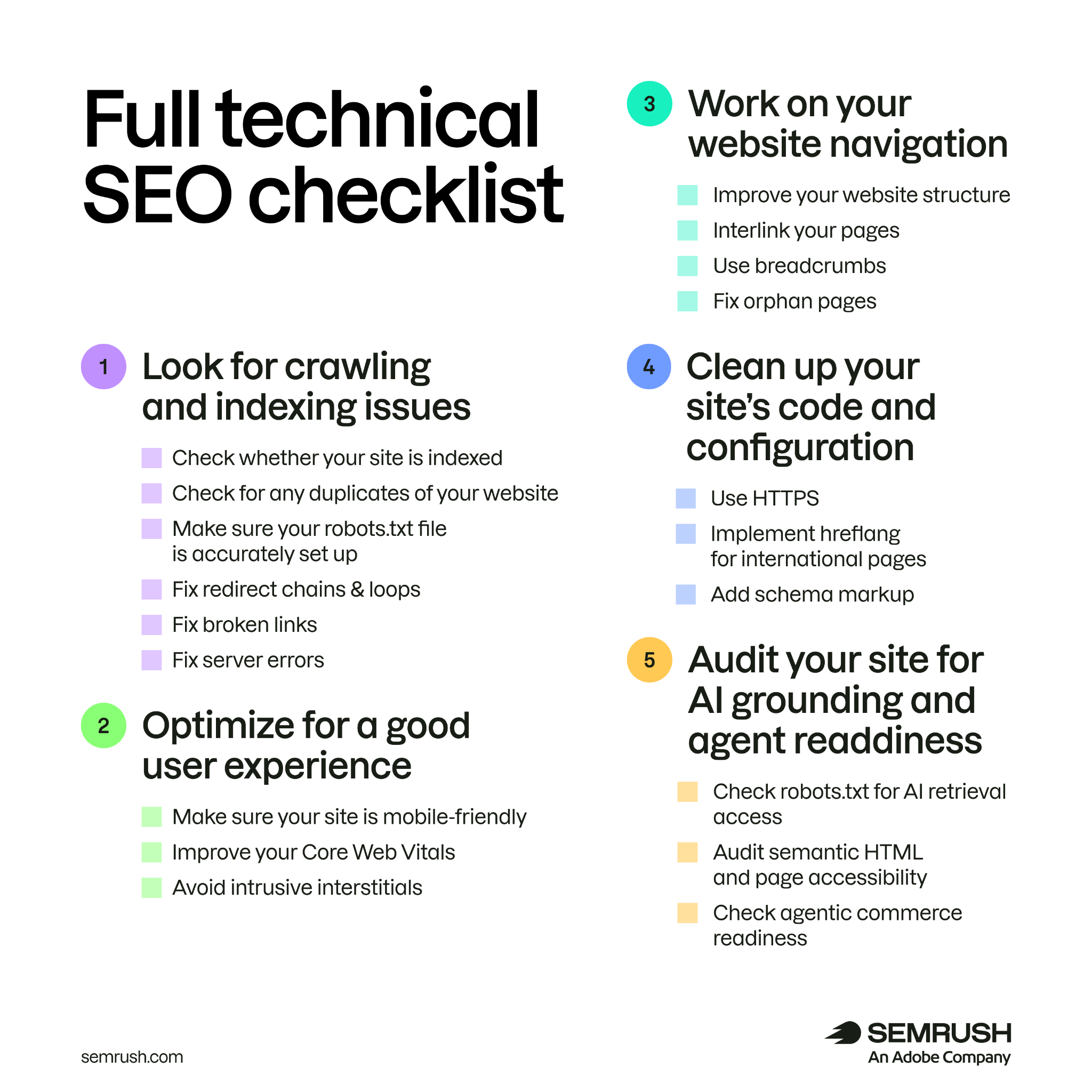
Technical issues can nullify the best content. AI crawlers simulate how search engines see your site, but the checklist keeps your team from ignoring alerts.
10. Schedule Weekly AI Crawls of Your Domain
Automate a full site crawl using an AI-powered technical SEO tool. The checklist item is not the crawl itself—it’s the review. Mandate that a team member reviews the crawl report within 48 hours and prioritizes issues by impact. AI can categorize errors as critical (broken internal links, noindex tags on important pages), warnings (slow load time), and opportunities (missing meta descriptions).
11. Validate Indexability and Crawl Budget Efficiency
Connect your site to Google Search Console and use AI log file analysis. The checklist requires a monthly check of crawl statistics: are search bots wasting time on low-value parameter pages? AI can identify patterns in server logs that a human would miss, like a sudden spike in crawled but unindexed pages. The checklist should then trigger a tech audit to fix the root cause.
12. Automate Core Web Vitals Monitoring and Prescriptive Fixes
AI tools now not only tell you that Largest Contentful Paint is slow but analyze render-blocking resources and suggest code-level optimizations. The checklist should demand a quarterly review of Core Web Vitals trends across device types and a specific action plan for any URL group falling below “Good.”
13. Use AI to Generate Structured Data Markup and Validate It
Schema markup remains an underused lever. Your AI SEO checklist should prompt you to identify key content types—articles, products, events—and use an AI script generator to produce JSON-LD markup. Then, always run it through a structured data testing tool. A checklist item ensures no markup goes live without validation.
Off-Page SEO and Authority Building: AI-Informed Outreach
AI can’t build relationships for you, but it can identify who to talk to and what to say.
14. Identify Link-Worthy Assets and High-Quality Prospect Lists
Use AI to scan your own content for assets that contain original statistics, unique tools, or definitive guides. Then reverse-engineer backlink profiles of competitors to find domains that link to similar but weaker resources. The checklist should produce a prioritized list of 50 prospects each month, ranked by domain authority and topical relevance.
15. Generate Personalized Outreach Frameworks, Not Spam Templates
AI can draft an outreach template in seconds, but a checklist must guard against mass, impersonal emailing. The step should be: feed prospect details into an AI tool to generate a starting point, then manually personalize the first two sentences based on a recent post or achievement. That human touch determines response rates, and the checklist makes it mandatory.
16. Monitor Brand Mentions and Unlinked Opportunities with AI Alerts
Set up AI-driven mention tracking. When a site mentions your brand or a key executive without a link, the checklist triggers a simple, polite link request. AI filters out low-quality sites, spam, and irrelevant forums so you only act on genuine opportunities.
Local SEO: An AI Checklist for Multi-Location Dominance
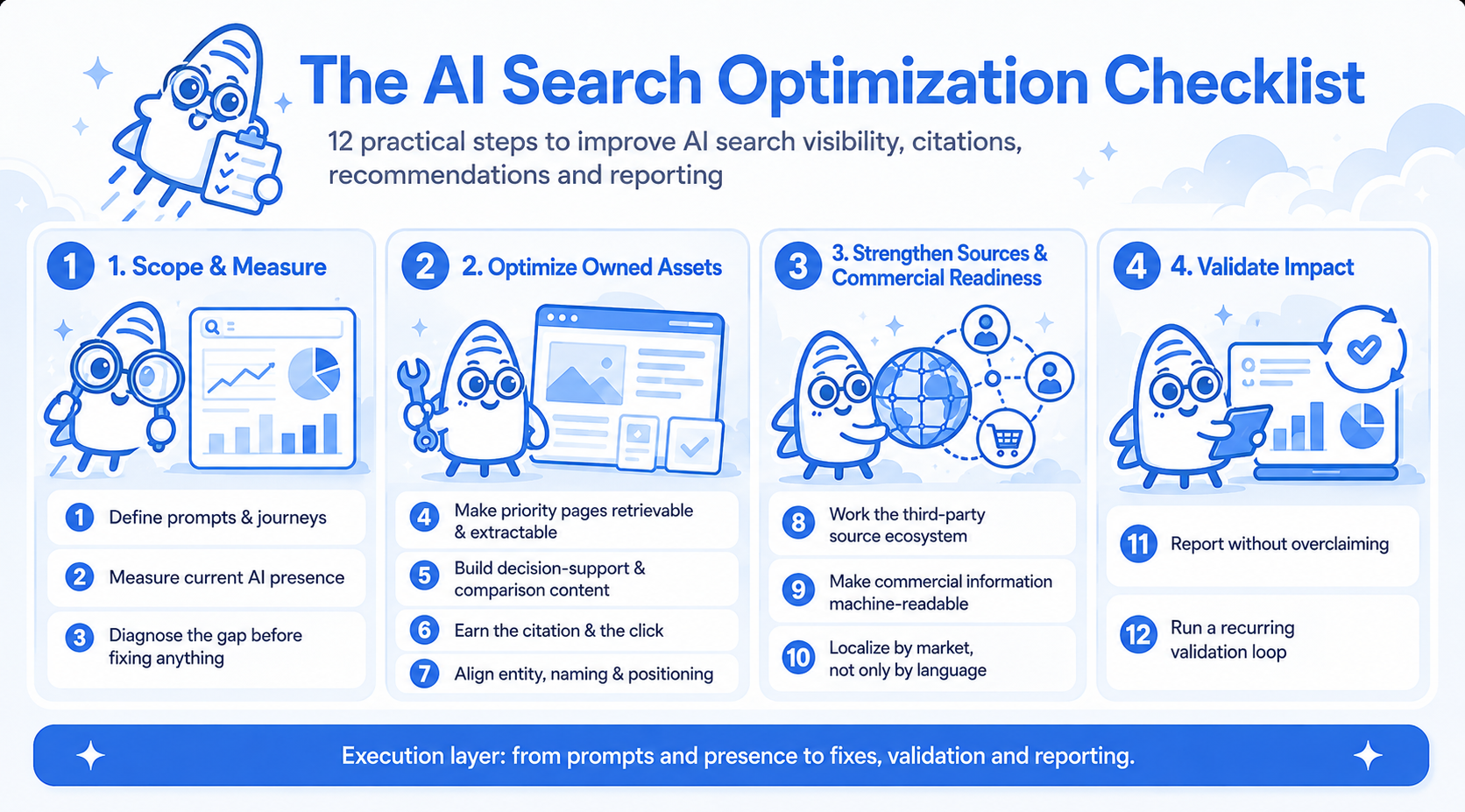
Local search thrives on accuracy, reviews, and relevance. AI scales what would otherwise be manual, repetitive work across dozens or hundreds of locations.
17. Bulk Optimize Google Business Profiles with AI-Assisted Descriptions
For multi-location brands, the checklist should call for AI to generate location-specific business descriptions that incorporate primary and secondary categories naturally, while keeping NAP data consistent. A human must verify each description for policy compliance and local flavor. No “As an AI…” language allowed.
18. Automate Review Sentiment Analysis and Response Drafting
Use an AI tool to aggregate reviews across platforms, detect emerging issues (like “wait time” complaints at a specific location), and draft manager responses. The checklist must force a human review before posting, but the speed of insight allows you to fix operational problems before they tank your local rankings.
Performance Tracking and Iteration: The Learning Loop
A static checklist is useless. AI SEO checklists must evolve as algorithms, search behavior, and your own data change.
19. Build Automated AI Dashboards That Highlight Anomalies, Not Just Averages
Standard analytics dashboards show traffic curves. AI-powered anomaly detection spots pages that lost 10% of clicks overnight due to a snippet change, or a sudden ranking dip for a high-value keyword. The checklist must schedule a weekly report review and assign a person to investigate each flagged anomaly.
20. Use AI to Correlate Content Updates with Ranking Changes
Don’t guess why rankings moved. Feed your change log and ranking history into an AI model that identifies which content refreshes, link acquisitions, or technical fixes correlated with positive or negative movements. The checklist then prompts you to do more of what the data proves works.
21. Run Quarterly Content Decay Audits with AI Predictive Tools
Content doesn’t stay fresh forever. AI can predict, based on trends and competitor publishing velocity, which of your pages are likely to decay in the next six months. The checklist triggers a proactive refresh before rankings drop, saving costly recovery efforts.
Common Mistakes to Avoid When Following an AI SEO Checklist

Even a brilliant checklist fails if misapplied. The most damaging pitfalls come from treating AI as a replacement for strategy rather than an amplifier of it.
22. Publishing AI Output Without Rigorous Human Editing
AI often hallucinates facts, produces generic examples, and misses the nuance of lived experience. Some checklists neglect a formal editing stage, leading to factual errors that destroy reader trust and invite manual actions. Every AI-generated sentence should be fact-checked, and every statistic sourced.
23. Ignoring Google’s “Helpful Content” Signal by Over-Optimizing for Search
When an AI checklist fixates on keyword density and entity mentions without checking if the content actually satisfies the user, it backfires. The checklist must include a “read aloud” test: if the finished piece sounds unnatural or robotic, it’s not ready to publish. Prioritize human readability above all AI scoring metrics.
24. Using Outdated or Unverified AI Training Data for Your Niche
Some AI models have knowledge cutoff dates. In fast-moving industries like finance, technology, or medicine, a checklist that doesn’t force the injection of current, domain-specific references will produce dangerously obsolete content. Always cross-reference AI suggestions with primary sources dated within the last three months.
25. Setting and Forgetting Automation Without Checking for Drift
Automated AI crawls, content generators, and reporting can drift. A keyword that drove converting traffic might subtly change intent. A scripted schema output might break after a CMS update. The final, critical checklist item is a monthly “AI system integrity check” where you manually verify a random 5% of AI outputs to ensure quality hasn’t degraded.
Benefits and Limitations of an AI SEO Checklist Approach
The checklist method brings undeniable advantages but also requires honest acknowledgment of its constraints.
Measurable Benefits
- Consistency across large teams: Everyone from junior writers to senior strategists follows the same quality gates.
- Speed of insight: Tasks that took days, like competitor gap analysis, are reduced to hours, enabling faster strategic pivots.
- Data-driven decisions: AI removes emotional attachment from content decisions, replacing “I think this topic is interesting” with “the data shows a 67% probability of ranking in the top 10.”
- Scalability without linear headcount growth: A small team can manage enterprise-level content operations by letting AI handle the heavy lifting of research and drafting.
- E-E-A-T gaps: AI cannot generate genuine first-hand experience, making it unsuitable for YMYL (Your Money Your Life) topics without heavy human contribution.
- Tool dependency risk: Over-reliance on a single AI platform creates a single point of failure. If the tool changes its model or pricing, the entire checklist may need rework.
- Standardization at the cost of creativity: A rigid checklist can stifle the unexpected, breakout content that defines a brand voice. The checklist must leave room for creative departures that are consciously made, not accidental.
- Initial setup burden: Building a tailored AI SEO checklist requires deeply understanding your tech stack, audience, and SEO maturity. It’s not a one-size-fits-all download.
- Google’s public stance on AI-generated content focuses on quality, not origin. Content created primarily to manipulate search rankings violates guidelines regardless of how it was produced. Your checklist must therefore judge output by helpfulness, not by whether a human or a machine typed the words.
- Regularly update the checklist. AI models receive updates, search engine guidelines evolve, and your site’s authority grows. A checklist from January 2024 will be dangerously outdated by mid-2025. Schedule a quarterly review of every checklist item and tool prompt.
- Always transparently attribute where required. In some industries, disclosing AI involvement in content creation builds trust; in others, it’s legally mandated. The checklist should include a legal and compliance review step for regulated niches like healthcare, finance, and legal services.
- Avoid “checklist fatigue.” If the AI SEO checklist becomes so long that team members skip steps, it’s worse than having no checklist at all. Ruthlessly prune steps that don’t directly impact rankings or user experience, and use AI to automate the checklist’s own tracking where possible.
Key Limitations to Manage
AI SEO Checklist vs. Traditional SEO Checklist: A Comparative View
The core difference lies in the source and velocity of insights. Traditional checklists lean on manual research and rule-based audits; AI-augmented checklists introduce dynamic, predictive, and generative components. The table below highlights these distinctions.
| Aspect | Traditional SEO Checklist | AI SEO Checklist |
|---|---|---|
| Keyword Research | Manual export from keyword tools, manual grouping | AI clustering with intent labeling and trend prediction |
| Content Briefing | Desk research, manual competitor review | AI-generated briefs with entity maps and gap suggestions |
| Drafting | Human writer from scratch | AI first draft, human-edited for experience and originality |
| Technical Audits | Scheduled manual crawls, spot-checking | Continuous AI crawls with anomaly detection and prescriptive fixes |
| Performance Analysis | Monthly reporting on traffic and rankings | Real-time AI correlation of updates to movements, decay predictions |
| Risk | Slow response to algorithm changes | Potential for over-automation if human checks are skipped |
Practical Implementation: How to Build Your Own AI SEO Checklist in One Day
Start by auditing your current SEO process. List every recurring task—from monthly reporting to daily content production. For each task, identify whether an AI tool can either: a) fully automate the grunt work, b) provide a starting point for a human, or c) offer insights invisible to manual analysis. Do not assume AI can do it all. Mark each task with the required human verification step. That pairing of AI action and human checkpoint becomes the core of your checklist.
Next, choose your AI tool stack carefully. Resist the urge to use a dozen different platforms. A robust combination might include: one generative AI model for drafting and research, one dedicated SEO platform with AI clustering and rank tracking, and one technical crawler with AI log analysis. Document in the checklist the exact prompt structure that yields consistent, high-quality outputs. Vague prompts produce vague results, so your checklist must include tested, reusable prompt templates.
Finally, pilot the AI SEO checklist on a contained project—perhaps one product category or one content pillar. Measure time saved, output quality, and ranking movements over 60 days. Refine the checklist based on what broke. Often, the human validation steps need tightening: maybe the editing guideline wasn’t specific enough, and some low-quality AI text slipped through. That’s the learning loop in action.
Important Notes for Long-Term Success with an AI SEO Checklist
Frequently Asked Questions
What exactly is an AI SEO checklist?
An AI SEO checklist is a documented workflow that combines artificial intelligence tools with mandatory human oversight steps for every critical SEO activity, from keyword research to content optimization and technical audits. It ensures that AI is used as an accelerator, not a replacement for strategic thinking and quality control.
Can I rely solely on an AI SEO checklist for my website’s rankings?
No checklist alone can guarantee rankings, and over-reliance on AI without human experience signals will likely harm performance. The checklist is a framework to ensure you apply AI consistently and ethically. The quality of your human input, proprietary data, and genuine expertise remains the determining factor for sustainable search visibility.
How often should I update my AI SEO checklist?
A minimum of once per quarter, or immediately following a major Google algorithm update or a significant change in your AI tool’s capabilities. Many teams review their checklist’s core assumptions monthly based on actual performance data to catch drift early.
Does Google penalize content created using an AI SEO checklist?
Google does not penalize content solely because it was AI-assisted. Penalties come from low-quality, unoriginal, or unhelpful content that violates spam policies. A properly executed AI SEO checklist requires heavy human editing and the injection of unique experience, which aligns with Google’s helpful content system.
What is the most common mistake people make with AI SEO checklists?
The most common mistake is skipping the human validation steps in the interest of speed. Publishing raw AI-generated text without fact-checking, adding original examples, and verifying intent leads to generic content that fails to differentiate or build trust. Another frequent error is applying the same checklist blind across all content types without adjusting for YMYL topics.
Is an AI SEO checklist suitable for local businesses?
Absolutely. For local SEO, an AI checklist can automate Google Business Profile updates, review response drafting, and competitor gap analysis across multiple locations. The key is ensuring local nuance—street-level knowledge, hyper-local offers, and community involvement—is manually added to avoid sounding generic across different markets.
Conclusion
An AI SEO checklist is no longer optional for teams that want to move fast without breaking trust. It converts the abstract promise of artificial intelligence into concrete, repeatable actions that elevate content quality, technical health, and strategic clarity. The checklist’s real power is not in the AI steps alone but in the deliberate fusion of machine scale with human judgment. Every checklist item that forces a review, a personal anecdote, or a data verification is a vote for long-term resilience against algorithm volatility. Start building yours now, test it ruthlessly, and let it evolve as the technology and your own experience deepen.
Xem thêm:
- WP Trove SEO Plugin: The Complete Guide to Smarter WordPress Optimization
- AI SEO Content Hubs: The Complete Guide to Building Automated Topic Clusters
- AI Content Pruning: The Complete Strategy to Remove Weak Pages and Skyrocket SEO Performance
- How to Build AI Content Systems: A Complete Guide to Scalable, Intelligent Content Operations
- AI SEO AI Brand Mentions: The Complete Guide to Automated Brand Monitoring
Bài viết cùng chủ đề:

AI SEO SEO Automation with Make: The Complete Workflow Guide

AI SEO SEO Automation with Zapier: The Complete Workflow Guide

AI SEO SEO Automation with n8n: The Complete Workflow Guide
AI SEO SEO Automation with Gemini: The Complete Guide to Scaling Organic Growth

AI SEO SEO Automation with Claude: The Complete Guide to Scaling Content in 2025

AI SEO SEO Automation with ChatGPT: The Complete Playbook for 2025

AI SEO & SEO Automation for Affiliate Sites: The 2025 Playbook for Passive Income Growth
AI SEO & SEO Automation for Bloggers: The Complete Guide to Scaling Your Content

AI SEO & SEO Automation for Agencies: The Complete 2025 Playbook

AI SEO and SEO Automation for Ecommerce: The Complete Playbook for 2025

AI SEO & SEO Automation for WordPress: The Complete Playbook for 2025
AI SEO SEO Automation Strategy: The Complete Playbook for 2025

Mastering the AI SEO SEO Automation Process: A Complete Guide to Scaling Organic Growth
AI SEO SEO Automation System: The Complete Guide to Scaling Organic Growth in 2025
AI SEO SEO Automation Platform: The Complete Guide to Scaling Organic Growth in 2025
AI SEO SEO Automation Software: The Complete Guide to Scaling Organic Growth in 2025















