
No products in the cart.
AI SEO Content Decay: The Hidden Threat to Your Search Rankings and How to Fix It

10
Aug
Aug
AI SEO Content Decay is the silent killer of organic traffic in the modern search landscape. It refers to the rapid decline in search visibility and rankings for content that was initially optimized using artificial intelligence tools, often due to algorithmic updates targeting AI-generated material, increased market saturation, or the inherent lack of unique human insight. As businesses rush to scale content production with AI, many are discovering that what ranks today can vanish tomorrow. Understanding this phenomenon is critical for any digital marketer relying on automated workflows, as the financial impact of losing top-tier rankings can be devastating to revenue streams.
Defining AI SEO Content Decay in the Modern Search Ecosystem
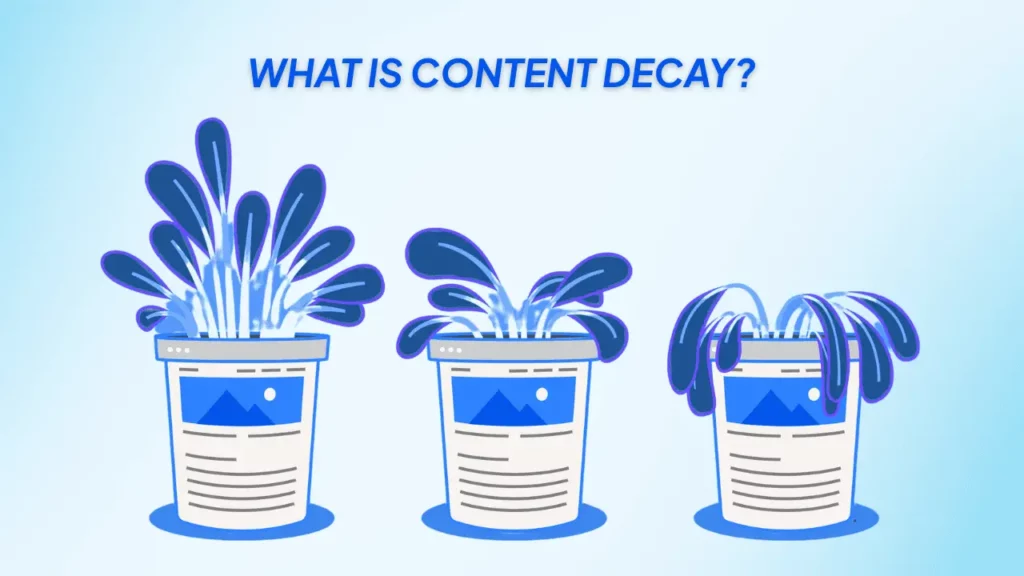
Content decay is not a new concept. Historically, all web pages experienced a natural decline in rankings as they aged and competitors published fresher, more comprehensive material. However, AI SEO Content Decay represents a distinct and accelerated version of this problem. It occurs when content produced with generative AI tools loses its competitive edge at a much faster rate than traditionally written content. This is often triggered by search engine algorithm updates like Google’s Helpful Content system, which specifically targets content that lacks first-hand experience and adds no real value beyond what is already available elsewhere.
The core issue lies in the nature of AI-generated text. Large language models are trained on existing data, meaning they often produce derivative information. When hundreds of sites use similar prompts to generate articles on the same topic, the search engine results pages (SERPs) become flooded with near-identical content. This saturation forces search engines to become more aggressive in filtering out what they perceive as low-value pages, leading to a sudden and sharp decay in rankings for AI-heavy sites.
The Difference Between Natural and AI-Accelerated Decay
Natural content decay is a slow process, often taking months or years. It happens because user intent changes, new research emerges, or competitors create better resources. AI SEO Content Decay, however, is characterized by a sudden cliff-drop in traffic. This usually happens immediately after a core algorithm update or when a competitor deploys a more sophisticated AI strategy that produces higher-quality output. The speed of this decay makes it particularly dangerous because standard SEO monitoring tools may not alert you in time to prevent significant revenue loss.
Another key difference is the recovery potential. With natural decay, updating the content with fresh statistics and examples usually restores rankings. With AI decay, the problem is often structural. If the content lacks original quotes, proprietary data, or unique perspectives, simply refreshing the text will not help. The page needs to be completely rewritten with a human-first approach to regain trust with search engines.
Why AI-Generated Content is Prone to Rapid Ranking Decline
Several factors contribute to the accelerated decay of AI-optimized pages. Understanding these root causes is the first step in building a sustainable content strategy that leverages AI without falling victim to its pitfalls.
Lack of Entity Authority and E-E-A-T Signals
Google’s Quality Rater Guidelines emphasize Experience, Expertise, Authoritativeness, and Trustworthiness (E-E-A-T). AI content often fails to demonstrate these qualities because it lacks a real author with verifiable credentials. A page written by an AI tool does not have a track record of expertise in the field. While you can add an author byline, if the content itself does not contain personal experience, case studies, or original research, the E-E-A-T signals remain weak. This makes the content vulnerable to decay when Google tightens its quality controls.
Algorithmic Updates Targeting Scalable Content Abuse
Search engines have become exceptionally good at detecting patterns of mass-produced content. The March 2024 core update and subsequent spam policy updates explicitly targeted “scaled content abuse,” which includes using AI to generate multiple pages primarily to manipulate search rankings. When these updates roll out, sites that have relied heavily on AI SEO Content Decay become collateral damage. The algorithms do not just penalize the specific low-quality pages; they often apply a sitewide signal that causes all content, even previously well-performing pieces, to lose ranking power.
Market Saturation and the “Sea of Sameness”
When a new AI SEO tool becomes popular, thousands of marketers use it to target the same high-volume keywords. This creates a “sea of sameness” where every article on the SERP has the same structure, similar headings, and nearly identical phrasing. When users click on these results, they often bounce back to the search page because the content does not answer their specific query better than the last site. High bounce rates and low dwell time are negative user experience signals that contribute to content decay.
Identifying the Early Warning Signs of AI SEO Content Decay
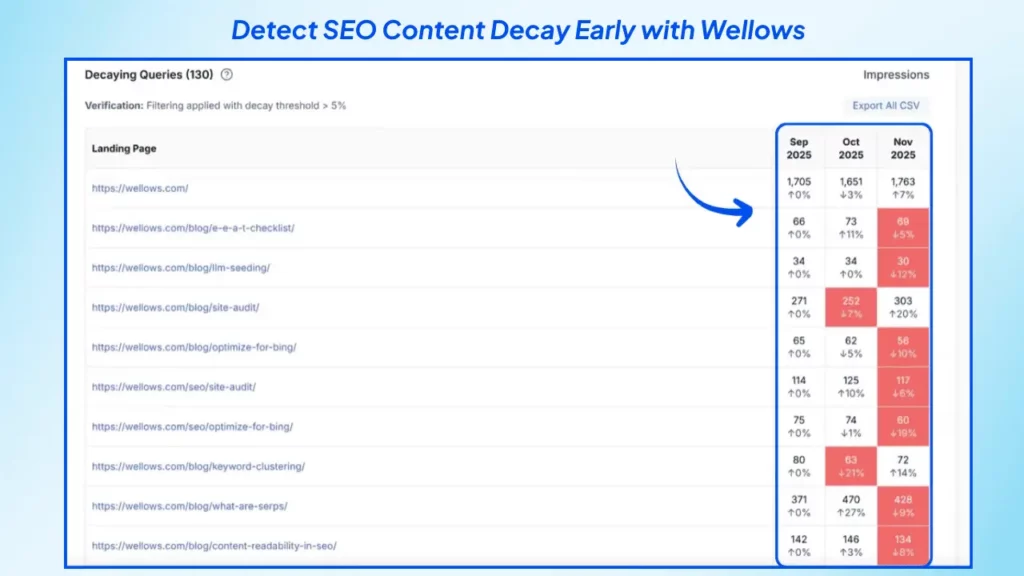
To prevent catastrophic traffic loss, you must monitor for the early indicators of decay. Waiting for your monthly analytics report is often too late. Instead, set up weekly or even daily monitoring for the following metrics.
Tracking Keyword Position Volatility
Use rank tracking tools to monitor your target keywords. A significant fluctuation in rankings—for example, dropping from position 3 to position 15 in a matter of days—is a clear warning sign. For AI-generated content, this volatility is often a precursor to a complete disappearance from the first page. Pay special attention to keywords that were previously stable for months.
Analyzing Engagement Metrics in Search Console
Google Search Console provides data on impressions, clicks, and average position. However, the most critical metric for detecting decay is the click-through rate (CTR). If your impressions remain the same but your clicks drop, it means your title and meta description are no longer compelling, or Google is testing your page in lower positions. Additionally, a sudden drop in impressions often indicates that Google has de-indexed the page or applied a manual action.
Monitoring SERP Feature Loss
If your AI-generated content was previously ranking for featured snippets, People Also Ask boxes, or image packs, and you suddenly lose these placements, it is a sign that Google no longer considers your content the best answer. Losing a featured snippet can cut your organic traffic by 50% or more, as these features dominate the top of the SERP.
Proven Strategies to Reverse AI SEO Content Decay
Recovering from AI SEO Content Decay requires a strategic shift from volume-based production to value-based production. The following methods have been proven effective in restoring rankings for affected pages.
Conducting a Full Content Audit with a Human Lens
Begin by exporting a list of all pages that have lost traffic. Do not just look at the keywords; read the content as a user. Ask yourself if the article provides information that the user could not find on the first page of Google already. If the answer is no, the content needs to be rewritten. Use a spreadsheet to categorize each page into three buckets: “Rewrite,” “Update,” or “Delete and Redirect.”
Injecting First-Hand Experience and Original Data
The most effective way to combat AI decay is to add elements that AI cannot generate. This includes:
- Original screenshots from your software or product.
- Quotes from industry experts you have interviewed.
- Proprietary survey data or case studies.
- Personal anecdotes about challenges you faced and how you solved them.
- Unique images, charts, and infographics created by your design team.
These elements signal to Google that a human with real experience created the content, significantly boosting its E-E-A-T score and making it immune to generic AI detection filters.
Implementing a “Human-in-the-Loop” Editing Process
If you use AI to draft content, you must have a subject matter expert edit it thoroughly. This is not just proofreading; it involves restructuring arguments, adding nuanced opinions, and removing generic fluff. The editor should fact-check every statistic and ensure the content aligns with current industry standards. This process increases production time but is essential for creating content that withstands algorithm updates.
Building a Sustainable AI Content Workflow to Prevent Future Decay
Prevention is always better than cure. To avoid the cycle of creating content and watching it decay, you need to change how you use AI in your SEO strategy.
Using AI for Research and Ideation, Not Final Drafts
Instead of asking AI to write a complete article, use it to generate outlines, identify knowledge gaps, and analyze competitor content. Use AI to find questions that people are asking on forums like Reddit and Quora. Then, use your human expertise to answer those questions in a unique way. This positions AI as a research assistant rather than a replacement for your writers.
Focusing on Topic Clusters Over Individual Keywords
AI SEO Content Decay often occurs when you target isolated keywords without building topical authority. Instead, create comprehensive topic clusters. Have a pillar page that covers a broad subject in depth, and then create cluster pages that address specific subtopics. Interlink these pages strategically. This architecture signals to Google that you are an authority on the entire subject, making it harder for your content to decay.
Establishing a Regular Content Refresh Schedule
Do not treat content as a one-and-done asset. Create a calendar to review your top-performing pages every 3-6 months. During these reviews, update statistics, add new examples, and remove outdated information. This proactive approach keeps your content fresh and signals to search engines that you are actively maintaining your site.
Common Mistakes That Accelerate AI Content Decay
Many marketers unknowingly make mistakes that speed up the decay process. Avoiding these errors is crucial for long-term SEO health.
Ignoring the “Why” Behind the Search Query
AI tools are excellent at matching keywords but poor at understanding the underlying intent. For example, if someone searches for “best running shoes,” they might be looking for a list, a review, or a comparison. If your AI article provides a generic list without specific sizing advice or durability tests, it will fail to satisfy the user. This mismatch leads to high bounce rates and eventual ranking loss.
Failing to Build Internal Links
AI-generated content often exists in a silo. If you do not link to your other relevant articles, the page has no “crawl path” for search engines to discover its context. Internal links pass authority and help search engines understand the relationship between pages. A page without internal links is like an island, and islands are easily forgotten.
Neglecting Technical SEO Elements
Even the best content will decay if the technical foundation is weak. Slow page speed, broken images, and poor mobile responsiveness all contribute to a bad user experience. Search engines prioritize pages that load quickly and are easy to navigate. Ensure your AI-generated content is not bloated with unnecessary code or large, unoptimized images.
Important Notes on the Future of AI and Search Rankings

The relationship between AI content and search rankings is evolving rapidly. Google’s integration of AI Overviews (formerly Bard) into search results has changed how users interact with SERPs. Now, users often get their answer directly on the search page without clicking through to a website. This means that even if your content ranks well, you may see a decline in clicks. To combat this, you must optimize your content to be the source that Google’s AI pulls information from. This requires clear, concise, and factual writing that is easy for machines to parse.
Furthermore, the rise of AI search engines like Perplexity and ChatGPT Search means that traditional SEO metrics may become less relevant. These platforms prioritize content that is cited and referenced by other authoritative sources. Building a strong digital PR strategy to earn backlinks and mentions is becoming more important than ever to prevent decay in these new channels.
Frequently Asked Questions About AI SEO Content Decay
How quickly does AI SEO Content Decay happen?
The timeline varies, but it is often much faster than traditional decay. In many cases, sites see a significant drop in rankings within 2-4 weeks after a major Google core update. In contrast, natural decay can take 6-12 months to become noticeable. The speed depends on the competitiveness of the niche and the quality of the AI output.
Can I recover from AI SEO Content Decay without deleting the content?
Yes, recovery is possible without deletion, but it requires substantial effort. You must rewrite the content to add unique value, improve the E-E-A-T signals, and build high-quality backlinks to the page. Simply updating the date and changing a few words will not work. If the content is beyond repair, it is better to redirect it to a more comprehensive page on the same topic.
Is all AI-generated content destined to decay?
No, not all AI content is bad. The problem is not the tool but how it is used. AI can be used to create excellent first drafts that are then heavily edited by humans. The content that decays is the content that is published without human oversight, fact-checking, or the addition of original insights. AI is a tool; the final output quality depends on the human operator.
What is the best tool to detect AI SEO Content Decay?
T Instead, you should use a combination of tools. Google Analytics and Google Search Console are free and essential for tracking traffic and impressions. Paid tools like Ahrefs, Semrush, or Moz can track keyword rankings and alert you to sudden drops. The key is to set up alerts for significant position changes.
How does Google differentiate between good AI content and bad AI content?
Google has stated that it does not penalize AI content simply because it is AI-generated. Instead, it penalizes content that is low-quality, regardless of how it was produced. Google’s systems look for signals of usefulness, such as original research, unique insights, and a satisfying user experience. If AI content meets these criteria, it can rank well. If it is spammy and unhelpful, it will decay.
Conclusion: Mastering the Balance Between AI Efficiency and Human Quality
AI SEO Content Decay is a real and present danger for businesses that have embraced automation without a corresponding focus on quality. The future of SEO does not lie in abandoning AI tools but in mastering the balance between AI efficiency and human creativity. The most successful content strategies will use AI to handle data analysis, keyword research, and initial drafting, while reserving the final creative and editorial decisions for experienced human experts.
To protect your rankings, you must adopt a proactive stance. Regularly audit your content, inject first-hand experience, and build a robust internal linking structure. Monitor your analytics for early warning signs and be prepared to pivot your strategy quickly when algorithm updates occur. By treating AI as a powerful assistant rather than a replacement for human insight, you can create content that not only ranks well today but continues to perform for years to come, effectively immunizing your site against the devastating effects of content decay.
Xem thêm:
- AI SEO Framework: The Complete Blueprint for Search Dominance in 2025
- AI SEO Ranking Predictions: The Complete Guide to Future-Proofing Your Search Strategy
- The Future of AI SEO: How Artificial Intelligence Is Reshaping Search Optimization
- AI SEO Long Tail Keyword Research: The Complete Guide to Smarter Rankings
- AI SEO PageRank Optimization: The Complete Guide to Modern Link Authority
Bài viết cùng chủ đề:

AI SEO SEO Automation with Make: The Complete Workflow Guide

AI SEO SEO Automation with Zapier: The Complete Workflow Guide

AI SEO SEO Automation with n8n: The Complete Workflow Guide
AI SEO SEO Automation with Gemini: The Complete Guide to Scaling Organic Growth

AI SEO SEO Automation with Claude: The Complete Guide to Scaling Content in 2025

AI SEO SEO Automation with ChatGPT: The Complete Playbook for 2025

AI SEO & SEO Automation for Affiliate Sites: The 2025 Playbook for Passive Income Growth
AI SEO & SEO Automation for Bloggers: The Complete Guide to Scaling Your Content

AI SEO & SEO Automation for Agencies: The Complete 2025 Playbook

AI SEO and SEO Automation for Ecommerce: The Complete Playbook for 2025

AI SEO & SEO Automation for WordPress: The Complete Playbook for 2025
AI SEO SEO Automation Strategy: The Complete Playbook for 2025

Mastering the AI SEO SEO Automation Process: A Complete Guide to Scaling Organic Growth
AI SEO SEO Automation System: The Complete Guide to Scaling Organic Growth in 2025
AI SEO SEO Automation Platform: The Complete Guide to Scaling Organic Growth in 2025
AI SEO SEO Automation Software: The Complete Guide to Scaling Organic Growth in 2025















