
No products in the cart.
AI SEO Contextual Search: The Complete Guide to Ranking in the New Search Era

10
Aug
Aug
The digital marketing landscape is undergoing a seismic shift. The days of simply stuffing a page with keywords and hoping for the best are long gone. Today, search engines are powered by sophisticated machine learning models that understand human language, intent, and the relationships between concepts. This evolution is driven by AI SEO Contextual Search, a paradigm that prioritizes the meaning behind a query over the literal words typed into the search bar. For businesses and content creators, adapting to this new reality is not optional; it is the defining factor between visibility and obscurity. This guide provides a deep dive into how contextual search works, why it matters, and how to optimize your digital strategy to thrive in this intelligent ecosystem.
What is AI SEO Contextual Search?

AI SEO Contextual Search refers to the use of artificial intelligence and machine learning algorithms to interpret the intent and semantic meaning of a user’s search query to deliver the most relevant results. Unlike traditional keyword matching, which relied on exact or partial word matches, contextual search analyzes the entire query, the user’s search history, location, and the relationships between words to understand what the user actually wants to know.
This approach moves beyond the surface level. For example, if a user searches for “apple,” a traditional search engine might return results for the fruit company or the fruit itself. A contextual search engine, however, uses additional signals—like recent news about technology, the user’s past searches for “iPhone,” or the device they are using—to determine that the user likely wants information about Apple Inc. This deep understanding allows search engines to provide a personalized and accurate result set, effectively bridging the gap between user intent and content relevance.
The Evolution: From Keywords to Context
To fully grasp the power of AI SEO Contextual Search, it is essential to understand the journey of search engine algorithms. The evolution can be broken down into distinct phases, each representing a leap in complexity and user understanding.
The Era of Exact Match Keywords
In the early days of the internet, search engines were simple databases. They crawled web pages, indexed the text, and returned results based on how many times a specific keyword appeared on a page. This led to practices like keyword stuffing, where webmasters would cram irrelevant terms into their content to trick the algorithm. The user experience was often poor, with results that were technically relevant but semantically useless.
The Rise of Semantic Search
The introduction of algorithms like Google’s Hummingbird in 2013 marked a significant turning point. This update shifted the focus from individual keywords to the entire query, aiming to understand the searcher’s intent. Semantic search began to recognize synonyms, related concepts, and the overall topic of a page. This was the precursor to the sophisticated AI systems we see today, laying the groundwork for understanding language as a complex web of meaning rather than a list of isolated words.
The Age of Neural Matching and BERT
The current era is defined by neural networks and models like BERT (Bidirectional Encoder Representations from Transformers). These technologies allow search engines to understand the nuances of language, including prepositions, conjunctions, and context. BERT helps the algorithm understand the relationship between words in a sentence, making it possible to interpret complex, conversational queries with high accuracy. This is the core engine behind modern AI SEO Contextual Search, enabling a level of comprehension that was previously impossible.
How AI Contextual Search Works: The Core Mechanisms
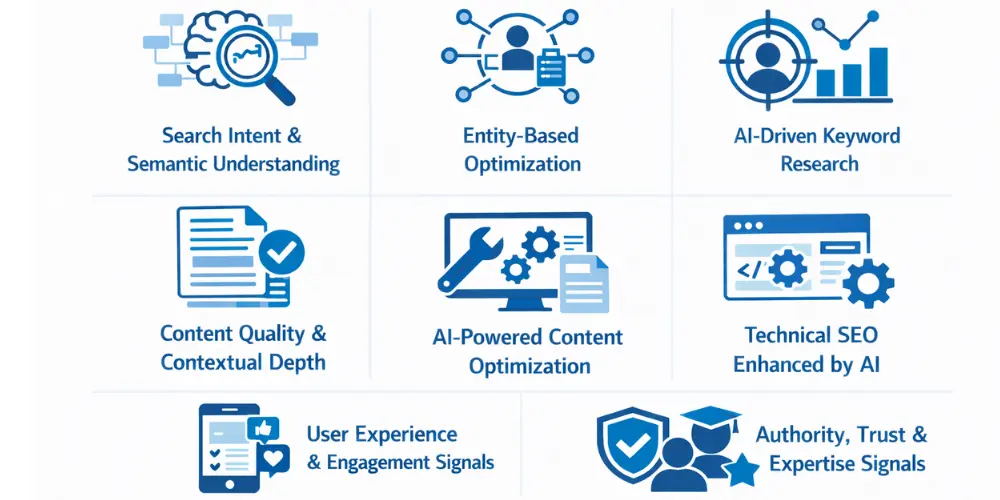
Understanding the mechanics behind AI SEO Contextual Search helps demystify how rankings are determined. It is not a single algorithm but a combination of several AI-driven processes working in tandem.
Natural Language Processing (NLP)
NLP is the branch of AI that enables computers to understand, interpret, and manipulate human language. In the context of search, NLP allows the engine to parse a query, identify the grammatical structure, and extract the key entities and their relationships. This is how the search engine understands that “best budget laptops for college students” is not just about laptops, but specifically about affordable options suitable for academic use.
Entity Recognition and Disambiguation
Entities are distinct objects or concepts, such as people, places, organizations, or products. AI systems are trained to recognize these entities within a query and, crucially, to disambiguate them based on context. For instance, the entity “Jaguar” could refer to the animal, the car brand, or the operating system. The AI uses surrounding words and user data to determine which specific entity is being referenced, ensuring the results are accurate.
Understanding Search Intent
Contextual search categorizes queries into different types of intent, primarily informational, navigational, and transactional. Informational intent is when a user wants to learn something (“how to bake a cake”). Navigational intent is when they want to find a specific website (“Facebook login”). Transactional intent is when they are ready to buy (“buy Nike running shoes size 10”). AI algorithms analyze the query’s phrasing and structure to classify the intent, which dictates the type of content that should rank. A transactional query will favor product pages, while an informational query will favor in-depth articles or guides.
The Role of User Context and Personalization
AI SEO Contextual Search is not a one-size-fits-all system. It personalizes results based on a user’s location, search history, device, and even the time of day. A search for “coffee shops” will yield different results for a user in New York compared to a user in London. Similarly, a user who frequently visits cooking websites will see different results for “pasta” than a user who is a professional chef. This personalization ensures that the search results are not just contextually relevant to the query, but also to the individual user.
Key Differences: Traditional SEO vs. AI Contextual Search
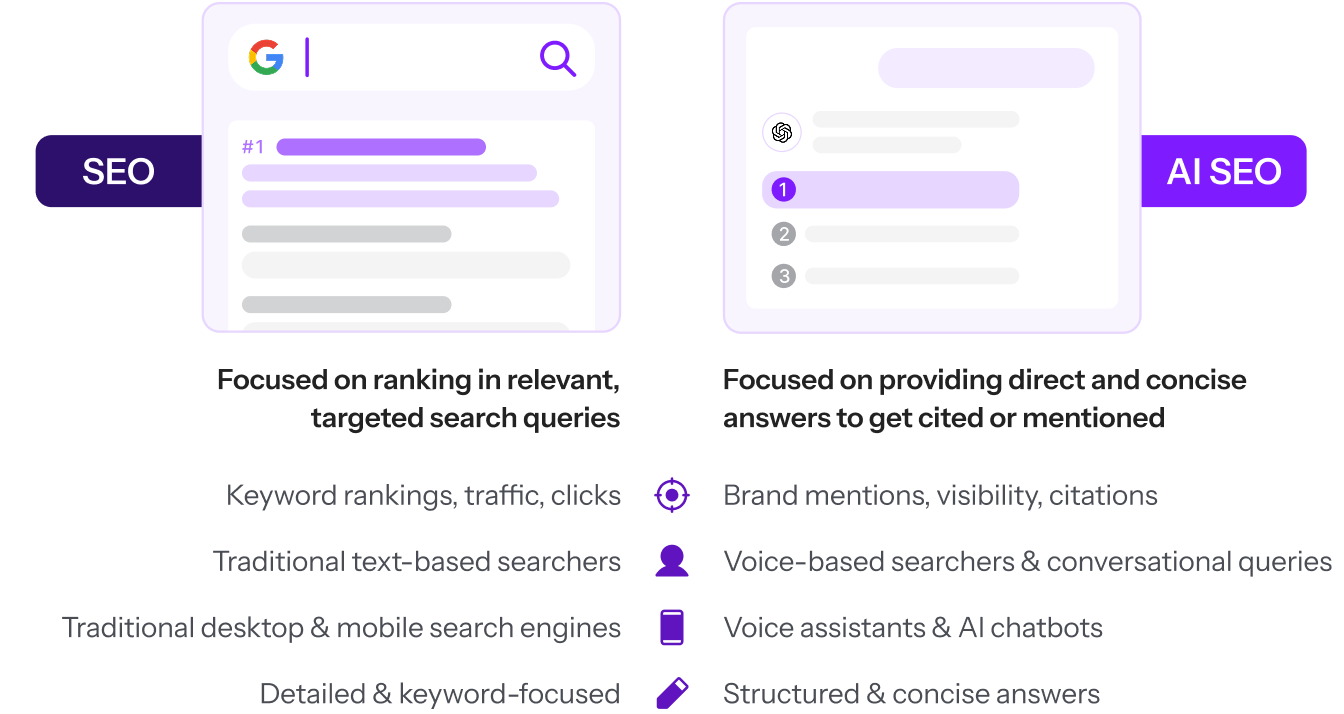
The shift from traditional SEO to AI-driven contextual search represents a fundamental change in optimization strategy. The following table highlights the key differences between the two approaches.
| Aspect | Traditional SEO | AI SEO Contextual Search |
|---|---|---|
| Primary Focus | Specific keywords and phrases | Topics, entities, and user intent |
| Content Strategy | Creating pages for individual keywords | Creating comprehensive, authoritative resources covering a full topic cluster |
| Keyword Usage | Exact match and partial match density | Semantic relevance and natural language inclusion of related terms |
| Understanding of Queries | Literal word matching | Understanding the meaning and context behind the words |
| User Experience | Often secondary to keyword placement | Primary driver of rankings; content must satisfy user needs |
| Measurement | Rankings for specific keywords | Visibility for a broad range of related topics and queries |
This table illustrates a clear progression. Traditional SEO was about signaling relevance through keywords. AI SEO Contextual Search is about proving relevance through comprehensive, high-quality content that genuinely answers the user’s question, regardless of the exact phrasing used.
Benefits and Limitations of AI Contextual Search

Like any technological advancement, AI-driven search brings a host of benefits for users and marketers, but it also presents new challenges and limitations.
The Benefits for Users and Marketers
- Improved Search Accuracy: Users receive results that are more closely aligned with their true intent, reducing the time spent sifting through irrelevant pages.
- Better Content Discovery: High-quality, in-depth content that might not target a specific high-volume keyword can still rank well if it thoroughly covers a topic. This levels the playing field for smaller, niche websites.
- Enhanced User Experience: By focusing on intent, search engines reward content that is engaging, informative, and easy to read, which directly benefits the end-user.
- Opportunity for Authority Building: Websites that consistently produce comprehensive content on a specific topic are recognized as authorities, leading to higher trust and better rankings across a wider range of related queries.
- Increased Complexity: Optimizing for context is significantly more complex than optimizing for keywords. It requires a deep understanding of your audience, their pain points, and the entire ecosystem of your industry.
- Difficulty in Tracking: It is harder to track rankings for hundreds of long-tail, conversational queries than for a few primary keywords. This requires a shift in analytics focus towards organic traffic and engagement metrics.
- Higher Content Standards: The bar for content quality is much higher. Thin, superficial content that was once acceptable will not rank. Creating truly authoritative content requires time, research, and expertise.
- Dependence on User Data: The personalization aspect relies heavily on user data, which raises privacy concerns and can lead to filter bubbles where users are not exposed to diverse information.
- Patience is Key: Building topical authority and earning trust from search engines takes time. Do not expect immediate results. Consistency and quality are the most important factors.
- Focus on E-E-A-T: Experience, Expertise, Authoritativeness, and Trustworthiness are the pillars of content quality. Demonstrate your expertise by providing unique insights, citing credible sources, and showcasing your experience in the field.
- Diversify Your Content Formats: Different users prefer different types of content. Incorporate videos, infographics, podcasts, and interactive tools to cater to a wider audience and enhance the overall user experience.
- Monitor Your Performance Holistically: Track not just keyword rankings, but also organic traffic, engagement metrics (time on page, bounce rate), and conversions. These metrics provide a more accurate picture of how well your content is satisfying user intent.
The Limitations and Challenges
How to Optimize for AI SEO Contextual Search
Adapting your SEO strategy for the age of contextual search requires a holistic approach that prioritizes user value above all else.
1. Build Topical Authority with Content Clusters
Instead of creating isolated blog posts for individual keywords, structure your website around topic clusters. This involves creating a “pillar page” that provides a comprehensive overview of a broad topic, and then creating multiple “cluster pages” that dive deep into specific subtopics. These cluster pages should all link back to the pillar page, and the pillar page should link out to them. This architecture signals to search engines that you are a comprehensive resource on that subject, boosting your authority across the entire cluster.
2. Focus on Deep Semantic Research
Move beyond simple keyword research tools. Use AI-powered tools and search engine autocomplete features to understand the questions people are asking and the related concepts they are exploring. Analyze the “People Also Ask” boxes and related searches on Google to identify the semantic landscape of your topic. Your content should naturally address these related concepts to provide a complete answer.
3. Write for Humans, Not Bots
This is the golden rule of modern SEO. Write in a natural, conversational tone that is easy for a human to read and understand. Use clear headings, bullet points, and short paragraphs to break up the text. The goal is to satisfy the user’s search intent completely. If a user leaves your page and immediately searches for the same thing again, it is a negative signal. Ensure your content is the definitive answer to the query.
4. Leverage Structured Data (Schema Markup)
Structured data is a code that you add to your website to help search engines understand the context of your content. By using schema markup, you can explicitly tell search engines what your content is about, such as whether it is a product, an article, a recipe, or an FAQ. This helps the AI understand the entities on your page and can lead to rich snippets in the search results, which improve click-through rates.
5. Optimize for User Experience (UX) and Core Web Vitals
Contextual search algorithms prioritize pages that offer a positive user experience. This includes fast loading times, mobile-friendliness, and visual stability. Core Web Vitals are a set of specific factors that Google considers important for user experience. A page that is technically sound and easy to navigate is more likely to be considered high-quality and relevant, regardless of its keyword usage.
6. Analyze Search Intent for Every Target Query
Before creating any piece of content, determine the dominant search intent for the target topic. Is it informational, commercial, transactional, or navigational? If the intent is informational, a detailed guide is appropriate. If it is transactional, a product page with clear calls-to-action is needed. Matching your content format to the user’s intent is critical for ranking in a contextual search environment.
Common Mistakes and How to Avoid Them
As marketers transition to this new paradigm, several common pitfalls can hinder success. Being aware of these mistakes is the first step to avoiding them.
Mistake 1: Keyword Cannibalization
Creating multiple pages that target the same or very similar keywords confuses search engines. The AI cannot determine which page is the most relevant, leading to none of them ranking well. Instead, consolidate similar topics into a single, comprehensive page or use canonical tags to point to the preferred version.
Mistake 2: Ignoring the “People Also Ask” Section
This section is a goldmine of information about user intent and related queries. Ignoring it means missing out on opportunities to answer questions that are directly connected to your main topic. Incorporate these questions into your content, either as a dedicated FAQ section or by weaving the answers naturally into the body of your article.
Mistake 3: Obsessing Over Keyword Density
Forcing a specific keyword into your content a certain number of times is a relic of the past. This practice often leads to awkward, unnatural writing that harms the user experience. Focus on using your primary keyword in the title, the first paragraph, and a few subheadings, and let the rest of the content flow naturally with related terms and synonyms.
Mistake 4: Neglecting Content Updates
Contextual search favors fresh, up-to-date information. A page that was written three years ago and has not been updated will likely be seen as less authoritative than a more recent, comprehensive piece. Regularly audit your top-performing content and update it with new data, examples, and insights to maintain its relevance and ranking power.
Important Notes for a Successful Strategy
Implementing an AI SEO Contextual Search strategy is a long-term commitment. It requires a shift in mindset from chasing rankings to building a valuable resource for your audience. Here are some final notes to keep in mind.
Frequently Asked Questions (FAQ)

What is the difference between semantic search and AI contextual search?
Semantic search is a component of AI contextual search. Semantic search focuses on understanding the meaning of words and their relationships within a query. AI contextual search is a broader concept that uses semantic understanding along with other signals like user location, search history, and device to provide a fully personalized and context-aware result. In essence, semantic search is the “what,” while contextual search is the “what” plus the “who, where, and why.”
How does AI SEO Contextual Search affect keyword research?
It shifts the focus from individual keywords to topics and entities. Instead of looking for high-volume keywords, you should research the core topics relevant to your business, the questions your audience is asking, and the related concepts they are interested in. The goal is to map out the entire semantic field of your niche, not just a few isolated phrases.
Will AI SEO Contextual Search make traditional SEO obsolete?
No, it does not make it obsolete, but it transforms it. The fundamental principles of SEO, such as creating high-quality content, building backlinks, and ensuring a good user experience, remain important. However, the tactics have evolved. The focus is no longer on manipulating the algorithm with keywords but on demonstrating genuine relevance and authority to both users and the AI systems that serve them.
How can small businesses compete in the age of AI search?
Small businesses can compete by focusing on niche topics and building deep topical authority. They can be more agile and create highly specific, expert-level content that larger, more generic websites cannot. By consistently answering the specific questions of their target audience and building a strong community, they can signal high levels of expertise and trust to search engines, which is a key factor in contextual ranking.
What is the role of backlinks in AI SEO Contextual Search?
Backlinks remain a crucial trust signal. They act as “votes of confidence” from other websites. In a contextual search environment, the quality and relevance of the linking site are more important than the sheer quantity. A backlink from a highly authoritative website in your specific niche carries far more weight than dozens of links from unrelated, low-quality directories.
Conclusion
The era of AI SEO Contextual Search has fundamentally changed the rules of digital visibility. The path to the top of the search results is no longer paved with keyword-stuffed pages but with comprehensive, authoritative, and user-centric content. By understanding the mechanics of natural language processing, search intent, and entity recognition, you can craft a strategy that aligns with the goals of modern search engines. The key takeaway is to prioritize the user above all else. When you create content that genuinely answers questions, solves problems, and provides value, you are not just optimizing for an algorithm; you are building a digital asset that will stand the test of time. Embrace this shift, invest in deep, meaningful content, and your website will be well-positioned to thrive in the intelligent, context-aware search landscape of today and the future.
Xem thêm:
- AI SEO LLM Visibility: The Complete Guide to Ranking in ChatGPT, Perplexity, and AI Overviews
- AI SEO Myths Debunked: The Truth About Ranking in the Age of Algorithms
- AI SEO Article Schema: The Complete Guide to Structured Data for AI Search
- AI SEO for Restaurants: The Complete Guide to Dominating Local Search in 2025
- AI SEO Content Gaps: The Complete Guide to Finding and Filling What Your Competitors Miss
Bài viết cùng chủ đề:

AI SEO SEO Automation with Make: The Complete Workflow Guide

AI SEO SEO Automation with Zapier: The Complete Workflow Guide

AI SEO SEO Automation with n8n: The Complete Workflow Guide
AI SEO SEO Automation with Gemini: The Complete Guide to Scaling Organic Growth

AI SEO SEO Automation with Claude: The Complete Guide to Scaling Content in 2025

AI SEO SEO Automation with ChatGPT: The Complete Playbook for 2025

AI SEO & SEO Automation for Affiliate Sites: The 2025 Playbook for Passive Income Growth
AI SEO & SEO Automation for Bloggers: The Complete Guide to Scaling Your Content

AI SEO & SEO Automation for Agencies: The Complete 2025 Playbook

AI SEO and SEO Automation for Ecommerce: The Complete Playbook for 2025

AI SEO & SEO Automation for WordPress: The Complete Playbook for 2025
AI SEO SEO Automation Strategy: The Complete Playbook for 2025

Mastering the AI SEO SEO Automation Process: A Complete Guide to Scaling Organic Growth
AI SEO SEO Automation System: The Complete Guide to Scaling Organic Growth in 2025
AI SEO SEO Automation Platform: The Complete Guide to Scaling Organic Growth in 2025
AI SEO SEO Automation Software: The Complete Guide to Scaling Organic Growth in 2025















