
No products in the cart.
AI SEO Ecommerce Content Strategy: The 2025 Playbook for Organic Growth

10
Aug
Aug
An effective AI SEO Ecommerce Content Strategy is no longer a competitive advantage; it is a baseline requirement for online retailers. With search engines shifting toward semantic understanding and generative experiences, brands must leverage artificial intelligence to scale content production, personalize user journeys, and automate technical optimizations. This comprehensive guide breaks down how to build a data-driven framework that increases organic visibility, drives qualified traffic, and converts visitors into loyal customers without sacrificing brand authenticity.
Understanding the Core of AI SEO Ecommerce Content Strategy

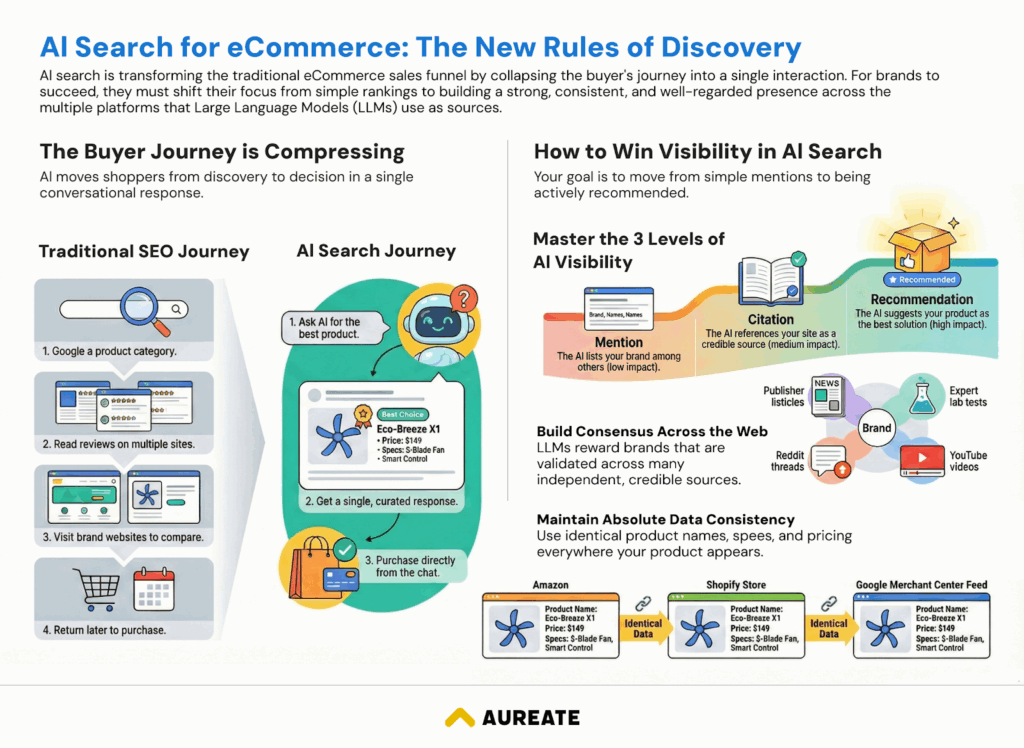
At its essence, an AI SEO Ecommerce Content Strategy involves using machine learning algorithms and natural language processing to plan, create, optimize, and distribute product-related content at scale. Unlike traditional methods that rely heavily on manual keyword research and human writing, this approach uses AI to analyze search intent patterns, predict consumer behavior, and generate content variations that match specific buyer stages.
The strategy encompasses everything from automated product descriptions and category pages to dynamic FAQ sections and personalized blog articles. The goal is to create a self-optimizing ecosystem where content continuously adapts to search engine algorithm updates and user engagement metrics. This is particularly critical for ecommerce sites with thousands of SKUs, where manual content creation is simply not feasible.
Why Traditional Ecommerce SEO Fails Without AI
Traditional ecommerce SEO often hits a scalability ceiling. A typical online store might have 500 products, but a successful retailer needs unique descriptions, meta tags, and supporting content for each one. Manual writing for this volume takes months and often results in thin, duplicated content that search engines penalize. Furthermore, consumer search behavior is shifting toward long-tail, conversational queries—often voice-based—that require a deeper understanding of context than static keyword matching can provide.
AI solves this by processing vast datasets to identify topic clusters and entity relationships. It can generate unique variations of product descriptions that avoid duplicate content penalties while incorporating semantic keywords that human writers might overlook. This allows ecommerce teams to focus on high-level strategy and creative direction rather than repetitive copywriting tasks.
Core Components of a Winning AI SEO Ecommerce Content Strategy
To implement this successfully, you must integrate several key components into your workflow. These elements work together to form a cohesive system that addresses technical, on-page, and off-page factors.
1. Predictive Keyword and Intent Mapping
AI tools like Clearscope, Surfer SEO, and MarketMuse go beyond simple keyword volume data. They analyze the top-ranking pages for your target terms and extract the entities, subtopics, and question patterns that Google considers relevant. For ecommerce, this means identifying not just “best running shoes” but also “shoes for flat feet,” “trail running shoes for women,” and “how to clean running shoes.”
This predictive mapping allows you to build content clusters. Your main product pages target high-intent, commercial keywords, while supporting blog posts target informational queries that funnel users down the sales path. The AI identifies gaps in your current content library, showing you exactly which topics to create next to capture untapped traffic.
2. Automated Content Generation and Optimization
Generative AI platforms such as ChatGPT, Jasper, and Copy.ai can draft product descriptions, buying guides, and category intros in seconds. However, the key to a successful strategy is not raw generation—it is the optimization layer. You must feed the AI with specific data points: product specifications, customer reviews, unique selling propositions, and brand voice guidelines.
The output should then pass through an AI-powered SEO optimizer that checks for keyword density, readability, internal linking opportunities, and schema markup suggestions. This hybrid approach ensures that the content is not only unique but also technically aligned with ranking factors. For example, an AI can generate 100 variations of a product title tag, testing which format (e.g., “Buy [Product] Online | Free Shipping” vs. “[Product] – [Brand] Official Store”) yields higher click-through rates based on historical data.
3. Dynamic Internal Linking Architecture
Internal linking is a critical ranking factor that many ecommerce sites neglect. An AI-driven strategy automates this process by analyzing the semantic relationship between pages. The system can automatically insert contextual links from a blog post about “Summer Fashion Trends” to your “Women’s Dresses” category page, using anchor text that is relevant to the user’s query.
This dynamic linking structure distributes page authority throughout your site, ensuring that deep product pages receive the “link juice” they need to rank. It also improves user experience by guiding visitors to relevant products, increasing the average session duration and reducing bounce rates—both of which are indirect ranking signals.
Practical Implementation: A Step-by-Step Guide
Moving from theory to execution requires a structured workflow.
Step 1: Audit Your Current Content Inventory
Start by exporting your entire URL list and analyzing each page’s performance. Use tools like Google Search Console and Screaming Frog to identify pages with low impressions, high bounce rates, or thin content. Categorize these pages into three groups: those that need rewriting, those that need consolidation, and those that need to be created from scratch.
Your AI tool can then process this data to suggest content improvements. For instance, it might detect that your product pages lack user-generated content or that your category descriptions are too short. This audit forms the foundation of your roadmap.
Step 2: Build a Data-Driven Content Matrix
Create a spreadsheet that maps every product to its corresponding search intent. Use AI to generate a list of long-tail keywords for each product, categorized by buyer stage (awareness, consideration, decision). For each keyword, define the content format: product page, blog post, video script, or FAQ schema.
This matrix ensures that you are not creating content in a vacuum. It aligns your production schedule with actual search demand, prioritizing high-volume, high-conversion keywords first. The AI can also estimate the difficulty of ranking for each term, helping you target low-competition “low-hanging fruit” early in your campaign.
Step 3: Generate and Humanize Content
Use AI to generate the first draft of your content, but never publish it without human review. The “human-in-the-loop” approach is essential for maintaining E-E-A-T (Experience, Expertise, Authoritativeness, Trustworthiness). Your editors should fact-check product claims, add personal insights, and ensure the tone matches your brand.
For product descriptions, incorporate real customer reviews and ratings into the AI prompt. This creates content that reflects actual user experience, which is a powerful trust signal for both users and search engines. The AI can also generate multiple variations of the same description for A/B testing, allowing you to see which version converts better.
Step 4: Automate Technical SEO Enhancements
AI is not just for copy. Use it to generate JSON-LD structured data for products, reviews, and FAQs. This markup helps search engines understand your content and enables rich snippets in search results, which significantly improves click-through rates. AI tools can also automatically generate alt text for product images, optimize file names, and compress images without losing quality.
Additionally, AI-powered log file analysis can identify crawl budget issues. It can detect pages that Googlebot is wasting time on (like faceted navigation filters) and suggest robots.txt rules or canonical tags to streamline crawling. This technical optimization ensures that your best content gets indexed quickly.
Benefits and Limitations of AI in Ecommerce SEO
Understanding what this strategy can and cannot do is crucial for setting realistic expectations and avoiding common pitfalls.
Key Benefits
- Scalability: Generate thousands of unique product descriptions and blog posts in days, not months.
- Cost Efficiency: Reduce reliance on expensive freelance writers for repetitive tasks, allowing your budget to focus on high-level strategy.
- Personalization: AI can dynamically alter content based on user location, device, or browsing history, creating a tailored experience that boosts conversion rates.
- Real-Time Adaptation: AI monitors search engine algorithm updates and adjusts your content strategy accordingly, keeping you ahead of competitors.
- Improved Accuracy: AI reduces human error in keyword placement, meta tag generation, and internal linking.
- Lack of True Creativity: AI cannot replicate the emotional storytelling or unique brand voice that truly differentiates a premium product.
- Data Dependency: The output quality is only as good as the input data. If your product data is incomplete, the A
- Risk of Generic Content: Without proper training, AI can produce bland, templated text that fails to engage users and may be flagged as low-quality by Google.
- Ethical Concerns: Over-reliance on AI without human oversight can lead to factual errors or content that violates Google’s spam policies.
Limitations to Consider
AI SEO Ecommerce Content Strategy vs. Traditional Methods
To appreciate the value of AI, it helps to compare it directly with traditional ecommerce content approaches. The differences are stark across several dimensions.
| Feature | Traditional SEO | AI-Powered SEO |
|---|---|---|
| Keyword Research | Manual analysis of search volume and difficulty | Predictive modeling of intent and topic clusters |
| Content Production | Human writers, 5-10 pages per week | AI drafts, 100+ pages per week with human editing |
| Personalization | Static content for all users | Dynamic content based on user behavior |
| Technical SEO | Manual audits and code changes | Automated schema generation and log file analysis |
| Adaptability | Slow response to algorithm updates | Real-time adjustments based on data feeds |
| Cost | High labor costs for writers and analysts | Lower marginal cost per piece of content |
The table illustrates that while the initial setup of an AI system requires investment, the long-term operational costs are significantly lower. More importantly, the speed and agility offered by AI allow ecommerce brands to react to market trends instantly, a capability that traditional methods simply cannot match.
Common Mistakes and How to Avoid Them
Many ecommerce brands fail to see results from AI because they make critical errors during implementation. Recognizing these pitfalls is the first step to avoiding them.
Mistake 1: Publishing Raw AI Output
The most common mistake is treating AI as a replacement for human writers. Publishing unedited AI text leads to generic, often inaccurate content that damages your brand’s credibility. Solution: Implement a strict editorial workflow where every AI-generated piece is reviewed by a subject matter expert who adds unique insights, personal anecdotes, and factual verification.
Mistake 2: Ignoring Search Intent
Using AI to generate content for keywords without understanding the user’s intent is a recipe for failure. Ranking for a keyword is useless if the content does not satisfy the user’s need. Solution: Use AI to analyze the top 10 results for your target keyword. Look at the format (video, listicle, product page) and the questions they answer. Match your content format to the dominant intent.
Mistake 3: Neglecting Content Refreshing
AI is not a “set it and forget it” tool. Product information changes, prices fluctuate, and consumer trends evolve. Content that is not updated becomes stale and loses rankings. Solution: Set up automated alerts that flag pages with declining traffic. Use AI to re-generate sections of these pages with updated data and new internal links.
Mistake 4: Over-Optimizing for Bots
In the rush to rank, some brands stuff AI-generated content with keywords, making it unreadable for humans. This triggers Google’s spam detection algorithms. Solution: Always prioritize readability. Use AI to check for natural language flow and ensure that keywords are used in context, not just repeated verbatim.
Important Notes on Quality and Brand Voice
Maintaining a distinct brand voice is the biggest challenge in an AI-driven workflow. AI models are trained on generic internet data, so their default output is neutral and bland. To combat this, you must create a detailed brand style guide that includes specific vocabulary, tone preferences, and examples of “do” and “don’t” phrasing. Feed this guide into your AI prompt every time.
Furthermore, focus on Experience and Expertise. Google’s E-E-A-T guidelines prioritize content that demonstrates first-hand experience. For ecommerce, this means including original photos, video demonstrations, and expert reviews. AI can help structure this content, but it cannot replace the authenticity of a real person testing a product. Combine AI efficiency with human experience to build trust with both users and search engines.
Frequently Asked Questions
What is the best AI tool for ecommerce SEO content?
T For content generation, tools like Jasper and Copy.ai are popular. For optimization and keyword research, Clearscope and Surfer SEO are industry standards. For technical SEO, tools like Screaming Frog and Botify offer AI-powered insights. Most successful strategies use a combination of these tools to cover the entire content lifecycle.
How long does it take to see results from an AI SEO strategy?
SEO is a long-term game, regardless of whether AI is involved. Typically, you can expect to see initial improvements in keyword rankings within 4-6 weeks, but significant traffic growth usually takes 3-6 months. The speed of results depends on the authority of your domain, the competitiveness of your niche, and the consistency of your content production.
Will Google penalize AI-generated content?
Google does not penalize content simply for being generated by AI. However, it penalizes content that is low-quality, regardless of how it was created. If the AI content is helpful, original, and demonstrates E-E-A-T, it will rank well. If it is spammy, duplicated, or lacks value, it will be penalized. The key is to use AI as a tool to enhance human creativity, not replace it.
Can AI help with local SEO for ecommerce?
Yes, AI can generate localized content for ecommerce brands with physical stores. It can create unique city-specific landing pages, local event announcements, and localized product descriptions that target “near me” searches. AI can also manage and optimize your Google Business Profile listings by generating responses to customer reviews.
How do I measure the ROI of my AI SEO content strategy?
Track the same metrics you would for any SEO campaign: organic traffic, keyword rankings, conversion rate, and revenue. Use UTM parameters to track traffic from specific content pieces. Compare your cost per acquisition (CPA) before and after implementing AI. A successful strategy should show a decrease in CPA and an increase in organic revenue over time.
Conclusion
An AI SEO Ecommerce Content Strategy is a powerful approach that combines the analytical power of machine learning with the creative nuance of human editors. It enables online retailers to scale their content operations, personalize user experiences, and stay agile in a rapidly changing search landscape. The key to success lies not in replacing your team with bots, but in augmenting their capabilities to produce higher-quality content at a faster pace.
By focusing on predictive intent mapping, automated optimization, and a rigorous human review process, you can build a content engine that drives sustainable organic growth. The future of ecommerce belongs to brands that can harness data to tell compelling stories at scale. Start by auditing your current content, selecting the right AI tools, and committing to a workflow that prioritizes quality and authenticity above all else.
Xem thêm:
- AI Content vs Human Content: Choosing the Right Approach for Trust, Engagement, and Search Rankings
- AI SEO Semantic Keywords: The Complete Guide to Smarter Content Optimization
- AI SEO Scaling Strategy: The Complete Playbook for 2025 and Beyond
- AI Readability Optimization: How Smart Algorithms Transform Content for Human Readers and Search Engines
- AI SEO Review Schema: The Complete Guide to Structured Data in 2025
Bài viết cùng chủ đề:

AI SEO SEO Automation with Make: The Complete Workflow Guide

AI SEO SEO Automation with Zapier: The Complete Workflow Guide

AI SEO SEO Automation with n8n: The Complete Workflow Guide
AI SEO SEO Automation with Gemini: The Complete Guide to Scaling Organic Growth

AI SEO SEO Automation with Claude: The Complete Guide to Scaling Content in 2025

AI SEO SEO Automation with ChatGPT: The Complete Playbook for 2025

AI SEO & SEO Automation for Affiliate Sites: The 2025 Playbook for Passive Income Growth
AI SEO & SEO Automation for Bloggers: The Complete Guide to Scaling Your Content

AI SEO & SEO Automation for Agencies: The Complete 2025 Playbook

AI SEO and SEO Automation for Ecommerce: The Complete Playbook for 2025

AI SEO & SEO Automation for WordPress: The Complete Playbook for 2025
AI SEO SEO Automation Strategy: The Complete Playbook for 2025

Mastering the AI SEO SEO Automation Process: A Complete Guide to Scaling Organic Growth
AI SEO SEO Automation System: The Complete Guide to Scaling Organic Growth in 2025
AI SEO SEO Automation Platform: The Complete Guide to Scaling Organic Growth in 2025
AI SEO SEO Automation Software: The Complete Guide to Scaling Organic Growth in 2025















