
No products in the cart.
AI SEO Entity Salience: The Complete Guide to Dominating Search Rankings in 2025
10
Aug
Aug
AI SEO Entity Salience is transforming how search engines interpret and rank content. As Google’s algorithms shift from keyword matching to semantic understanding, the prominence and relevance of entities within your content have become the single most critical factor for organic visibility. This comprehensive guide explains what entity salience means in the age of artificial intelligence, how it works, and exactly how to optimize your website to become the authoritative source for your niche.
What is AI SEO Entity Salience?
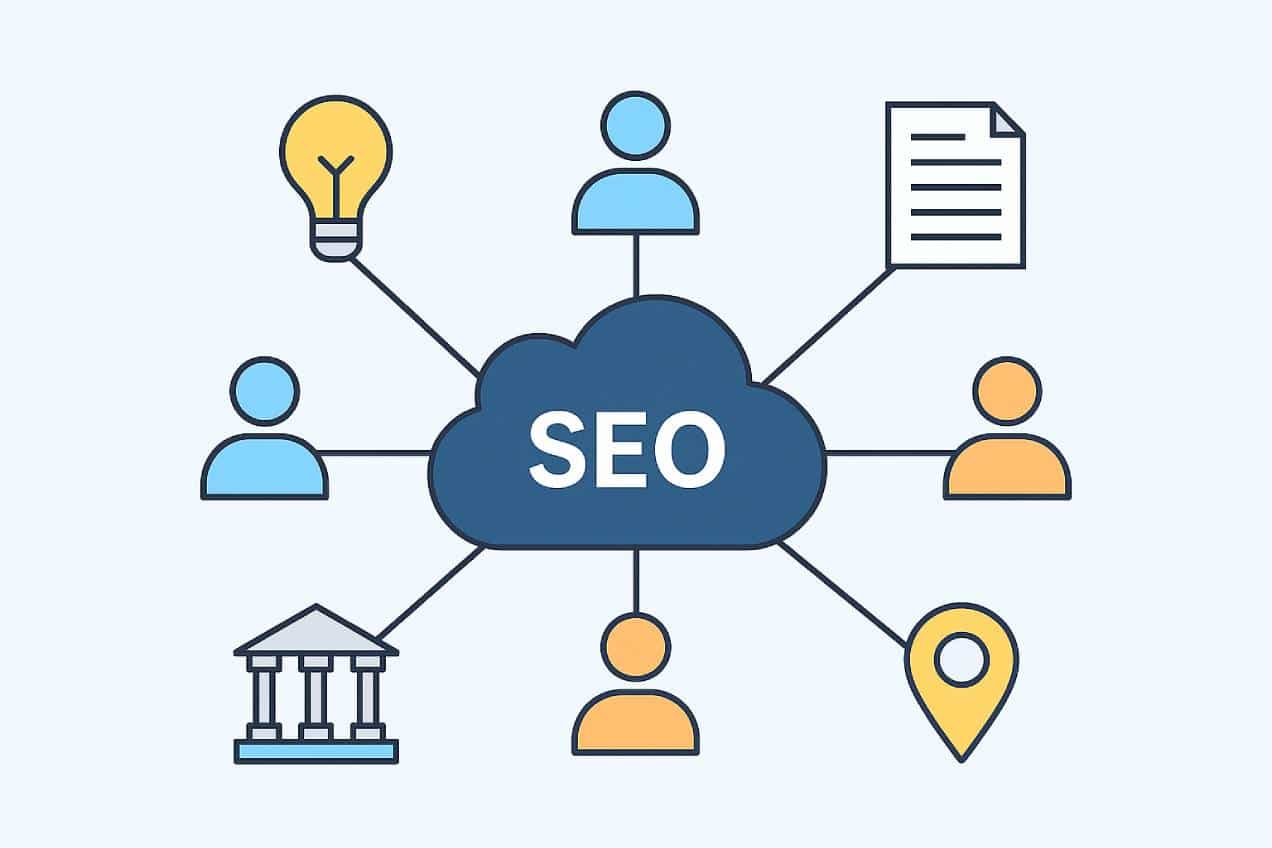
AI SEO Entity Salience refers to the degree of prominence, importance, and contextual relevance that a specific entity (a person, place, organization, concept, or thing) holds within a piece of content, as determined by artificial intelligence algorithms. In simple terms, it measures how strongly and clearly your content signals to search engines that it is fundamentally about a particular subject.
When Google’s AI systems, particularly those built on neural networks like BERT and MUM, analyze a webpage, they do not merely count keywords. They build a semantic map of the content, identifying the main entities and their relationships to one another. Salience is the weight assigned to each entity in that map. A page with high entity salience for “artificial intelligence” will be considered more authoritative and relevant for that topic than a page that mentions the term only in passing.
The Shift from Keywords to Entities
Traditional SEO relied on exact-match keywords and keyword density. The problem was that this approach ignored context and meaning. The word “apple” could refer to the fruit or the technology company. Search engines needed a way to disambiguate meaning and understand the true subject of a page.
Entities solved this problem. An entity is a distinct, well-defined object or concept with a unique identifier in a knowledge graph. Google’s Knowledge Graph contains millions of entities, each with defined attributes and relationships. AI SEO Entity Salience leverages this graph to determine which entities are central to your content and how they connect to the broader web of knowledge.
Why Entity Salience Matters for Modern SEO
The importance of AI SEO Entity Salience cannot be overstated. It directly influences how Google ranks your pages in several fundamental ways.
Improved Search Intent Matching
Google’s primary goal is to satisfy user intent. By understanding the salience of entities, the algorithm can better match your content to queries that are semantically related, even if they do not contain your exact keywords. For example, a page with high salience for “electric vehicle charging” might rank for queries about “EV battery range” because the AI understands the relationship between these entities.
Enhanced Featured Snippet Eligibility
Featured snippets are extracted from pages that Google considers highly authoritative and relevant. High entity salience signals to the algorithm that your content provides a clear, focused, and comprehensive answer to a specific question. This makes your page a prime candidate for position zero.
Stronger Topical Authority
When you consistently produce content with high salience for a cluster of related entities, you build topical authority. Google recognizes your website as a hub for that subject area. This authority extends to all pages on your site, boosting their rankings for both head terms and long-tail variations.
How AI Determines Entity Salience
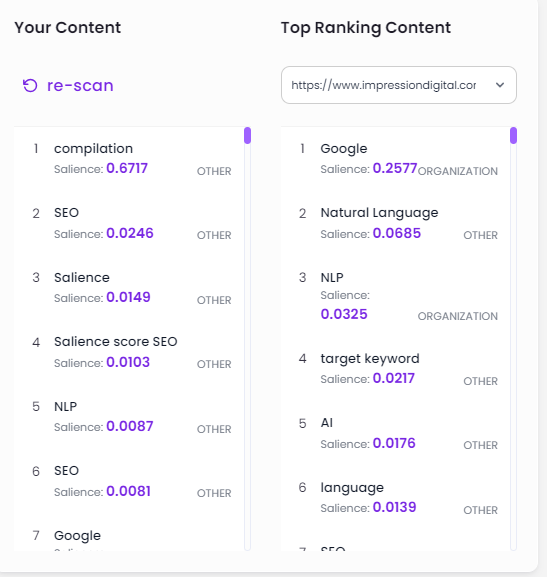
Understanding the mechanics behind AI SEO Entity Salience helps you optimize more effectively. The process involves several layers of natural language processing (NLP) and machine learning.
Contextual Embeddings
Modern AI models convert words and phrases into numerical vectors, known as embeddings. These vectors capture the meaning of a word based on its surrounding context. The AI analyzes every sentence to understand how entities are used. If an entity appears frequently in the subject position of sentences and is surrounded by related descriptive terms, its salience score increases.
Knowledge Graph Integration
Google cross-references the entities identified in your content with its Knowledge Graph. If your content mentions an entity and correctly aligns with its known attributes and relationships, the AI validates your content as accurate. This validation increases the salience score because the content is deemed trustworthy and factually grounded.
Co-occurrence and Semantic Density
Salience is not just about how often an entity appears, but how it appears. The AI looks at the co-occurrence of related entities. For instance, an article about “climate change” that also discusses “carbon emissions,” “renewable energy,” and “global warming” will have higher salience for the main entity because it demonstrates a deep, contextual understanding of the topic.
Key Components of an Entity Salience Strategy
To optimize for AI SEO Entity Salience, you need a structured approach that goes beyond simple on-page tweaks. Here are the core components of a successful strategy.
Entity-First Content Planning
Before writing, identify the primary entity and all secondary entities that should be associated with it. Create a semantic map of your topic. For a page about “digital marketing,” your secondary entities might include “SEO,” “content marketing,” “social media,” “PPC,” and “analytics.” Your content plan should ensure all these entities are naturally integrated.
Structured Data Implementation
Schema markup is the most direct way to communicate entity relationships to search engines. Use vocabulary such as schema.org/Thing, Person, Organization, and Product to explicitly define your entities. The sameAs property is particularly powerful for linking your entities to their Knowledge Graph IDs, which dramatically boosts salience.
Internal Linking with Descriptive Anchors
Internal links help search engines understand the relationship between entities on your site. Use descriptive anchor text that includes the entity name. For example, instead of “click here,” use “learn more about AI SEO Entity Salience.” This reinforces the salience of the target page for that entity.
Practical Guide to Optimizing for Entity Salience
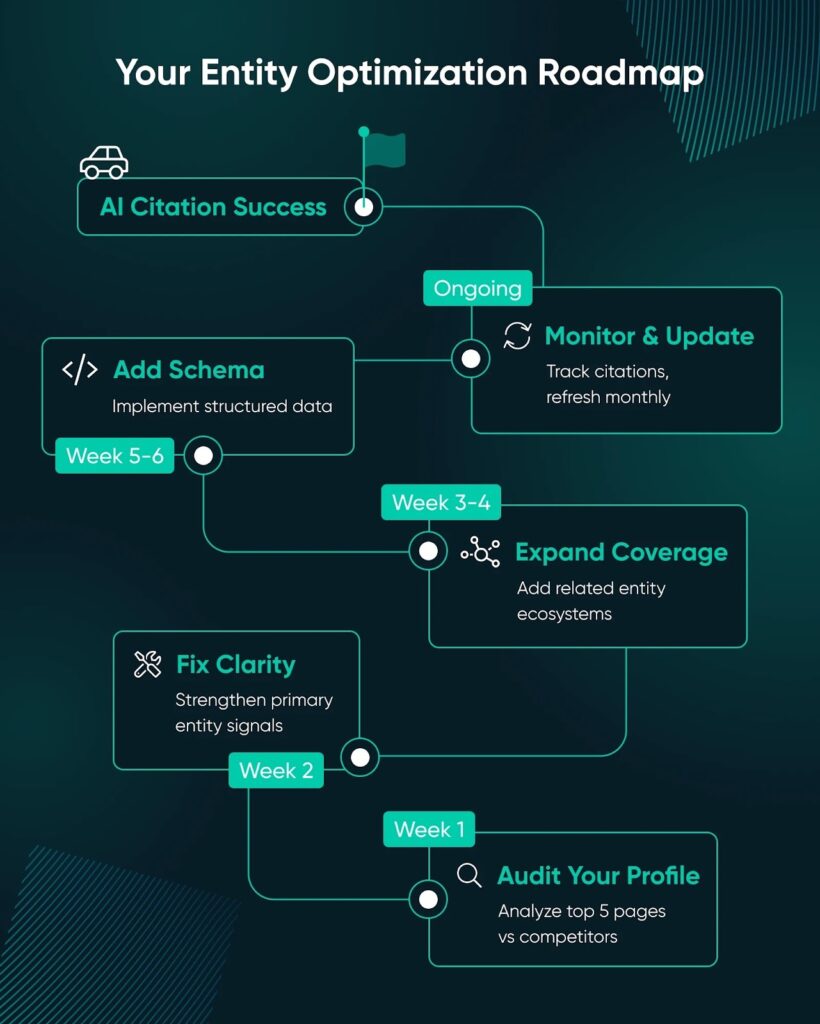
Now that you understand the theory, let’s look at the practical steps you can take to improve the AI SEO Entity Salience of your web pages.
Step 1: Define Your Core Entity
Every page on your website should have one clear, primary entity. Ask yourself: “What is the single most important thing this page is about?” Write this down. All content on the page should revolve around this entity. If you find your content drifting to multiple unrelated entities, split it into separate pages.
Step 2: Use Exact and Varied Entity Mentions
Use the exact name of the entity in the title tag, H1, and first paragraph. Then, use synonyms, abbreviations, and related terms throughout the body. This variety helps the AI understand the full scope of the entity. For example, for the entity “World Health Organization,” you should also use “WHO” and “global health agency.”
Step 3: Build a Semantic Cocoon
A semantic cocoon is a cluster of interlinked pages that all relate to a central entity. Create pillar pages that cover the main entity in depth, and then create cluster pages that cover specific aspects or related entities. Link them all together. This structure signals to Google that you have comprehensive knowledge of the topic.
Step 4: Optimize for Natural Language Processing
Write in a natural, conversational tone that mirrors how people actually speak and search. Use complete sentences and avoid keyword stuffing. The AI needs to parse your content easily. Short, declarative sentences and clear topic sentences for each paragraph help the algorithm identify the main subject of each section.
Step 5: Leverage Multimedia for Entity Reinforcement
Images and videos can also contribute to entity salience. Use descriptive file names and alt text that include the entity name. For example, an image file named “ai-seo-entity-salience-graph.jpg” with alt text “AI SEO Entity Salience diagram” reinforces the topic to the search engine.
Common Mistakes That Dilute Entity Salience
Many websites inadvertently weaken their entity salience through common SEO mistakes. Avoiding these errors is just as important as implementing the positive strategies.
Keyword Cannibalization
Creating multiple pages that target the same entity confuses search engines. The AI cannot determine which page is the most authoritative for that entity, so it may rank none of them well. Consolidate similar pages or differentiate them by targeting distinct secondary entities.
Off-Topic Content
Adding sections to a page that are only tangentially related to the main entity dilutes its salience. For example, a page about “dog food” that includes a long section about “cat toys” will confuse the AI. The salience score for “dog food” will drop because the algorithm sees mixed signals.
Inconsistent Entity Naming
If you refer to your entity using different names inconsistently, the AI may not recognize them as the same thing. For example, if you write “NYC” in one paragraph and “New York City” in another, without establishing the relationship, you may split the salience. Always define the full name first and then use abbreviations consistently.
Ignoring Entity Relationships
Focusing solely on the primary entity without mentioning related entities limits your content’s depth. The AI needs to see how your entity fits into the larger context. A page about “electric cars” that never mentions “battery technology” or “charging infrastructure” will have lower salience than one that does.
Tools for Measuring and Analyzing Entity Salience
Several tools can help you analyze the entity salience of your content and your competitors’ content. These tools provide insights into how AI perceives your pages.
| Tool | Function | Best For |
|---|---|---|
| Google Natural Language API | Analyzes text and extracts entities, along with salience scores (0 to 1). | Detailed content analysis and entity identification. |
| Google Search Console | Shows which queries your pages rank for and how Google understands your content. | Monitoring performance and identifying gaps in entity coverage. |
| Semrush Topic Research | Identifies related entities and subtopics based on search data. | Content planning and semantic mapping. |
| MarketMuse | Uses AI to analyze content against a database of top-ranking pages and suggests entities to include. | Optimizing existing content and creating new briefs. |
Interpreting Salience Scores
When using the Google Natural Language API, you will see a salience score for each entity. A score of 0.5 or higher for your primary entity indicates strong focus. If your primary entity has a score below 0.1, your content is likely too scattered. Use this data to refine your content and increase the prominence of your target entity.
Advanced Techniques for Boosting Entity Salience
Once you have mastered the basics, you can employ advanced techniques to further enhance your AI SEO Entity Salience and outrank your competitors.
Entity-Focused Digital PR
Getting mentions of your brand or your key entities on high-authority external websites is a powerful salience signal. When reputable sources link to you using your entity name as the anchor text, it reinforces to Google that your entity is important and trustworthy. Focus your digital PR efforts on securing these contextual mentions.
Optimizing for Voice Search
Voice search queries are typically longer and more conversational. They often take the form of questions. By structuring your content to directly answer these questions using the entity name, you increase the chances of being featured in voice search results. The AI needs to clearly identify the entity to provide a spoken answer.
Leveraging User Engagement Signals
While not a direct ranking factor, user engagement signals like dwell time and low bounce rate indicate to Google that your content is satisfying. If users stay on your page and interact with it, the AI interprets this as a sign that your content is highly relevant for the entity, which can boost your salience score over time.
Case Study: Entity Salience in Action
Consider two websites writing about “Mediterranean diet.” Website A writes a generic article that mentions the diet, some foods, and general health benefits. Website B writes a comprehensive guide that defines the Mediterranean diet, discusses the specific entities of “olive oil,” “fish,” “whole grains,” and “red wine,” and explains the relationship between these entities and heart health, referencing the “PREDIMED study.”
Website B will have significantly higher AI SEO Entity Salience for “Mediterranean diet.” The AI recognizes that Website B provides a deeper, more contextual understanding of the entity and its related concepts. Consequently, Website B will rank higher for the main keyword and also for a wide range of related long-tail keywords like “Mediterranean diet heart health study” or “best olive oil for Mediterranean diet.”
Important Notes on AI SEO Entity Salience
As you implement these strategies, keep the following important notes in mind to ensure long-term success.
- Entity salience is not a one-time fix. It requires continuous monitoring and refinement as your content evolves and as Google’s algorithms update.
- Quality always trumps quantity. A single, well-optimized, in-depth page is far more effective than multiple thin pages that all target the same entity.
- User experience is paramount. If your content is confusing or difficult to read, the A Always prioritize clarity.
- Stay updated on Knowledge Graph changes. Entities can be added, removed, or merged in Google’s Knowledge Graph. Regularly check if your key entities are still correctly defined.
- Combine entity salience with traditional SEO. Do not abandon keyword research. Use keywords to guide your content creation, but use entity salience to structure and deepen that content.
Frequently Asked Questions (FAQ)
What is the difference between a keyword and an entity?
A keyword is a literal string of text that a user types into a search engine. An entity is a distinct concept or object that has a unique identity and defined relationships. For example, “apple” is a keyword, but it can refer to two different entities: the fruit and the technology company. Entity salience helps the search engine determine which entity you are writing about.
How do I find the entities for my content?
Start with your primary topic and brainstorm all related concepts, people, places, and organizations. Use tools like Google’s Natural Language API to analyze your draft and see which entities it detects. Also, look at the “People also ask” box and related searches in Google to find additional entities that users associate with your topic.
Does entity salience affect local SEO?
Yes, it is critical for local SEO. For local businesses, the primary entities are your business name, address, and phone number (NAP), as well as your business category and service area. Ensuring consistent NAP information across your website and citations builds high entity salience for your local business, helping you rank in the local pack.
Can I have high entity salience for multiple entities on one page?
It is possible, but not recommended. A page with high salience for multiple distinct entities will likely rank well for none of them. It is better to focus each page on one primary entity and use secondary entities to support it. This creates a clear semantic structure that the AI can easily understand.
How long does it take to see results from entity salience optimization?
Results vary depending on the competitiveness of your niche and the current state of your website. Some changes can be noticed within a few weeks, especially for long-tail queries. However, building strong topical authority and entity salience is a long-term strategy that typically yields significant results over 3 to 6 months.
Conclusion
AI SEO Entity Salience is not a passing trend; it is the fundamental way modern search engines understand and rank content. By shifting your focus from simple keyword placement to building a rich, contextual web of entities, you align your website with the very algorithms that determine your visibility. The strategies outlined in this guide provide a clear roadmap for this transition.
Start by auditing your existing content to identify pages with weak entity focus. Then, apply the principles of entity-first planning, structured data, and semantic internal linking to build a website that Google’s AI recognizes as a true authority. The effort you invest in mastering AI SEO Entity Salience today will pay dividends in sustained organic traffic and search dominance for years to come.
Xem thêm:
- AI SEO for Enterprises: The Complete Guide to Scaling Organic Growth in 2025
- AI SEO for SaaS: The Complete Strategy to Dominate Search in 2025
- AI SEO Best Practices: The Complete Guide to Smarter Search Optimization
- AI SEO Project Management: The Complete Guide to Scaling Organic Growth in 2025
- AI SEO for Influencers: The Complete Guide to Ranking and Growing in 2025
Bài viết cùng chủ đề:

AI SEO SEO Automation with Make: The Complete Workflow Guide

AI SEO SEO Automation with Zapier: The Complete Workflow Guide

AI SEO SEO Automation with n8n: The Complete Workflow Guide
AI SEO SEO Automation with Gemini: The Complete Guide to Scaling Organic Growth

AI SEO SEO Automation with Claude: The Complete Guide to Scaling Content in 2025

AI SEO SEO Automation with ChatGPT: The Complete Playbook for 2025

AI SEO & SEO Automation for Affiliate Sites: The 2025 Playbook for Passive Income Growth
AI SEO & SEO Automation for Bloggers: The Complete Guide to Scaling Your Content

AI SEO & SEO Automation for Agencies: The Complete 2025 Playbook

AI SEO and SEO Automation for Ecommerce: The Complete Playbook for 2025

AI SEO & SEO Automation for WordPress: The Complete Playbook for 2025
AI SEO SEO Automation Strategy: The Complete Playbook for 2025

Mastering the AI SEO SEO Automation Process: A Complete Guide to Scaling Organic Growth
AI SEO SEO Automation System: The Complete Guide to Scaling Organic Growth in 2025
AI SEO SEO Automation Platform: The Complete Guide to Scaling Organic Growth in 2025
AI SEO SEO Automation Software: The Complete Guide to Scaling Organic Growth in 2025















