
No products in the cart.
AI SEO for SaaS: The Complete Strategy to Dominate Search in 2025
29
Jul
Jul
The landscape of search engine optimization for software-as-a-service companies has shifted permanently. AI SEO for SaaS is no longer about sprinkling keywords into blog posts and waiting for rankings. Machine learning algorithms from Google, such as RankBrain and the Helpful Content System, now reward sites that demonstrate real expertise and user value. For a SaaS business, this means blending artificial intelligence tools with a deep understanding of customer pain points to build content programs that convert visitors into free trials and paid subscriptions. This guide breaks down every component of the strategy, from keyword clustering with natural language processing to automated technical audits, ensuring you build a predictable growth engine.
What Exactly Is AI SEO for SaaS?
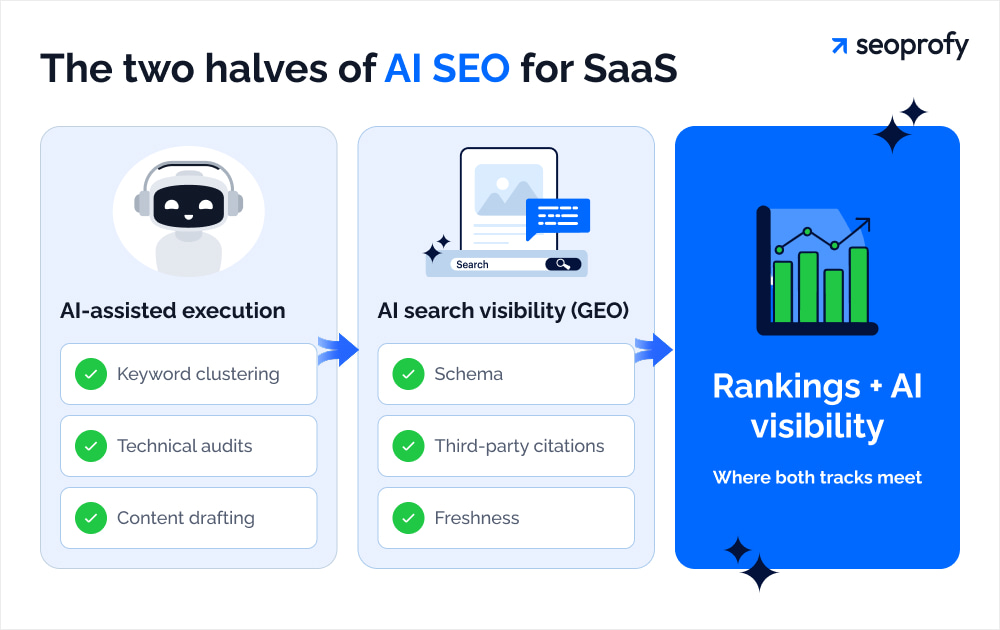
AI SEO for SaaS is the systematic use of artificial intelligence technologies to plan, execute, and optimize organic search campaigns specifically tailored to the subscription software business model. It goes far beyond using ChatGPT to write a blog outline. The practice involves training machine learning models on your own customer data to predict which topics will attract high-intent users, deploying automated content optimization tools that analyze SERP patterns, and running continuous technical audits that would take a human team weeks to complete manually. The goal is not to replace human strategists but to amplify their ability to make data-driven decisions at scale.
A typical SaaS company using AI SEO will have interconnected systems: one that monitors thousands of keywords and their intent shifts, another that scores existing content for freshness and entity coverage, and a third that suggests internal linking structures to strengthen topic clusters. These processes work together to signal to search engines that the domain is a topical authority in its niche, whether that is project management, email marketing, or financial analytics.
Why Traditional SaaS SEO Methods Are Failing
Many SaaS brands still operate on a legacy playbook: identify a high-volume keyword, write a 2,000-word article targeting it, and repeat. This approach fails for three reasons. First, search engines now evaluate content at the query level using sophisticated user interaction signals, so a generic article without specific expertise will be outranked by niche influencers or forums. Second, SaaS buyer journeys are deeply research-intensive, often involving dozens of touchpoints before a demo request; single-page keyword targeting ignores these complex paths. Third, manual research cannot keep up with the speed at which competitors are publishing AI-assisted content that covers related entities and user questions thoroughly.
The core problem is a lack of scalability and precision. Without AI, it is nearly impossible to analyze the semantic relationships between 5,000 keywords and map them to the correct stage of the buyer funnel. Teams also struggle to identify content decay—pages that once ranked well but have slipped because the search intent changed or a competitor created a more comprehensive resource. AI systems solve this by constantly ingesting ranking fluctuations, click-through rate data, and on-page engagement metrics to prioritize updates that move the needle on trial signups.
Core Components of an AI SEO Strategy for SaaS

Predictive Keyword Research and Intent Modeling
AI-powered keyword tools go beyond volume and difficulty. They cluster queries by latent intent and predict the likelihood of conversion based on historical CRM data. For a SaaS company, this means distinguishing between a search like “best CRM for small business” (evaluation intent) and “how to import contacts into HubSpot” (post-purchase intent). The AI assigns a value score to each keyword group by connecting search behavior with in-product events—did users from a certain organic cohort start a trial, engage with a key feature, and eventually convert to paid? With these predictive models, you can allocate content budget to topics that have a statistically significant impact on revenue, not just traffic.
Content Generation and Optimization at Scale
Large language models have made it possible to draft content quickly, but the true benefit for SaaS SEO is in optimization. AI can analyze the top 20 ranking pages for a target keyword and identify missing entities, subtopics, and media types. It then generates a detailed brief that includes required semantic structures, question-and-answer pairs, and even suggested data visualizations. After a human writer creates the draft, the AI acts as a robo-editor, checking readability, keyword cannibalization risks, and E-E-A-T signals. The output is a piece that satisfies both the algorithm and the informed SaaS buyer who expects technical depth.
Automated Technical Audits and Crawl Optimization
SaaS websites often blow up with thousands of dynamically generated pages: knowledge bases, changelogs, integration directories, comparison pages. Manually auditing these for duplicate content, broken internal links, or improper canonicalization is a losing battle. AI crawlers simulate how Googlebot navigates the site, identify crawl budget waste, and recommend fixes like consolidating thin programmatic pages or improving server response times. They also monitor Core Web Vitals across all template types, flagging specific URL patterns that degrade user experience. For an enterprise SaaS with a large engineering team, integrating these AI audit reports into the CI/CD pipeline ensures that new feature pages launch with clean technical foundations.
Intelligent Internal Linking and Topic Clusters
Building topic authority requires a well-connected content architecture. AI tools can analyze the link graph of your entire domain and compare it to competitors, revealing gaps where pillar pages lack enough cluster support or where important hub pages are isolated. The system then recommends specific internal link placements, anchor text variations, and new content nodes to strengthen the semantic relationship between pages. This goes far beyond a simple list of “related articles”; it is a dynamic map that evolves as you publish and as search algorithms change their understanding of your niche.
How to Build an AI SEO Tech Stack for Your SaaS
The market for AI-powered SEO software has exploded, and choosing the right combination depends on your growth stage and budget. The key is to avoid point solutions that do not talk to each other. A modern stack will have three layers: a data pipeline, an execution engine, and a measurement framework.
| Layer | Function | Tool Examples |
|---|---|---|
| Data Pipeline | Collects keyword rankings, SERP features, competitor moves, and internal analytics | Ahrefs API, Semrush, Google Search Console bulk data exports, Snowflake for storage |
| Execution Engine | Generates briefs, scores content, recommends optimizations, automates technical fixes | Clearscope, MarketMuse, Frase, custom GPT models trained on your content guidelines |
| Measurement Framework | Connects organic traffic to product signups, feature adoption, and revenue | Segment, Mixpanel, Google Analytics 4 explorations, attribution models like Ruler Analytics |
Integrating these layers is critical. For example, when your measurement framework detects that a blog post drives high-quality trial starts but its ranking drops from position 3 to 7, that signal should automatically trigger a content refresh task in your project management tool, assigned to the relevant writer with an AI-generated optimization brief pulled from the execution engine. This closed-loop system ensures that the most valuable assets never decay.
Applying AI SEO to Each Stage of the SaaS Funnel

A common mistake is treating SEO as a top-of-funnel only activity. For SaaS companies, organic content must nurture users through awareness, evaluation, and onboarding. AI helps tailor content for each stage with precision.
Top of Funnel: Awareness and Problem Recognition
AI identifies broad pain-point queries that your ideal customers search before they even know your solution category exists. For a project management SaaS, this might be “symptoms of scope creep in software projects” or “how to reduce meeting overload remote team.” The AI not only finds these queries but also analyzes the emotional tone and framing used by top-ranking pages, enabling you to create content that resonates immediately. It can also predict trending topics by analyzing social signals and news cycles, giving you a first-mover advantage.
Middle of Funnel: Evaluation and Comparison
Here, AI SEO for SaaS shines. Buyers searching “Monday.com vs Asana” or “best DevOps tools for startups” are close to purchasing. AI tools can build comprehensive comparison pages that dynamically update features, pricing, and user review sentiments from G2 and Capterra. They can also generate competitive battlecards that highlight your product’s unique differentiators based on real user feedback analysis. By mapping the co-occurrence of brand names and feature terms in search queries, AI uncovers the exact criteria your prospects weigh, allowing you to structure landing pages that address those criteria head-on.
Bottom of Funnel: Activation and Expansion
Bottom-funnel SEO is often ignored. Searches like “HubSpot onboarding template” or “Slack workflow for remote HR” represent users already committed to a tool but seeking to maximize value. AI can mine your support tickets and community forums to surface these queries, then create help articles and use-case guides that not only improve organic visibility but also reduce churn. The system can personalize content recommendations based on the user’s industry or plan type when they land on your site, automatically serving the most relevant retention-boosting resource.
Benefits of AI SEO for SaaS Beyond Traffic
While increased organic traffic is the most visible outcome, the ancillary benefits transform the business. First, content velocity accelerates dramatically. Teams that previously published four high-quality articles a month can now produce twelve without sacrificing depth, because AI handles research, outlining, and first-pass editing. Second, the cost per acquisition drops as you stop targeting keywords that generate traffic but never convert. Third, product and marketing alignment strengthens when the SEO team uses the same data signals—like feature-related search demand—to inform the product roadmap. Finally, your content becomes defensible. An AI-optimized topic cluster with hundreds of interconnected assets built on proprietary customer data is nearly impossible for competitors to replicate quickly.
Limitations and Risks You Must Address

- Hallucinated Data and Inaccuracies: Generative AI can confidently produce information that is false. Every statistic, product claim, or technical specification must be verified by a subject matter expert before publishing. In regulated SaaS industries like fintech or healthtech, this is non-negotiable.
- Brand Voice Dilution: Relying too heavily on AI-generated text can make your content sound generic and carbon-copied. Train models on your specific style guide and have a skilled editor inject personality and original anecdotes.
- Algorithmic Over-Dependence: Google’s guidelines emphasize that AI content created primarily to manipulate rankings violates policies. The final judgment is on value. If your AI simply rehashes what already ranks, you add no value and risk a penalty. Use AI to augment, not replace, original insights from your engineers, founders, and customers.
- Data Privacy and Proprietary Information: Feeding your CRM data into public AI models can expose sensitive customer information. Use dedicated instances or on-premise solutions for anything involving personally identifiable or competitive data.
- Audit Your Current Technical Foundation: Run an AI-powered crawl to fix indexability issues, site speed, and mobile usability. This is non-negotiable before scaling content.
- Ingest and Clean Your Data: Connect Google Search Console, analytics, CRM, and product usage data into a warehouse. Train initial models to correlate search queries with business outcomes.
- Build a Topic Opportunity Map: Use semantic clustering to identify 20-30 pillar topics with high revenue potential. For each pillar, map 15-50 cluster articles based on AI intent analysis.
- Create an AI-Assisted Content Production Line: Set up templates for briefs, drafts, optimization checklists, and human review stages. Train your AI models on approved content to maintain consistency.
- Establish a Continuous Optimization Cycle: Automate weekly alerts for pages that lost ranking or traffic. Use AI to diagnose if the cause is content freshness, new competitor, or technical regression, and queue fixes accordingly.
- Scale Internal Linking with Automation: Deploy a script or plugin that scans new articles and suggests semantically relevant internal links from existing posts, inserting them with proper anchor text as soon as publication is live.
- Report on Revenue Impact: Every month, compile a dashboard that traces closed deals back to the first organic touchpoint, showing the value of your AI SEO investment to the executive team.
Common Mistakes SaaS Companies Make with AI SEO
The most frequent pitfall is launching thousands of AI-generated pages without a clear topical strategy, hoping to catch long-tail traffic. This programmatic approach often creates index bloat, wastes crawl budget, and produces pages that get filtered out because they lack differentiation. Another failure is treating AI content briefs as final documents. A brief from a tool like Clearscope is a map, not the territory; the writer must still interview experts, embed unique case studies, and provide a perspective only your company can offer. Neglecting internal linking is also rampant—AI can suggest links, but if those suggestions are not implemented systematically, topic clusters never gain authority. Finally, many teams stop optimizing after hitting publish. AI should monitor the page’s performance against forecasted metrics, flagging underperformers for a refresh based on newly surfaced competitor content or intent shifts.
Measuring the Success of AI SEO for SaaS
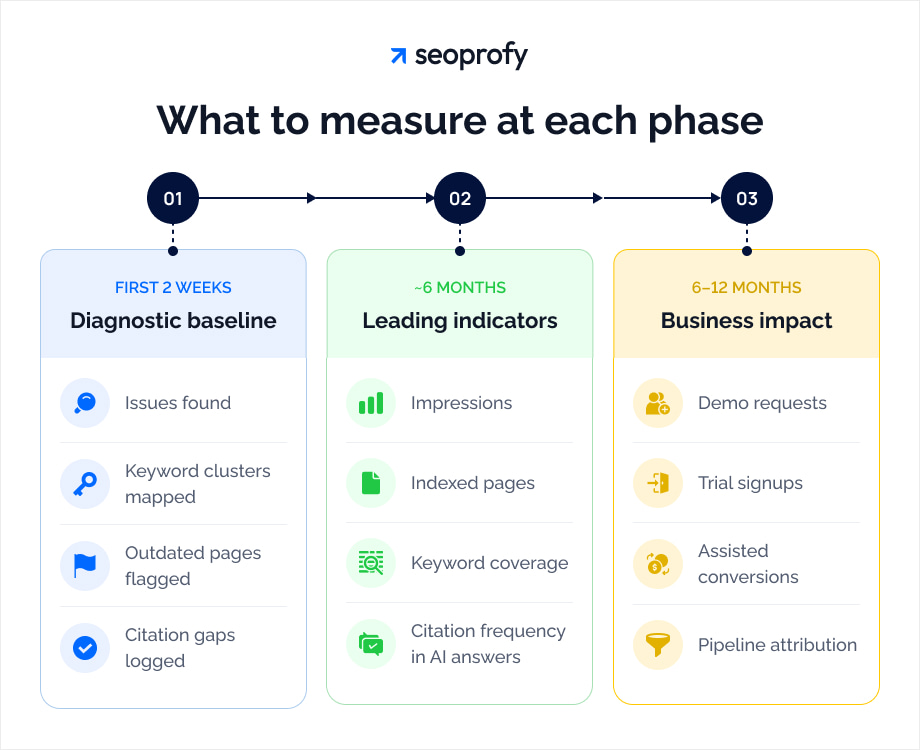
Vanity metrics like total organic traffic hide the real story. Effective measurement anchors on SaaS-specific KPIs. Track the number of organic signups and the percentage that reach the activation event inside the product. Monitor trial-to-paid conversion rate segmented by landing page to identify which content captures the most qualified users. Observe customer acquisition cost from organic search and how it trends over time as your AI-optimized assets mature. A north-star metric might be the organic monthly recurring revenue influenced by content that an AI system identified as high-value six months ago. Use multi-touch attribution to give proper credit to the awareness-stage posts that initiated the buyer journey, and connect that data back to keyword rankings to quantify the business impact of position changes.
Detailed Step-by-Step Guide to Implementing AI SEO in Your SaaS
The Future of AI SEO for SaaS
Search itself is being reinvented. Google’s Search Generative Experience and other AI-answer engines are beginning to displace traditional blue links for informational queries. SaaS companies must adapt by optimizing for inclusion in these AI-generated snapshots. This requires structuring content with clear, authoritative statements that language models can extract confidently. Entities and structured data become even more critical. Beyond that, we will see SEO tools that autonomously write, publish, and update content within guardrails set by human strategists—a true autopilot for known, stable topics. However, the brands that will win long-term are those that combine AI’s efficiency with a relentless focus on delivering original research and unique product insights that no algorithm can fabricate.
Frequently Asked Questions
What exactly is AI SEO for SaaS?
It is the integration of artificial intelligence into every facet of organic search strategy for software companies. This includes using machine learning for keyword intent prediction, natural language processing for content optimization, and automated crawling for technical health, all tied to SaaS-specific metrics like trial signups and monthly recurring revenue.
How does AI improve keyword research for B2B SaaS?
AI goes beyond volume data to model the likelihood of conversion. It analyzes historical CRM and product data to reveal which search queries actually lead to high-value actions, then clusters semantically related terms so you can build content that addresses the full buyer journey, from problem awareness to vendor comparison.
Can AI replace human writers for SaaS content?
Not effectively for high-quality SEO. AI excels at drafting structures, suggesting topics, and optimizing for search entities, but human oversight is essential for verifying accuracy, injecting original insights, and maintaining a distinctive brand voice that builds trust with both users and search engines.
What is the biggest risk of using AI for SaaS SEO?
The greatest risk is creating content that lacks genuine expertise. AI-generated text can be factually wrong or generic, harming your site’s authority. Google’s systems are increasingly tuned to reward content that demonstrates first-hand experience and unique value, which AI alone cannot provide.
How can a small SaaS company start with AI SEO?
Begin with a focused data integration. Connect Google Search Console and your product analytics into a tool like Looker Studio. Use an AI writing assistant like Claude or ChatGPT to help you analyze the top 10 SERPs for your most important keywords and generate a detailed content brief. From there, write the content yourself or with a skilled writer, then use an optimization tool like SurferSEO to refine it before publishing.
Does AI SEO work for technical SaaS products?
Yes, and it is especially powerful. Technical niches have clearer entity relationships and user intents. AI can analyze massive documentation sets, identify content gaps based on common integration or setup queries, and generate precise articles that help developers and decision-makers, while human editors ensure code samples and architectures are correct.
Conclusion
Adopting AI SEO for SaaS is not about chasing a trend; it is about building a durable competitive moat. When you train intelligent systems on your unique customer data, product feedback, and market insights, your organic content becomes a reflection of your entire company’s knowledge. That combination—machine scale with human expertise—is exactly what modern search engines reward. Start by cleaning your technical foundation, define a topic map rooted in revenue impact, and then layer on AI tools to accelerate execution and ongoing optimization. The SaaS brands that integrate this deeply will own the search results their buyers use every day, turning organic into the most reliable channel for growth.
Xem thêm:
- AI SEO Transactional Intent: The Complete Guide to Converting Search Traffic
- AI SEO AI SEO Audit Tool: The Complete Guide to Automated Site Optimization
- AI Title Generator: Craft Click-Worthy Headlines That Drive Traffic and Engagement
- Mastering AI SEO Keyword Selection: The Complete Guide to Data-Driven Rankings
- AI SEO Outreach Automation: The Complete Guide to Scaling Link Building in 2025
Bài viết cùng chủ đề:

AI SEO SEO Automation with Make: The Complete Workflow Guide

AI SEO SEO Automation with Zapier: The Complete Workflow Guide

AI SEO SEO Automation with n8n: The Complete Workflow Guide
AI SEO SEO Automation with Gemini: The Complete Guide to Scaling Organic Growth

AI SEO SEO Automation with Claude: The Complete Guide to Scaling Content in 2025

AI SEO SEO Automation with ChatGPT: The Complete Playbook for 2025

AI SEO & SEO Automation for Affiliate Sites: The 2025 Playbook for Passive Income Growth
AI SEO & SEO Automation for Bloggers: The Complete Guide to Scaling Your Content

AI SEO & SEO Automation for Agencies: The Complete 2025 Playbook

AI SEO and SEO Automation for Ecommerce: The Complete Playbook for 2025

AI SEO & SEO Automation for WordPress: The Complete Playbook for 2025
AI SEO SEO Automation Strategy: The Complete Playbook for 2025

Mastering the AI SEO SEO Automation Process: A Complete Guide to Scaling Organic Growth
AI SEO SEO Automation System: The Complete Guide to Scaling Organic Growth in 2025
AI SEO SEO Automation Platform: The Complete Guide to Scaling Organic Growth in 2025
AI SEO SEO Automation Software: The Complete Guide to Scaling Organic Growth in 2025















