
No products in the cart.
AI SEO Generative Search Visibility: The Complete Playbook for 2025
10
Aug
Aug
The way users discover content has fundamentally shifted. Traditional blue links are being replaced by AI-generated summaries, conversational answers, and curated overviews. This transformation has created a new discipline known as AI SEO Generative Search Visibility. This concept refers to the ability of a website or brand to appear within AI-generated search results, such as those produced by Google AI Overviews, ChatGPT, Perplexity, and Bing Copilot. Understanding this new visibility metric is no longer optional; it is essential for maintaining organic traffic and brand authority in the modern search landscape.
What is AI SEO Generative Search Visibility?
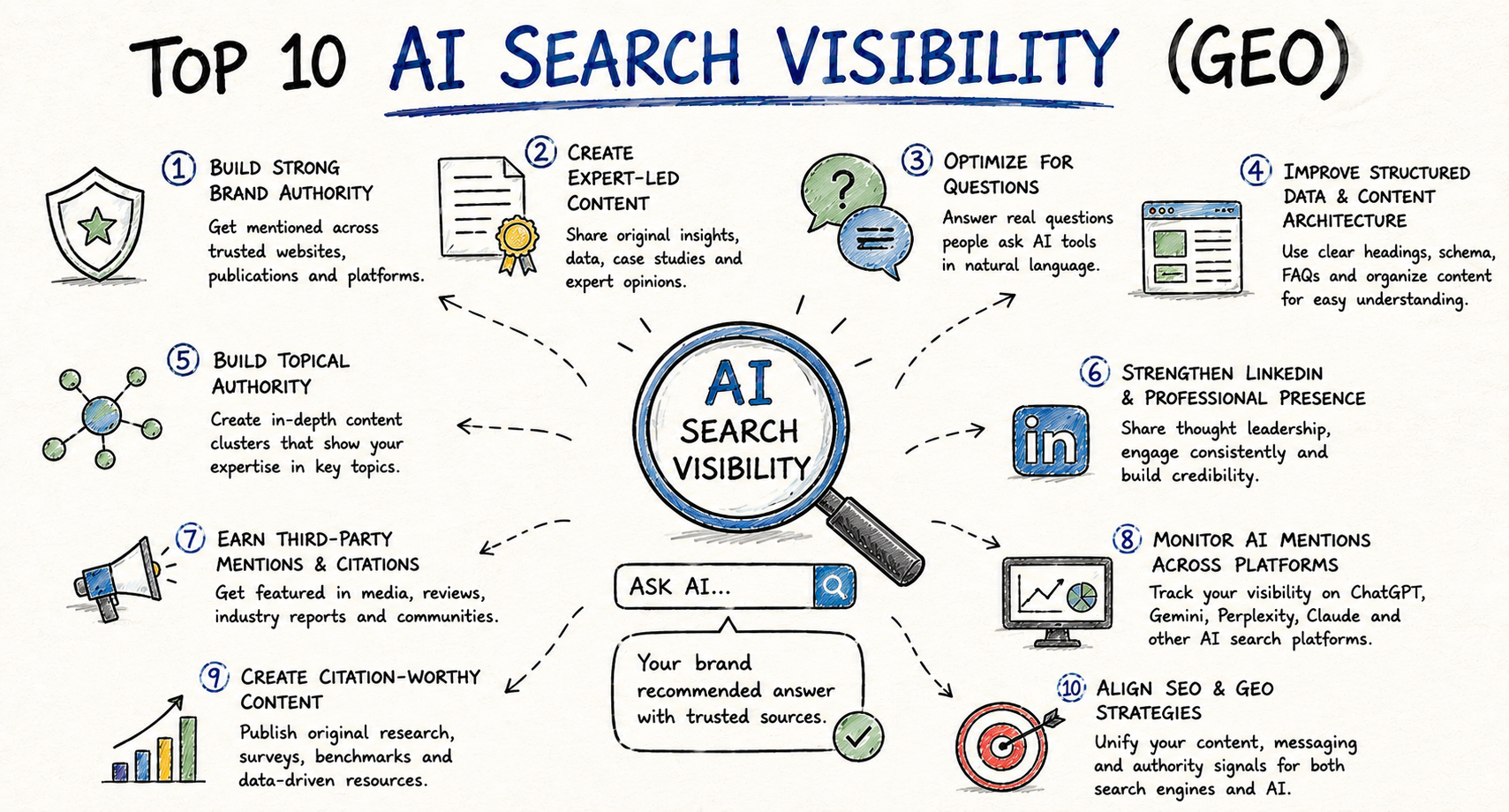
AI SEO Generative Search Visibility measures how often and how prominently your content is cited, referenced, or synthesized within generative AI search outputs. Unlike traditional SEO, which focuses on ranking in a list of ten links, this new paradigm focuses on being the source that AI models trust to formulate their answers. When a user asks a complex question, the AI engine scans indexed web content, evaluates authority, and compiles an answer. If your content is not part of that compilation, you are invisible to that user.
This visibility is not about a single ranking position. It is about semantic relevance and digital trust. The AI engine does not just look for keyword matches; it looks for comprehensive, well-structured, and authoritative content that answers the query holistically. The goal is to become a primary source, not just a citation. This requires a shift from optimizing for crawlers to optimizing for machine comprehension and contextual understanding.
The Difference Between Traditional SEO and Generative Visibility
Traditional SEO is largely deterministic. You optimize for specific keywords, build backlinks, and improve page speed to climb a fixed ranking algorithm. Generative visibility is probabilistic. The AI decides which sources to use based on a complex blend of relevance, freshness, and domain authority. You cannot “hack” the AI output with a single tactic. Instead, you must build a foundation of trust that makes your content the default choice for the AI model.
Another key difference lies in the user interface. In traditional search, users scan titles and meta descriptions. In generative search, users read a synthesized paragraph. This means your content must be written to be extracted and rephrased. Clear, declarative sentences and logical flow are critical. If your content is buried in jargon or unstructured paragraphs, the A
Why Generative Search Visibility Matters for Your Business
The rise of generative search represents a massive shift in user behavior. Users are asking longer, conversational questions and expecting direct answers. If your brand is absent from these AI-generated responses, you are losing market share to competitors who have adapted. The click-through rate for traditional links is already declining as users find answers directly in the AI overview. This makes appearing within the overview itself the new top prize.
Furthermore, generative visibility builds brand authority. When an AI model cites your data or quotes your expert opinion, it positions your brand as a thought leader. Users who see your name in an AI answer are more likely to trust you later. This is a compounding effect. The more you are cited, the more authoritative you appear, which leads to more citations. This virtuous cycle is the core benefit of investing in this new SEO discipline.
How Do AI Engines Select Content for Generative Results?

To improve your AI SEO Generative Search Visibility, you must understand the selection criteria. AI models do not browse the web in real-time for every query. They rely on a combination of a pre-trained knowledge base and live retrieval from search indexes. The retrieval phase is where your SEO efforts matter most. The AI uses a process called Retrieval-Augmented Generation (RAG) to find the most relevant documents.
The selection process prioritizes several key factors. First, the content must be topically relevant. Second, it must be structured in a way that is easy to parse. Third, the source must have high authority. Finally, the information must be consistent with other high-quality sources. If your content contradicts the majority of the web, the A
The Role of Entity Clarity
AI engines think in entities—people, places, organizations, and concepts. To be visible, your content must clearly define the entities you are discussing. For example, if you are writing about “Apple,” the AI needs to know if you mean the fruit or the technology company. Using structured data, clear definitions, and consistent naming conventions helps the AI disambiguate your content. This clarity increases the likelihood of your content being selected for the right queries.
Core Strategies to Improve AI SEO Generative Search Visibility
Improving your generative visibility requires a multi-faceted approach. It is not enough to simply write more content. You must write content that is optimized for extraction and synthesis. The following strategies are the most effective methods for increasing your presence in AI-generated search results.
1. Optimize for Information Gain and Depth
Generative AI models are designed to provide comprehensive answers. They favor content that covers a topic from multiple angles. Thin content that only scratches the surface is rarely used. Instead, create “cornerstone” content that acts as a definitive guide on a subject. Include statistics, historical context, future predictions, and practical examples. The goal is to provide the AI with everything it needs to formulate a complete answer without referencing multiple other sites.
When writing, focus on the “why” and “how” in addition to the “what.” AI models are trained on data that explains reasoning. If your content simply states facts without explaining the underlying logic, it is less valuable to the model. Detailed analysis and expert commentary signal to the AI that your content is a high-quality source worth citing.
2. Implement Structured Data and Schema Markup
Schema markup is the most direct way to communicate with search engines and AI models. By implementing structured data, you are explicitly telling the AI what your content is about. Use the Article, FAQPage, HowTo, and Organization schemas where appropriate. This helps the AI understand the relationship between different parts of your content and increases the chance of rich results.
Pay special attention to the FAQPage schema. AI engines frequently pull from FAQ sections to answer user questions directly. If you have a well-structured FAQ with clear, concise answers, you are providing the AI with ready-made snippets. This is one of the fastest ways to improve visibility for long-tail conversational queries.
3. Build a Strong Digital Footprint and Authority
Generative AI models are conservative. They prefer to cite established, authoritative domains. Building your domain authority through traditional link-building is still vital. However, the quality of the links matters more than ever. Links from other authoritative sites in your niche signal to the AI that you are a trusted source. Focus on earning mentions from industry publications, universities, and government sites.
Beyond backlinks, your digital footprint includes your presence on social media, review sites, and professional networks. AI models scrape the web for information about your brand. A consistent, positive presence across multiple platforms builds the trust signals necessary for the AI to consider you a reliable source. Ensure your NAP (Name, Address, Phone) data is consistent everywhere.
4. Write for Conversational and Long-Tail Queries
Generative search is driven by natural language. Users type or speak full sentences. Your content must mirror this style. Include a section in your articles that addresses common questions in a conversational tone. Use the exact phrasing that users might speak aloud. This increases the semantic overlap between your content and the user’s query, making it easier for the AI to match them.
Create content that targets “People Also Ask” questions and related queries. These are goldmines for generative visibility. By answering these specific sub-questions within your main article, you create multiple entry points for the AI to cite your content. This strategy expands your visibility beyond the primary keyword to a wide network of related terms.
Technical SEO Adjustments for AI Crawlers
While the content strategy is crucial, technical accessibility is the foundation. If AI crawlers cannot access your site, your content will never be considered. The major AI engines use specific crawlers, such as GPTBot, ClaudeBot, and Google-Extended. You must ensure your robots.txt file is not blocking these agents.
Check your server logs to see if these crawlers are visiting your site. If they are not, there may be a technical issue. Ensure your site loads quickly and is fully rendered. AI crawlers are often less sophisticated than Googlebot and may not execute JavaScript perfectly. Consider using server-side rendering or static HTML for your most important content to guarantee it is visible to all crawlers.
Page Speed and Core Web Vitals
While AI models do not “see” the page visually, they do measure the efficiency of the crawl. A slow, bloated site wastes the crawler’s resources. This can lead to a lower crawl frequency. Optimize your images, minify your CSS and JavaScript, and leverage browser caching. A fast, clean site is more likely to be crawled thoroughly and frequently, ensuring your latest content is indexed quickly.
Measuring Your AI SEO Generative Search Visibility
Measuring this new metric is more complex than checking a rank tracker. T” However, you can track your progress through several indirect methods. The first is brand mention monitoring. Use tools to track when your brand name appears in AI outputs. You can manually test this by asking ChatGPT or Perplexity specific questions about your industry and noting if your brand is mentioned.
Another method is analyzing your referral traffic. If you see traffic coming from “chat.openai.com” or “perplexity.ai,” that is a direct signal of generative visibility. Set up these as separate channels in your analytics platform. Finally, monitor your organic traffic for your core keywords. If your traffic remains stable or grows while traditional click-through rates are declining, it is likely that you are gaining visibility in AI overviews that are keeping your brand in front of users.
Comparison: Traditional SEO vs. AI SEO Generative Visibility

| Feature | Traditional SEO | AI SEO Generative Visibility |
|---|---|---|
| Primary Goal | Rank #1 in organic listings | Be cited as a source in AI answers |
| User Intent | Click to find information | Read the answer directly |
| Content Style | Keyword-optimized, scannable | Comprehensive, explanatory, data-rich |
| Key Metric | Click-Through Rate (CTR) | Mention Rate and Referral Traffic |
| Optimization Focus | Meta tags, backlinks, keywords | Entity clarity, schema, authority, depth |
| Algorithm Type | Deterministic ranking | Probabilistic synthesis |
Common Mistakes That Hurt Your Generative Visibility
Many website owners are inadvertently blocking their own success. The most common mistake is blocking AI crawlers. In an attempt to protect content, some sites block GPTBot and other agents. This is a fatal error. If you block the crawler, you are guaranteed to be invisible in that AI engine. Review your robots.txt file immediately to ensure you are not blocking these essential bots.
Another mistake is relying on outdated SEO tactics like keyword stuffing. AI models are sophisticated enough to detect unnatural language. Content that is written purely for search engines, rather than for humans, is often penalized or ignored by AI synthesis. Focus on writing naturally and providing genuine value. The A
Finally, ignoring the importance of citations and references is a critical error. In the academic and professional world, citing sources builds trust. The same applies to AI. If you make bold claims, link to the original research or data. This not only builds trust with your human readers but also helps the AI verify your information. Content that is well-sourced is more likely to be considered authoritative.
Important Notes on Content Freshness and Updates
Generative AI models have a knowledge cutoff, but they also retrieve live data. This means freshness matters. If you have a “cornerstone” article, you must update it regularly. The AI looks for the most recent information to answer time-sensitive queries. If your article is outdated, the A Set a schedule to review and update your top 20% of content every quarter.
When updating, do not just change the date. Add new statistics, remove outdated references, and expand on new developments in the industry. This signals to the AI that your content is actively maintained and relevant. A regularly updated article is a strong trust signal that can significantly boost your generative visibility.
Frequently Asked Questions (FAQ)
What is the difference between AI Overviews and traditional search results?
AI Overviews are generated summaries that appear at the top of search results. They synthesize information from multiple sources to answer the user’s query directly. Traditional results are a list of blue links that require the user to click through to a website to find the answer. AI Overviews aim to provide the answer instantly, reducing the need for clicks.
How do I check if my site is visible in ChatGPT or Perplexity?
You can manually check by asking these AI tools specific questions related to your niche. If your brand or content is mentioned, you have visibility. For a more systematic approach, monitor your referral traffic in Google Analytics for sources like “chat.openai.com” or “perplexity.ai.” An increase in traffic from these sources indicates growing visibility.
Does schema markup help with generative search visibility?
Yes, schema markup is highly beneficial. It provides explicit context to AI crawlers about the meaning and structure of your content. Using schemas like Article, FAQPage, and HowTo helps the AI understand and extract your information more efficiently, increasing the likelihood of being cited in generative answers.
Is traditional SEO dead because of generative AI?
No, traditional SEO is not dead, but it is evolving. The principles of technical accessibility, site speed, and content quality remain essential. However, the focus is shifting from ranking for clicks to ranking for citations. You still need to optimize for crawlers, but you must also optimize for machine comprehension and entity extraction.
What is the fastest way to improve AI SEO Generative Search Visibility?
The fastest way is to implement FAQPage schema on your existing high-traffic pages and ensure your robots.txt file allows AI crawlers. Additionally, create a “definitive guide” style article for your main keyword that is more comprehensive than anything currently ranking. This combination of technical access and superior content will yield the quickest results.
Conclusion
AI SEO Generative Search Visibility is the new frontier of digital marketing. The shift from link-based discovery to answer-based discovery requires a fundamental change in strategy. By focusing on entity clarity, content depth, and technical accessibility, you can position your brand as a primary source for AI engines. This is not a temporary trend; it is the future of how information is consumed. The brands that adapt now will dominate the generative search landscape for years to come. Start by auditing your current content for depth, implementing structured data, and ensuring your site is open to AI crawlers. The effort invested today will secure your visibility in the AI-driven search ecosystem of tomorrow.
Xem thêm:
- AI SEO AI Search Traffic: The Complete Guide to Winning Generative Engine Rankings
- AI SEO Planning Workflow: The Complete Guide to Scaling Organic Growth in 2025
- AI SEO ChatGPT Search Optimization: The Complete Guide to Ranking in the AI Era
- AI SEO for Influencers: The Complete Guide to Ranking and Growing in 2025
- AI Search Traffic: Your Complete Guide to Organic Visibility in the Age of Generative AI
Bài viết cùng chủ đề:

AI SEO SEO Automation with Make: The Complete Workflow Guide

AI SEO SEO Automation with Zapier: The Complete Workflow Guide

AI SEO SEO Automation with n8n: The Complete Workflow Guide
AI SEO SEO Automation with Gemini: The Complete Guide to Scaling Organic Growth

AI SEO SEO Automation with Claude: The Complete Guide to Scaling Content in 2025

AI SEO SEO Automation with ChatGPT: The Complete Playbook for 2025

AI SEO & SEO Automation for Affiliate Sites: The 2025 Playbook for Passive Income Growth
AI SEO & SEO Automation for Bloggers: The Complete Guide to Scaling Your Content

AI SEO & SEO Automation for Agencies: The Complete 2025 Playbook

AI SEO and SEO Automation for Ecommerce: The Complete Playbook for 2025

AI SEO & SEO Automation for WordPress: The Complete Playbook for 2025
AI SEO SEO Automation Strategy: The Complete Playbook for 2025

Mastering the AI SEO SEO Automation Process: A Complete Guide to Scaling Organic Growth
AI SEO SEO Automation System: The Complete Guide to Scaling Organic Growth in 2025
AI SEO SEO Automation Platform: The Complete Guide to Scaling Organic Growth in 2025
AI SEO SEO Automation Software: The Complete Guide to Scaling Organic Growth in 2025















