
No products in the cart.
AI SEO GEO Checklist: The Complete Guide to Generative Engine Optimization
10
Aug
Aug
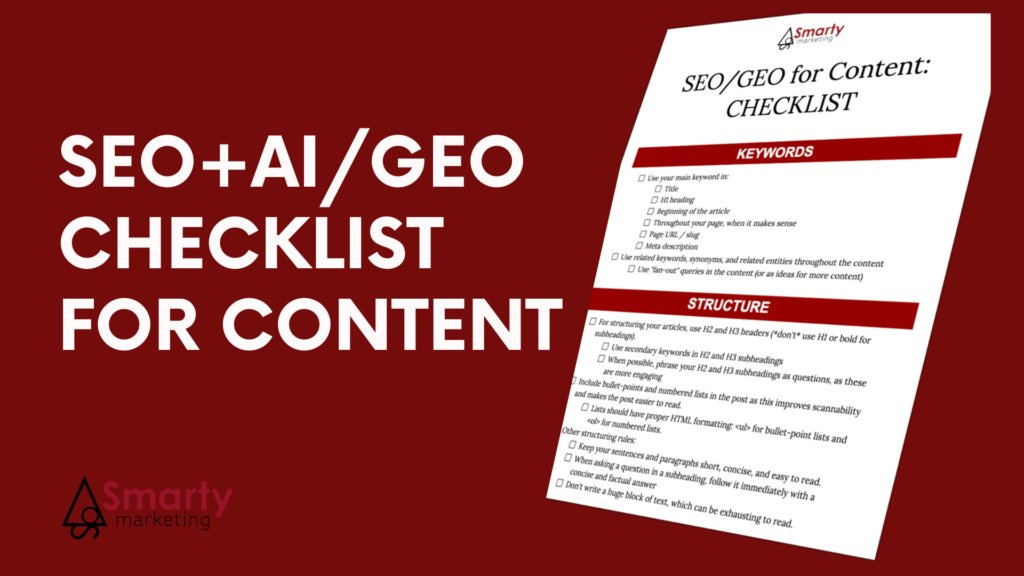
The digital landscape has shifted dramatically with the rise of AI-powered search engines like ChatGPT, Perplexity, Google AI Overviews, and Bing Copilot. Traditional SEO focused on ranking in blue links, but the new frontier is Generative Engine Optimization (GEO). This AI SEO GEO Checklist serves as your strategic roadmap to ensure your brand becomes the primary source cited by AI models when users ask questions. By following this comprehensive guide, you will learn how to optimize your content for both traditional search engines and the AI-driven answer engines that are reshaping how people find information online.
Understanding the AI SEO GEO Checklist Landscape
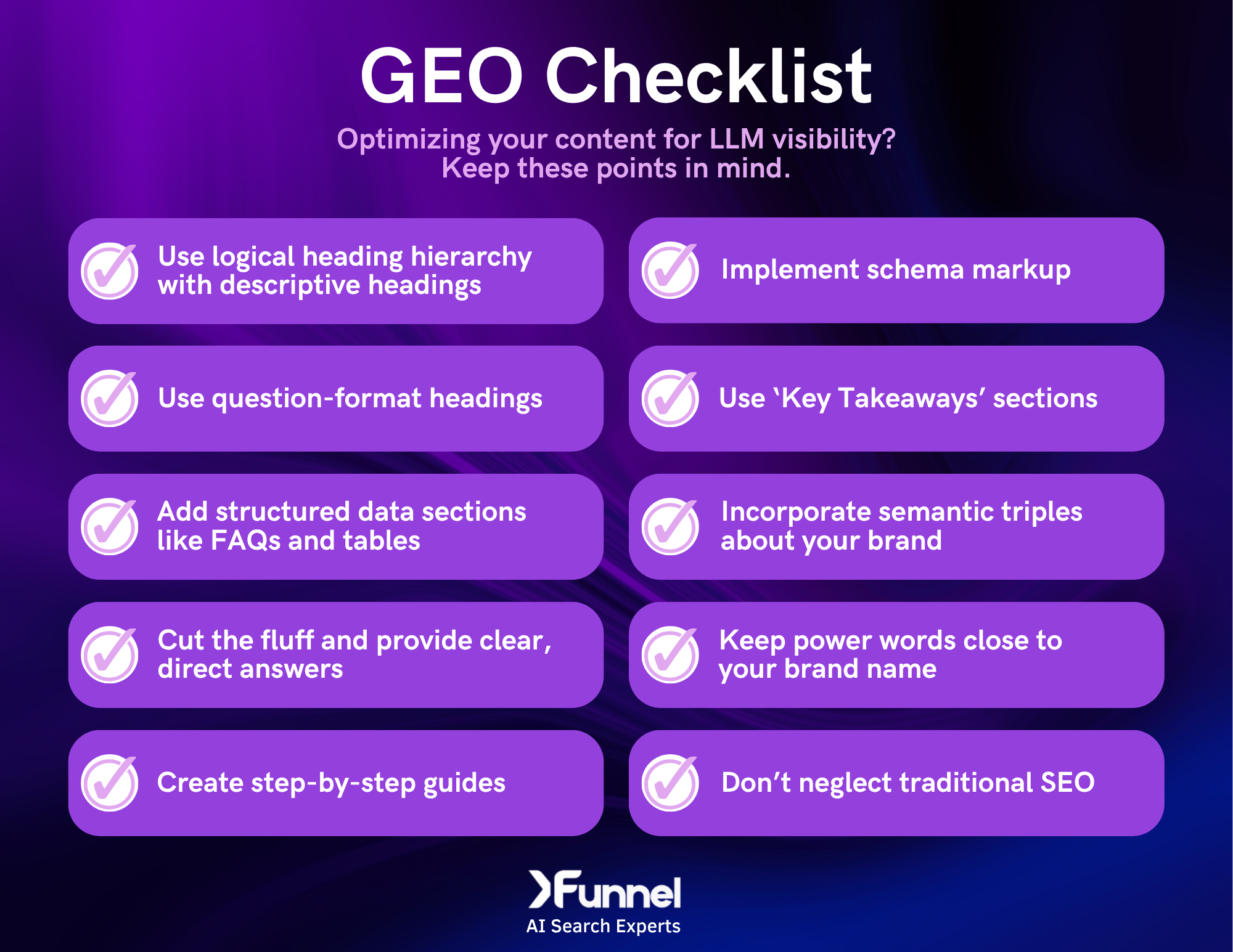
Generative Engine Optimization is the practice of optimizing digital content so that AI models can easily crawl, understand,, and cite it in their generated responses. Unlike traditional SEO, which focuses on keywords and backlinks, GEO focuses on entity clarity, factual accuracy, and structured data that allows AI to trust your content as a reliable source.
The AI SEO GEO Checklist is not just a list of tasks; it is a fundamental shift in content strategy. When a user asks an AI chatbot a question, the model synthesizes information from multiple sources. Your goal is to be one of those primary sources. This requires a deep understanding of how large language models (LLMs) process information, which differs significantly from how Google’s crawlers index web pages.
Why Traditional SEO is No Longer Sufficient
Traditional SEO metrics like domain authority and backlink profiles still matter, but they are not the only factors. AI models prioritize clarity, directness, and verifiable data. A page with 5,000 words of fluff will be ignored in favor of a concise, well-structured 500-word answer that directly addresses the query. The AI SEO GEO Checklist addresses this by focusing on content that is both machine-readable and highly valuable to human readers.
Furthermore, AI models often pull from specific sections of a webpage rather than the entire page. This means your content must be modular. Each section should be able to stand alone as a complete answer to a specific question. This granular approach is a core component of any effective AI SEO GEO Checklist.
The Core Components of the AI SEO GEO Checklist
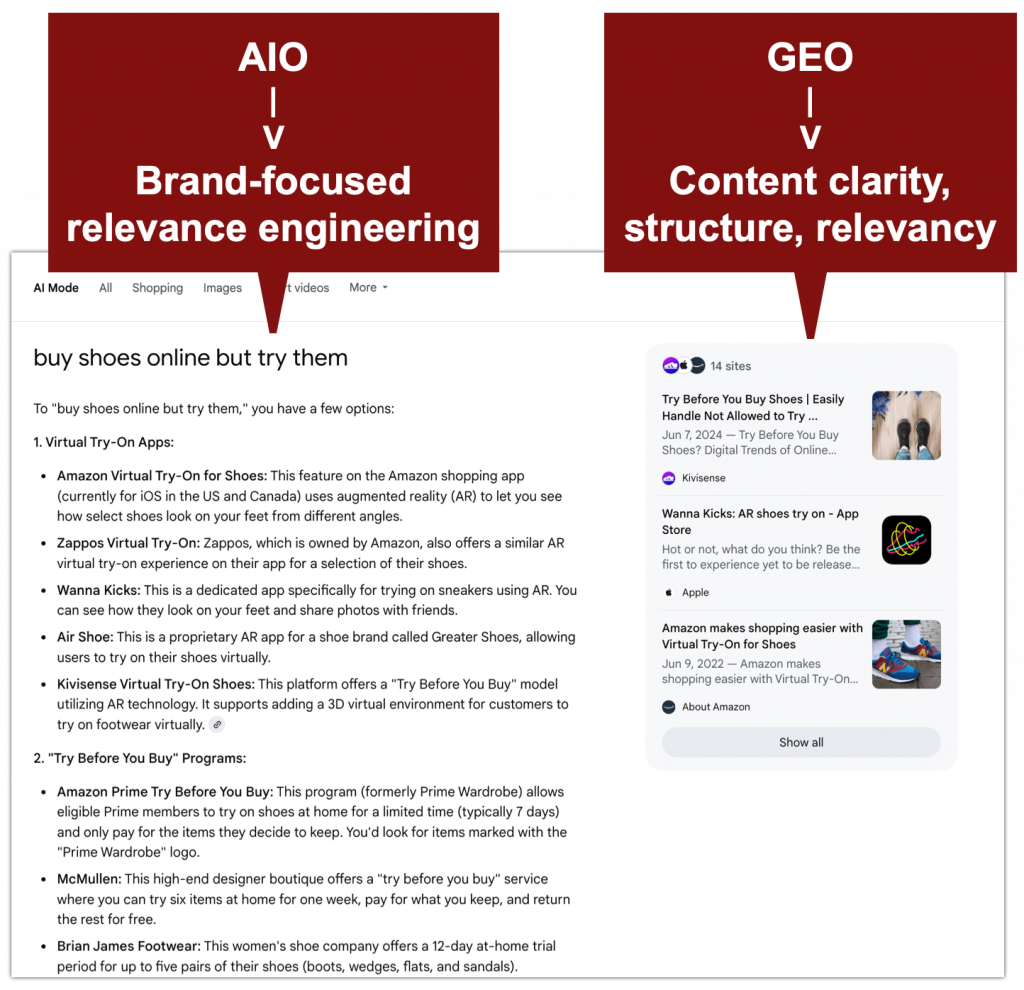
To succeed in this new era, you must implement a multi-faceted strategy. This AI SEO GEO Checklist breaks down into four primary pillars: Technical Foundation, Content Architecture, Entity Optimization, and Authority Building. Each pillar requires specific actions to ensure your content is primed for AI citation.
1. Technical Foundation for AI Crawlers
AI crawlers, such as GPTBot, ClaudeBot, and Google-Extended, access your site differently than Googlebot. Your technical setup must accommodate these specific bots. The first item on the AI SEO GEO Checklist is to ensure your robots.txt file allows access to these AI crawlers. Blocking them means you are invisible to generative engines.
- Robots.txt Configuration: Verify that GPTBot, CCBot, and PerplexityBot are not disallowed.
- Server Response Time: AI crawlers are aggressive; ensure your server can handle high crawl rates without slowing down.
- XML Sitemaps: Submit a clean, updated sitemap that includes your most important content pillars.
- Schema Markup: Implement JSON-LD structured data for Articles, FAQs, HowTo, and Organization.
- Direct Answers: Start each H2 section with a direct answer to the implied question.
- Bullet Points: Use lists to break down complex processes or features.
- Tables: Use HTML tables for comparisons, specifications, and data sets.
- Concise Paragraphs: Keep paragraphs under 50 words to improve readability and AI parsing.
- Clear Definitions: Define key terms within the first paragraph of a section.
- Synonym Usage: Use related terms to help AI understand the context of your topic.
- Entity Relationships: Explicitly state how your product or service relates to other entities in your industry.
- Internal Linking: Use descriptive anchor text that clarifies the relationship between pages.
- Author Bylines: Ensure every article has a clear author with a bio and credentials.
- Original Data: Publish unique statistics, surveys, or research findings.
- Citations: Link to reputable sources (government sites, academic papers, industry leaders) to support your claims.
- Freshness: Regularly update your content to ensure the information is current and accurate.
- Asynchronous communication reduces interruptions.
- Clear goals (OKRs) provide direction.
- Structured routines help separate work from personal life.
Without this technical foundation, the rest of the AI SEO GEO Checklist is useless. If the AI cannot access your site, it cannot cite you. Performance optimization is also critical; a slow site will be deprioritized by AI models that prioritize user experience.
2. Content Architecture and Formatting
AI models excel at extracting information from content that is logically structured. The AI SEO GEO Checklist mandates a shift away from vague, meandering prose toward direct, structured answers. You must format your content to answer questions immediately.
Use the “inverted pyramid” style. Put the conclusion first, then the supporting details. This helps AI models extract the core answer without having to parse through unnecessary filler. Additionally, use bullet points and tables frequently, as these are easily parsed by LLMs.
This structural approach is a key differentiator in the AI SEO GEO Checklist. Content that is scannable by humans is also more likely to be quoted verbatim by AI. The goal is to create “answer blocks” that AI can lift directly from your page.
3. Entity Optimization and Semantic Clarity
AI models think in entities (people, places, things, concepts) and their relationships. Your content must clearly define these entities. The AI SEO GEO Checklist requires you to explicitly state who you are, what you do, and who you serve. Avoid ambiguity.
For example, if you write about “Apple,” the AI needs to know if you mean the fruit or the technology company. Use contextual clues and synonyms to disambiguate. Define acronyms on first use and provide clear definitions for industry jargon.
This semantic clarity ensures that when an AI model processes your content, it builds a correct knowledge graph. Incorrect or vague entity associations can lead to the AI ignoring your content entirely, making this a critical step in the AI SEO GEO Checklist.
4. Authority and Trust Signals
AI models are programmed to prioritize trustworthy sources. The AI SEO GEO Checklist emphasizes the importance of E-E-A-T (Experience, Expertise, Authoritativeness, Trustworthiness). You must prove to the AI that you are a credible source of information.
This goes beyond just having a good “About Us” page. You need to demonstrate first-hand experience with the topic. Include data from original research, cite your own case studies, and link to authoritative external sources for verification.
Trust is the currency of the AI economy. The AI SEO GEO Checklist prioritizes building this trust through verifiable facts and transparent authorship. Content that lacks these signals is often filtered out as low-quality or spammy.
Practical Application: Step-by-Step Implementation Guide

Now that we have covered the theory, let’s apply the AI SEO GEO Checklist to a practical scenario. Imagine you run a SaaS company that sells project management software. “
Step 1: Keyword and Query Mapping
Start by identifying the specific questions your target audience asks. Use tools like “AnswerThePublic” or “AlsoAsked” to find long-tail questions. For our example, the primary query might be “How to improve remote team productivity.” The AI SEO GEO Checklist requires you to map this query to a specific section of your content.
Create a table mapping the query to the content section:
| User Query | Content Section (H2) | Format |
|---|---|---|
| How to improve remote team productivity? | Key Strategies for Remote Productivity | Bullet List |
| What tools are best for remote teams? | Essential Software Stack | Comparison Table |
| How to manage remote employees? | Management Best Practices | Numbered List |
This mapping ensures that every question has a clear, direct answer block within your content. This is the core of the AI SEO GEO Checklist—aligning your content structure with the user’s query intent.
Step 2: Writing for Extraction
Write the content section for “Key Strategies” using the inverted pyramid style. Start with the answer, then expand. For example:
H2: Key Strategies for Remote Productivity
The most effective strategies for remote productivity are asynchronous communication, clear goal-setting, and structured daily routines.
This format allows an AI model to extract the core answer (the first sentence) and the supporting points (the list) without any ambiguity. This is a direct application of the AI SEO GEO Checklist principles.
Step 3: Schema Implementation
Add the “FAQPage” schema to the bottom of the article. This structured data explicitly tells search engines and AI models what questions are answered on the page. This is a technical element of the AI SEO GEO Checklist that significantly increases the chances of being featured in AI-generated answers.
Ensure the schema matches the visible text on the page. Mismatched schema is a penalty signal. Use the “Speakable” schema if you want Google Assistant to read your content aloud.
Common Mistakes and How to Avoid Them
Even with the best intentions, many marketers fail to implement the AI SEO GEO Checklist correctly. Here are the most common pitfalls and how to navigate them.
Mistake 1: Keyword Stuffing in AI Era
Stuffing your content with the exact keyword “AI SEO GEO Checklist” repeatedly will harm your chances. AI models detect unnatural language patterns. Instead, use synonyms and related phrases naturally. Focus on the topic, not the exact keyword density.
Solution: Write for humans first. Use the keyword in the H1, the first paragraph, and one H2. Use variations like “GEO optimization” or “AI search optimization” elsewhere.
Mistake 2: Ignoring the “Zero-Click” Answer
Many sites try to hide the answer to force clicks. This is counterproductive. The AI SEO GEO Checklist encourages giving the answer immediately. If you provide a clear answer, the A
Solution: Provide the answer in the first 50 words of the section. Then, provide the “why” and “how” in the following paragraphs.
Mistake 3: Neglecting Content Updates
AI models prioritize freshness. A blog post from 2019 about AI trends is not going to be cited in 2024. The AI SEO GEO Checklist requires a content refresh schedule. Update statistics, replace outdated tools, and add new insights.
Solution: Set a quarterly review calendar for your top 20 pages. Update the data and re-publish with a new date.
Important Notes on AI Search Behavior

Understanding how AI models “read” your content is crucial. They do not see the visual design; they see the raw HTML. Therefore, your HTML structure must be clean. Use proper heading hierarchy (H1 to H4) without skipping levels.
Also, note that AI models often paraphrase. They rarely copy text verbatim. Therefore, your goal is not to be quoted verbatim, but to be the primary source of the information they use to paraphrase. This means your facts must be accurate and your logic must be sound.
Finally, the AI SEO GEO Checklist is not a one-time task. It is an ongoing process. As AI models evolve, their preferences change. Stay updated with the latest guidelines from major AI providers like OpenAI and Google.
Frequently Asked Questions (FAQ)
What is the difference between SEO and GEO?
SEO (Search Engine Optimization) focuses on ranking in traditional search engine results pages (SERPs) like Google’s blue links. GEO (Generative Engine Optimization) focuses on being cited as a source in AI-generated answers. SEO targets crawlers and algorithms, while GEO targets large language models and their ability to synthesize information.
How long does it take to see results from GEO?
GEO results are not immediate. It can take several weeks to a few months for AI crawlers to index your updated content and begin citing it. Consistency is key. The AI SEO GEO Checklist should be applied to all new content and gradually retrofitted to existing high-value pages.
Do backlinks still matter for AI SEO?
Yes, but indirectly. AI models use backlinks as a trust signal. A page with high-quality backlinks is considered more authoritative. However, the anchor text and the context of the link matter more than the sheer quantity. Focus on earning links from relevant, high-authority sites.
Can I block AI crawlers and still rank on Google?
Yes, you can block AI crawlers and still rank on Google. However, you will lose visibility in AI search engines like ChatGPT and Perplexity. As AI search usage grows, blocking these crawlers will likely lead to a significant loss of referral traffic and brand visibility.
Is structured data necessary for GEO?
Structured data (Schema.org) is highly recommended. It helps AI models understand the context of your content, such as what is a FAQ, what is a recipe, or who is the author. While not strictly mandatory, it significantly increases the probability of being featured in rich results and AI summaries.
Conclusion: The Future of Search is Generative
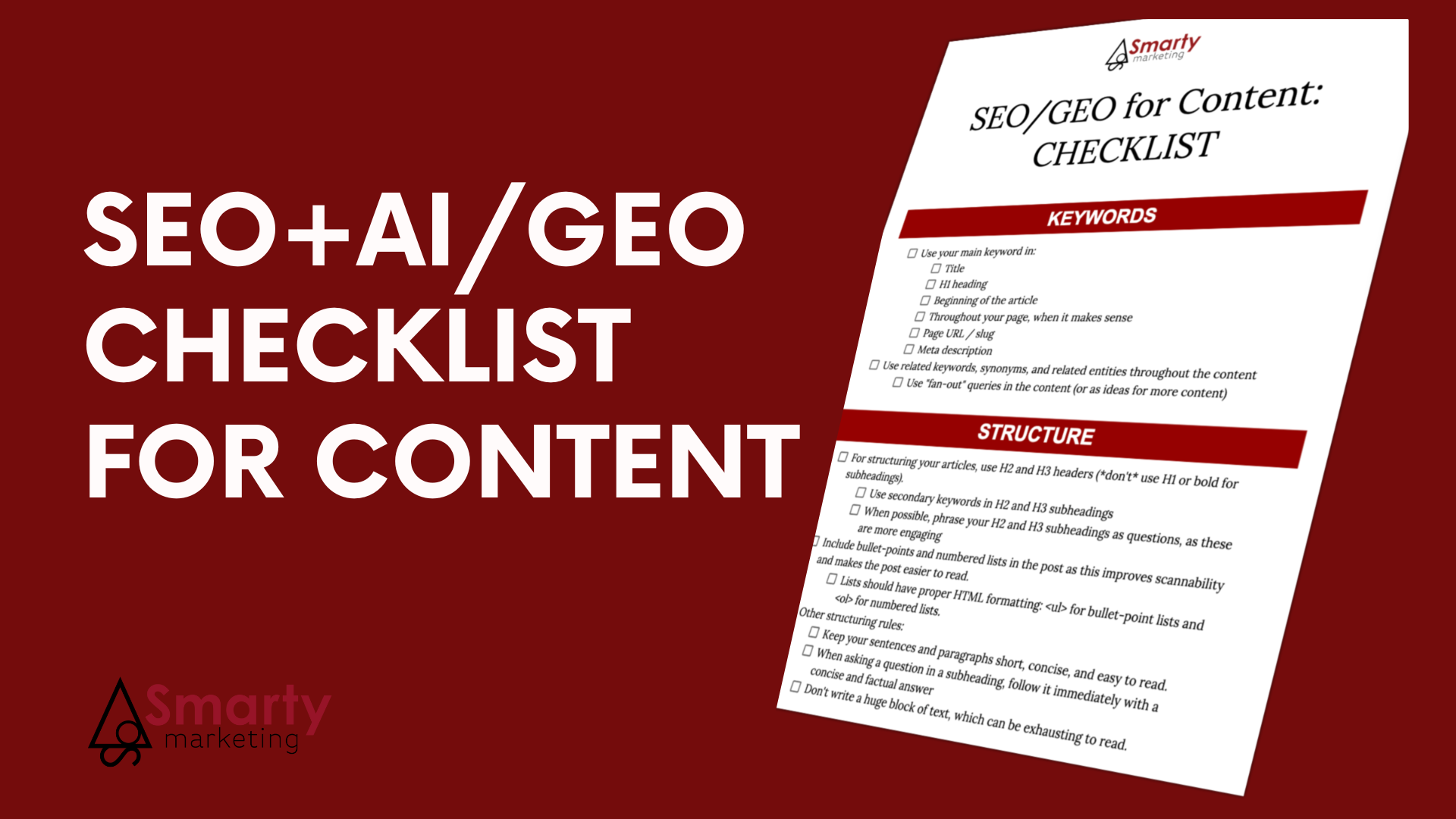
The rise of generative engines marks a paradigm shift in how information is consumed. The AI SEO GEO Checklist is your essential tool for navigating this new reality. By optimizing for AI crawlers, structuring content for extraction, and building undeniable authority, you position your brand at the forefront of this evolution.
Do not view this as a replacement for traditional SEO, but as an evolution of it. The principles of quality content and user experience remain paramount. However, the technical execution must adapt to the new consumers of your data—the algorithms that power AI search. Implement this checklist diligently, monitor your performance in AI tools, and adjust your strategy as the technology matures. The brands that master GEO today will dominate the search landscape of tomorrow.
Xem thêm:
- Claude SEO: The Complete Guide to Using Anthropic’s AI for Search Engine Optimization
- AI SEO Brand Signals: The Complete Guide to Building a Future-Proof Digital Presence
- AI SEO Keyword Modifiers: The Complete Guide to Smarter Search Optimization
- AI SEO CDN Setup: The Complete Guide to Boosting Search Rankings and Site Speed
- AI Landing Page Optimization: Transform Your Conversion Rates with Smart Technology
Bài viết cùng chủ đề:

AI SEO SEO Automation with Make: The Complete Workflow Guide

AI SEO SEO Automation with Zapier: The Complete Workflow Guide

AI SEO SEO Automation with n8n: The Complete Workflow Guide
AI SEO SEO Automation with Gemini: The Complete Guide to Scaling Organic Growth

AI SEO SEO Automation with Claude: The Complete Guide to Scaling Content in 2025

AI SEO SEO Automation with ChatGPT: The Complete Playbook for 2025

AI SEO & SEO Automation for Affiliate Sites: The 2025 Playbook for Passive Income Growth
AI SEO & SEO Automation for Bloggers: The Complete Guide to Scaling Your Content

AI SEO & SEO Automation for Agencies: The Complete 2025 Playbook

AI SEO and SEO Automation for Ecommerce: The Complete Playbook for 2025

AI SEO & SEO Automation for WordPress: The Complete Playbook for 2025
AI SEO SEO Automation Strategy: The Complete Playbook for 2025

Mastering the AI SEO SEO Automation Process: A Complete Guide to Scaling Organic Growth
AI SEO SEO Automation System: The Complete Guide to Scaling Organic Growth in 2025
AI SEO SEO Automation Platform: The Complete Guide to Scaling Organic Growth in 2025
AI SEO SEO Automation Software: The Complete Guide to Scaling Organic Growth in 2025















