
No products in the cart.
The Definitive AI SEO Guide: How to Leverage Artificial Intelligence for Higher Rankings
29
Jul
Jul
Search engine optimization is undergoing its most profound transformation since the introduction of mobile-first indexing. Artificial intelligence has moved from a futuristic buzzword to the engine room of modern search, reshaping how content is created, evaluated, and ranked. This AI SEO guide demystifies the technology, providing a practical framework for marketers, content creators, and business owners who want to harness AI without sacrificing quality or integrity. You will learn exactly how AI is already baked into Google’s algorithms, which tools deliver genuine value, and how to build a workflow that amplifies human expertise rather than replacing it. Every recommendation is grounded in current search engine behavior and real-world application.
What Is AI SEO? Understanding the Foundation

Defining AI-Powered Search Engine Optimization
AI SEO is the strategic integration of artificial intelligence technologies into every phase of the search optimization process. This includes using machine learning models for keyword discovery, natural language processing for content generation, and predictive analytics to forecast ranking fluctuations. At its core, AI SEO does not change the fundamental goal of matching user intent with high-quality content. Instead, it dramatically accelerates research, surfaces patterns invisible to manual analysis, and automates repetitive technical tasks. An AI SEO guide must start with this clarity: artificial intelligence is an accelerator and an enhancer, not a magic replacement for strategic thinking.
The Evolution From Traditional SEO to AI-Driven Strategies
Traditional SEO relied on manual keyword research, hunches about user intent, and labor-intensive audits. The shift began with Google’s RankBrain in 2015, a machine learning system that interprets never-before-seen queries. Since then, BERT and MUM have embedded deep language understanding directly into the ranking process. Today, the emergence of generative AI in search results like the Search Generative Experience means that SEO professionals must optimize not only for blue links but also for AI-generated summaries. An effective AI SEO guide acknowledges this new landscape: ranking now depends on being the authoritative source that AI models cite, paraphrase, and recommend within conversational answers.
How AI Fundamentally Changes Search Rankings
The algorithms that determine what appears on page one are now powered by neural networks that analyze content with near-human comprehension. This has three immediate consequences for anyone following an AI SEO guide. First, keyword density is dead; semantic relevance and topic coverage reign supreme. Second, user engagement signals like dwell time and interaction patterns are processed by AI to judge content quality. Third, Google’s systems can now generate answers directly, extracting information from multiple pages. Your content must be structured so that AI can easily identify, validate, and surface the most trustworthy answer.
Key AI Systems Inside Modern Search Engines
Understanding the AI that reads your site is essential. RankBrain helps Google interpret complex long-tail queries by connecting words to broader concepts. BERT examines the full context of each word in relation to every other word, grasping nuance and prepositions. MUM is multimodal, meaning it can understand information across text, images, and eventually video, in 75 languages. Recently, Google has integrated generative AI into the search results page itself, pulling together information from multiple sources and presenting a synthesized answer. A practical AI SEO guide must prepare you for this zero-click reality: your content must be the most cited source inside those AI-generated snapshots.
Core Pillars of an AI SEO Strategy
AI-Assisted Keyword Research and Topic Modeling
Manual keyword research often traps you in a bubble of similar head terms. AI tools process vast amounts of search data, forums, social conversations, and competitor content to uncover clusters of semantically related topics. They predict search intent with higher accuracy, categorizing queries into informational, commercial, transaction, and navigational buckets. This enables the creation of content that comprehensively addresses a subject rather than chasing a single keyword. Following this AI SEO guide means shifting from a keyword list to a topic map, ensuring your site becomes a topical authority that AI algorithms reward with higher rankings and more frequent appearances in AI-generated overviews.
Content Creation With Generative AI
The most visible application in any AI SEO guide is content generation. Models like GPT-4 can produce full article drafts, meta descriptions, social snippets, and even schema markup. The key is not to publish raw AI output. The best results come from a collaborative workflow: AI provides the structural outline and first-draft prose based on top-ranking competitor analysis, while human editors inject original insights, case studies, brand voice, and first-hand experience. This blend satisfies Google’s E-E-A-T guidelines, which explicitly reward content demonstrating real expertise. AI handles the heavy lifting of research synthesis; humans provide the unique value that AI cannot replicate.
Technical SEO Automation Through AI
Site audits, log file analysis, and hreflang implementation can be painstakingly manual. AI dramatically shortens these cycles. Intelligent crawlers now prioritize issues based on their potential ranking impact, suggesting fixes via natural language explanations. AI can automatically generate optimized title tags by learning patterns from top-performing pages in your niche. It can detect internal linking opportunities by understanding the topical relationship between pages at a conceptual level, not just keyword matching. Following this AI SEO guide for technical foundations means using AI to move from reactive fixes to proactive, predictive maintenance of your website’s health.
User Experience and Behavioral Signal Optimization
Google’s AI evaluates whether users are satisfied after clicking a result. High bounce rates and short dwell times send negative quality signals. AI tools can now simulate user behavior, heatmap clicks, and predict which content layouts will maximize engagement. AI chatbots, when trained on your knowledge base, reduce bounce rates by answering visitor questions instantly. Personalization engines powered by machine learning deliver content tailored to a user’s previous interactions, increasing page views per session. Every AI SEO guide needs to stress that technical ranking factors now blend seamlessly with user experience signals, and AI provides the bridge to optimize both simultaneously.
AI SEO Tools: A Comparative Overview
The toolkit landscape is vast, but not all AI is created equal. The table below categorises the main types of AI-powered SEO tools and highlights what they do best. This classification helps you select tools based on specific needs rather than adopting every new product that launches.
| Tool Category | Primary AI Application | Function in SEO Workflow |
|---|---|---|
| Generative AI Assistants | Natural language generation, summarisation | Draft articles, FAQs, meta tags, product descriptions |
| AI SEO Platforms | Content scoring, SERP analysis, keyword clustering | Optimize briefs, check topical authority, gap analysis |
| Technical Crawlers | Anomaly detection, predictive alerting | Automate audits, detect indexing issues, suggest fixes |
| Analytics & Data Intelligence | Predictive traffic modeling, anomaly alerts | Forecast ranking drops, identify seasonality patterns |
| Conversational AI | Intent classification, response generation | On-site chatbots, reduce bounce, increase dwell time |
An effective AI SEO guide does not prescribe a single tool but instead shows how to integrate different AI capabilities into a cohesive stack. Over-reliance on one category often leads to blind spots. Combining generative AI drafts with platform-based content scoring and automated technical monitoring creates a powerful, self-improving system.
Step-by-Step Guide to Implementing AI SEO
Step 1: Establish Your Baseline With AI-Powered Audits
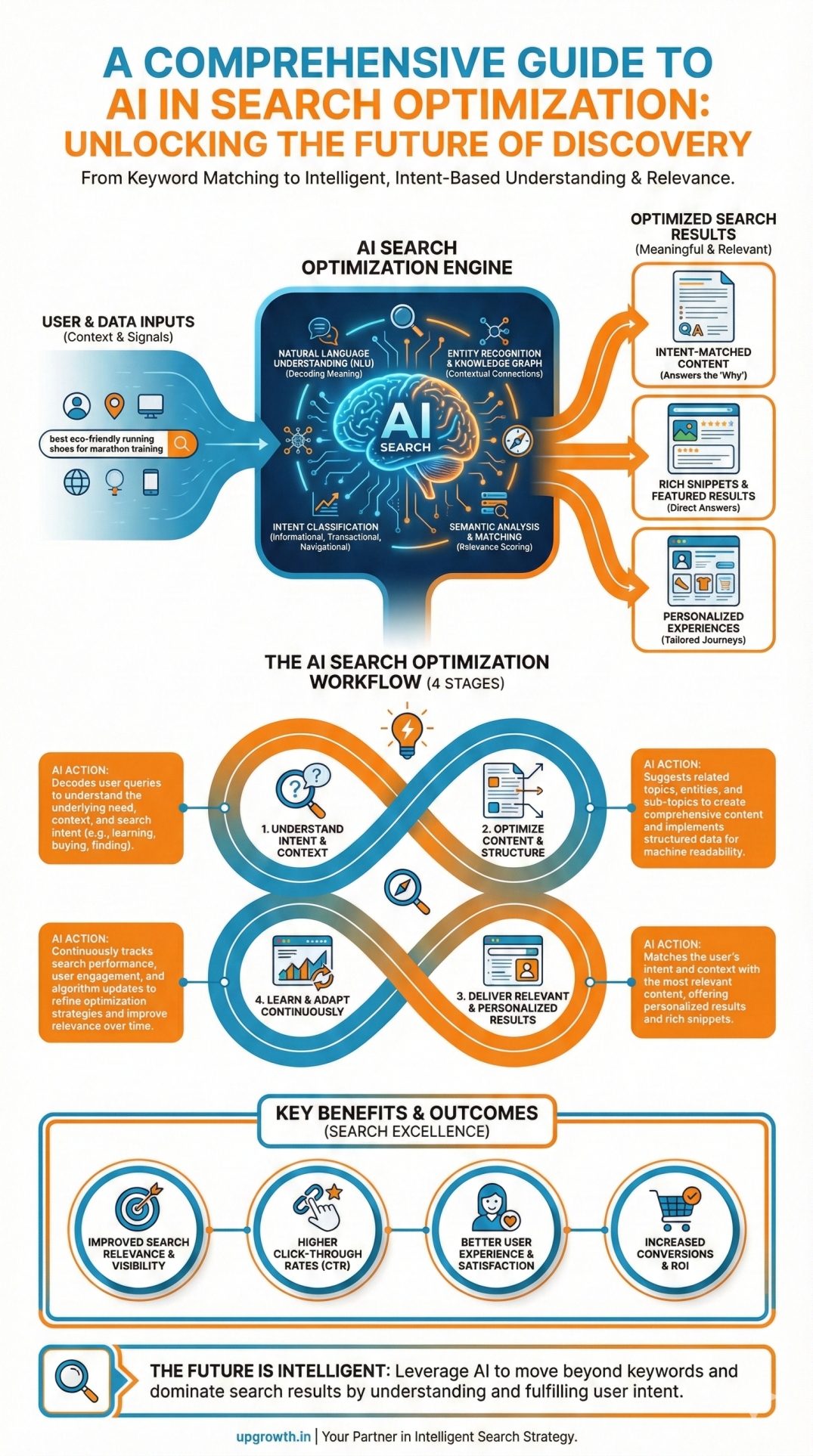
Begin by running an intelligent site crawl that uses machine learning to prioritize errors. The crawl should segment issues by severity and page type, highlighting patterns such as slow-loading templates or missing structured data across blog sections. Export a prioritized list and start with fixes that correlate most strongly with ranking potential. This data-driven triage ensures your AI SEO efforts address genuine bottlenecks first.
Step 2: Build Topic Clusters Using Semantic Analysis
Input your core service or product pages into an AI topic modeling tool. It will return clusters of related terms, questions, and subtopics that real searchers care about. Map these into pillar pages and supporting content. The AI identifies gaps where your site is thin compared to competitors, allowing you to plan a content calendar that establishes authority systematically.
Step 3: Create Content With a Human-AI Hybrid Model
For each topic, use AI to generate a detailed brief including target entities, suggested headings based on top-ranking analysis, and even a skeleton draft. A human subject-matter expert then writes, enriches, and fact-checks the piece, adding proprietary data, case studies, and nuanced opinions. This process is the gold standard of any modern AI SEO guide because it produces content that satisfies both algorithm comprehension and real user needs.
Step 4: Automate On-Page Optimization Elements
Deploy AI to dynamically test and generate title tags and meta descriptions at scale. Many platforms allow you to set rules based on page type and let the AI produce variations that maximize click-through rates. Monitor performance in Search Console and continuously feed winning patterns back into the system, creating a reinforcement loop that improves indexing and organic CTR over time.
Step 5: Monitor and Adapt to AI-Generated Search Features
Track appearance in featured snippets, People Also Ask boxes, and AI-generated answer carousels. Analyze the structure of content that wins these placements. AI can reverse-engineer the phrasing and heading formats that Google prefers for specific query types. Adjust your content formatting accordingly, because appearing in these AI-powered SERP features now drives the majority of above-the-fold visibility on mobile.
Benefits and Limitations of AI in SEO
Every AI SEO guide must honestly appraise the trade-offs. The benefits are transformative: dramatic time savings on research and repetitive tasks, the ability to uncover hidden semantic relationships, scaling personalized content, and predictive insights that prevent traffic losses before they happen. AI also empowers smaller teams to compete with enterprise resources by automating what once required large manual teams. However, the limitations are equally real. AI models hallucinate facts, lack genuine lived experience, and can produce content that reads as generic or soulless. Over-optimization via AI can trigger quality alarms if the output is not adequately differentiated. Search engines are increasingly adept at identifying purely synthetic content that adds nothing original. The core principle of this AI SEO guide is that technology augments human judgment, never replaces it.
Common AI SEO Mistakes and How to Avoid Them
- Publishing raw AI content without review. Google’s guidelines punish scaled content abuse. Solution: always include a human review layer that fact-checks, adds unique insights, and refines the narrative voice.
- Ignoring content freshness and updating. AI-generated posts can become outdated. Solution: schedule quarterly reviews where AI scans for outdated statistics, and humans update them.
- Over-optimizing for AI rather than humans. Writing solely to please topic models can result in dense, unnatural prose. Solution: write for a human first, then use AI to verify entity coverage and semantic completeness.
- Neglecting technical foundations. Fantastic AI content on a slow, poorly indexed site will not rank. Solution: automate technical audits and prioritize core web vitals, structured data, and crawl budget maximization.
- Using AI to generate manipulative backlinks. Some tools promise AI-powered link building through mass outreach. Spammy link networks are easily identified by search engines. Solution: use AI to find genuine, high-authority prospects and personalize outreach, but never automate link creation.
Important Ethical and Practical Notes for Long-Term Success
Transparency with your audience matters. When AI assists in content creation, disclose it where appropriate if that builds trust. More importantly, the E-E-A-T framework is now an AI-driven evaluation of your entire online presence. Google’s algorithms assess author expertise through biographical signals, citations, and real-world credentials. An AI SEO guide must emphasize that investing in author profiles, industry recognition, and original research is more critical than ever. AI helps you format and distribute that expertise, but it cannot fabricate genuine authority. Avoid the temptation to generate fake author profiles or synthetic reviews; these tactics are actively targeted by advanced spam detection systems. Sustainability comes from building real reputation signals that AI algorithms recognize as trustworthy.
Frequently Asked Questions About AI SEO
Can AI completely replace human SEO professionals?
No. AI excels at data processing, pattern recognition, and generating drafts, but it lacks strategic creativity, genuine empathy for user pain points, and the ability to build authentic relationships that lead to natural backlinks. The role of an SEO professional evolves into that of an orchestra conductor, guiding and refining AI outputs with human insight.
Does Google penalize AI-generated content?
Google does not penalize content simply because it was created with AI. The search engine penalizes content that is unhelpful, unoriginal, or created primarily to manipulate rankings, regardless of how it was produced. When AI output is substantially improved with human expertise and first-hand experience, it can rank very well.
How do I optimize for Google’s AI-generated search results?
Structure your content with clear, concise answers to common questions, use descriptive headings, and implement FAQ schema. Build topical authority so that Google’s AI identifies your domain as a highly trusted source. The most effective tactic from any AI SEO guide is to become the source that generative AI quotes directly.
What is the most important AI SEO tool a beginner should use?
Beginners should start with a generative AI assistant like ChatGPT or Claude for brainstorming and a dedicated AI SEO platform like Surfer SEO or Frase for content optimization. This provides a balance of creative generation and data-driven competitive analysis without overwhelming complexity.
Will AI make backlinks obsolete?
Not in the foreseeable future. AI-driven search engines still use backlinks as a fundamental authority signal. However, the quality and relevance of links are weighted more intelligently by machine learning models. Natural editorial links from authoritative sites remain one of the strongest ranking factors.
How can I measure whether my AI SEO strategy is working?
Track organic traffic to pages created with the hybrid human-AI model, monitor their average position for target topic clusters, and measure engagement metrics such as scroll depth and conversion rate. Also, watch your appearance frequency in AI-generated SERP features like the new generative AI snapshot. An increase in these metrics over 3-6 months indicates an effective strategy.
Conclusion: The Human-AI Partnership Is the Future of Search
This AI SEO guide has mapped the journey from understanding how search engines use AI to building a practical, ethical, and effective implementation plan. Artificial intelligence is not a distant future; it is the operating system of modern search. The winners in this landscape will not be those who deploy the most advanced tools or who chase every algorithm update. They will be the professionals who blend machine efficiency with irreplaceable human qualities: original thinking, hard-won experience, and the ability to earn genuine trust. Use AI to handle the scale and the data, but keep human judgment at the center of every decision. That partnership, more than any single technique, is what will deliver sustainable organic growth in the age of AI-powered search.
Xem thêm:
- AI SEO Broken Link Opportunities: The Complete Guide to Automated Link Recovery
- AI SEO Email Outreach: The Complete Guide to Automating Link Building in 2025
- AI Semantic Analysis: Unlocking Human-Like Understanding from Text Data
- AI SEO Keyword Database: The Complete Guide to Smarter Search Rankings
- Mastering AI SEO Automation Tools: The Ultimate Guide to Scaling Organic Growth Without Burning Out
Bài viết cùng chủ đề:

AI SEO SEO Automation with Make: The Complete Workflow Guide

AI SEO SEO Automation with Zapier: The Complete Workflow Guide

AI SEO SEO Automation with n8n: The Complete Workflow Guide
AI SEO SEO Automation with Gemini: The Complete Guide to Scaling Organic Growth

AI SEO SEO Automation with Claude: The Complete Guide to Scaling Content in 2025

AI SEO SEO Automation with ChatGPT: The Complete Playbook for 2025

AI SEO & SEO Automation for Affiliate Sites: The 2025 Playbook for Passive Income Growth
AI SEO & SEO Automation for Bloggers: The Complete Guide to Scaling Your Content

AI SEO & SEO Automation for Agencies: The Complete 2025 Playbook

AI SEO and SEO Automation for Ecommerce: The Complete Playbook for 2025

AI SEO & SEO Automation for WordPress: The Complete Playbook for 2025
AI SEO SEO Automation Strategy: The Complete Playbook for 2025

Mastering the AI SEO SEO Automation Process: A Complete Guide to Scaling Organic Growth
AI SEO SEO Automation System: The Complete Guide to Scaling Organic Growth in 2025
AI SEO SEO Automation Platform: The Complete Guide to Scaling Organic Growth in 2025
AI SEO SEO Automation Software: The Complete Guide to Scaling Organic Growth in 2025















