
No products in the cart.
AI SEO HTTP Status Codes: The Complete Guide to Automated Crawl Management
31
Jul
Jul
Search engines are evolving rapidly, and the integration of artificial intelligence into crawling, indexing, and ranking algorithms has fundamentally changed how websites must handle HTTP status codes. AI SEO HTTP status codes represent the intersection where machine learning models interpret server responses to determine content relevance, crawl budget allocation, and page quality signals. Understanding this dynamic relationship is no longer optional for technical SEO professionals. Modern AI-driven crawlers like Google’s MUM and RankBrain process status codes differently than traditional bots, making it essential to align your server responses with machine learning expectations.
What Are AI SEO HTTP Status Codes?
AI SEO HTTP status codes are server response signals that artificial intelligence systems use to evaluate, prioritize, and understand web pages during the crawling and indexing process. These three-digit codes communicate the outcome of a browser or crawler’s request to the server, indicating whether a page loaded successfully, moved permanently, encountered an error, or requires authentication. In the context of AI-driven search, these codes serve as critical data points that machine learning models analyze to make decisions about page quality, freshness, and relevance.
Traditional search engine crawlers followed a relatively straightforward path: request a URL, receive a status code, and decide whether to index the content. AI-powered systems add layers of complexity. They analyze patterns across thousands of status codes, cross-reference them with user engagement metrics, and adjust their crawling behavior dynamically. For instance, an AI algorithm might notice that pages returning 404 errors on a particular site tend to have high backlink profiles, prompting it to recommend redirects or content restoration.
The Evolution of HTTP Status Codes in AI-Driven Search
The relationship between HTTP status codes and search engine optimization has transformed dramatically over the past decade. Early crawlers treated status codes as binary indicators—either a page existed or it didn’t. Modern AI systems interpret these codes contextually, considering factors like response time, server location, and historical crawl patterns.
Google’s introduction of neural matching and transformer-based models has made status code interpretation more nuanced. AI systems now evaluate whether a 410 Gone status is appropriate for permanently removed content versus a 404 Not Found, which might indicate a temporary issue. They also assess how quickly a server responds with a status code, using this latency data to inform page experience rankings.
How AI Models Process Status Code Data
Machine learning algorithms process HTTP status codes through several distinct mechanisms. First, they aggregate status code distributions across entire websites to identify patterns. A site with an unusually high percentage of 500-level errors might trigger a crawl frequency reduction. Second, AI systems correlate status codes with content quality signals. A 200 OK response with thin content receives different treatment than a 200 OK response with comprehensive, authoritative material.
Third, AI models use historical status code data to predict future crawl behavior. If a server consistently returns 301 redirects for a specific URL pattern, the AI might learn to skip those URLs entirely or follow them more efficiently. This predictive capability represents a significant advancement over rule-based crawling systems.
Critical HTTP Status Codes Every AI SEO Strategy Must Address
Not all HTTP status codes carry equal weight in AI-driven search environments. Understanding which codes matter most and how AI interprets them is crucial for developing an effective technical SEO strategy.
200 OK: The Foundation of AI Indexing
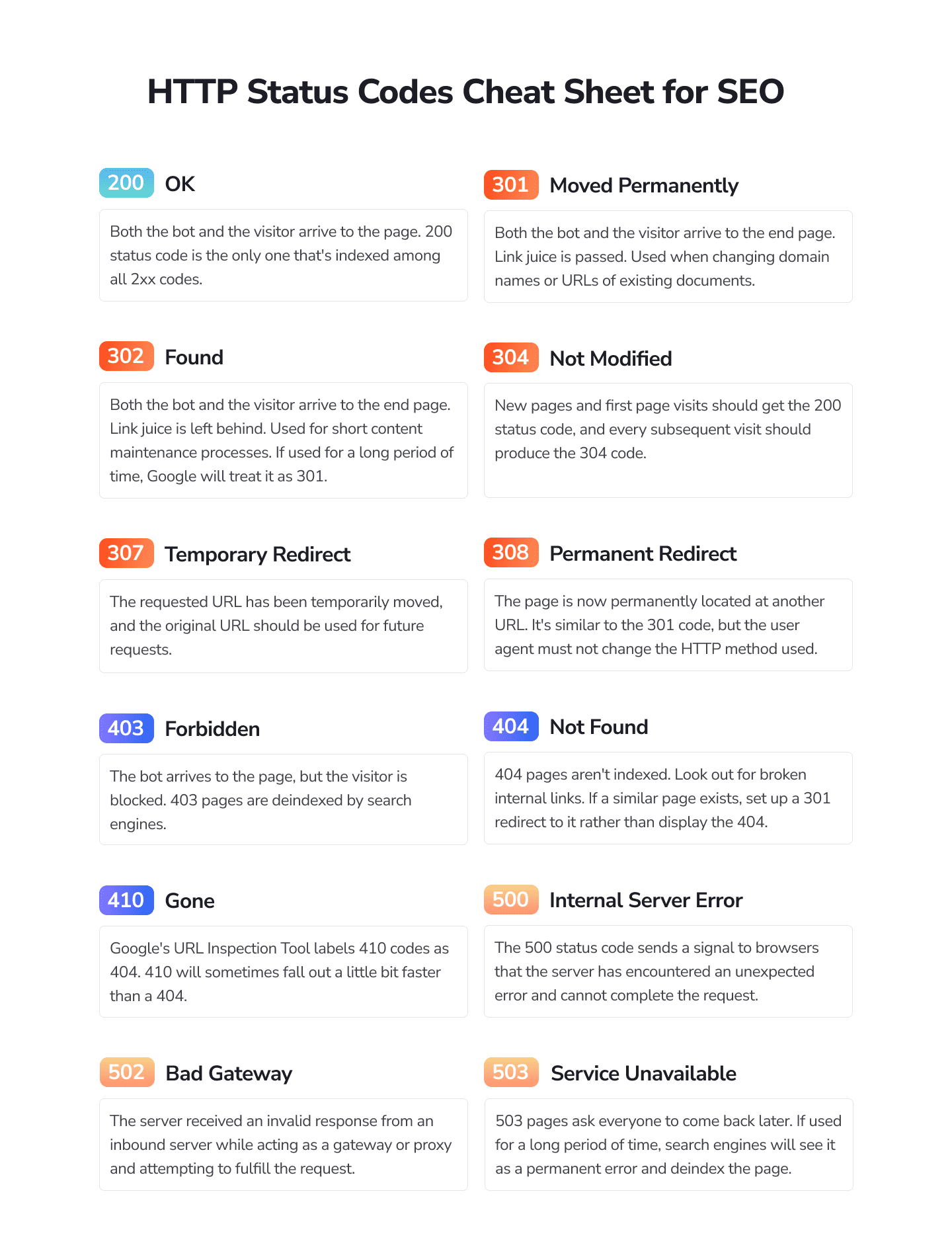
A 200 OK response signals that the server successfully processed the request and delivered the requested content. For AI systems, this status code indicates that a page is accessible and potentially indexable. However, AI models go beyond the simple presence of a 200 response. They analyze the content delivered alongside this status code, evaluating factors like semantic relevance, entity coverage, and topical authority.
AI algorithms also monitor how consistently a server returns 200 OK responses. Fluctuations between 200 and 500 status codes for the same URL can signal instability, prompting AI systems to reduce crawl frequency or lower the page’s perceived reliability.
301 vs 302 Redirects: AI’s Preference for Permanent Signals
Search engine AI models treat 301 Moved Permanently and 302 Found (or 307 Temporary Redirect) responses very differently. A 301 tells AI systems that a page has permanently relocated, and the accumulated authority should transfer to the new URL. AI algorithms process this signal by consolidating ranking signals, updating their index, and adjusting crawl priorities.
In contrast, 302 responses indicate temporary moves. AI systems maintain the original URL in their index and continue to crawl it, potentially wasting crawl budget if the temporary redirect persists for extended periods. Advanced AI models now detect redirect chains and loops, penalizing sites that create complex redirect structures that waste computational resources.
404 and 410: Communicating Content Removal to AI
When content is removed from a website, the server response tells AI systems whether the removal is temporary or permanent. A 404 Not Found status suggests the resource might return, so AI systems may continue to crawl the URL periodically. A 410 Gone status clearly communicates permanent removal, prompting AI systems to drop the URL from their index more quickly.
AI-driven search engines have become sophisticated at distinguishing between legitimate 404s and soft-404s—pages that return a 200 status but display “page not found” content. Machine learning models detect these inconsistencies and may penalize sites that fail to implement proper status codes.
500-Level Errors: The AI Crawl Budget Killer
Server errors in the 500 range (500 Internal Server Error, 502 Bad Gateway, 503 Service Unavailable) signal to AI systems that a website is experiencing technical difficulties. When AI crawlers encounter these errors, they typically reduce crawl frequency and may delay re-crawling attempts. Persistent 500 errors can lead to significant drops in indexation and rankings.
AI models now analyze the duration and frequency of server errors to determine whether they represent temporary spikes or systemic issues. A site that returns 503 errors during peak traffic hours might be treated differently than one with random 500 errors throughout the day.
How AI Crawlers Differ from Traditional Bots
Understanding the behavioral differences between AI-powered crawlers and traditional bots is essential for optimizing HTTP status code implementation. Traditional crawlers like the classic Googlebot followed deterministic rules: request URLs from the sitemap, follow internal links, and respect robots.txt directives. AI-driven crawlers operate with greater autonomy and learning capability.
| Characteristic | Traditional Crawlers | AI-Powered Crawlers |
|---|---|---|
| Decision Making | Rule-based, deterministic | Probabilistic, context-aware |
| Status Code Interpretation | Literal, binary | Contextual, pattern-based |
| Crawl Frequency Adjustment | Based on site-wide rules | Dynamic, per-URL learning |
| Error Recovery | Fixed retry schedules | Adaptive, based on historical data |
| Redirect Handling | Follows chains sequentially | Predicts and skips known patterns |
AI crawlers also demonstrate improved ability to interpret JavaScript-rendered content. When a server returns a 200 status but the page requires client-side rendering, AI systems evaluate the rendered output rather than just the raw HTML. This capability means that status codes alone don’t determine indexability—the rendered content quality matters equally.
Practical Applications: Optimizing Status Codes for AI Search
Implementing an AI-friendly HTTP status code strategy requires a systematic approach that goes beyond basic server configuration. The following practices help align your technical infrastructure with AI search engine expectations.
Implementing Proper Redirect Chains
AI systems penalize excessive redirect chains because they waste crawl resources and slow down content discovery. When restructuring a website, implement direct 301 redirects from old URLs to final destinations, avoiding intermediate hops. Use tools to audit redirect chains regularly and consolidate them into single-step redirects.
For e-commerce sites with faceted navigation, consider whether 301 redirects or canonical tags better serve AI crawling. AI models can detect when redirects are used to manipulate crawl budget and may respond by reducing overall crawl frequency.
Monitoring Server Response Times
AI algorithms factor server response time into their crawl frequency decisions. A server that consistently responds with 200 status codes within 200 milliseconds signals reliability and efficiency. Conversely, slow responses—even with correct status codes—can lead AI systems to deprioritize crawling.
Implement server-side caching, optimize database queries, and use content delivery networks to maintain fast response times. Monitor Time to First Byte (TTFB) metrics alongside status code distributions to identify performance bottlenecks.
Using Structured Data to Complement Status Codes
Structured data markup provides AI systems with additional context about page content, complementing the information conveyed by HTTP status codes. When a page returns a 200 OK status, structured data helps AI models understand the page’s purpose, entities, and relationships. This combination of technical signals and semantic markup improves indexing accuracy.
Ensure that structured data matches the actual content served. AI systems can detect discrepancies between structured data claims and visible content, potentially flagging the page for manual review.
Common Mistakes in AI SEO Status Code Management
Many websites inadvertently sabotage their AI search visibility through improper status code implementation. Recognizing and correcting these mistakes is critical for maintaining strong crawl health.
Returning 200 Status for Error Pages
Soft 404s remain one of the most common technical SEO errors. When a page returns a 200 OK status but displays “content not found” or empty results, AI systems receive conflicting signals. The status code suggests the page exists, but the content indicates otherwise. This confusion can lead to index bloat and diluted crawl budget.
Implement proper 404 or 410 status codes for genuinely missing content. For empty search results or category pages with no products, consider using a 200 status only if the page provides meaningful value, such as helpful suggestions or alternative navigation options.
Ignoring Crawl Anomalies in Server Logs
AI systems generate detailed crawl logs that reveal how they interpret your status codes. Failing to analyze these logs means missing opportunities to identify and fix issues. Review server logs regularly to identify unusual crawl patterns, unexpected status code distributions, and areas where AI crawlers spend excessive time.
Pay particular attention to status codes returned for URLs that receive significant external links. If AI systems encounter errors on these high-authority URLs, they may reduce the site’s overall trust signals.
Overusing 302 Redirects for Permanent Changes
Some webmasters use 302 redirects to avoid “losing” PageRank, but this strategy backfires with AI-driven search. AI models interpret 302 as temporary and continue to crawl the original URL, wasting resources and potentially serving outdated content. Use 301 redirects for any change expected to last more than a few days.
Benefits of AI-Optimized Status Code Strategies
Implementing a status code strategy aligned with AI search behavior delivers measurable benefits beyond basic crawl efficiency. Websites that master this technical discipline typically experience improved indexation rates, more accurate content representation, and better overall search visibility.
- Enhanced crawl budget utilization, allowing AI systems to discover and index more valuable pages
- Reduced index bloat from soft 404s and improperly redirected URLs
- Improved server performance through reduced unnecessary crawl requests
- Faster detection and correction of technical issues through AI pattern recognition
- Better alignment with Google’s Core Web Vitals and page experience signals
AI-optimized status code management also supports international SEO efforts. When implementing hreflang annotations and country-specific content, proper status codes help AI systems understand which version of a page to serve in different regions.
Limitations and Challenges of AI Status Code Interpretation
Despite the sophistication of modern AI systems, HTTP status code interpretation still presents challenges. AI models occasionally misinterpret legitimate server responses, leading to incorrect indexing decisions. Understanding these limitations helps set realistic expectations for technical SEO outcomes.
One significant challenge involves JavaScript-heavy websites that return 200 status codes but require extensive client-side processing. AI crawlers may render these pages differently than human users, leading to discrepancies between what gets indexed and what users see. Implementing server-side rendering or dynamic rendering helps bridge this gap.
Another limitation relates to the opacity of AI decision-making. While traditional crawlers followed documented guidelines, AI systems make probabilistic decisions that aren’t always explainable. This opacity makes it difficult to diagnose why certain pages receive different crawl treatment despite identical status codes.
Important Notes for AI SEO Status Code Implementation
Several critical considerations should guide your approach to status code management in an AI-driven search environment. These notes reflect current best practices and observed AI behavior patterns.
First, consistency matters more than perfection. AI systems learn from historical patterns, so maintaining stable status code behavior over time builds trust. Frequent changes between 200 and 404 statuses for the same URL confuse AI models and may trigger reduced crawling.
Second, prioritize mobile status code consistency. With mobile-first indexing, AI systems primarily crawl the mobile version of your site. Ensure that status codes returned for mobile URLs match those for desktop versions, or implement proper responsive design to avoid discrepancies.
Third, monitor status codes for paginated content carefully. AI systems treat pagination differently than traditional crawlers, often consolidating paginated pages into a single canonical view. Returning proper status codes for paginated URLs helps AI models understand the relationship between pages.
Frequently Asked Questions About AI SEO HTTP Status Codes
How does AI interpret a 404 status code differently from traditional crawlers?
AI systems analyze 404 status codes contextually, considering factors like the URL’s historical performance, backlink profile, and crawl frequency. A 404 on a high-authority URL might trigger AI to recommend a redirect or content restoration, while a 404 on a low-value URL might simply result in de-indexation. Traditional crawlers treated all 404s equally, but AI models prioritize based on learned importance.
Should I use 410 Gone instead of 404 for deleted content?
Yes, for permanently removed content, 410 Gone provides clearer signals to AI systems. This status code explicitly communicates that the resource will not return, allowing AI models to de-index the URL faster and reallocate crawl budget. Use 404 for temporary situations or when you’re unsure whether content might return.
Can AI detect soft 404s that return 200 status codes?
Modern AI systems are highly effective at detecting soft 404s. They analyze content similarity, page layout, and user engagement signals to identify pages that return 200 status but provide no meaningful content. Google’s algorithms specifically target soft 404s as a quality issue, and sites with high numbers of soft 404s may experience ranking penalties.
How do AI crawlers handle redirect chains?
AI crawlers process redirect chains more efficiently than traditional bots, often following multiple hops in a single request cycle. However, they still penalize excessive chains because they waste resources. AI models learn from historical redirect patterns and may stop following chains that consistently lead to dead ends or loops.
What is the ideal server response time for AI crawl optimization?
While there’s no universal threshold, AI systems favor servers that respond within 200-500 milliseconds. Faster response times correlate with higher crawl frequencies and better indexation rates. Monitor your server logs to identify URLs with slow response times and optimize them to improve overall crawl health.
Does AI treat 503 Service Unavailable differently than other 500 errors?
Yes, AI systems recognize 503 as a temporary condition and typically retry crawling after a specified retry-after period. Other 500-level errors like 500 Internal Server Error or 502 Bad Gateway suggest more serious issues, prompting AI to reduce crawl frequency more aggressively. Use 503 responses for planned maintenance to minimize crawl disruption.
Conclusion
AI SEO HTTP status codes represent a critical intersection between technical infrastructure and machine learning-driven search algorithms. As search engines continue to integrate artificial intelligence into every stage of the crawling and indexing process, the importance of proper status code implementation will only grow. Websites that align their server responses with AI expectations gain significant advantages in crawl efficiency, indexation accuracy, and overall search visibility.
The key takeaway is that status codes are no longer just technical signals—they are data points that AI systems use to build comprehensive models of website health, content quality, and user experience. By implementing proper redirect strategies, avoiding soft 404s, maintaining fast response times, and monitoring crawl patterns, you position your site to thrive in an AI-driven search landscape. Regular audits of your status code implementation, combined with analysis of AI crawl behavior, ensure that your technical SEO foundation remains solid as search algorithms continue to evolve.
Xem thêm:
- WP Trove AI Plugin: The Complete Guide to Automating Your WordPress Content Workflow
- AI SEO for Beginners: A Practical Guide to Boosting Your Rankings with Artificial Intelligence
- AI SEO LLM Citations: The Complete Guide to Getting Referenced by Generative Engines
- AI SEO Site Structure: The Complete Guide to Building an AI-Ready Website Architecture
- AI SEO Keyword Clusters: The Complete Guide to Building Topical Authority in 2025
Bài viết cùng chủ đề:

AI SEO SEO Automation with Make: The Complete Workflow Guide

AI SEO SEO Automation with Zapier: The Complete Workflow Guide

AI SEO SEO Automation with n8n: The Complete Workflow Guide
AI SEO SEO Automation with Gemini: The Complete Guide to Scaling Organic Growth

AI SEO SEO Automation with Claude: The Complete Guide to Scaling Content in 2025

AI SEO SEO Automation with ChatGPT: The Complete Playbook for 2025

AI SEO & SEO Automation for Affiliate Sites: The 2025 Playbook for Passive Income Growth
AI SEO & SEO Automation for Bloggers: The Complete Guide to Scaling Your Content

AI SEO & SEO Automation for Agencies: The Complete 2025 Playbook

AI SEO and SEO Automation for Ecommerce: The Complete Playbook for 2025

AI SEO & SEO Automation for WordPress: The Complete Playbook for 2025
AI SEO SEO Automation Strategy: The Complete Playbook for 2025

Mastering the AI SEO SEO Automation Process: A Complete Guide to Scaling Organic Growth
AI SEO SEO Automation System: The Complete Guide to Scaling Organic Growth in 2025
AI SEO SEO Automation Platform: The Complete Guide to Scaling Organic Growth in 2025
AI SEO SEO Automation Software: The Complete Guide to Scaling Organic Growth in 2025















