
No products in the cart.
AI SEO Hyperlocal SEO: The Complete Guide to Dominating Local Search in 2025

31
Jul
Jul
The digital marketing landscape has shifted dramatically. Businesses no longer compete just on a national or global scale; they compete for customers within a two-mile radius. This is where the fusion of AI SEO and Hyperlocal SEO becomes a game-changer. By leveraging artificial intelligence to analyze local intent, predict consumer behavior, and automate content personalization, brands can achieve unprecedented visibility in their immediate vicinity. This guide dives deep into how these two powerful forces combine to transform local search strategies, ensuring your business appears exactly when and where it matters most.
Understanding the Core Concepts: AI SEO and Hyperlocal SEO

To master this strategy, one must first separate the two pillars. Hyperlocal SEO is the practice of optimizing a digital presence to attract customers in a tightly defined geographic area, often a specific neighborhood, zip code, or even a single street. It goes beyond standard local SEO by focusing on “near me” searches and micro-moments, targeting users who are physically close to a point of sale.
AI SEO, on the other hand, refers to the application of artificial intelligence and machine learning algorithms to automate, analyze, and optimize search engine optimization tasks. This includes predictive analytics for keyword trends, natural language processing (NLP) for content creation, and automated schema markup generation. When these two disciplines merge, AI provides the brain, and hyperlocal provides the location, creating a system that is both intelligent and geographically precise.
The Evolution from Local SEO to Hyperlocal with AI
Traditional local SEO relied heavily on static citations and directory listings. The process was manual, slow, and often reactive. With the introduction of AI, the approach has become proactive. AI algorithms can now process vast amounts of location-based data, such as weather patterns, traffic congestion, and local events, to predict search demand. This allows businesses to adjust their hyperlocal content in real-time, ensuring relevance that was previously impossible to achieve manually.
Why the Combination of AI and Hyperlocal is Critical for Modern Businesses
The consumer journey has become fragmented. A user might search for “coffee shop open now” while walking down a specific street. Standard SEO might rank a website for “best coffee shop,” but AI-driven hyperlocal SEO ensures the result is tailored to the user’s exact location, the time of day, and even their past preferences. This level of specificity drastically increases conversion rates because the search intent is high and the friction to purchase is low.
Furthermore, Google’s algorithms are increasingly favoring entities that demonstrate strong local relevance. By using AI to optimize for hyperlocal queries, businesses signal to search engines that they are the most authoritative and relevant result for that specific geographic query. This leads to higher click-through rates, better foot traffic, and improved return on investment compared to broad-spectrum advertising.
Key Components of an AI-Powered Hyperlocal SEO Strategy
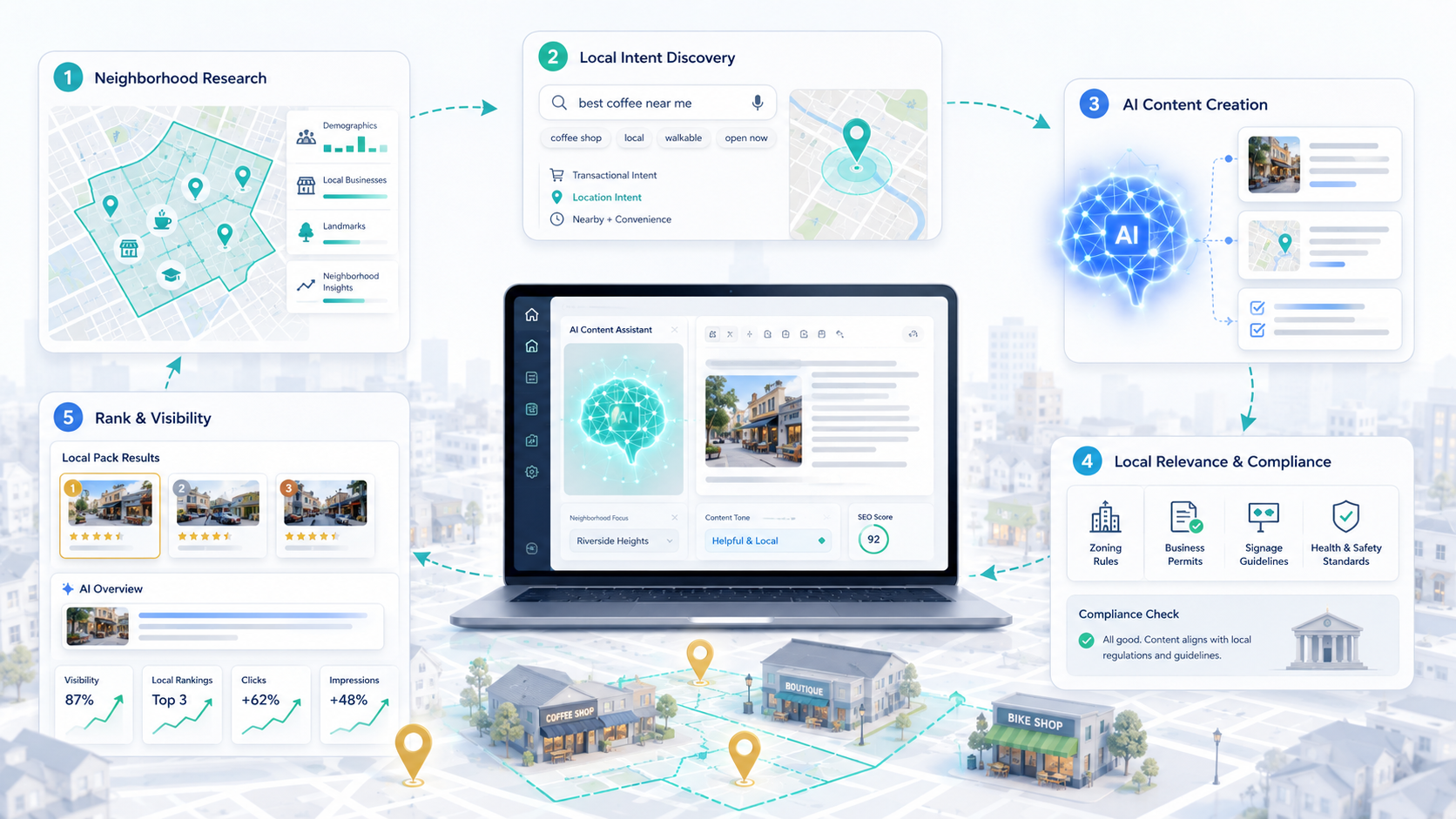
Implementing this strategy requires a multi-faceted approach. It is not simply about adding a city name to a title tag. It involves a deep integration of data science and local marketing tactics. Below are the critical components that form the backbone of this advanced SEO methodology.
1. Predictive Local Keyword Analysis
AI tools can analyze search queries to identify patterns that human analysts might miss. These tools can predict which hyperlocal keywords will spike in volume based on seasonality, local news, or emerging trends. For instance, an AI system might detect a surge in searches for “roof repair” in a specific zip code following a severe storm, allowing a local contractor to immediately publish targeted content and run ads before competitors even notice the trend.
2. Automated Content Personalization at Scale
Creating unique content for every neighborhood is time-consuming. AI solves this by generating dynamic content blocks. A multi-location restaurant chain can use AI to automatically swap out menu descriptions, local events, and even images based on the user’s IP address or GPS coordinates. This creates a personalized experience that feels native to the user’s location, significantly boosting engagement metrics.
3. Intelligent Schema Markup and Structured Data
Schema markup helps search engines understand the context of your content. AI can automate the generation and implementation of LocalBusiness, Geo, and Offer schema. More importantly, AI can dynamically update this structured data based on inventory changes, holiday hours, or temporary closures, ensuring that the search engine always has the most accurate hyperlocal information, which is crucial for voice search accuracy.
4. Real-Time Review and Sentiment Analysis
Hyperlocal reputation management is vital. AI-powered sentiment analysis tools can monitor reviews across Google, Yelp, and Facebook in real-time. These tools can identify specific complaints related to a particular store location and alert managers instantly. Moreover, AI can generate personalized responses to reviews, addressing the customer by name and referencing specific details, which improves local trust signals and ranking factors.
Practical Applications: How to Implement AI Hyperlocal SEO
Moving from theory to practice, there are specific actionable steps that businesses can take today. The implementation process involves selecting the right tools and integrating them into your existing workflow. Below is a structured guide to launching an AI-driven hyperlocal campaign.
Step 1: Data Aggregation and Integration
The first step is to consolidate data from all sources. This includes Google Business Profile insights, CRM data, point-of-sale systems, and website analytics. AI algorithms require this data to identify correlations between local events and sales spikes. Use tools like Google Cloud or specialized local SEO platforms that offer API access to aggregate this information into a single dashboard.
Step 2: AI-Driven Competitor Gap Analysis
Use AI tools to analyze the hyperlocal content of your top three competitors in each specific neighborhood. The AI can identify which keywords they are ranking for, what content gaps exist, and where their citations are weak. This allows you to target areas of opportunity with precision, rather than guessing which tactics might work.
Step 3: Dynamic Landing Page Creation
Instead of static location pages, use AI to create dynamic landing pages. These pages should automatically adjust their content based on the user’s search query and location. For example, a plumbing company can have a page that automatically highlights “Emergency Water Heater Repair” if the user searches for that specific service in a specific suburb, while showing “Bathroom Renovation” to another user in a different suburb.
Step 4: Voice Search Optimization
Voice search is inherently hyperlocal. AI helps optimize for conversational long-tail keywords that people use when speaking, such as “w
Benefits and Limitations of AI Hyperlocal SEO
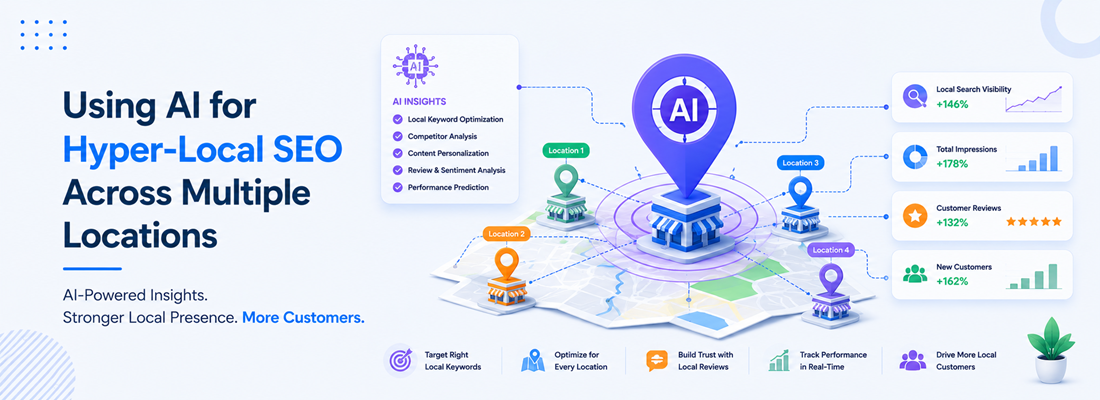
Like any advanced strategy, this approach comes with distinct advantages and potential drawbacks. Understanding both sides is essential for setting realistic expectations and mitigating risks.
The Advantages of an AI-Driven Local Approach
- Unmatched Efficiency: Automates repetitive tasks like citation building and report generation, freeing up human resources for strategic planning.
- Deeper Consumer Insights: AI uncovers hidden patterns in local search behavior that are invisible to the naked eye, leading to more effective marketing campaigns.
- Scalability: Managing hyperlocal campaigns for 100 locations is nearly impossible manually, but AI makes it feasible and cost-effective.
- Real-Time Adaptation: The ability to change bids, content, and offers instantly based on live data is a massive competitive advantage.
- Data Privacy Concerns: Hyperlocal targeting relies heavily on location data, which is subject to strict regulations like GDPR. Mismanagement can lead to legal penalties.
- Dependence on Data Quality: AI is only as good as the data it receives. Inaccurate or outdated business hours will lead to poor AI decisions and a bad user experience.
- Loss of Human Touch: Over-automation can make a brand feel robotic. It is crucial to maintain human oversight for creative tasks and complex customer interactions.
- Implementation Cost: High-end AI tools and the expertise required to manage them can be expensive for small local businesses.
The Limitations and Challenges to Consider
Comparison: Traditional Local SEO vs. AI Hyperlocal SEO
To fully grasp the value of this evolution, a direct comparison highlights the operational differences and outcomes. The table below illustrates the key distinctions between the old methodology and the new AI-powered approach.
| Feature | Traditional Local SEO | AI Hyperlocal SEO |
|---|---|---|
| Keyword Research | Manual, based on historical data and intuition. | Predictive, based on real-time trends and machine learning. |
| Content Creation | Static pages, often duplicated across locations. | Dynamic, personalized content generated for specific micro-regions. |
| Data Analysis | Weekly or monthly reporting, reactive. | Real-time dashboards, proactive adjustments. |
| Targeting Scope | City or county level. | Neighborhood, street, or even building level. |
| User Experience | Generic experience for all visitors. | Highly personalized experience based on location context. |
| Scalability | Difficult to scale beyond 10-20 locations. | Easily scalable to hundreds of locations with automation. |
Common Mistakes and How to Avoid Them
Even with advanced AI tools, businesses often stumble on fundamental issues. Recognizing these pitfalls early can save significant time and budget. Here are the most frequent errors in AI hyperlocal SEO execution.
Ignoring the “Entity” Aspect of Local Search
Many marketers focus solely on keywords and forget that Google builds entities around businesses. AI can help establish your brand as a distinct entity by ensuring consistent Name, Address, and Phone number (NAP) data across all platforms. Failing to do this confuses the AI algorithms and dilutes your local authority.
Over-Optimizing for Robots, Not Humans
While AI generates content, it is vital to ensure that the output reads naturally. Search engines are sophisticated enough to detect AI-generated fluff. Always have a human editor review AI-generated hyperlocal content to ensure it provides genuine value, answers user questions, and maintains brand voice. Avoid stuffing location names into every sentence.
Neglecting Mobile User Experience
Hyperlocal searches are predominantly performed on mobile devices. If your website is not optimized for mobile speed and usability, all your AI efforts will be wasted. Google prioritizes mobile-first indexing, and a slow-loading page will kill your rankings regardless of how well you target the location.
Important Notes on Data Privacy and Ethics
As you integrate AI into your hyperlocal strategy, ethical considerations must be at the forefront. Collecting location data requires explicit user consent. Be transparent about what data you collect and how it is used. Furthermore, avoid using AI to create fake reviews or manipulate local rankings, as this violates Google’s guidelines and can result in severe penalties, including de-indexing.
It is also crucial to remember that AI is a tool, not a replacement for strategic thinking. The most successful campaigns combine the analytical power of AI with the creative and empathetic insights of human marketers. The goal is to enhance the customer experience, not to deceive or spam.
Frequently Asked Questions (FAQ)
What is the difference between Local SEO and Hyperlocal SEO?
Local SEO typically targets a broader area like a city or a large town. Hyperlocal SEO narrows the focus to specific neighborhoods, zip codes, or even a radius around a physical store. It targets users who are in the immediate vicinity and have high purchase intent, such as “near me” searches.
How does AI improve hyperlocal keyword research?
AI improves this by analyzing massive datasets to identify emerging trends and search patterns. It can predict which location-specific keywords will become popular based on external factors like weather, local events, or economic changes, allowing businesses to optimize content before the competition does.
Can small businesses afford AI hyperlocal SEO tools?
Yes, there are now many affordable AI-powered SEO tools designed for SMBs. While enterprise-level solutions are expensive, many platforms offer tiered pricing. Additionally, using AI for specific tasks like content generation or review analysis can be done with low-cost subscriptions, making it accessible for small businesses.
Is AI hyperlocal SEO effective for voice search?
It is highly effective. Voice search queries are conversational and location-specific. AI helps parse natural language to understand the intent behind phrases like “find a pizza place open late near me.” By optimizing content to answer these specific queries, businesses can capture a significant share of voice search traffic.
How long does it take to see results from AI hyperlocal SEO?
Results can vary, but typically, improvements in local pack rankings and organic traffic can be seen within 3 to 6 months. However, the real-time adaptation capabilities of AI mean that for time-sensitive promotions or events, results can be seen almost immediately, especially in paid search campaigns.
Conclusion
The integration of AI SEO and Hyperlocal SEO represents the next frontier in digital marketing. It moves beyond simple geographic targeting to create a dynamic, intelligent system that anticipates user needs and delivers personalized experiences in real-time. By leveraging predictive analytics, automated content, and real-time data, businesses can dominate their immediate market and build stronger connections with their local community.
The key to success lies in balancing technological power with human oversight. While AI handles the heavy lifting of data analysis and automation, the strategic direction, creative messaging, and ethical considerations must remain human-led. As search engines continue to evolve, the businesses that embrace this synergy will not only survive but thrive, capturing the attention of high-intent customers exactly when they are ready to buy.
Xem thêm:
- AI SEO Google Search Console: The Complete Guide to Smarter Search Performance
- AI SEO Google Gemini SEO: The Complete Playbook for 2025
- AI SEO Search Performance: The Complete Guide to Ranking in the Age of Machine Learning
- AI SEO Traffic Prediction: The Complete Guide to Forecasting Organic Growth
- AI SEO Organic Rankings: The Complete Guide to Dominating Search in 2025
Bài viết cùng chủ đề:

AI SEO SEO Automation with Make: The Complete Workflow Guide

AI SEO SEO Automation with Zapier: The Complete Workflow Guide

AI SEO SEO Automation with n8n: The Complete Workflow Guide
AI SEO SEO Automation with Gemini: The Complete Guide to Scaling Organic Growth

AI SEO SEO Automation with Claude: The Complete Guide to Scaling Content in 2025

AI SEO SEO Automation with ChatGPT: The Complete Playbook for 2025

AI SEO & SEO Automation for Affiliate Sites: The 2025 Playbook for Passive Income Growth
AI SEO & SEO Automation for Bloggers: The Complete Guide to Scaling Your Content

AI SEO & SEO Automation for Agencies: The Complete 2025 Playbook

AI SEO and SEO Automation for Ecommerce: The Complete Playbook for 2025

AI SEO & SEO Automation for WordPress: The Complete Playbook for 2025
AI SEO SEO Automation Strategy: The Complete Playbook for 2025

Mastering the AI SEO SEO Automation Process: A Complete Guide to Scaling Organic Growth
AI SEO SEO Automation System: The Complete Guide to Scaling Organic Growth in 2025
AI SEO SEO Automation Platform: The Complete Guide to Scaling Organic Growth in 2025
AI SEO SEO Automation Software: The Complete Guide to Scaling Organic Growth in 2025















