
No products in the cart.
AI SEO LLM Brand Authority: The Complete Guide to Dominating Search in the Age of Generative Engines
10
Aug
Aug
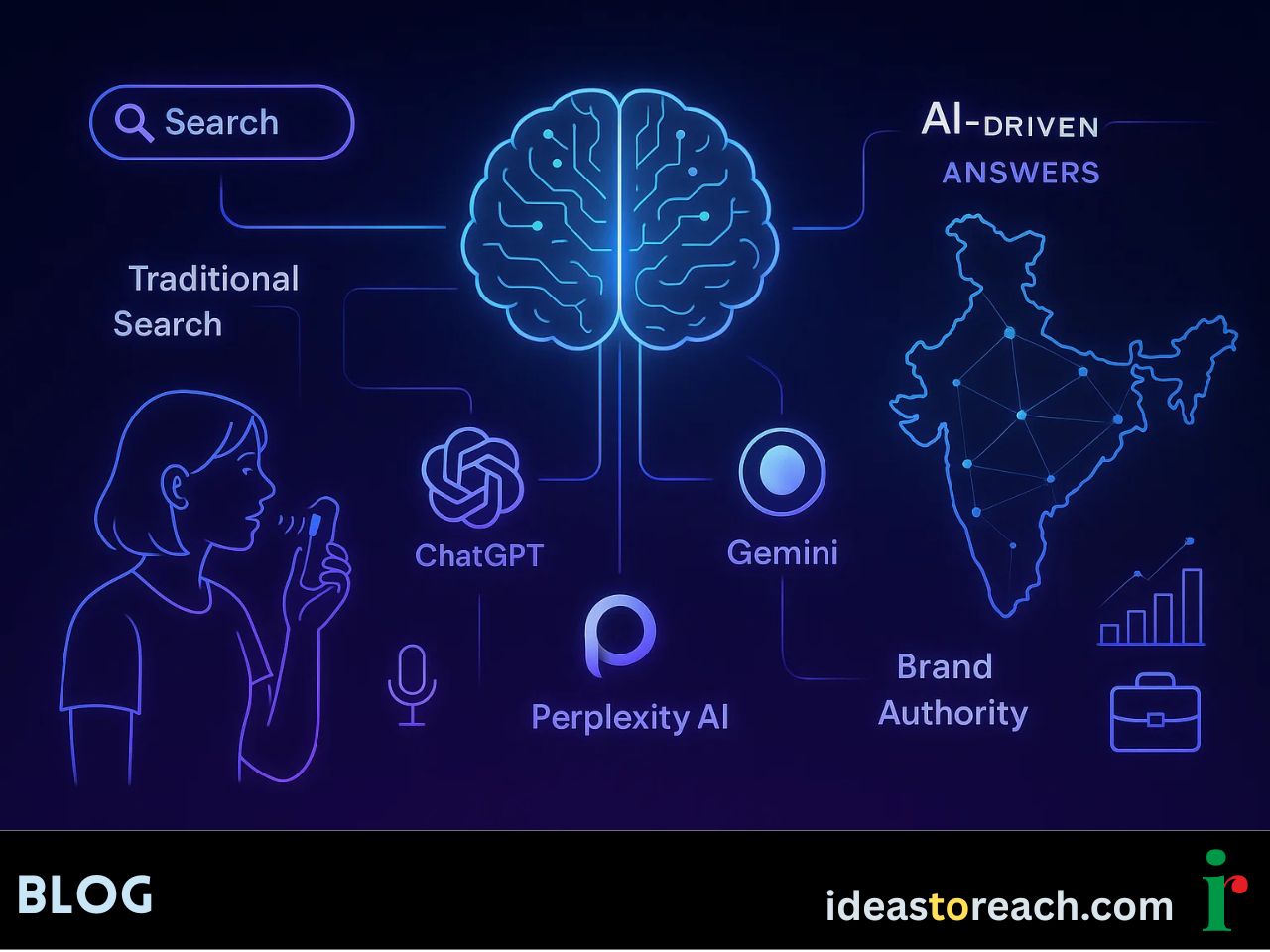
The digital marketing landscape has shifted beneath our feet. Traditional search engine optimization focused on backlinks and keyword density. Today, a new paradigm dominates: AI SEO LLM Brand Authority. This concept represents the intersection of technical search optimization, artificial intelligence, and the trust signals that large language models use to recommend brands. As Google integrates generative AI into search results and platforms like ChatGPT, Perplexity, and Claude become primary information gateways, your brand’s visibility depends on how well these systems understand, trust, and cite your content.
This guide provides a comprehensive roadmap for building authority that resonates with both traditional algorithms and the neural networks powering modern AI search. You will learn the mechanics of LLM citation, the specific strategies to optimize for AI-driven discovery, and the pitfalls that can render your digital presence invisible to generative engines.
Understanding the Shift: From PageRank to Neural Ranking
For two decades, Google’s PageRank algorithm dominated. It counted links as votes, creating a web of authority based on human curation. The rise of large language models has fundamentally altered this equation. LLMs do not “browse” the web in real-time for every query. Instead, they rely on a mixture of pre-training data, retrieval-augmented generation (RAG), and real-time search APIs to formulate answers.
This means your brand must be legible to two distinct systems simultaneously. The first is the classic crawler-based index. The second is the semantic embedding space of the LLM. AI SEO LLM Brand Authority is the measure of how consistently and accurately your brand appears in the latent knowledge of these models. When a user asks an AI assistant for a product recommendation, the model does not read your homepage. It retrieves snippets, reviews, and structured data that it has been trained to associate with high trust and relevance.
The Anatomy of an LLM Citation
When an AI model cites a source, it is not a random selection. The model evaluates several weighted factors. Understanding these factors is the first step toward optimization.
- Source Consistency: The model looks for corroboration. If your claims appear on your site, on reputable news outlets, and in industry databases, the model assigns higher confidence to your information.
- Entity Clarity: The model must be able to unambiguously identify who you are. This requires a clean digital footprint with consistent Name, Address, and Phone Number (NAP) data, clear authorship, and distinct entity schema.
- Semantic Relevance: The model measures the distance between your content’s vector embeddings and the query’s intent. Superficial keyword matching fails here; deep topical coverage wins.
- Recency and Freshness: LLMs are trained on snapshots of data. However, RAG systems pull live data. Brands that continuously publish updated, accurate information are more likely to be selected for real-time retrieval.
- Audit Your Digital Footprint: Search for your brand name in ChatGPT and Perplexity. What do they say about you? If the answer is “I couldn’t find information,” you have a gap. If the answer is inaccurate, you have a misinformation problem.
- Implement Entity Schema: Add Organization and Person schema to your site. Verify your brand on Google Business Profile and Bing Places. Ensure consistency across all directories.
- Create a “Data Vault”: Designate a section of your site for original research. Publish one unique study or survey per quarter. This becomes your authority anchor.
- Optimize for Snippet Extraction: Rewrite your top 10 pages to include a concise, 40-60 word summary at the top. This “TL;DR” block is often what the AI pulls for a featured snippet.
- Build Author E-E-A-T: Add author bios with credentials, links to LinkedIn, and a photo. LLMs look for “Experience, Expertise, Authoritativeness, and Trustworthiness.” A named author with a verifiable background is a strong trust signal.
- Citation Rate: How often does an LLM cite your domain in its answers?
- Sentiment Alignment: Is the AI presenting your brand in a positive, neutral, or negative light?
- Entity Association: What keywords and topics does the AI associate with your brand name?
Why Traditional SEO Fails to Build LLM Authority
Many brands see their traffic plummet despite ranking #1 for high-volume keywords. The reason is simple: the SERP (Search Engine Results Page) is shrinking. Google’s AI Overviews answer the query directly, pushing traditional blue links down. If you are not the source cited within that AI Overview, your click-through rate drops to near zero.
Traditional SEO often relies on “thin” content designed to satisfy a specific query string. LLMs penalize this. They are trained to detect fluff, redundancy, and lack of original insight. If your content merely rephrases the top three results on Google, the LLM has no reason to cite you. It will cite the original source instead. To build AI SEO LLM Brand Authority, you must move beyond “ranking” and focus on “referencing.”
The Core Pillars of AI SEO LLM Brand Authority
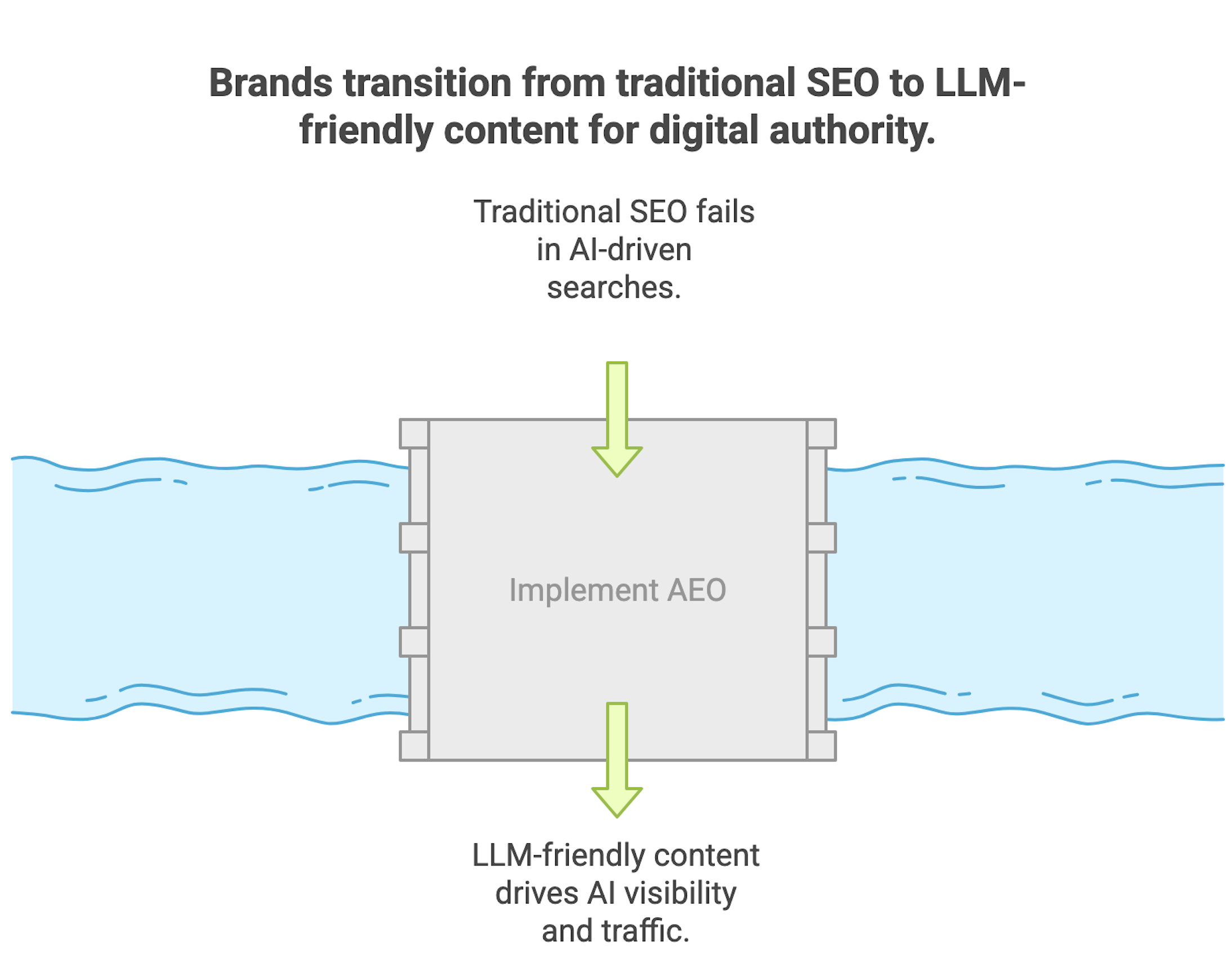
Building authority in the age of AI requires a holistic approach. It is not a single tactic but a systemic overhaul of how you produce and distribute content. The following pillars form the foundation of this strategy.
1. Entity Optimization and Knowledge Graph Alignment
An entity is a distinct, well-defined thing—a person, brand, place, or concept. Google and LLMs use Knowledge Graphs to connect entities. If your brand is not a recognized entity, you do not exist to the AI.
To optimize your entity, you must implement schema markup (specifically Organization, Person, Product, and FAQPage schema). This structured data acts as a cheat sheet for crawlers, telling them exactly what your brand is, what you do, and who is behind it. Furthermore, you must build a Wikipedia or Wikidata presence. These platforms are heavily weighted in LLM training data. A verified Wikipedia page is often the single strongest signal of authority you can possess.
2. Digital PR and Authoritative Link Building
Links still matter, but the quality threshold has skyrocketed. A link from a spammy directory is now a negative signal. A link from a major news outlet, a.edu domain, or a recognized industry leader is a massive positive signal. LLMs use these links to verify your credibility. They treat a mention in Forbes or TechCrunch as a “witness” testifying to your legitimacy.
Focus on digital PR campaigns that generate coverage from high-authority domains. This is not about guest posting for links. It is about earning citations through original research, expert commentary, and unique data. When an LLM sees your brand consistently mentioned alongside authoritative publishers, it raises your trust score.
3. Content Depth and Original Research
The era of the 500-word blog post is over. LLMs are trained on the entire internet. To stand out, you must provide information that does not exist elsewhere. This means publishing original studies, proprietary data, and expert interviews. This “data exhaust” becomes your unique selling proposition to the AI.
When you publish a study with a unique statistic, you create a “citation magnet.” Other writers will link to your data. LLMs will use your data point to answer queries. This creates a flywheel effect where your brand becomes the definitive source for a specific fact. Ensure your data is presented in a clear, scannable format, including tables and charts with descriptive alt text, so the AI can parse the information effectively.
Technical SEO for Generative Engines
While content is king, the technical infrastructure must be flawless. Generative engines are sensitive to crawlability and rendering issues. If a bot cannot read your JavaScript, it cannot index your content.
Optimizing for Retrieval-Augmented Generation (RAG)
RAG is the process by which LLMs fetch real-time data to answer queries. To be retrieved, your content must be structured in a way that is easy to chunk. This means using clear headings, short paragraphs, and bullet points. Avoid monolithic walls of text. The AI needs to extract a specific “chunk” of information to answer a query. If your content is a 5,000-word essay with no subheadings, the A
Use a “question-and-answer” format naturally within your content. If you answer the exact question a user is asking, the AI is more likely to pull your text verbatim. This is why the FAQ section is critical for AI SEO LLM Brand Authority.
Log File Analysis and Bot Management
You must monitor how AI crawlers (like GPTBot, ClaudeBot, and Google-Extended) interact with your site. Use log file analysis to see which pages these bots are crawling. If they are hitting 404 errors or being blocked by your robots.txt, you are losing authority. Ensure that your most important pages are accessible to these specific bots. While you may block them from training, you should allow them to access your site for RAG retrieval.
Practical Application: A Step-by-Step Guide
Implementing this strategy requires a systematic approach. Follow these steps to begin building your authority today.
Benefits and Limitations of the AI SEO Approach
Adopting this strategy yields significant advantages, but it is not without its challenges. Understanding the trade-offs is essential for setting realistic expectations.
| Aspect | Benefits | Limitations |
|---|---|---|
| Traffic Quality | Higher conversion rates as users come with high intent from AI recommendations. | Lower raw traffic volume compared to broad keyword rankings. |
| Brand Resilience | Protects against algorithm updates that target thin content. | Requires continuous investment in original research and PR. |
| Competitive Moat | Harder for competitors to copy your proprietary data and entity signals. | Long lead time (6-12 months) before authority is recognized by LLMs. |
| Cost | Reduces reliance on expensive PPC ads over time. | High upfront cost for data creation and digital PR campaigns. |
Common Mistakes and How to Avoid Them
Many brands sabotage their efforts by applying outdated tactics to this new paradigm. Here are the most frequent errors and the corrections you should implement.
Mistake 1: Ignoring the “Zero-Click” Reality
Many marketers panic when they see a drop in clicks. They assume the SEO is failing. In reality, the AI is answering the query, and the user is satisfied without clicking. The mistake is not optimizing for this. You must track “brand mentions” and “share of voice” in AI responses, not just clicks. If you are cited in the AI answer, you are winning, even without the click.
Mistake 2: Blocking AI Crawlers
Some brands block GPTBot to protect their content from “theft.” This is a fatal error. While you may prevent the model from training on your data, you also prevent it from citing you in real-time retrieval. You are invisible to the very audience you want to reach. Allow access for retrieval, even if you block training.
Mistake 3: Focusing on Volume Over Specificity
Publishing 10 generic articles a week dilutes your authority. The LLM sees you as a “content farm” and lowers your trust score. Instead, publish one definitive, 3,000-word guide that covers a topic exhaustively. The LLM prefers depth over breadth.
Important Notes on Measuring Success
Measuring AI SEO LLM Brand Authority requires a shift in analytics. Google Analytics will not show you the full picture. You must use AI-specific tracking tools to monitor your visibility in ChatGPT, Perplexity, and Google AI Overviews. Track the following metrics:
These metrics require manual checks or specialized software. A monthly audit of 50 key queries across different AI platforms is a practical starting point.
Frequently Asked Questions
What is the difference between traditional SEO and AI SEO?
Traditional SEO focuses on ranking web pages in a list of blue links. AI SEO focuses on being referenced as a source within a generated answer. Traditional SEO relies on backlinks and keyword density, while AI SEO relies on entity clarity, structured data, and original research that an LLM can verify and cite.
How do I check my brand’s visibility in ChatGPT?
You can perform a manual audit by asking ChatGPT specific questions about your industry and your brand. For a scalable approach, use AI SEO tools that integrate with OpenAI’s API to track your domain’s appearance in responses. Look for the “cited sources” section to see if your URL appears.
Does Google’s AI Overview affect my click-through rate?
Yes, significantly. When Google’s AI Overview appears, it often satisfies the user’s query without requiring a click. However, if your content is cited within that Overview, you gain brand exposure and credibility. The goal is to be the source inside the box, not just a link below it.
Is schema markup still important for LLMs?
Absolutely. Schema markup provides explicit signals about your entity. While LLMs can infer meaning from unstructured text, structured data removes ambiguity. It tells the AI exactly what your business is, who the founder is, and what your products do, which increases the confidence score of the model.
How long does it take to build AI SEO LLM Brand Authority?
It is a long-term strategy. While you can see initial results in 3-4 months, significant authority typically takes 6-12 months. This timeline depends on the competitiveness of your niche and the consistency of your digital PR and content output. The models update their knowledge bases periodically, so patience is essential.
Conclusion
The transition from keyword-based search to semantic, AI-driven discovery is irreversible. Brands that cling to outdated tactics will find themselves invisible to the next generation of internet users. AI SEO LLM Brand Authority is not a trend; it is the new standard for digital visibility.
By focusing on entity optimization, publishing original research, and ensuring your content is structured for machine retrieval, you position your brand as a trusted source in the neural networks that now mediate our access to information. The investment is significant, but the payoff is a durable competitive advantage that cannot be easily replicated by competitors still stuck in the PageRank era. Start building your authority today, and ensure your brand is the answer when the world asks the AI.
Xem thêm:
- AI SEO AI Mention Tracking: The Complete Guide to Monitoring Brand Visibility in the Age of Generative Search
- The Ultimate AI SEO Roadmap: How to Rank in the Age of Intelligent Search
- AI SEO Frase: The Complete Guide to AI-Powered Content Optimization in 2025
- AI SEO Content Intelligence: The Complete Guide to Data-Driven Content That Ranks
- AI Image SEO: The Definitive Guide to Ranking AI-Generated Visuals
Bài viết cùng chủ đề:

AI SEO SEO Automation with Make: The Complete Workflow Guide

AI SEO SEO Automation with Zapier: The Complete Workflow Guide

AI SEO SEO Automation with n8n: The Complete Workflow Guide
AI SEO SEO Automation with Gemini: The Complete Guide to Scaling Organic Growth

AI SEO SEO Automation with Claude: The Complete Guide to Scaling Content in 2025

AI SEO SEO Automation with ChatGPT: The Complete Playbook for 2025

AI SEO & SEO Automation for Affiliate Sites: The 2025 Playbook for Passive Income Growth
AI SEO & SEO Automation for Bloggers: The Complete Guide to Scaling Your Content

AI SEO & SEO Automation for Agencies: The Complete 2025 Playbook

AI SEO and SEO Automation for Ecommerce: The Complete Playbook for 2025

AI SEO & SEO Automation for WordPress: The Complete Playbook for 2025
AI SEO SEO Automation Strategy: The Complete Playbook for 2025

Mastering the AI SEO SEO Automation Process: A Complete Guide to Scaling Organic Growth
AI SEO SEO Automation System: The Complete Guide to Scaling Organic Growth in 2025
AI SEO SEO Automation Platform: The Complete Guide to Scaling Organic Growth in 2025
AI SEO SEO Automation Software: The Complete Guide to Scaling Organic Growth in 2025















