
No products in the cart.
AI SEO LLM Rankings: The Complete Guide to Winning AI Search in 2025
10
Aug
Aug
The digital marketing landscape has shifted dramatically with the rise of generative AI. Traditional search engine optimization focused on Google’s algorithms, but a new frontier has emerged: optimizing for large language models (LLMs) like ChatGPT, Claude, and Perplexity. Understanding AI SEO LLM Rankings is no longer optional for brands that want visibility. This guide breaks down how these rankings work, why they matter, and exactly how to position your content to be cited by AI systems.
What Are AI SEO LLM Rankings?
AI SEO LLM Rankings refer to the process and metrics used to determine how frequently and prominently a piece of content is referenced, cited, or recommended by large language models in their generated responses. Unlike traditional search rankings that rely on backlinks and domain authority, LLM rankings depend on data accessibility, semantic clarity, and source trustworthiness.
When a user asks ChatGPT a question, the model does not “search” the web in real-time (unless browsing is enabled). Instead, it generates text based on patterns learned from training data. However, with retrieval-augmented generation (RAG), models like Perplexity and Bing Chat actively fetch live web pages. In both scenarios, your content must be structured in a way that the model can easily parse and extract as a reliable answer.
The Shift from PageRank to Semantic Relevance
Google’s PageRank revolutionized search by using backlinks as a proxy for authority. LLMs, however, prioritize semantic relevance and factual consistency. A page with 50 backlinks but poor structure may be ignored by an LLM, while a well-structured, authoritative page with zero backlinks could be cited as a primary source. This shift means that technical SEO for LLMs focuses on entity clarity, concise definitions, and logical content hierarchy.
How Do LLMs Determine Which Content to Rank?
To improve your AI SEO LLM Rankings, you must understand the underlying mechanics. LLMs do not use a scoring system like Google’s 200+ ranking factors. Instead, they rely on a combination of training data prevalence and real-time retrieval quality.
1. Training Data Prevalence
If your content is widely available on the open web, it is more likely to be included in the model’s training corpus. High-quality, syndicated content from major publications often dominates. For niche sites, this means you need to earn mentions from larger, authoritative domains to get into the training data.
2. Retrieval-Augmented Generation (RAG) Signals
For models that browse the web (e.g., Perplexity, ChatGPT with browsing), the retrieval system ranks pages based on:
- Keyword match: Exact phrases and synonyms used in the query.
- Freshness: How recently the page was updated.
- Source reliability: Domain reputation, editorial standards, and factual accuracy.
- Formatting: Clear headings, bullet points, and tables that are easy to extract.
- Zero-Click Dominance: Your brand becomes the default answer, even if users never click through.
- Future-Proofing: As AI search grows, you are already positioned for the next algorithm shift.
- Enhanced Brand Trust: Being cited by an AI model lends an air of authority and factual reliability.
- Competitive Moats: Few brands are actively optimizing for LLMs, so early adopters gain a significant edge.
3. Entity Consistency
LLMs build knowledge graphs of entities (people, places, concepts). If your content clearly defines entities and their relationships, the model can confidently use it. For example, if you write about “AI SEO LLM Rankings,” you must clearly define what an LLM is, what SEO is, and how they intersect.
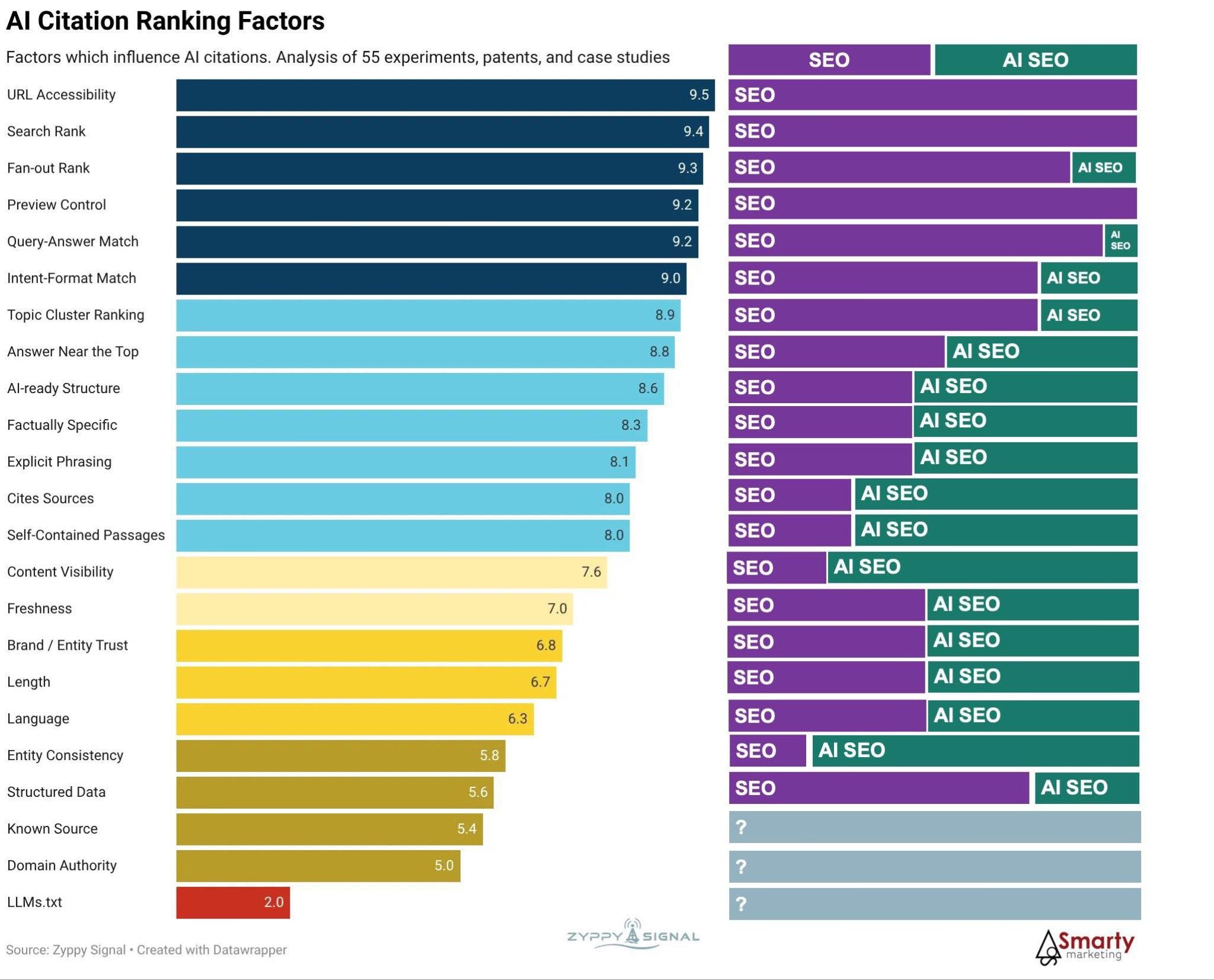
Key Factors That Influence AI SEO LLM Rankings
Optimizing for LLMs requires a different technical and editorial approach. Here are the critical factors that directly impact whether your content gets picked up.
Content Structure and Schema Markup
LLMs love structured data. Using JSON-LD schema markup (e.g., FAQPage, Article, HowTo) helps the model understand the context of your content. Additionally, using proper HTML heading hierarchy (H1, H2, H3) allows the crawler to segment your content into digestible chunks.
Citation Density and Authority
While backlinks matter less, citations from other LLMs and AI tools matter more. If ChatGPT references your article in a response, that creates a “digital footprint” that other models may learn from. Monitoring your brand mentions in AI outputs is a new KPI for AI SEO LLM Rankings.
Readability and Clarity
Complex jargon and ambiguous sentences confuse LLMs. Use simple, declarative sentences. Define acronyms on first use. Avoid “fluff” content that pads word count without adding value. The model needs to extract a clear answer quickly.
Factual Accuracy and Consistency
LLMs are prone to hallucination, but they are also trained to avoid unreliable sources. If your content contains outdated statistics or contradicts widely accepted facts, the model will likely ignore it. Always cite primary sources and update your content regularly.
AI SEO vs. Traditional SEO: A Detailed Comparison
Understanding the differences helps you allocate resources effectively.
| Aspect | Traditional SEO | AI SEO LLM Rankings |
|---|---|---|
| Primary Ranking Factor | Backlinks, domain authority | Semantic clarity, source trust, data structure |
| User Intent | Click-through to website | Direct answer extraction (zero-click) |
| Content Length | Often 1500-2500 words | Variable, but concise definitions are key |
| Keyword Strategy | Exact match and partial match | Entity-based and conversational phrases |
| Measurement | Rankings, organic traffic | Brand mentions in AI outputs, citation rate |
| Technical Focus | Page speed, mobile usability | Schema markup, clean HTML, API accessibility |
Traditional SEO drives visitors to your site. AI SEO LLM Rankings drive your brand into the “answer box” of the future. Both are necessary, but they require different tactics.
Practical Guide: How to Improve Your AI SEO LLM Rankings
Improving your visibility in LLM outputs is a systematic process. Follow these steps to build a robust AI SEO strategy.
Step 1: Conduct an LLM Visibility Audit
Start by asking major LLMs (ChatGPT, Claude, Perplexity) questions related to your niche. Document which sources they cite. If your competitors appear but you don’t, analyze their content structure. Use tools like “ChatGPT mentions” tracking or manual queries to establish a baseline.
Step 2: Create “Answer-First” Content
Structure your content to answer the question in the first 50-100 words. Use a direct, declarative sentence. For example, if your target keyword is “AI SEO LLM Rankings,” your introduction should immediately define it. This “answer block” is what LLMs extract for featured snippets and AI responses.
Step 3: Implement FAQ Schema
FAQPage schema markup is one of the most effective ways to get picked up by LLMs. Create a dedicated FAQ section at the end of your article. Each question should be a full sentence that mirrors how users speak to AI (e.g., “What is the best way to improve AI SEO LLM Rankings?”).
Step 4: Build Digital PR for AI Citations
Get your content mentioned in AI-generated roundups and newsletters. Tools like “ChatGPT” and “Claude” are often trained on high-authority publications like Forbes, TechCrunch, and industry-specific journals. Pitch guest posts to these sites or get quoted as an expert source.
Step 5: Optimize for Perplexity and Bing Chat
These platforms use live web crawling. Ensure your site is crawlable and fast. Use clear, descriptive URLs. Avoid heavy JavaScript rendering that might hide content from crawlers. Perplexity, in particular, favors content with clear citations and references.
Benefits of Optimizing for AI SEO LLM Rankings
Investing in this new discipline offers several strategic advantages beyond just visibility.
Limitations and Challenges of AI SEO LLM Rankings
It is not all smooth sailing. There are significant hurdles to overcome.
Lack of Transparency
Unlike Google Search Console, t” You must manually audit outputs, which is time-consuming and imprecise.
Hallucination Risk
Even if you do everything right, an LLM might hallucinate a fact and attribute it to you incorrectly. Monitoring and correcting these errors is difficult.
Rapid Model Updates
LLMs are updated frequently. A strategy that works for GPT-4 might fail for GPT-5. You must stay agile and continuously test.
Common Mistakes to Avoid in AI SEO LLM Rankings
Many marketers apply traditional SEO tactics that backfire in the AI space. Avoid these pitfalls.
Keyword Stuffing in Headings
Using the exact keyword repeatedly in H2s and H3s looks unnatural to LLMs. They prefer semantic variations. Write for humans, not for a keyword density checker.
Ignoring the “Answer Block”
If your introduction is a long, winding story, the LLM will skip it. Put the answer right at the top. Use a “TL;DR” or summary box for complex topics.
Relying Solely on Backlinks
Backlinks still help with domain authority, but they do not guarantee LLM citations. Focus on content clarity and factual accuracy first.
Neglecting Content Freshness
LLMs with browsing capabilities prioritize fresh content. If your statistics are from 2022, the model will likely choose a 2024 source instead. Update your data quarterly.
Important Notes for Long-Term Success
To sustain high AI SEO LLM Rankings, you must adopt a holistic mindset. AI models are not static; they learn from user interactions. If users frequently upvote or save your content within AI interfaces, that signals quality to the system.
Additionally, consider the “LLM Knowledge Graph.” Your brand should be consistent across all platforms—your website, LinkedIn, Wikipedia, and industry directories. The more consistent the data, the easier it is for the model to trust and cite you.
Finally, do not abandon traditional SEO. Google is still the largest search engine, and it is also integrating AI into its own results (SGE). A strong traditional SEO foundation supports your AI SEO efforts, and vice versa.
Frequently Asked Questions (FAQ)
What is the difference between AI SEO and traditional SEO?
Traditional SEO focuses on ranking in search engine results pages (SERPs) to drive clicks. AI SEO focuses on being cited as a source within AI-generated answers, which often results in zero clicks but high brand visibility.
How do I check my AI SEO LLM Rankings?
T You can manually query ChatGPT, Claude, and Perplexity with your target keywords and note whether your brand appears. Third-party tools like “Brand24” or “Mention” can track AI mentions, but manual audits are most accurate.
Does schema markup help with LLM rankings?
Yes. Schema markup (especially FAQPage and Article) helps LLMs understand the structure and context of your content, making it easier to extract and cite.
Are backlinks still important for AI SEO?
Backlinks are less important for direct LLM citation but still matter for overall domain authority. High-authority domains are more likely to be included in training data and trusted by retrieval systems.
How long does it take to see results from AI SEO?
It varies. If you are optimizing for live-browsing models like Perplexity, you can see results within days. For training data inclusion (ChatGPT without browsing), it can take months or years, depending on how often your content is crawled and syndicated.
Conclusion
AI SEO LLM Rankings represent a fundamental shift in how digital visibility is earned. The old playbook of backlinks and keyword density is giving way to a new paradigm of semantic clarity, structured data, and factual authority. By implementing the strategies outlined in this guide—creating answer-first content, using schema markup, auditing AI outputs, and building digital PR—you can position your brand as the go-to source for AI systems.
The transition will not be instant, but the brands that start optimizing for LLMs today will own the AI search landscape of tomorrow. Focus on being the most clear, concise, and credible source in your niche, and the algorithms will follow.
Xem thêm:
- LLM Optimization: The Complete Guide to Boosting Speed, Accuracy, and Cost Efficiency
- AI SEO Content Workflow: The Complete Blueprint for Scaling Organic Growth in 2025
- AI SEO AI Search Reputation: The Complete Playbook for 2025
- AI Indexing: The Complete Guide to How Artificial Intelligence is Revolutionizing Search and Data Retrieval
- AI SEO Integrations: The Complete Guide to Smart Automation and Higher Rankings
Bài viết cùng chủ đề:

AI SEO SEO Automation with Make: The Complete Workflow Guide

AI SEO SEO Automation with Zapier: The Complete Workflow Guide

AI SEO SEO Automation with n8n: The Complete Workflow Guide
AI SEO SEO Automation with Gemini: The Complete Guide to Scaling Organic Growth

AI SEO SEO Automation with Claude: The Complete Guide to Scaling Content in 2025

AI SEO SEO Automation with ChatGPT: The Complete Playbook for 2025

AI SEO & SEO Automation for Affiliate Sites: The 2025 Playbook for Passive Income Growth
AI SEO & SEO Automation for Bloggers: The Complete Guide to Scaling Your Content

AI SEO & SEO Automation for Agencies: The Complete 2025 Playbook

AI SEO and SEO Automation for Ecommerce: The Complete Playbook for 2025

AI SEO & SEO Automation for WordPress: The Complete Playbook for 2025
AI SEO SEO Automation Strategy: The Complete Playbook for 2025

Mastering the AI SEO SEO Automation Process: A Complete Guide to Scaling Organic Growth
AI SEO SEO Automation System: The Complete Guide to Scaling Organic Growth in 2025
AI SEO SEO Automation Platform: The Complete Guide to Scaling Organic Growth in 2025
AI SEO SEO Automation Software: The Complete Guide to Scaling Organic Growth in 2025















