
No products in the cart.
AI SEO Plugins: Automate Your Search Rankings Without Losing the Human Touch
29
Jul
Jul
Understanding the New Era of AI SEO Plugins
The landscape of search engine optimization has shifted dramatically. Manual keyword stuffing and guesswork no longer deliver results. Instead, a new category of tools has emerged: AI SEO plugins. These intelligent systems integrate directly into content management platforms like WordPress, Shopify, or custom CMS setups, and use machine learning models to analyze, predict, and automate on-page and technical SEO tasks. An AI SEO plugin does not just suggest meta descriptions; it reads your competitor’s top-ranking pages, understands search intent, and builds a content blueprint in real time. The main keyword here—AI SEO Plugins—represents a fusion of natural language processing, big data, and traditional ranking signals, all packaged into a user-friendly interface that requires no coding skills. For digital marketers, agencies, and small business owners, understanding how these plugins work is essential to staying competitive. They compress months of manual research into minutes of guided optimization. Yet the technology is not magic. It still demands strategic oversight. Without that, even the smartest plugin becomes a crutch rather than a catalyst.
What Exactly Are AI SEO Plugins?
At its core, an AI SEO plugin is a software extension that uses artificial intelligence to enhance or fully automate parts of the search optimization workflow. Unlike traditional SEO tools that rely on static rule-based checks (like counting keyword density or flagging missing alt text), AI-powered plugins leverage models trained on vast datasets of ranking pages, user behavior signals, and Google’s own algorithm updates. They interpret context, suggest semantically related terms, and even generate entire content sections that align with what users actually search for.
These plugins often integrate with large language models (LLMs) and real-time SERP analysis APIs. For example, when you write a blog post, the plugin might scan the first page of Google for your target query, detect content gaps, and prompt you to add specific subtopics that competitors cover. Some plugins go further by auto-generating schema markup, optimizing internal linking structures, or adjusting page load factors based on Core Web Vitals predictions. The result is a dynamic, data-driven SEO assistant that lives inside your website’s backend.
The shift from reactive to predictive optimization is what sets AI SEO plugins apart. They don’t wait for rankings to drop; they proactively identify content decay and re-optimize pages before traffic sinks. This level of automation was unthinkable five years ago, and its adoption is accelerating as search engines themselves become more AI-centric.
The Core Components of AI-Powered SEO Tools
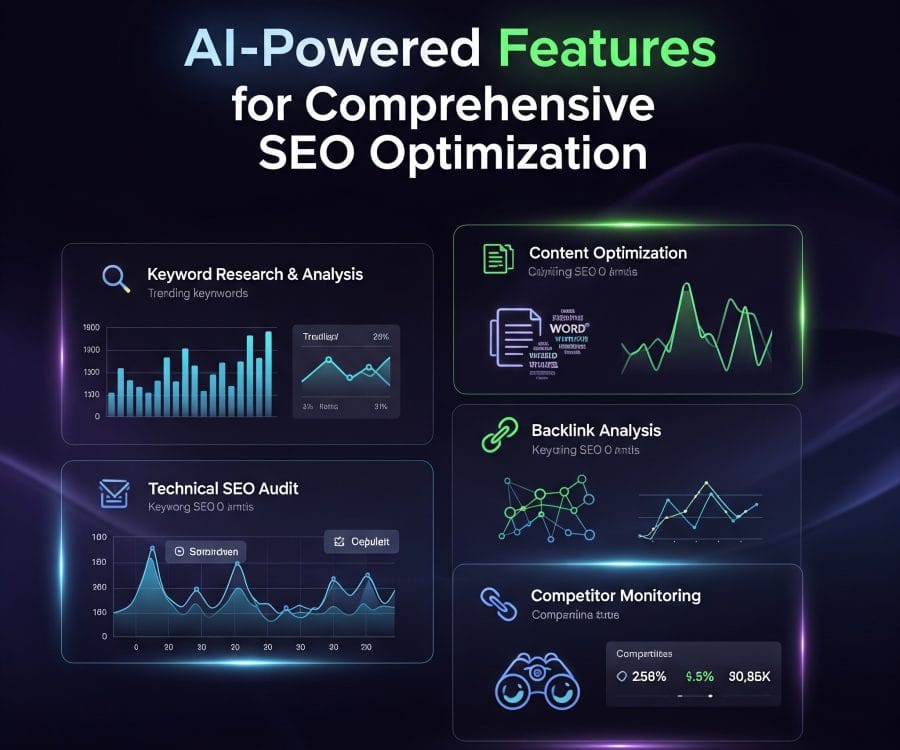
To fully grasp how these plugins deliver value, it helps to break down their underlying architecture. Most advanced AI SEO plugins combine several specialized modules, each addressing a different ranking factor. These components rarely work in isolation; they feed data into a central recommendation engine.
Content Intelligence and NLP Optimization
The content module is often the headline feature. It uses natural language processing to analyze top-performing pages and extract topics, entities, and question phrases that Google expects to see. Instead of focusing on exact-match keywords, the plugin builds a topic model. It might recommend including terms like “local citations” alongside “local SEO,” or flag that a missing H2 about “voice search optimization” is weakening your page’s comprehensiveness. Some plugins also score readability and adjust tone of voice based on the target audience segment. This moves SEO away from a mechanical checklist toward genuine subject matter depth.
Automated Technical Audits
Technical SEO is often the most tedious part of optimization. AI SEO plugins automate site crawls and interpret error logs. They don’t just list broken links; they prioritize fixes based on traffic impact, using machine learning to estimate which issues directly hurt crawl budget or user engagement. For instance, a plugin might detect that a set of thin-content pages is draining crawl equity and suggest consolidating them, while automatically implementing 301 redirects and updating the XML sitemap. Core Web Vitals optimization gets a similar treatment, with AI suggesting specific element delays or unused JavaScript removal based on real-user monitoring data.
Internal Linking and Site Architecture
Manually mapping internal links across a large site is nearly impossible without error. AI SEO plugins analyze link graphs and identify orphan pages, weak spots in topic clusters, and opportunities to boost authority flow. They often suggest contextual link insertion points within existing content, using semantic matching to ensure the anchor text and destination are topically aligned. This keeps the site structure tight without requiring constant manual audits.
Schema Markup Generation
Structured data remains a powerful yet underused ranking lever. AI plugins can scan page content and auto-generate appropriate schema types—FAQ, HowTo, Article, Product, Review, and more—without manual coding. They even validate against Google’s Rich Results Test within the plugin dashboard, reducing the risk of errors that could lead to manual actions.
Classification of AI SEO Plugins by Function
The market now includes dozens of solutions, but they generally fall into a few distinct categories. Understanding these helps you choose the right tool for your specific needs.
- All-in-One AI SEO Suites: Plugins like Rank Math PRO (with its Content AI module) or All In One SEO’s AI features aim to cover everything from meta tags to full site audits. They are built for WordPress and integrate tightly with the block editor.
- AI Content Optimization Extensions: Tools such as Surfer SEO’s WordPress plugin or Frase’s integration focus almost exclusively on content. They provide real-time topical suggestions and competitor comparisons as you write, often connecting to external NLP APIs.
- Automated Internal Link Builders: Plugins like Link Whisper use AI to analyze your entire site and recommend relevant internal links. They can even auto-link specified keywords to target pages, saving hours of manual work.
- AI-Powered Schema Plugins: Solutions like Schema Pro with AI enhancements automatically generate and manage structured data across a site, detecting content type and applying the right markup without user intervention.
- Chatbot and Generative AI Assistants: A newer breed, such as AI Engine for WordPress, embeds GPT-based chatbots that can generate content, answer SEO questions, and even produce meta data from simple commands inside the admin panel.
Benefits of Integrating AI SEO Plugins
The most immediate benefit is speed. A content brief that once required an afternoon of manual SERP analysis now takes a few minutes. For businesses publishing at scale—e-commerce product descriptions, news outlets, multi-location service pages—that time saving compounds quickly. Accuracy also improves. Human errors in canonical tags, hreflang implementation, or duplicate content often slip through manual checks. AI plugins catch these systematically, reducing the risk of costly search penalties.
Another underappreciated advantage is consistency across large teams. When multiple writers and editors contribute, maintaining a uniform SEO standard is difficult. An AI plugin enforces baseline rules and automates quality gates, ensuring every page meets the same technical and content thresholds. This leads to more predictable ranking results and a cleaner site architecture.
Cost efficiency is a significant factor. While premium plugins and API credits aren’t free, they often replace the need for multiple point solutions. A single AI SEO plugin can handle keyword research, content optimization, internal linking, and schema markup, consolidating budgets and reducing tool-switching friction. For agencies, this also simplifies client reporting and onboarding.
Limitations and Real-World Drawbacks
Despite the hype, AI SEO plugins are not infallible. Their recommendations come from models trained on historical search data, which means they can be slow to adapt to algorithm shifts or entirely new search paradigms like generative AI summaries (SGE). A plugin might still suggest outdated tactics like exact-match anchor text in a world where Google penalizes over-optimization. Human oversight is mandatory.
Content quality can suffer if users blindly follow AI suggestions. Natural language generation modules sometimes produce bland, repetitive text that lacks brand voice or compelling storytelling. Search engines are increasingly sophisticated at detecting AI patterns, and over-reliance on machine-generated content can trigger quality classifier flags. The most effective approach treats plugin output as a draft, not a finished product.
Privacy and data security concerns also exist. Many AI-powered plugins send your content and site data to external APIs for processing. If your niche involves sensitive legal, medical, or financial information, you must review the plugin’s data handling policies carefully. Some plug-ins cache requests locally, but others transmit full page text to third-party servers, potentially violating GDPR or client NDAs.
Comparing Top AI SEO Plugins for WordPress
WordPress dominates the CMS market, so the most mature AI SEO plugins exist there. The table below compares key features across popular solutions, but keep in mind that updates roll out constantly.
| Plugin | Primary AI Function | Content Generation | Schema Automation | Internal Linking | Pricing Model |
|---|---|---|---|---|---|
| Rank Math PRO (Content AI) | On-page content scoring + topic suggestions | Yes (via API credits) | Advanced templates | Built-in Link Suggestions | Subscription (annual) |
| All In One SEO (AIOSEO) | SEO audits + smart meta tags | Limited (smart tags, no full article generation) | Basic auto-schema | Link Assistant add-on | Freemium + Premium |
| Yoast SEO + AI Add-ons | Readability + keyword analysis | No native; relies on external integrations | Manual/structured guidance | None (third-party needed) | Freemium |
| Surfer SEO WordPress Plugin | Real-time content editor with NLP | Full article outlines + paragraphs | No | No | Standalone SaaS + plugin |
| Link Whisper | AI internal link suggestions | No | No | Core feature, automated linking | One-time or annual |
| AI Engine | ChatGPT integration + content & chatbots | Full article & image generation | Manual | No | Freemium + API costs |
The choice depends on your primary pain point. If content throughput is the bottleneck, a tool like Surfer SEO’s plugin might be best. If site architecture and link equity are weak, Link Whisper delivers focused value. Many businesses combine a content-focused plugin with a lightweight technical SEO tool to cover all bases without duplication.
How to Choose and Deploy AI SEO Plugins Effectively
Selecting a plugin requires more than just comparing feature lists. Start by auditing your current SEO gaps. If your team struggles with content depth, prioritize an NLP-based content optimizer. If technical issues plague your site, look for plugins with robust crawler automation and smart reporting. Avoid the temptation to install multiple AI plugins that overlap, as they can conflict—for example, two schema generators may output competing markup, confusing search engines.
During implementation, begin with a staging environment. Enable the plugin’s AI features gradually. For content generation, establish clear human review protocols. A good practice is to use the plugin to generate outlines, topic clusters, and initial drafts, then have an expert writer refine the material. For technical automation, allow the plugin to detect issues but keep manual approval for bulk changes like redirects or noindex tags. A botched auto-noindex can wipe entire sections from the index overnight.
Monitor performance closely in the first month. Compare before-and-after metrics: Core Web Vitals scores, crawl stats in Google Search Console, and keyword rankings for pages optimized by the AI. If an AI plugin’s recommendations consistently underperform against your own manual pages, re-evaluate its prompt settings or the quality of the external API it relies on. Not all AI is equal; some models lag behind the latest search trends.
Common Mistakes That Sabotage AI SEO Plugin Success
One of the biggest errors is treating the plugin as a replacement for strategy. An AI can suggest what to write, but it cannot understand your brand’s unique value proposition or audience nuances. Auto-generated content that ignores user intent subtleties often ranks briefly and then plateaus. Always infuse domain expertise that no algorithm can replicate.
Another frequent misstep is ignoring the plugin’s learning curve. Premium AI SEO plugins have dozens of settings. Leaving them on default might produce mediocre results. Take time to configure the tone, target audience, and competitor sets. For example, an e-commerce store selling luxury watches needs a different content voice than a bargain tool shop, and the AI won’t know that unless you tell it.
Keyword cannibalization is a growing problem when AI plugins suggest topics without considering your existing content inventory. A plugin might prompt you to write a new article on “best running shoes for flat feet” when you already have one. Without a system to map suggestions to current URLs, you’ll create duplicate topic pages that compete against each other. Some advanced plugins like Clearscope or MarketMuse integrate content inventory analysis, but many WordPress-level plugins lack this feature. You must manually cross-check the plugin’s topic ideas against your sitemap.
Important Technical and Ethical Notes
Search engines continue to emphasize E-E-A-T (Experience, Expertise, Authoritativeness, Trustworthiness). Relying solely on AI-generated content can undermine authoritativeness if the output lacks firsthand experience or verifiable citations. For YMYL (Your Money or Your Life) sites—health, finance, legal—Google’s quality rater guidelines explicitly prioritize content from qualified experts. An AI SEO plugin can help structure that content, but it cannot fabricate genuine medical advice or legal analysis. Use AI as an amanuensis, not as the sole author.
Data privacy must remain front and center. Many AI plugins send text to external servers for processing. If you operate in the EU, confirm that the plugin’s data processor agreement meets GDPR requirements. Some plugins allow you to process data using local models or offer opt-out for sensitive pages. Check the plugin’s documentation rather than assuming safe harbor. Similarly, be cautious with plugins that automatically publish content. A malfunctioning API or rate limit can result in blank pages or garbled text going live without review.
Accessibility considerations also apply. Some AI-generated rich media (images, videos) may lack proper alt text or captions. Ensure your workflows include an accessibility review step. Plugins that generate image tags with AI should be tested for accuracy; an inaccurate alt text damages both SEO and screen reader experience.
Frequently Asked Questions
Do AI SEO plugins eliminate the need for SEO experts?
No. AI SEO plugins automate repetitive tasks and surface data, but strategic decisions—topic prioritization, brand positioning, content quality standards—still require human judgment. Experts use these tools to work faster, not to replace themselves. The technology augments creativity and analysis; it does not substitute for deep industry knowledge.
Which AI SEO plugin works best for e-commerce sites?
For WooCommerce stores, Rank Math PRO offers robust product schema, automated SEO for product variations, and integrates with Google Shopping. For Shopify, plugins like Plug In SEO use AI for site audits and quick fixes. The best choice depends on your platform and whether you need bulk product description generation—some plugins specialize in that through GPT integration.
Can AI SEO plugins help recover from Google penalty?
Indirectly, yes. A plugin can identify thin content, duplicate pages, aggressive anchor text, and technical flaws that often contribute to penalties. However, the actual recovery involves manual cleanup and sometimes a reconsideration request. AI can pinpoint the damage, but human SEO experts must verify and implement fixes while ensuring compliance with Google’s guidelines.
Are free AI SEO plugins worth using?
Free versions of plugins like Yoast or Rank Math provide basic AI suggestions and solid on-page analysis. They are a good starting point for beginners. However, advanced features like full NLP content scoring, automated internal linking, and real-time competitor analysis typically require a premium tier. Evaluate your scale: a site with 1,000 pages may need the automated linking a free plugin cannot offer, while a 20-page brochure site may be fine without it.
How do AI SEO plugins handle multilingual SEO?
Many top plugins, including Rank Math and AIOSEO, support multilingual setups through compatibility with WPML or Polylang. AI content modules can analyze search intent in multiple languages, but the quality of suggestions depends on the underlying model’s training data. For less common languages, AI recommendations may be less accurate. Always have a native speaker review outputs in non-English languages.
Will AI-generated content be penalized by Google?
Google does not penalize AI content if it demonstrates experience, expertise, authoritativeness, and trustworthiness. The algorithm targets low-quality, unhelpful content regardless of its origin. If an AI plugin produces robotic, shallow text without real insight, that content will likely underperform. Focus on using AI as a drafting aid, then enrich the material with unique data, case studies, and expert commentary.
Conclusion
AI SEO plugins represent a fundamental shift in how websites approach search visibility. They distill complex data into actionable optimizations, enabling faster content creation, tighter technical hygiene, and smarter internal linking. The technology is not a fad; it is an evolution of the SEO toolset that mirrors the increasing intelligence of search engines. Yet the human element remains the differentiator. The most successful implementations treat AI as a powerful analyst and draftsman, while reserving final authority for experienced professionals who understand audience psychology, brand voice, and the ever-changing nuances of search. Learn the tools, integrate them wisely, and always keep one hand on the steering wheel. Your rankings will reflect the balance.
Xem thêm:
- AI Citation SEO: The Complete Guide to Earning and Optimizing AI-Generated Citations in Search
- AI SEO Automation Workflow: The Complete Blueprint for Scaling Organic Growth in 2025
- AI FAQ Generator: Automate Your Customer Support With Intelligent Self-Service
- AI SEO Split Testing: The Complete Guide to Data-Driven Search Optimization
- AI SEO Maintenance: The Complete Guide to Sustaining Search Rankings in 2025
Bài viết cùng chủ đề:

AI SEO SEO Automation with Make: The Complete Workflow Guide

AI SEO SEO Automation with Zapier: The Complete Workflow Guide

AI SEO SEO Automation with n8n: The Complete Workflow Guide
AI SEO SEO Automation with Gemini: The Complete Guide to Scaling Organic Growth

AI SEO SEO Automation with Claude: The Complete Guide to Scaling Content in 2025

AI SEO SEO Automation with ChatGPT: The Complete Playbook for 2025

AI SEO & SEO Automation for Affiliate Sites: The 2025 Playbook for Passive Income Growth
AI SEO & SEO Automation for Bloggers: The Complete Guide to Scaling Your Content

AI SEO & SEO Automation for Agencies: The Complete 2025 Playbook

AI SEO and SEO Automation for Ecommerce: The Complete Playbook for 2025

AI SEO & SEO Automation for WordPress: The Complete Playbook for 2025
AI SEO SEO Automation Strategy: The Complete Playbook for 2025

Mastering the AI SEO SEO Automation Process: A Complete Guide to Scaling Organic Growth
AI SEO SEO Automation System: The Complete Guide to Scaling Organic Growth in 2025
AI SEO SEO Automation Platform: The Complete Guide to Scaling Organic Growth in 2025
AI SEO SEO Automation Software: The Complete Guide to Scaling Organic Growth in 2025















