
No products in the cart.
AI SEO Publishing Workflow: The Complete Guide to Scaling Content Production in 2025
31
Jul
Jul
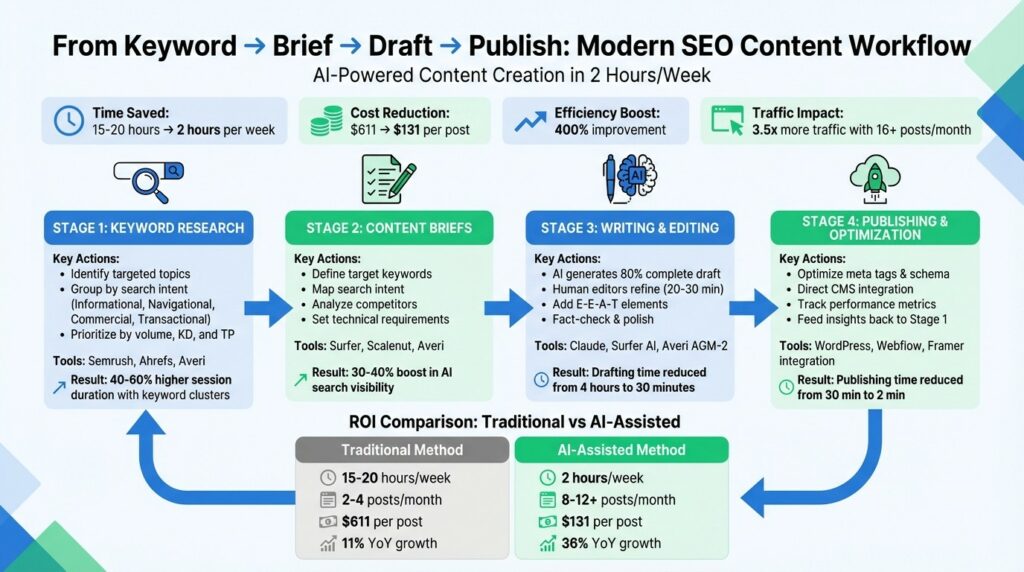
The modern digital landscape demands a relentless pace of content creation, yet maintaining quality and search visibility has never been more challenging. An AI SEO publishing workflow bridges this gap by integrating artificial intelligence into every stage of the content lifecycle, from keyword discovery to post-publication analysis. This systematic approach allows marketing teams to produce more relevant, optimized content in less time without sacrificing the human touch that builds trust with readers. By automating repetitive tasks and providing data-driven insights, an AI-powered workflow transforms publishing from a bottleneck into a competitive advantage.
What is an AI SEO Publishing Workflow?
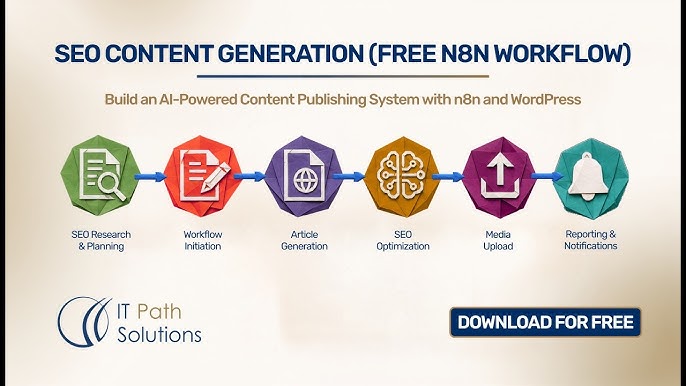
An AI SEO publishing workflow is a structured, technology-enhanced process that leverages machine learning and natural language processing to plan, create, optimize, publish, and measure digital content. Unlike traditional methods that rely heavily on manual research and guesswork, this workflow uses AI tools to analyze search engine result pages, understand user intent, generate drafts, suggest on-page optimizations, and predict content performance.
The core value lies in its ability to handle large volumes of data quickly. For instance, an AI can analyze thousands of search queries in seconds to identify topic clusters that a human team might take days to uncover. The workflow is not about replacing writers but about augmenting their capabilities, allowing them to focus on strategy, creativity, and factual accuracy while the AI handles the heavy lifting of data processing and initial drafting.
The Core Components of a Modern AI Publishing System
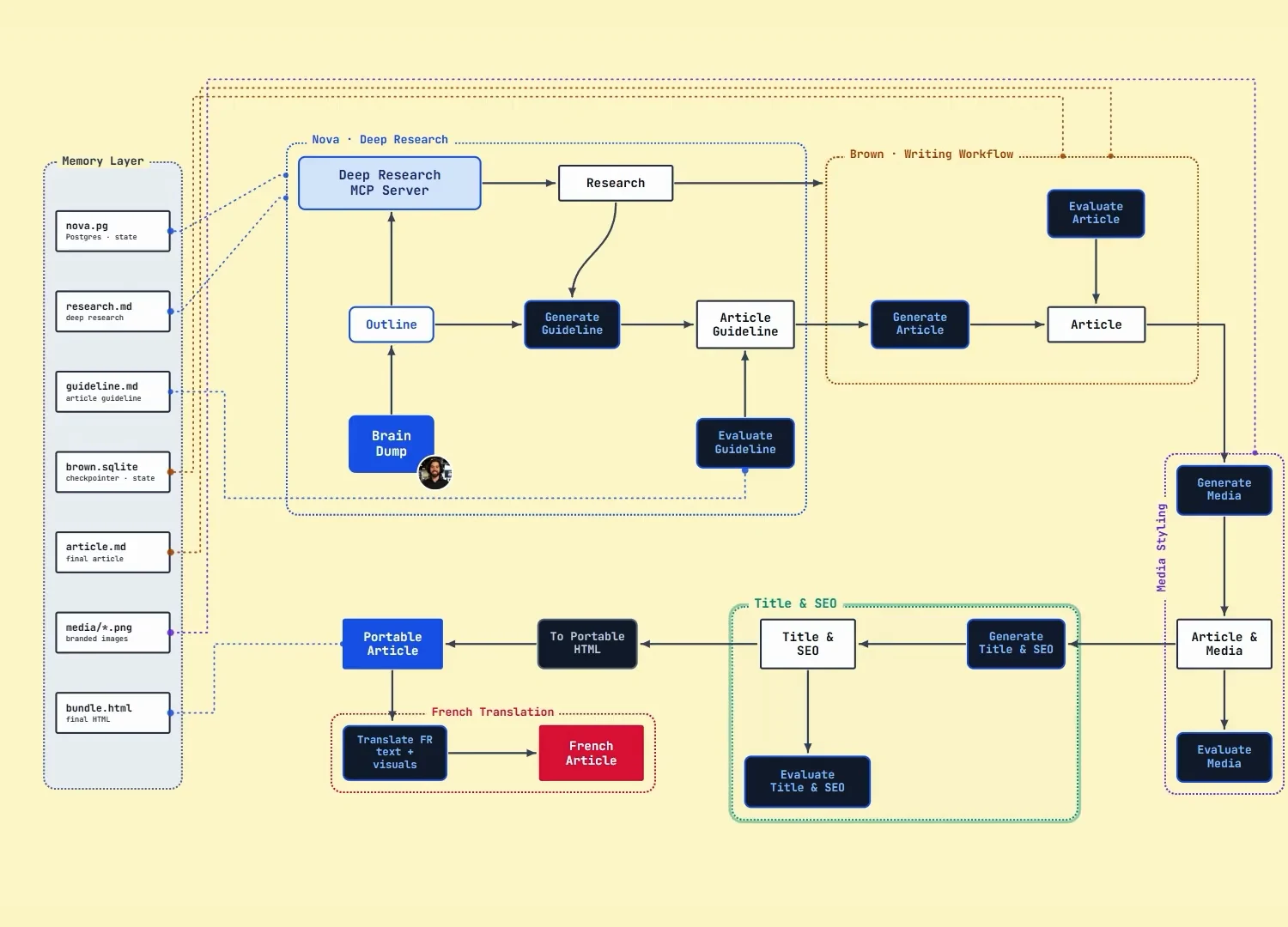
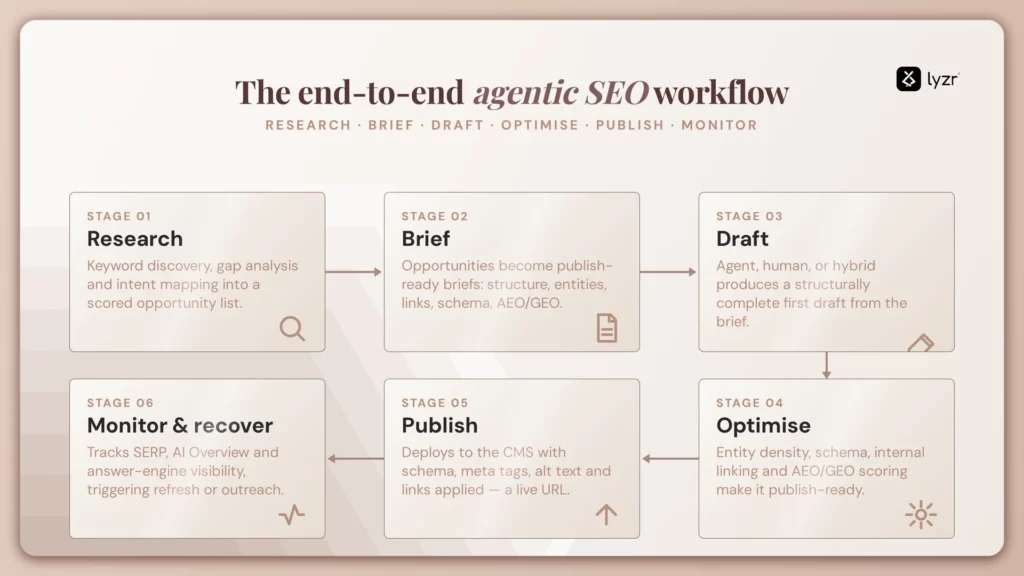
To build an effective system, it is essential to understand the distinct modules that make up the entire pipeline. Each component serves a specific function, and when connected, they create a seamless flow from idea to published article.
1. AI-Powered Keyword and Topic Research
This is the foundation of the workflow. Instead of manually entering terms into a keyword tool, AI platforms aggregate data from multiple sources, including Google Autocomplete, “People Also Ask” boxes, and competitor analysis. They group keywords by search intent—informational, navigational, or transactional—and predict which topics are gaining traction. Tools like Clearscope or MarketMuse use AI to analyze top-ranking pages and provide a list of related terms and entities that should be covered to achieve topical authority.
2. Automated Content Brief Generation
Once a topic is selected, the AI generates a comprehensive brief. This brief includes the target keyword, secondary keywords, suggested headings, word count, readability score, and even examples of questions the content should answer. This step ensures that the writer or the AI generator has a clear roadmap, reducing the time spent on planning and increasing the likelihood of ranking for multiple related queries.
3. AI-Assisted Drafting and Writing
Here, the actual content is created. This can range from fully automated generation using large language models to a collaborative approach where the AI writes a first draft and a human editor refines it. The best workflows use AI to generate outlines and initial paragraphs, then rely on human writers to inject personal experience, case studies, and unique insights that AI cannot fabricate. This hybrid model ensures the content is both comprehensive and authentic.
4. On-Page SEO Optimization and Review
Before hitting publish, the draft goes through an AI review process. The software checks for keyword density, semantic relevance, internal linking opportunities, meta description length, and title tag effectiveness. It also flags potential issues like duplicate content or missing alt text. This automated quality check is faster and more consistent than manual proofreading, catching errors that might be overlooked after hours of writing.
5. Programmatic Publishing and Scheduling
This component handles the logistics of getting the content live. AI can determine the optimal time to publish based on historical engagement data for your specific audience. It can also automate the distribution to various channels, such as the company blog, social media profiles, and email newsletters, ensuring that the content reaches the audience when they are most active.
6. Performance Tracking and Iteration
The workflow does not end at publication. AI analytics tools monitor key performance indicators like organic traffic, dwell time, bounce rate, and keyword rankings. The system identifies underperforming articles and suggests specific updates—such as adding a new section, refreshing statistics, or improving the introduction—to boost visibility. This creates a continuous improvement loop where old content is constantly updated to maintain relevance.
Step-by-Step Guide to Implementing the Workflow
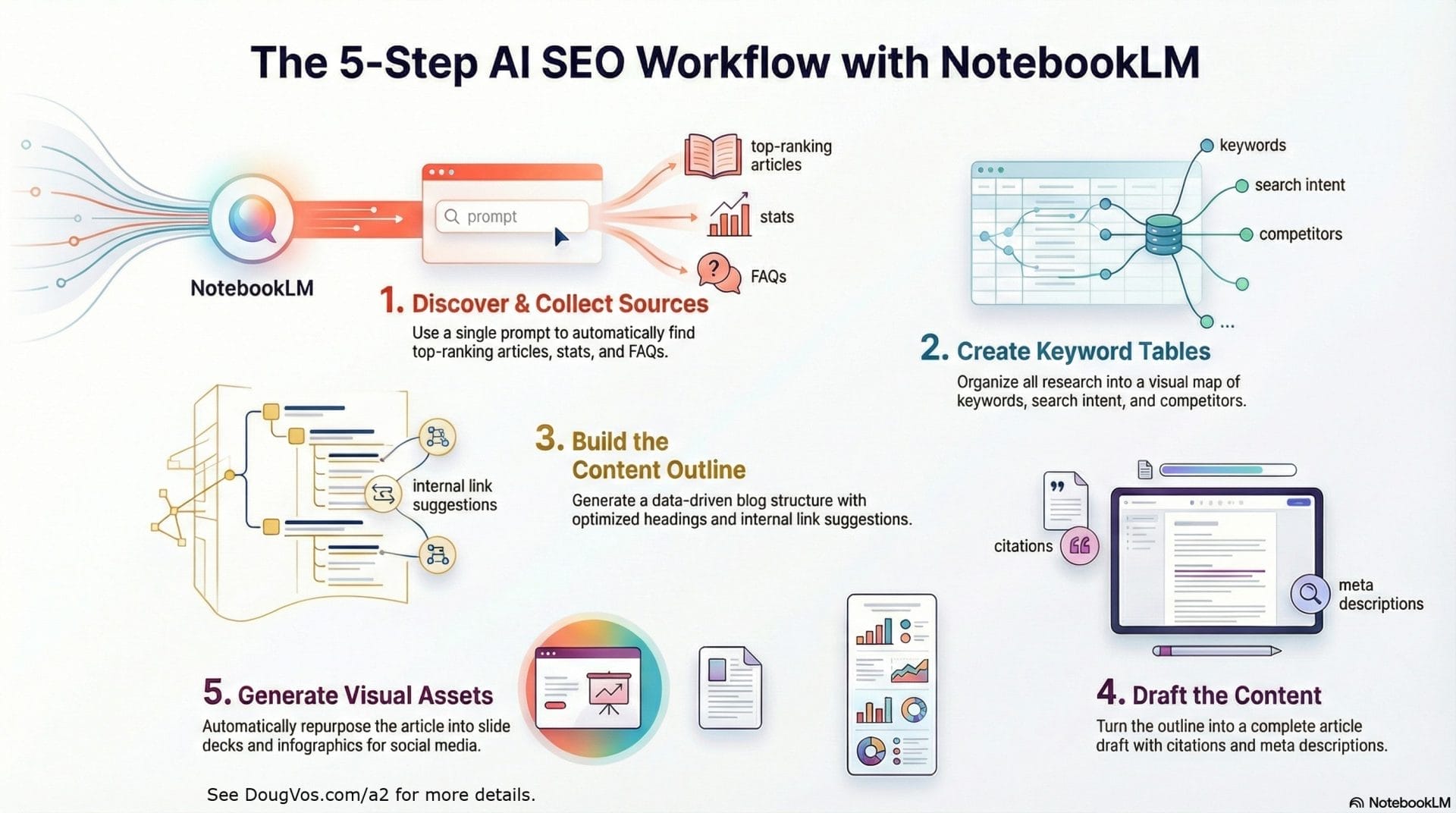
Transitioning from a manual process to an AI-driven one requires a strategic approach.
Phase 1: Audit Your Current Process
Before introducing new tools, map out your existing workflow. Identify where the bottlenecks are. Is it in research? Writing? Editing? Understanding your current time-to-publish ratio helps you set realistic goals for improvement. For example, if you currently publish 4 articles per month, an AI workflow might help you scale to 20 without hiring additional staff.
Phase 2: Select the Right Tool Stack
T You will likely need a combination. Consider these categories:
- Research Tools: Ahrefs, Semrush, or Surfer SEO for keyword data and SERP analysis.
- Writing Assistants: Jasper, Copy.ai, or ChatGPT for generating drafts and headlines.
- Optimization Platforms: Clearscope or Frase for content scoring and brief generation.
- Project Management: Notion or Asana to track the progress of each piece through the pipeline.
Start with one tool per category to avoid overwhelming your team. Integrate them via APIs or manual export/import to ensure data flows smoothly.
Phase 3: Define Your Content Standards
AI needs guidelines to produce consistent output. Create a style guide that includes your brand voice, target audience personas, and formatting rules. Input this into your AI tools as custom instructions. For instance, if your brand is professional and data-driven, instruct the AI to avoid colloquialisms and to include statistics where relevant. This step is critical for maintaining brand integrity.
Phase 4: Pilot the Workflow on a Small Scale
Choose a small cluster of related topics and run them through the new system. Monitor the results closely for the first month. Track not only the rankings but also the qualitative feedback from your editors. Are the AI-generated briefs accurate? Is the writing assistant producing usable text? Use this pilot phase to fine-tune your prompts and adjust the workflow before scaling to full production.
Phase 5: Scale and Automate
Once the pilot is successful, gradually increase the volume. Automate the handoffs between stages. For example, set up a system where a completed draft automatically triggers a notification for the SEO reviewer. This reduces the administrative overhead and allows your team to focus on high-value tasks like link building and content strategy.
Benefits of an AI-Driven Publishing Strategy
The advantages of adopting this technology extend beyond just saving time. They impact the overall quality and ROI of your content marketing efforts.
Increased Production Velocity
AI can generate a 1,500-word draft in minutes, a task that takes a human writer several hours. This speed allows you to cover more topics, target more long-tail keywords, and outpace competitors who are still using manual methods. A team of two can now manage the output that previously required a team of ten.
Enhanced Content Relevance and Accuracy
AI tools analyze the current top-ranking pages for a query and ensure your content covers all the necessary subtopics. This reduces the risk of publishing thin content that fails to satisfy user intent. The result is higher dwell time and lower bounce rates, which are positive signals to search engines.
Data-Backed Decision Making
Instead of guessing which topics will perform well, you rely on predictive analytics. AI can forecast the potential traffic for a given keyword based on historical trends and current competition. This allows you to prioritize topics with the highest potential ROI, ensuring your efforts are focused on areas that will actually drive business results.
Consistent Quality Control
Human editors have off days, but AI does not. The automated review process ensures that every piece of content meets the same standards for grammar, readability, and SEO best practices. This consistency is vital for building a strong, recognizable brand voice across a large content library.
Limitations and Challenges to Consider
While the benefits are significant, it is equally important to acknowledge the limitations of relying too heavily on AI. Ignoring these can lead to serious pitfalls.
The Risk of Generic, Unoriginal Content
AI models are trained on existing data, which means they can produce text that sounds similar to what is already out there. Without human intervention, your content may lack the unique perspective, personal anecdotes, and original research that differentiate a brand. Search engines are increasingly sophisticated at detecting AI-generated content that provides no added value, which can lead to ranking penalties.
Factual Inaccuracies and Hallucinations
Large language models can confidently state incorrect information. They do not have real-time access to the internet unless specifically integrated with a search tool. This is particularly dangerous for YMYL (Your Money or Your Life) topics like health, finance, or legal advice. Every statistic and claim generated by AI must be verified by a human expert before publication.
Dependency on Tool Quality
The output is only as good as the tool and the data it was trained on. If your AI tool is not updated regularly, it may provide outdated SEO advice. For example, it might suggest keyword stuffing, a practice that is now penalized. Staying current with tool updates and industry best practices is an ongoing responsibility.
AI SEO Workflow vs. Traditional Manual Process
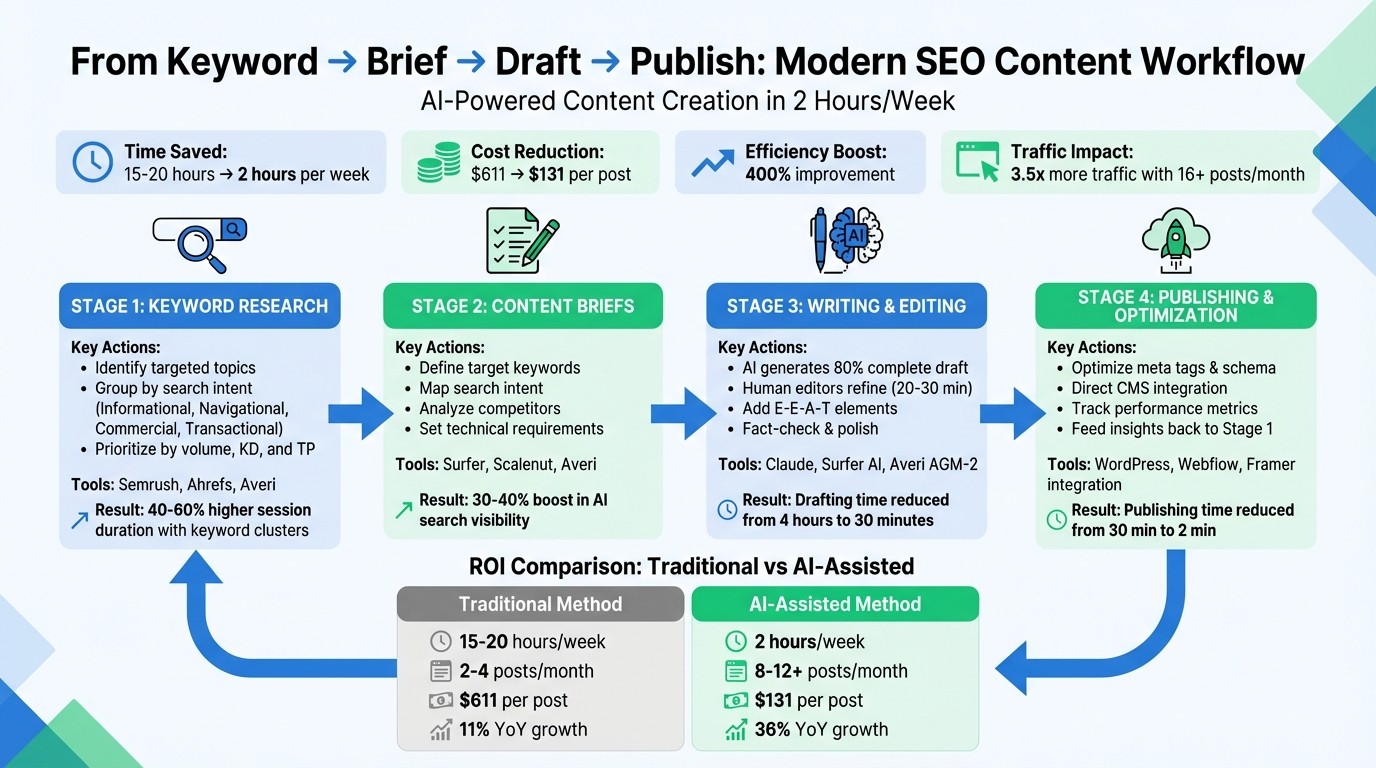
To fully appreciate the value of the AI-driven approach, it helps to compare it directly with the traditional method across key operational metrics.
| Factor | Traditional Workflow | AI SEO Publishing Workflow |
|---|---|---|
| Research Speed | 2-3 days for a topic cluster | 2-3 hours for a topic cluster |
| Drafting Time | 4-6 hours per 1,500 words | 30 minutes for a draft, 2 hours for editing |
| Scalability | Limited by team size | Limited by review capacity, not writing speed |
| Optimization | Manual review, prone to human error | Automated checks for semantic relevance |
| Cost Efficiency | High labor costs per article | Lower cost per article after tool subscription |
| Uniqueness | High, based on human experience | Requires human input to ensure uniqueness |
The table illustrates that while the AI workflow is superior in speed and scalability, it requires a deliberate effort to maintain the uniqueness and authority that comes naturally to human writers.
Common Mistakes and How to Avoid Them
Many teams fail to see results from their AI workflow not because the technology is flawed, but because of how they implement it. Here are the most frequent errors and practical solutions.
Mistake 1: Publishing AI Output Without Editing
This is the most damaging mistake. Raw AI text is often repetitive, lacks logical flow, and contains subtle inaccuracies. Publishing it directly damages your credibility and can trigger search engine spam filters.
Solution: Implement a mandatory human-in-the-loop review. Every article must be read, fact-checked, and edited by a subject matter expert before it goes live. Treat the AI draft as a very detailed outline, not the final product.
Mistake 2: Ignoring Search Intent in Favor of Keywords
Focusing solely on keyword volume without understanding why the user is searching leads to high bounce rates. For example, ranking for “best running shoes” with a product page when the user wants a comparison guide will fail.
Solution: Use AI to analyze the top 10 results for your target keyword. Look at the content format (listicle, guide, video) and the angle they take. Instruct your AI to match that format and intent, not just to include the keyword.
Mistake 3: Neglecting Internal Linking
AI tools often generate content in isolation. Without a strategy to link new posts to existing relevant content, you miss out on distributing page authority and helping search engines understand your site structure.
Solution: Use an AI tool that suggests internal links based on semantic similarity. Alternatively, have your editor manually add 3-5 internal links to each new article, pointing to cornerstone content and related blog posts.
Mistake 4: Not Updating the AI’s Knowledge Base
If you are using a custom AI model or a tool that allows custom data, failing to feed it your latest product information, case studies, and customer feedback will result in outdated content.
Solution: Schedule a monthly review of your AI tool’s training data. Update it with new company information and remove any outdated references to ensure the AI is always working with the most current facts.
Important Notes for Maximizing E-E-A-T
Google’s Quality Rater Guidelines emphasize Experience, Expertise, Authoritativeness, and Trustworthiness. An AI workflow can help with these, but only if managed correctly.
Experience: AI cannot have lived experiences. To satisfy this criterion, you must layer in original quotes, personal stories, or unique data from your business. For example, if you are writing about a software tool, include a screenshot of your own dashboard or a specific workflow you use.
Expertise: The AI can help structure the content, but the factual depth must come from a human expert. Have a specialist review the technical sections to ensure accuracy. This is non-negotiable for industries with high stakes.
Authoritativeness: Use the workflow to generate content that cites reputable sources. Instruct the AI to include references to industry studies, government data, or academic papers. Then, have a human verify these links are active and relevant.
Trustworthiness: Be transparent about your processes. Do not hide the use of AI. Instead, focus on the value you add. Ensure your “About Us” page clearly states your team’s credentials and that your content is fact-checked. This builds trust with both users and search engines.
Practical Application: A Real-World Example
Consider a SaaS company that sells project management software. Their goal is to rank for “best project management tools for remote teams.”
Step 1: The AI research tool identifies that the top-ranking pages are listicles with detailed comparisons, pros/cons, and pricing tables. It also finds related queries like “free project management tools” and “project management tools for small business.”
Step 2: The AI generates a brief that includes these secondary keywords and suggests a structure: Introduction, Comparison Table, Detailed Reviews of 10 Tools, Buying Guide, and FAQ.
Step 3: The AI writes a first draft for each tool review. A human editor then replaces the generic descriptions with specific insights from their own experience using the tools. They add a unique screenshot of their team’s workflow in one of the tools.
Step 4: The optimization tool checks the draft and suggests adding a section on “Security Features” because it is a common question in the “People Also Ask” box. The editor adds this section.
Step 5: The article is published and scheduled for social sharing. After 30 days, the AI analytics tool shows that the article ranks #5 for the main keyword but #1 for “free project management tools.” The team decides to create a separate, more detailed article targeting that specific long-tail keyword, using the same workflow.
Frequently Asked Questions
Will AI replace SEO content writers?
A The role of the writer is shifting from typing words to strategizing, editing, and providing unique insights. AI handles the grunt work of research and drafting, freeing writers to focus on creativity and accuracy, which are still beyond the reach of current AI models.
How much does it cost to implement an AI SEO workflow?
The cost varies widely based on the tools chosen. A basic setup might cost $100-$200 per month for a single writing assistant and a keyword research tool. A comprehensive enterprise stack with advanced analytics and custom AI models can cost over $1,000 per month. However, the return on investment is often realized through reduced labor costs and increased organic traffic.
Is AI-generated content penalized by Google?
Google’s official stance is that they penalize spammy, low-quality content regardless of how it is produced. They do not penalize AI content simply for being AI-generated. The key is the quality and value of the content. If the AI content is helpful, accurate, and original, it can rank well. If it is mass-produced and unhelpful, it will be penalized.
What is the best AI tool for SEO content?
T The right choice depends on your specific needs. For research and optimization, tools like Surfer SEO and Clearscope are popular. For writing, Jasper and ChatGPT are widely used. Many teams use a combination of these. It is recommended to take advantage of free trials to see which tools integrate best with your existing workflow.
How do I ensure my AI content is original?
To ensure originality, always run the AI-generated text through a plagiarism checker like Copyscape or Grammarly. More importantly, instruct the AI to avoid generic phrases and to use your specific data points. Adding your own commentary, examples, and analysis is the most effective way to make the content unique and valuable.
Conclusion
The AI SEO publishing workflow represents a fundamental shift in how digital content is produced and optimized. It is a powerful system that, when implemented correctly, enables teams to scale their output, improve search visibility, and make data-driven decisions. The key to success lies in viewing AI as a collaborative partner rather than a replacement for human intelligence. By combining the speed and analytical power of AI with the experience, expertise, and ethical judgment of human editors, you can create a content engine that consistently delivers value to your audience and achieves your business goals. The future of SEO is not about choosing between humans and machines, but about building a seamless workflow where both work in harmony.
Xem thêm:
- AI SEO Automated Meta Tags: The Complete Guide to Smarter On-Page Optimization
- AI SEO Knowledge Base: The Complete Guide to Building and Using One in 2025
- AI SEO GPT Tools: The Complete Guide to Automating Your Search Rankings in 2025
- Perplexity SEO: How to Rank in AI‑Powered Search Engines and Get Cited
- AI SEO for Technology: The Complete Playbook for B2B and SaaS Growth
Bài viết cùng chủ đề:

AI SEO SEO Automation with Make: The Complete Workflow Guide

AI SEO SEO Automation with Zapier: The Complete Workflow Guide

AI SEO SEO Automation with n8n: The Complete Workflow Guide
AI SEO SEO Automation with Gemini: The Complete Guide to Scaling Organic Growth

AI SEO SEO Automation with Claude: The Complete Guide to Scaling Content in 2025

AI SEO SEO Automation with ChatGPT: The Complete Playbook for 2025

AI SEO & SEO Automation for Affiliate Sites: The 2025 Playbook for Passive Income Growth
AI SEO & SEO Automation for Bloggers: The Complete Guide to Scaling Your Content

AI SEO & SEO Automation for Agencies: The Complete 2025 Playbook

AI SEO and SEO Automation for Ecommerce: The Complete Playbook for 2025

AI SEO & SEO Automation for WordPress: The Complete Playbook for 2025
AI SEO SEO Automation Strategy: The Complete Playbook for 2025

Mastering the AI SEO SEO Automation Process: A Complete Guide to Scaling Organic Growth
AI SEO SEO Automation System: The Complete Guide to Scaling Organic Growth in 2025
AI SEO SEO Automation Platform: The Complete Guide to Scaling Organic Growth in 2025
AI SEO SEO Automation Software: The Complete Guide to Scaling Organic Growth in 2025















