
No products in the cart.
AI SEO ROI: How to Measure and Maximize Your Return on Investment
29
Jul
Jul
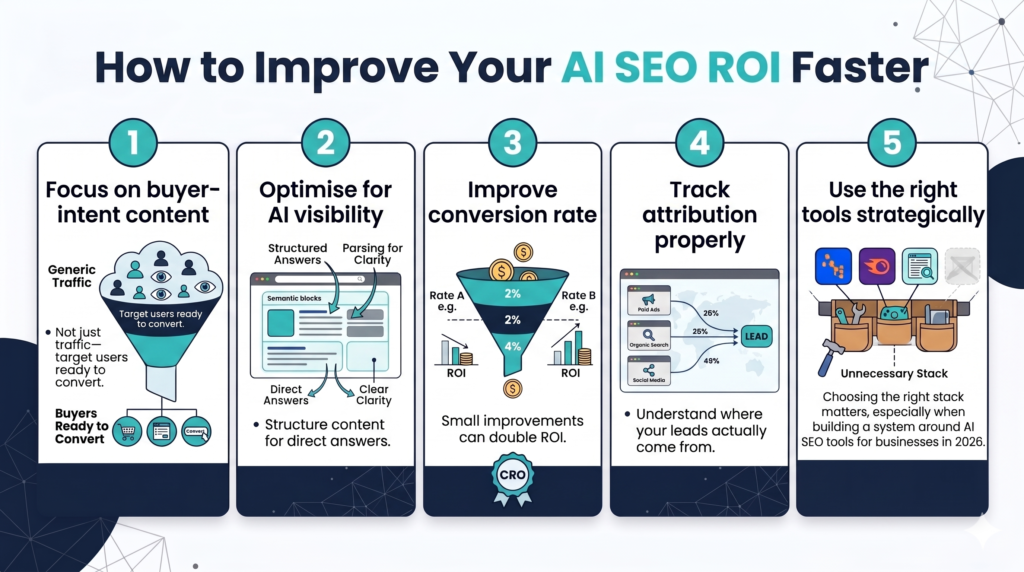
Investing in artificial intelligence for search engine optimization is no longer a futuristic gamble. It is a measurable business decision that directly impacts traffic, leads, and revenue. Yet many teams struggle to connect their AI SEO tooling to a clear return on investment. Understanding AI SEO ROI means moving beyond vague promises of “better rankings” and into hard numbers that prove every dollar spent on AI is driving profitable organic growth. This comprehensive guide breaks down exactly how to define, calculate, and amplify the return you get from AI-powered SEO.
What Is AI SEO ROI?

AI SEO ROI is the net financial return generated by implementing artificial intelligence technologies within your organic search strategy, divided by the total cost of those technologies and the resources required to run them. It translates the abstract capabilities of machine learning, natural language processing, and automation into bottom-line business value. When a company deploys an AI content assistant, an automated keyword clustering tool, or a predictive rank-tracking platform, the AI SEO ROI answers one critical question: did the incremental organic performance gains outweigh the investment?
In practical terms, this metric captures how much additional traffic, qualified leads, and revenue can be attributed to AI interventions, minus the software subscription fees, integration costs, training time, and any required human oversight. The calculation becomes more nuanced than traditional SEO ROI because AI systems can simultaneously improve efficiency (doing more with less) and effectiveness (unlocking new ranking opportunities humans might miss).
Modern SEO teams measure AI SEO ROI through a combination of efficiency gains – like creating 10 times more optimized landing pages in the same timeframe – and performance uplifts, such as a 40% increase in non-branded organic clicks from AI-identified content gaps. The most mature organizations tie these metrics directly to customer acquisition cost and lifetime value, creating a closed-loop attribution model that leaves no ambiguity about the value of their AI stack.
The Core Components of AI-Driven SEO
To understand where AI SEO ROI comes from, you need to recognize the distinct components that artificial intelligence brings to an SEO operation. Each component contributes differently to the final return equation.
Automated Keyword and Topic Research
AI systems can process millions of search queries, social threads, and competitor pages to uncover semantic clusters and long-tail opportunities that manual brainstorming would never surface. Instead of spending 20 hours building a keyword matrix, AI models generate intent-matched topic architectures in minutes, complete with predicted search volume trends and difficulty scores. The efficiency gain alone often pays for the tool subscription within the first month of use.
Content Generation and Optimization at Scale
Natural language generation tools now produce first drafts, meta descriptions, and schema markup that align with search engine guidelines. More importantly, AI content optimization platforms analyze top-ranking pages and provide real-time recommendations on entities, readability, and topical depth. This lifts existing content performance while enabling teams to publish in bulk without sacrificing quality. The ROI here surfaces as faster indexation, broader keyword footprints, and higher average positions across thousands of URLs.
Technical SEO Auditing and Monitoring
Crawling and log file analysis traditionally consumed dozens of engineer hours per month. AI-powered auditors detect patterns in server responses, JavaScript rendering issues, and Core Web Vitals deviations before they become ranking problems. By catching a mobile usability bug that would have dropped a category page from position 3 to position 8, one automated alert can save months of recovery effort – a direct AI SEO ROI contribution that standard audits often miss.
Predictive Rank and Traffic Modeling
Advanced models now forecast how algorithm updates, content refreshes, or link velocity changes will shift organic traffic weeks in advance. Teams use these predictions to prioritize high-ROI tasks, deprioritize low-impact work, and justify budget requests to executives with confidence. The ability to say “this AI model predicts a 23% traffic increase if we execute these 14 action items” transforms SEO from a cost center into a revenue driver.
Calculating AI SEO ROI: A Step-by-Step Framework
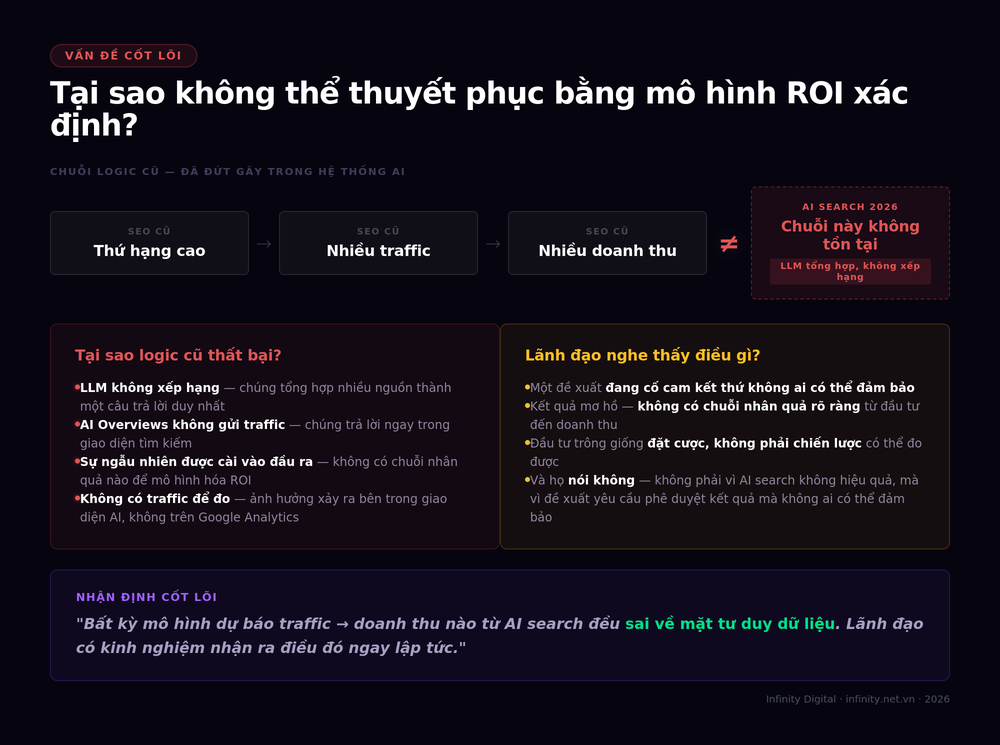
A reliable AI SEO ROI calculation requires separating noise from signal. The framework below has been validated across B2B and e‑commerce operations and works with Google Analytics 4, CRM data, and standard financial reports.
Step 1 – Establish a Clear Attribution Window
Decide whether you will measure ROI over 6 months, 12 months, or a campaign-specific period. AI-driven SEO changes often take 60 to 120 days to mature, so short windows hide real returns. A quarterly review with a rolling 12-month view balances agility with accuracy.
Step 2 – Quantify the Full Investment
Include every cost line: AI tool subscriptions (yearly fees divided by 12), API usage charges, internal team hours spent on prompt engineering, training sessions, integration developer costs, and any third-party consulting. If you migrated from a legacy tool to an AI-native one, include migration labor. For a mid-size company, a realistic monthly AI SEO investment might range from $3,000 to $15,000.
Step 3 – Isolate the Incremental Organic Revenue
Analyze organic revenue during the measurement period and subtract the baseline organic revenue from the same period before AI adoption (adjusted for seasonality and market trends). If your CRM tracks lead source, attribute closed-won revenue from organic leads. For e‑commerce, use Google Analytics 4 purchase events filtered by organic medium. Multiply incremental transactions by average order value to get AI-attributable revenue. When possible, set up a holdback group – a set of pages not touched by AI – to establish a true control.
Step 4 – Account for Efficiency Savings
AI often reduces the need for manual content writing, data analysis, or agency retainers. Assign a dollar value to hours saved using the blended hourly rate of the roles involved. If your team previously spent 80 hours per month on manual rank tracking and reporting and AI now automates 70 of those hours, that is a recurring cost reduction of roughly $3,500 monthly (assuming a $50 blended rate). These savings count as a positive return component.
Step 5 – Apply the ROI Formula
The core formula is: ((Incremental Revenue + Efficiency Savings) – Total AI Investment) / Total AI Investment × 100. For example, if incremental organic revenue is $40,000 per month, efficiency savings are $3,000, and total AI investment is $8,000, the AI SEO ROI is (($43,000 – $8,000) / $8,000) × 100 = 437.5%. This figure goes beyond a generic traffic lift – it speaks the language of the CFO.
Benefits of Investing in AI for SEO
Organizations that measure AI SEO ROI consistently report a cluster of business advantages that extend far beyond ranking improvements.
- Speed-to-Publish Advantage: AI-assisted content workflows cut the time from keyword identification to published page by up to 70%, allowing brands to capture trending topics before competitors.
- Deeper Content Coverage: Machine learning models suggest semantically related entities and questions that satisfy Google’s Helpful Content signals, resulting in longer session durations and higher conversion rates.
- Proactive Risk Mitigation: Anomaly detection algorithms alert teams to traffic drops, indexing errors, or cannibalization issues within hours instead of weeks, preserving hard-earned rankings.
- Scalable Personalization: AI dynamically adjusts title tags and meta descriptions based on user intent signals, increasing click-through rates from search results without manual A/B testing.
- Cross-Channel Insight Integration: AI models connect SEO data with paid search, social listening, and CRM data to reveal keywords that drive both top-of-funnel awareness and bottom-of-funnel revenue, tightening the marketing flywheel.
- Hallucinated Facts and Thin Content: When used without human editorial review, generative AI can produce inaccuracies, duplicate content, or shallow pages that trigger manual actions. One poorly reviewed batch of AI articles can undo months of domain authority gains.
- Training and Onboarding Friction: The steep learning curve for prompt engineering and output validation adds hidden costs that delay breakeven. Teams often underestimate the time required to align AI outputs with brand tone and legal compliance.
- Algorithmic Penalty Risk: Google’s guidelines emphasize that scaled content abuse, even if AI-assisted, can lead to ranking declines. Over-automation that prioritizes quantity over quality undermines AI SEO ROI very quickly.
- Data Privacy and Security Concerns: Feeding proprietary business data into public large language models can expose confidential strategies. On-premise deployments add infrastructure costs that change the ROI calculus.
- Model Drift and Maintenance: AI models require retraining as search behavior evolves and as your own site’s architecture changes. Neglecting this leads to stale recommendations that waste budget.
- Using AI to Replace Strategy, Not Execute It: Feeding a topic into an AI writer and publishing without a documented content strategy aligned with buyer intent often leads to pages that rank for irrelevant terms and attract unqualified traffic. Always let a human SEO strategist define the content brief and target entity list before AI generates a single word.
- Ignoring Search Intent Mismatches: AI models can produce well-written content that targets a keyword but fails to match the dominant intent (informational vs. commercial vs. navigational). An AI article designed for “best running shoes” that reads like a buying guide when Google expects a product comparison grid will never earn clicks, rendering the investment wasted.
- Neglecting Content Decay Monitoring: AI-generated pages, like any pages, lose freshness. Unless you have automated systems that detect when AI-optimized posts start to drop in performance and re‑optimize them, the initial ROI spike will fade. Build decay detection into your AI workflow.
- Measuring Only Vanity Metrics: Celebrating a 200% increase in keyword rankings without tracking whether those rankings brought paying customers is the fastest way to a negative AI SEO ROI. Tie every AI SEO action to a monetary outcome, even if it is a proxy like “estimated lead value from organic form fills.”
- Underfunding the AI Transition: Teams that scrape by on a limited license and one seat for a department of ten create bottlenecks that make AI slower than manual work. Properly budget for enough seats, API capacity, and training so the tool accelerates the team rather than creating a queue.
Potential Drawbacks and Limitations

No technology is without risk, and AI SEO investments can erode ROI if mismanaged. Recognizing these limitations helps teams set realistic expectations and design governance that protects the return.
Comparison: AI-Powered SEO vs. Traditional SEO
To contextualize the return, it helps to see how AI-driven processes compare side-by-side with manual, traditional SEO methods. The following table outlines key operational and financial differences that directly impact ROI.
| Dimension | Traditional SEO | AI-Powered SEO |
|---|---|---|
| Keyword Research | Manual spreadsheet work; 10–15 hours per project. Limited to obvious head terms. | AI clusters thousands of keywords in minutes; identifies long-tail, question-based, and zero-volume gems that convert. |
| Content Production | Writers produce one piece per day; editing cycles slow scaling. | AI drafts 20+ pages per day with human polish; keeps content inventory growing while maintaining entity depth. |
| Technical Audits | Monthly crawls with manual triage; issues linger for weeks. | Continuous monitoring with smart prioritization; critical errors get fixed same-day, protecting ranking stability. |
| Competitor Analysis | Periodic reviews of 5–10 competitors; mostly reactive. | Real-time SERP feature tracking and content gap detection across hundreds of domains, enabling proactive moves. |
| ROI Visibility | Attribution is opaque; reporting centers on rankings and clicks, not revenue. | Predictive models map specific AI actions to revenue forecasts; dashboards show dollar impact, making budget justification straightforward. |
| Cost Structure | Heavy reliance on headcount and agency retainers. Linear cost scaling. | Software-driven with marginal cost per additional page approaching zero. ROI improves at scale. |
How to Implement AI SEO to Maximize ROI

Turning AI into a reliable profit center demands a structured rollout. Random tool adoption without process changes leads to flat or negative AI SEO ROI. Follow this proven implementation path.
Audit Your Current SEO Bottleneck
Start by identifying the single biggest constraint that limits organic growth today. For some, it is painfully slow content creation. For others, it is the inability to detect technical debt before it harms rankings. Map your AI investment directly to that bottleneck. If your bottleneck is keyword research speed, purchase an AI research tool first. If your bottleneck is poor content quality, invest in an entity-rich content optimization platform. Laser-focused deployment delivers a faster payback period than buying a suite of features you will not fully use.
Select Tools with Native ROI Tracking
Prioritize platforms that include built-in performance dashboards showing organic clicks, impressions, and attributed conversions for AI-touched pages. Tools that integrate natively with Google Search Console and your analytics setup eliminate the manual data assembly that kills ROI measurement momentum. Look for AI SEO platforms that offer holdout group testing, where you can compare optimized pages against untouched controls under identical algorithmic conditions.
Design a Human-in-the-Loop Workflow
The highest AI SEO ROI comes from a hybrid model where AI generates recommendations, drafts, and analysis, while SEO strategists apply judgment, brand voice, and editorial standards. Structure a three-step pipeline: AI output, human review scoring, and final publishing approval. This prevents the “set it and forget it” trap that leads to low-value pages. Treat AI as a very fast junior analyst, not a replacement for strategic thinking.
Run a 90-Day Pilot with Strict KPIs
Select a segment of your site – a blog category, a product line, or a set of location pages – and apply AI fully while keeping the rest of the site under your old process. Before the pilot, define exactly what success looks like: a 25% increase in organic entries to that segment, a 15% lift in conversion rate, or $X in incremental revenue. At the end of 90 days, compare segment performance against the control group and compute the pilot ROI. Use this data to secure wider budget and scale.
Scale with an Optimization Calendar
Once the pilot proves itself, build a rolling quarterly calendar that feeds your highest-value pages through AI optimization cycles. Prioritize pages with high impressions but low click-through rate, pages that rank on page two, and pages that attract revenue-driving queries. Each week, cycle a batch of pages through content refresh, internal linking enhancements, and schema updates. Track the revenue contribution of each batch to maintain visibility into ongoing returns.
Common Mistakes That Hurt AI SEO ROI
Even experienced teams sabotage their return by falling into predictable traps. Avoiding these errors protects your investment from being wasted.
Important Considerations When Measuring AI SEO ROI
Attribution and accounting choices can double or halve your reported return. These considerations ensure your numbers are defensible and useful for future decision-making.
Time Lag and Compounding Effects
AI SEO investments compound over time. A content cluster built with an AI brief may start earning rankings in month three, accelerate through months six to twelve, and continue to deliver traffic for years. Accounting for the full lifetime value of AI-assisted pages, rather than just the first quarter, reveals a much higher AI SEO ROI. For accurate reporting, calculate both the 6-month return and the projected 24-month return using conservative traffic decay assumptions.
Brand vs. Non-Brand Traffic Separation
Always split organic performance into brand and non-brand segments. AI efforts typically impact non-brand queries where you compete on information quality. If your overall organic revenue increases because of a strong brand campaign, that should not inflate the AI SEO ROI figure. Isolating non-brand incremental revenue provides a pure read on how AI is expanding your total addressable organic market.
Integration Costs with Existing MarTech
Connecting an AI content tool to your CMS, analytics, and CDP often requires developer time for API connections and data mapping. These one-time costs are part of the initial investment and should be amortized over the expected tool lifespan. Failing to include a $8,000 integration fee in the ROI denominator can make the investment appear more attractive than it truly is.
Risk of Cannibalization
When AI generates many closely related pages, you risk keyword cannibalization where multiple URLs compete for the same query, diluting authority and confusing search engines. This often leads to the illusion of growth while overall traffic to the topic cluster stagnates. Active cannibalization monitoring is a requirement for any ROI model to remain valid. Deduct lost revenue from cannibalized pages when calculating net incremental return.
Frequently Asked Questions
What exactly does AI SEO ROI mean?
AI SEO ROI quantifies the financial gain from using artificial intelligence in your organic search activities relative to the cost. It measures whether the additional revenue and cost savings generated by AI tools exceed the subscription fees, implementation expenses, and human oversight costs. A positive ROI means AI is a profit driver, not just a shiny expense.
How do I calculate the ROI of a specific AI SEO tool?
Start by defining the key metric the tool improves, such as content publishing speed or click-through rate. Measure the baseline before tool adoption. After a consistent period, measure the uplift and convert it into a dollar value – for instance, hours saved multiplied by employee hourly cost, or incremental leads multiplied by lead value. Subtract the tool’s total cost from that dollar value, then divide by the total cost to get the ROI percentage.
Can AI-generated content deliver a positive SEO ROI?
Yes, when guided by a solid SEO strategy and thorough human editing. AI content can achieve rapid indexing and solid rankings for long-tail queries, but only if each piece satisfies user intent and contains original insights. The ROI becomes negative when teams publish AI drafts without adding factual verification, expert quotes, or unique data, because low-quality pages absorb crawl budget and may trigger quality algorithms.
What is a good AI SEO ROI benchmark?
A healthy AI SEO ROI for mid-market companies typically exceeds 200% within the first year, meaning the return is at least double the investment. High-performing programs reach 400-600% when AI is deeply integrated into technical SEO, content, and reporting. However, benchmarks vary by industry and competition level. Always compare against your own pre-AI baseline rather than generic industry numbers.
How long does it take to see AI SEO ROI?
Efficiency gains from AI – like automated reports or faster content briefs – can show returns within the first month. Performance-based returns, such as increased organic traffic and revenue, usually materialize between three and six months after AI-optimized pages are indexed. Complex technical SEO fixes driven by AI can yield results in weeks, while building a new AI-powered content hub may take 8 to 12 months to reach full ROI potential.
Does using AI for SEO violate Google’s guidelines?
Google does not penalize AI usage by default. It penalizes spammy, scaled content that provides little value regardless of production method. The key to maintaining AI SEO ROI while staying guideline-compliant is to ensure every piece of AI-assisted content passes a human quality check, demonstrates genuine expertise, and serves a clear user need. Many top-ranking sites now use AI as an efficiency layer, not a replacement for subject-matter authority.
Conclusion
AI SEO ROI is not about magical algorithms replacing human expertise; it is about systematically leveraging machine intelligence to amplify every dollar and hour you invest in organic search. The companies winning today are those that moved past experimentation and built closed-loop measurement systems that trace AI actions directly to pipeline and revenue. They treat AI as a force multiplier for strategists, not a replacement, and they obsess over the quality of every page that goes live under an AI-assisted banner.
The formula is clear: audit your biggest bottleneck, implement AI surgically, enforce human oversight, and measure relentlessly against a pre-AI baseline. When done right, AI SEO ROI becomes the most compelling argument for doubling down on organic search as a growth engine. The technology is ready, the measurement frameworks exist, and the competitive window is open – but only for those who commit to governing AI with the same rigor they apply to any other major investment.
Xem thêm:
- AI SEO Engagement Metrics: The Complete Guide to Measuring What Truly Matters in 2025
- AI SEO Cornerstone Content: The Complete Playbook for Dominating Search Rankings
- AI SEO Silo Architecture: The Complete Guide to Building Topically Authoritative Websites
- AI Title Generator: Craft Click-Worthy Headlines That Drive Traffic and Engagement
- AI SEO Traffic Prediction: The Complete Guide to Forecasting Organic Growth
Bài viết cùng chủ đề:

AI SEO SEO Automation with Make: The Complete Workflow Guide

AI SEO SEO Automation with Zapier: The Complete Workflow Guide

AI SEO SEO Automation with n8n: The Complete Workflow Guide
AI SEO SEO Automation with Gemini: The Complete Guide to Scaling Organic Growth

AI SEO SEO Automation with Claude: The Complete Guide to Scaling Content in 2025

AI SEO SEO Automation with ChatGPT: The Complete Playbook for 2025

AI SEO & SEO Automation for Affiliate Sites: The 2025 Playbook for Passive Income Growth
AI SEO & SEO Automation for Bloggers: The Complete Guide to Scaling Your Content

AI SEO & SEO Automation for Agencies: The Complete 2025 Playbook

AI SEO and SEO Automation for Ecommerce: The Complete Playbook for 2025

AI SEO & SEO Automation for WordPress: The Complete Playbook for 2025
AI SEO SEO Automation Strategy: The Complete Playbook for 2025

Mastering the AI SEO SEO Automation Process: A Complete Guide to Scaling Organic Growth
AI SEO SEO Automation System: The Complete Guide to Scaling Organic Growth in 2025
AI SEO SEO Automation Platform: The Complete Guide to Scaling Organic Growth in 2025
AI SEO SEO Automation Software: The Complete Guide to Scaling Organic Growth in 2025















