
No products in the cart.
AI SEO vs Traditional SEO: How Automation Is Rewriting the Rules of Search Visibility

29
Jul
Jul
The landscape of search engine optimization has fractured into two distinct paths: the human-led, methodical approach of traditional SEO, and the accelerated, data-crunching engine of AI SEO. Both share the same ultimate goal — higher organic rankings, qualified traffic, and conversions — yet the tools, speed, and strategic depth differ dramatically. Understanding AI SEO vs Traditional SEO is no longer a theoretical debate; it is a daily operational decision for marketers, agencies, and in-house teams that directly impacts content quality, resource allocation, and long-term brand authority. This article unpacks the definitions, workflows, advantages, pitfalls, and integration strategies so you can decide what blends best for your domain.
What Is Traditional SEO? Foundations Built on Human Expertise
Traditional SEO refers to the manual, human-driven process of optimizing websites to meet search engine guidelines and user intent. For over two decades, practitioners have relied on a combination of keyword research, on-page optimization, technical audits, and link building, all executed through experience, editorial judgment, and iterative testing. The core belief is that deep human understanding of audience psychology, brand nuance, and creative storytelling cannot be fully replicated by algorithms.
At its heart, traditional SEO follows a linear, expert-led cycle: thorough competitor analysis uncovers content gaps, keyword planners like Google Keyword Planner or Ahrefs reveal search volume, and writers craft content aligned with E-E-A-T (Experience, Expertise, Authoritativeness, Trustworthiness). Technical SEO professionals manually audit site architecture, crawl budgets, and page speed, while outreach specialists build backlinks through genuine relationship-building. Every decision is filtered through a human lens of quality and context.
The strength of this approach lies in its strategic depth. A seasoned SEO strategist can interpret subtle ranking fluctuations, adjust content tone for a specific buyer persona, or pivot a campaign based on industry shifts — all without a machine’s prompt. Traditional SEO also inherently guards against the risks of generic, low-value content because human oversight catches factual inaccuracies, brand voice mismatches, and culturally insensitive phrasing before publication. On the flip side, the process is slow, resource-intensive, and often plagued by repetitious tasks that drain creative energy.
What Is AI SEO? Automation Meets Intelligent Optimization
AI SEO leverages artificial intelligence, machine learning, and natural language processing to automate, accelerate, and enhance virtually every facet of search optimization. Unlike tools that simply follow pre-set rules, AI-driven platforms analyze vast datasets — search patterns, user behavior, SERP features, and competitor content — to generate actionable insights, draft full-length articles, predict ranking probabilities, and identify technical fixes in seconds. The promise is scale without proportional headcount increases.
Modern AI SEO stacks include large language models (like GPT-4) for content drafting, platforms such as SurferSEO or MarketMuse for content scoring and topic clustering, and crawling bots powered by machine learning that detect patterns invisible to manual audits. These tools can instantly rewrite meta tags for thousands of pages, dynamically adjust internal linking based on topical authority models, and even generate schema markup tailored to voice search queries. A single AI prompt can outline a complete content brief, suggest semantically related LSI keywords, and forecast traffic potential — tasks that once took hours.
The power of AI SEO sits in its ability to process real-time signals. When Google rolls out a core update, AI models can crawl SERPs, identify what factors shifted, and propose on-the-fly content and technical adjustments. This agility enables brands to maintain or improve rankings while competitors relying solely on manual monitoring fall behind. However, AI SEO’s efficiency comes with a critical caveat: the output is only as good as the training data and human guardrails. Without strategic human oversight, auto-generated copy can become bland, repetitive, and even harmful to brand trust.
The Core Differences Between AI SEO and Traditional SEO
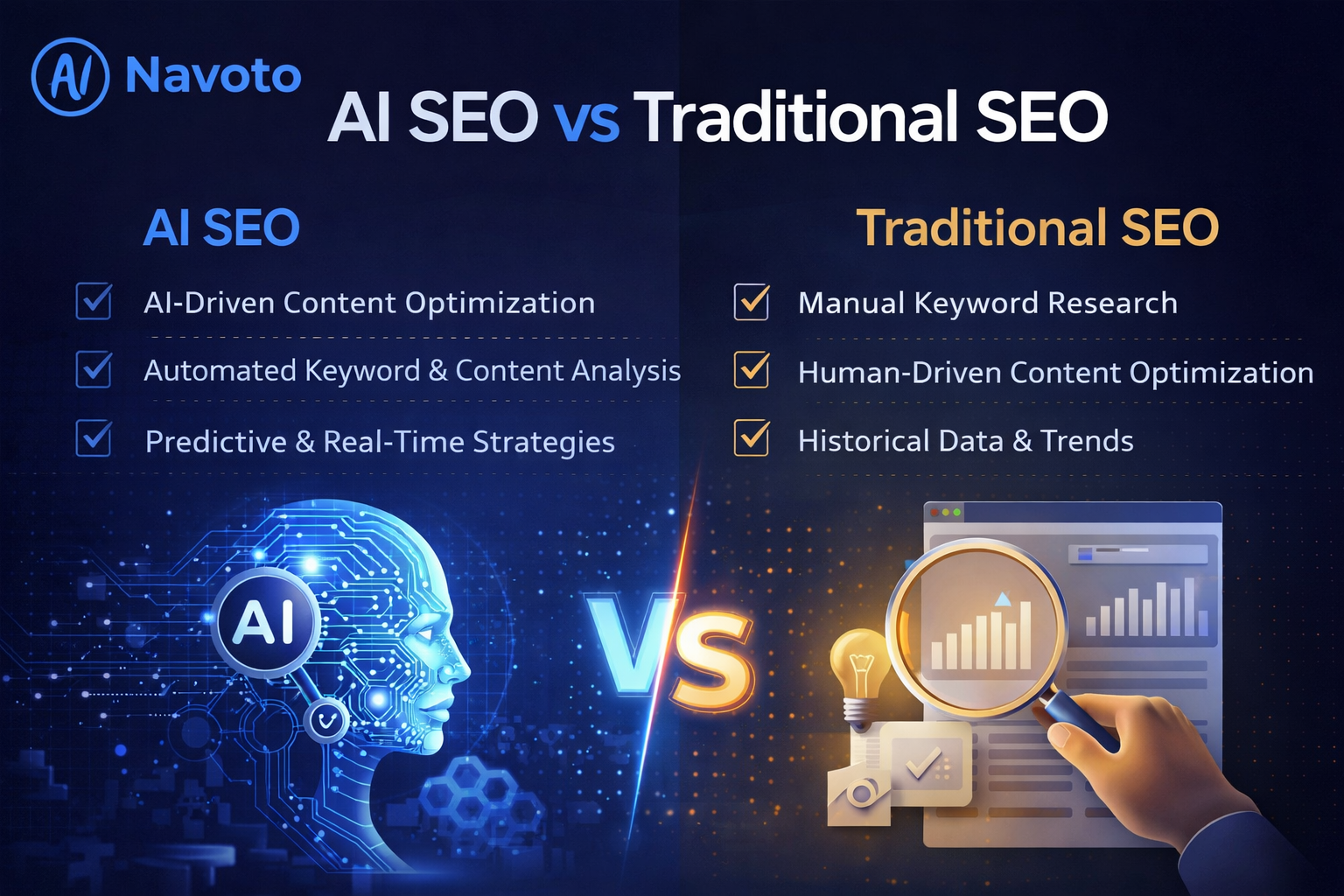
While both methodologies aim for the same outcome, the operational DNA of AI SEO vs Traditional SEO differs in speed, data handling, creativity, and risk profile. Understanding these contrasts helps practitioners allocate tasks appropriately. The table below outlines the key differentiators.
| Dimension | Traditional SEO | AI SEO |
|---|---|---|
| Speed of Execution | Slow; tasks like content creation and technical audits take days to weeks | Real-time to hours; bulk content updates, audits, and reporting in minutes |
| Data Analysis | Manual correlation of keyword data, SERP analysis, and spreadsheets | Instant pattern recognition across millions of data points; predictive analytics |
| Content Generation | Handcrafted by human writers; high originality but inconsistent scalability | AI drafts based on top-ranking patterns; can produce massive volumes but may lack nuance |
| Keyword & Topic Research | Expert-driven with tools; relies on historical data and intuition | AI uncovers hidden semantic relationships and forecasts trending topics |
| Technical Optimization | Manual crawl audits, log file analysis, one-by-one fixes | Automated crawl prioritization, anomaly detection, and auto-fix suggestions |
| Personalization & User Intent | Segment-based; limited to known personas and seller insights | Can hyper-personalize content and adjust in real time based on user signals |
| Risk of Generic Output | Low if skilled writers are involved; high brand alignment | High if unedited; risks thin content, factual errors, and duplicate patterns |
| Cost Over Time | High labor costs per piece; linear scaling | Higher initial tool investment but marginal cost drops with scale |
Benefits and Limitations of AI SEO
The rapid adoption of AI in search optimization isn’t hype — the technology solves real operational bottlenecks. However, a balanced perspective requires acknowledging where AI SEO falls short and where human judgment remains irreplaceable.
Core Benefits of AI SEO
- Exponential speed and scale: AI can generate a complete content cluster — pillar page plus 15 supporting articles — in the time a human team outlines one. This speed is crucial for large e-commerce sites or news portals that need hundreds of pages optimized daily.
- Data-driven content precision: AI tools analyze top-10 SERPs in real time to identify exact word counts, heading structures, entities, and media elements required to compete. This eliminates guesswork and aligns content directly with what Google rewards.
- Advanced topic discovery: Natural language processing uncovers latent semantic relationships humans might miss, creating comprehensive topic maps that cover every angle of a subject and strengthen topical authority.
- Automated technical hygiene: Platforms like Botify or Deepcrawl use machine learning to prioritize crawling, detect JavaScript rendering issues, and suggest internal linking improvements — tasks that would take a manual team weeks every month.
- Continuous optimization at scale: AI can monitor thousands of URLs, identify pages losing traffic, and auto-suggest refreshed content or meta tag updates, enabling proactive rather than reactive SEO.
- Quality and originality risks: Large language models tend to produce statistically average content pulled from training data. Without rigorous editing, the output lacks unique anecdotes, expert quotes, and the innovative angles that build true E-E-A-T.
- Factual hallucinations: AI can confidently assert incorrect data, cite non-existent studies, or misinterpret industry statistics. This erodes credibility and can lead to Google penalties if published unchecked.
- Brand voice dilution: Maintaining a consistent, distinctive tone across AI-generated content is challenging. Over time, the brand may sound indistinguishable from competitors using the same tools, weakening audience connection.
- Over-dependence and skill erosion: Teams that lean entirely on AI for strategy may lose the ability to conduct nuanced competitive analysis or interpret subtle algorithm shifts. SEO becomes a button-pushing exercise rather than a craft.
- Google’s evolving stance: While Google doesn’t penalize AI content outright, its helpful content system explicitly rewards people-first content. Mass-produced AI pages that fail to demonstrate genuine expertise can see rankings collapse after updates.
- Deep contextual understanding: A skilled writer or strategist understands cultural resonance, buyer psychology, and industry pain points that an algorithm cannot fully grasp. This leads to content that truly connects and converts.
- Original research and thought leadership: Traditional SEO campaigns often involve surveys, expert interviews, and proprietary data that AI cannot generate from existing sources. These assets attract high-quality backlinks organically.
- Editorial integrity and trust: Human review processes ensure every statistic, claim, and recommendation is vetted. This builds user trust and aligns with Google’s E-E-A-T guidelines, especially in YMYL (Your Money or Your Life) niches like finance and health.
- Relationship-driven link building: Genuine outreach, digital PR, and relationship management yield natural, high-authority backlinks that AI-powered mass email tools rarely secure sustainably.
- Strategic agility: Experienced professionals can interpret algorithm updates beyond pattern recognition, devising creative counter-strategies that a machine simply cannot conceive.
- Slow and costly: Producing a single 2,000-word article with expert review can take a week and cost several hundred dollars, making it impractical for sites needing thousands of optimized pages.
- Human bias and inconsistency: Different team members interpret data differently; keyword research might overlook emerging trends that AI-powered semantic analysis catches instantly.
- Limited data processing capacity: Humans cannot manually assess millions of search queries or competing pages. Valuable opportunities hide in data blind spots that only machine-scale analysis can illuminate.
- Reactive rather than predictive: Traditional analysis often looks backward at historical keyword data, while AI models can forecast search volume shifts based on news, social sentiment, and seasonal anomalies.
- Publishing unedited AI content at scale: Some sites mass-produce hundreds of AI articles, hoping to capture long-tail traffic. Without human quality checks, this leads to low-quality pages that trigger Google’s helpful content classifier, dragging down the entire domain’s rankings.
- Ignoring E-E-A-T signals: In sectors like healthcare, law, or finance, Google demands clear evidence of expertise. AI-generated content lacking author bios, citations from authoritative sources, and real-world credentials will not rank sustainably, regardless of on-page optimization.
- Over-optimizing for tools, not people: Chasing a perfect SurferSEO score can result in awkwardly stuffed keywords and a robotic reading experience. When the tool dictates every sentence, the content loses its human appeal, harming dwell time and conversions.
- Neglecting brand differentiation: Relying on the same AI models competitors use can produce eerily similar content across multiple sites. Without injecting proprietary data, unique opinions, or company-specific examples, the brand drowns in a sea of sameness.
- Forgetting manual link building: AI can identify link prospects and even draft personalized outreach emails, but genuine relationship-building — responding to queries, nurturing journalist connections — still requires human empathy and timing that automation alone cannot replicate.
Significant Limitations of AI SEO
Benefits and Limitations of Traditional SEO
Traditional SEO, rooted in human expertise, carries its own blend of strengths and weaknesses. For many brands, the human touch remains the differentiator that builds lasting authority.
Why Traditional SEO Still Matters
Where Traditional SEO Falls Short
How AI Is Transforming SEO Workflows: Practical Integration
The most sophisticated teams don’t treat AI SEO vs Traditional SEO as an either/or battle. They fuse automation with human judgment to create a hybrid model that maximizes efficiency without sacrificing quality or brand integrity.
Content Strategy and Topic Clustering
AI tools like MarketMuse or Clearscope ingest a seed keyword and instantly build a complete taxonomy of related topics, subtopics, and questions. The human strategist then reviews these clusters, filters out irrelevant tangents, and prioritizes based on business goals. The final content brief — containing exact headings, entities to mention, and ideal word count — is handed to a writer or an AI drafting assistant, drastically reducing planning time while preserving strategic direction.
Drafting with Guardrails
Many teams now use large language models to generate first drafts of blog posts, product descriptions, or FAQs. This raw output is never published directly. Instead, it flows through a mandatory editorial layer where subject matter experts add unique insights, case studies, proprietary data, and brand voice adjustments. This collaboration turns a decent but generic AI draft into a competitive, trustworthy asset. Tools like Frase or SurferSEO overlay real-time content scores to ensure the edited draft meets on-page optimization benchmarks.
Automated Technical Audits and Prioritization
AI-powered crawlers like Screaming Frog with machine learning integrations or Botify analyze site architecture at scale, flagging pages with thin content, orphan URLs, or wasteful crawl budget consumption. The human SEO then interprets the reports, aligning fixes with revenue impact rather than blindly chasing every alert. For enterprise sites with millions of URLs, this hybrid approach prevents paralysis by focusing attention on the 20% of issues causing 80% of traffic loss.
Real-Time Performance Adjustments
AI monitoring dashboards track thousands of keywords and alert the team when a page slips from position 3 to 8. Instead of waiting for the next monthly report, the system suggests specific updates — tighten title tag, add missing entities, improve page speed — which a human quickly validates and deploys. This cycle happens within hours, not weeks, giving brands an edge during core updates.
Common Mistakes When Integrating AI into SEO
Blending AI and traditional methods isn’t without pitfalls. Avoiding these common errors separates successful hybrid teams from those who damage their search presence.
Important Notes for Balancing AI and Traditional Methods
Striking the right balance means viewing AI as a powerful assistant, not a replacement for strategic thinking. Begin by auditing your current SEO tasks: which are repetitive, data-heavy, and scalable? Assign those to AI tools — keyword gap analysis, meta description templating, basic reporting, and first-draft content. Which tasks demand nuance, creativity, and trust-building? Reserve those for human experts — final editing, thought leadership pieces, crisis response, and delicate outreach campaigns.
Build quality assurance checkpoints into every AI-involved workflow. No piece of AI-generated content should go live without passing through an expert reviewer who verifies facts, enhances originality, and aligns tone with the brand manual. Regularly audit AI-assisted pages for engagement metrics; if bounce rates spike or time on page drops, revisit the balance of automation versus human touch.
Stay informed on Google’s guidelines regarding AI-generated content. The emphasis remains on helpful, people-first information regardless of the production method. A hybrid team that uses AI to amplify human expertise rather than mask a lack of it will be well-positioned for long-term success. Ultimately, the winner in AI SEO vs Traditional SEO is the practitioner who leverages both intelligently.
Frequently Asked Questions

What is the main difference between AI SEO and traditional SEO?
The primary difference lies in execution speed and data handling. Traditional SEO depends on manual research, human writing, and slow iteration cycles, while AI SEO automates content creation, analysis, and optimization at scale. Traditional SEO offers deeper contextual understanding and brand nuance; AI SEO delivers unprecedented speed and pattern recognition across massive datasets.
Can AI replace human SEO professionals?
AI cannot fully replace experienced SEO strategists. It excels at repetitive, data-intensive tasks but lacks the strategic judgment, creativity, empathy, and ethical reasoning humans bring. The strongest approach merges AI’s efficiency with human oversight to craft high-quality, trustworthy content that aligns with both search algorithms and real user needs.
Does Google penalize AI-generated content?
Google does not automatically penalize AI content. However, its systems target low-quality, unoriginal material created primarily to manipulate rankings, regardless of the production method. AI content that is unedited, factually incorrect, or fails to demonstrate expertise is highly vulnerable to ranking drops after helpful content updates. Content written for people, even if assisted by AI, can still perform well if it provides genuine value.
Is AI SEO more cost-effective than traditional SEO?
At scale, AI SEO can reduce per-piece content costs and dramatically lower the time needed for technical optimizations. However, hidden costs arise if AI-generated content must be substantially rewritten, damages brand credibility, or causes algorithmic downgrades. The most cost-effective model often blends AI assistance with human editing, achieving both speed and quality without sacrificing long-term trust.
Which industries benefit most from AI SEO?
E-commerce, aggregator sites, news portals, and any niche requiring vast amounts of consistently optimized product descriptions or articles benefit from AI’s scale. Industries with high YMYL sensitivity, such as healthcare and finance, must use AI with extreme caution, ensuring all content undergoes rigorous expert review to meet strict E-E-A-T standards.
How do I start integrating AI into my existing SEO workflow?
Begin with low-risk, high-volume tasks: use AI for keyword clustering, meta tag generation, and first-draft outlines. Gradually incorporate AI-powered content optimization tools during the editing phase. Always maintain a mandatory human review gate before publication. Measure results carefully; if user engagement remains strong, expand AI’s role incrementally while continuously validating output quality.
Conclusion
The contrast of AI SEO vs Traditional SEO is not about choosing a side but about architecting a workflow that multiplies human potential with machine precision. Traditional SEO provides the strategic compass — brand voice, trust signals, creative intuition — that algorithms cannot replicate. AI SEO furnishes the engine — speed, scale, and data synthesis — that makes modern competition possible. The brands winning in search today are those that harness AI to eliminate drudgery and amplify insights while never relinquishing the human editorial judgment that safeguards quality and authority. In the end, the most powerful SEO toolkit isn’t purely manual or fully automated; it is a thoughtful fusion of both, guided by an unwavering commitment to helping users.
Xem thêm:
- AI NLP SEO: The Complete Guide to Optimizing Content for the Age of Intelligent Search
- AI SEO Alerts: The Ultimate Guide to Automated Search Monitoring and Real-Time Warnings
- AI SEO Generative Search Optimization: The Complete Playbook for 2025
- AI SEO GEO Citations: The Complete Guide to Future-Proofing Your Local Search Strategy
- WP Trove AI Prompts: The Complete Guide to Unlocking WordPress Automation
Bài viết cùng chủ đề:

AI SEO SEO Automation with Make: The Complete Workflow Guide

AI SEO SEO Automation with Zapier: The Complete Workflow Guide

AI SEO SEO Automation with n8n: The Complete Workflow Guide
AI SEO SEO Automation with Gemini: The Complete Guide to Scaling Organic Growth

AI SEO SEO Automation with Claude: The Complete Guide to Scaling Content in 2025

AI SEO SEO Automation with ChatGPT: The Complete Playbook for 2025

AI SEO & SEO Automation for Affiliate Sites: The 2025 Playbook for Passive Income Growth
AI SEO & SEO Automation for Bloggers: The Complete Guide to Scaling Your Content

AI SEO & SEO Automation for Agencies: The Complete 2025 Playbook

AI SEO and SEO Automation for Ecommerce: The Complete Playbook for 2025

AI SEO & SEO Automation for WordPress: The Complete Playbook for 2025
AI SEO SEO Automation Strategy: The Complete Playbook for 2025

Mastering the AI SEO SEO Automation Process: A Complete Guide to Scaling Organic Growth
AI SEO SEO Automation System: The Complete Guide to Scaling Organic Growth in 2025
AI SEO SEO Automation Platform: The Complete Guide to Scaling Organic Growth in 2025
AI SEO SEO Automation Software: The Complete Guide to Scaling Organic Growth in 2025















