
No products in the cart.
Best AI Keyword Tools: Unlock Hidden Search Opportunities in 2025
29
Jul
Jul
The race to dominate organic search now belongs to those who understand search intent at scale. Manually sifting through spreadsheets of keywords is no longer viable, which is why brands are turning to the best AI keyword tools. These platforms don’t just guess—they analyze billions of data points, uncover semantic connections, and predict which terms will actually convert, saving you hundreds of manual hours while improving content precision.
What Exactly Are AI Keyword Tools and Why Do They Matter?
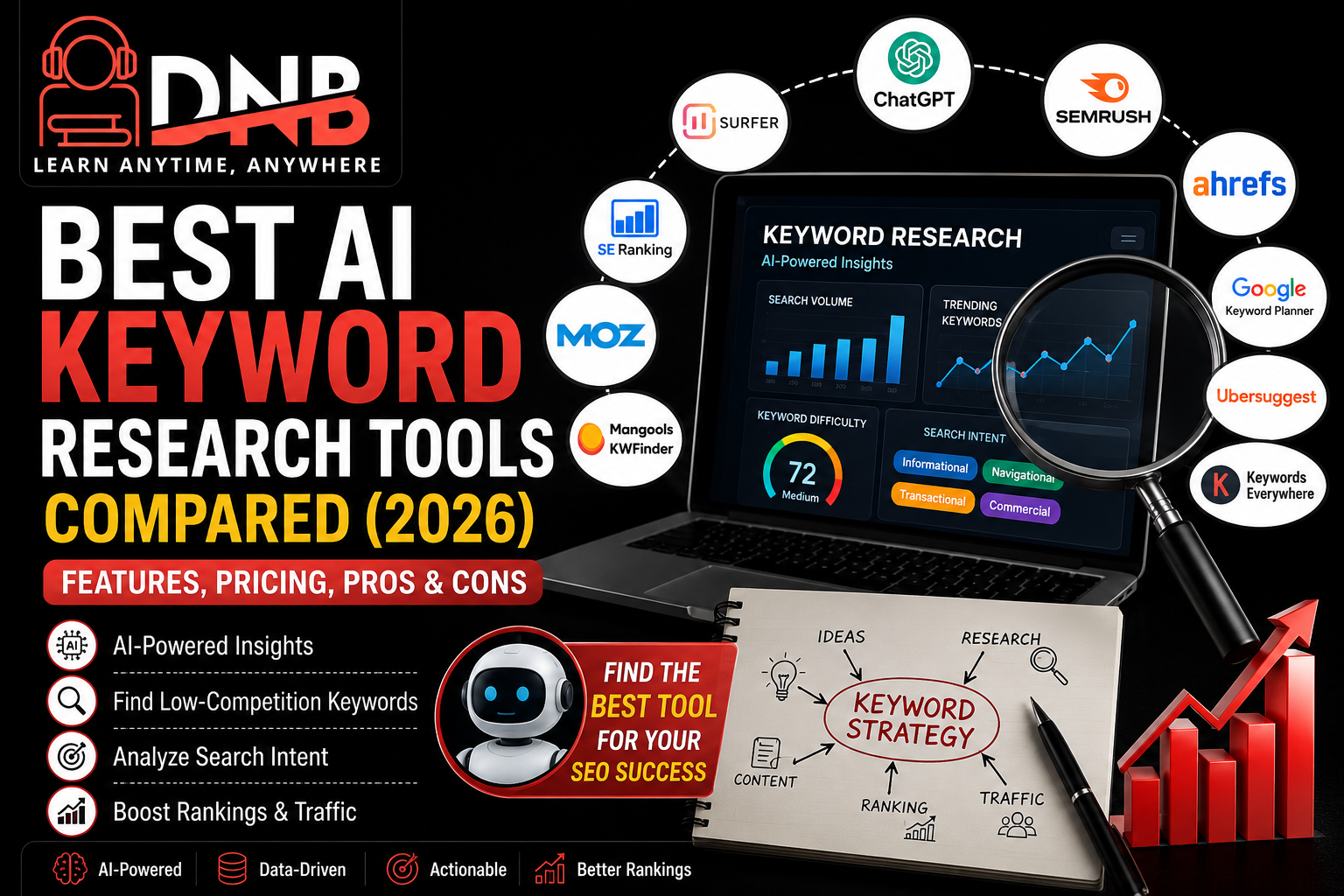
AI keyword tools leverage machine learning, natural language processing, and predictive analytics to automate and enhance the keyword research process. Unlike traditional tools that rely solely on historical search volume and basic suggestions, AI-driven platforms can understand search intent classification, contextual relevance, and topical authority. They decode the “why” behind a query, not just the “what.”
These tools pull data from search engines, clickstream sources, social listening, and competitor analysis simultaneously. The engine then identifies clusters of related terms, detects emerging trends before they peak, and assigns difficulty scores based on live SERP analysis rather than static metrics. The result is a strategic roadmap that aligns with how modern search algorithms process content. For SEO teams, this means moving from reactive guessing to proactive content architecture that covers entire topic landscapes.
How Modern AI Toolkits Redefine Keyword Research
The core shift lies in moving from isolated keyword targeting to topical authority modeling. Traditional tools might give you “best running shoes” and a list of variants. An AI keyword tool will map the entire buyer journey, segmenting informational, commercial, and transactional queries, and then group them into pillar content and cluster pages. This semantic mapping is what Google’s BERT, MUM, and updated Helpful Content System reward.
Furthermore, these platforms are now trained to detect latent entity relationships. They recognize that a page about “electric cars” must also cover “charging infrastructure,” “range anxiety,” and “tax incentives” to be considered comprehensive. By analyzing top-ranking pages, the AI reverse-engineers the entity set required for maximum relevance. This level of analysis, achievable in seconds, was previously a painstaking manual effort for advanced SEO strategists.
Classification of the Best AI Keyword Tools on the Market
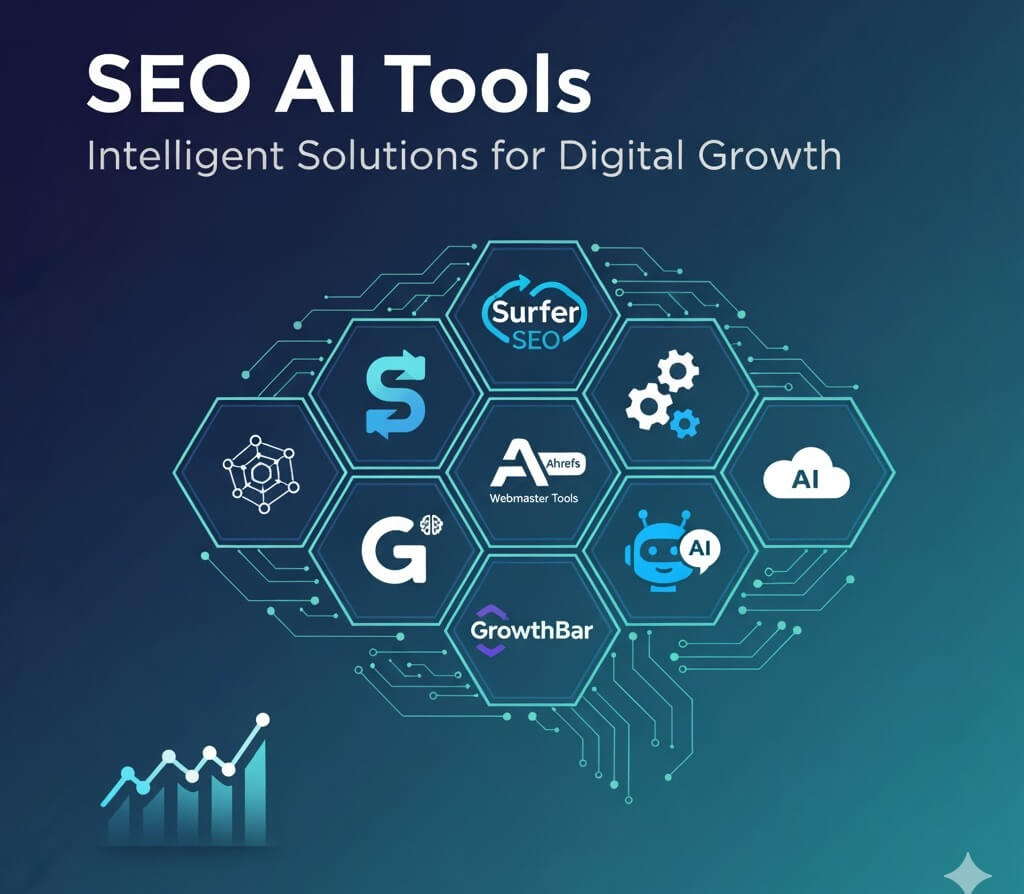
The landscape splits into three main categories. Understanding where each fits prevents paying for overlapping features or missing critical capabilities needed for your workflow.
1. All-in-One SEO Suites With Integrated AI
These platforms embed AI across their entire toolset—keyword discovery, rank tracking, content optimization, and competitive analysis. They are best for in-house teams and agencies that need a centralized source of truth. The AI acts as an intelligent layer across all modules, often connecting keyword data directly to content editors and performance dashboards.
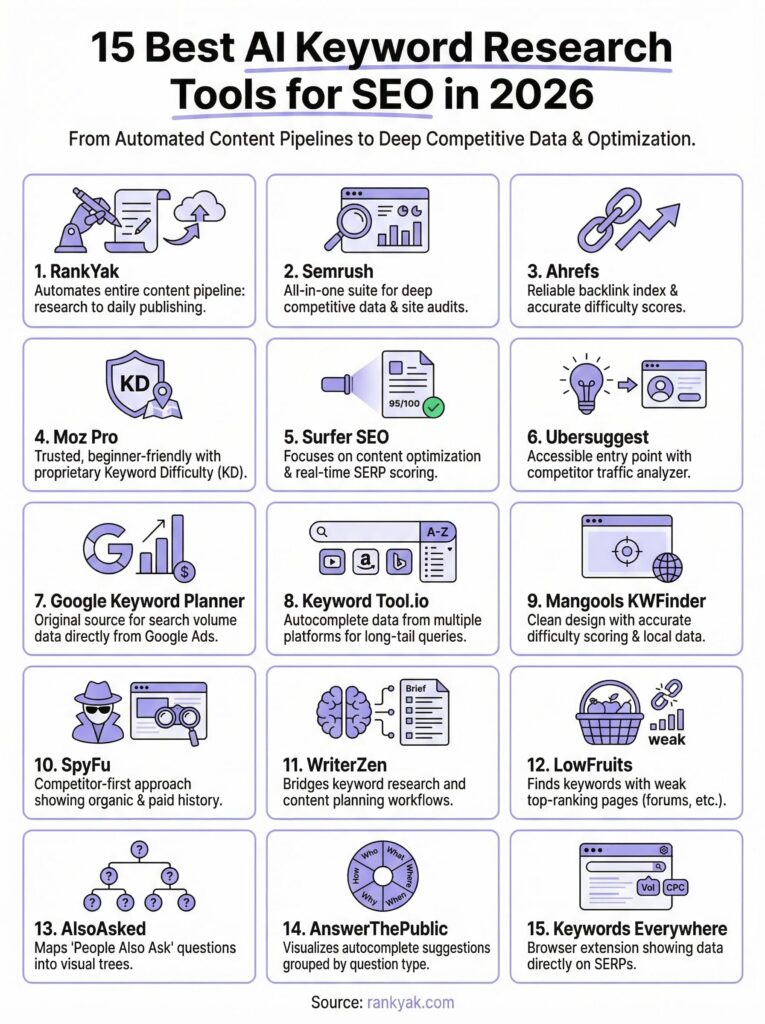
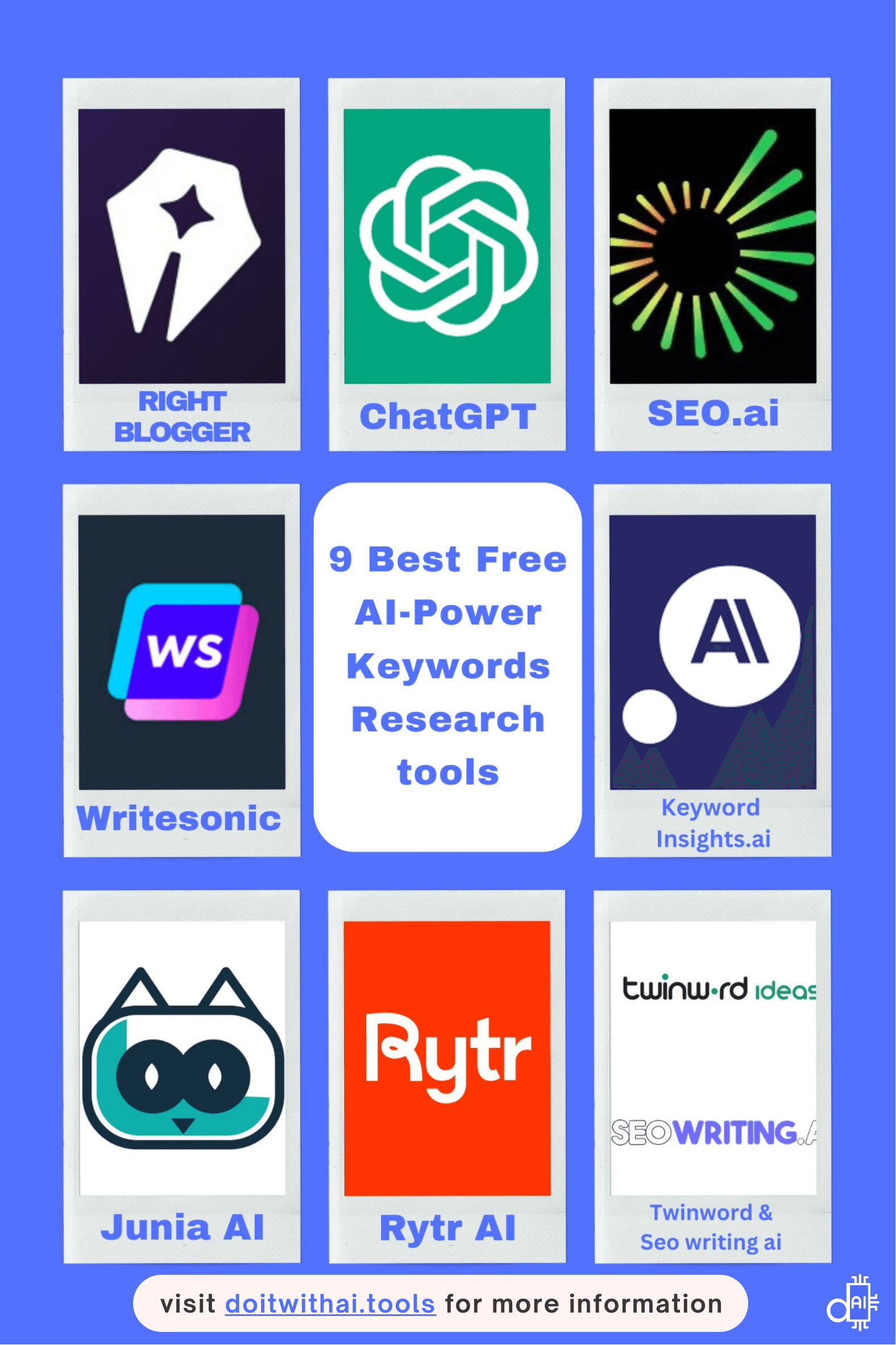
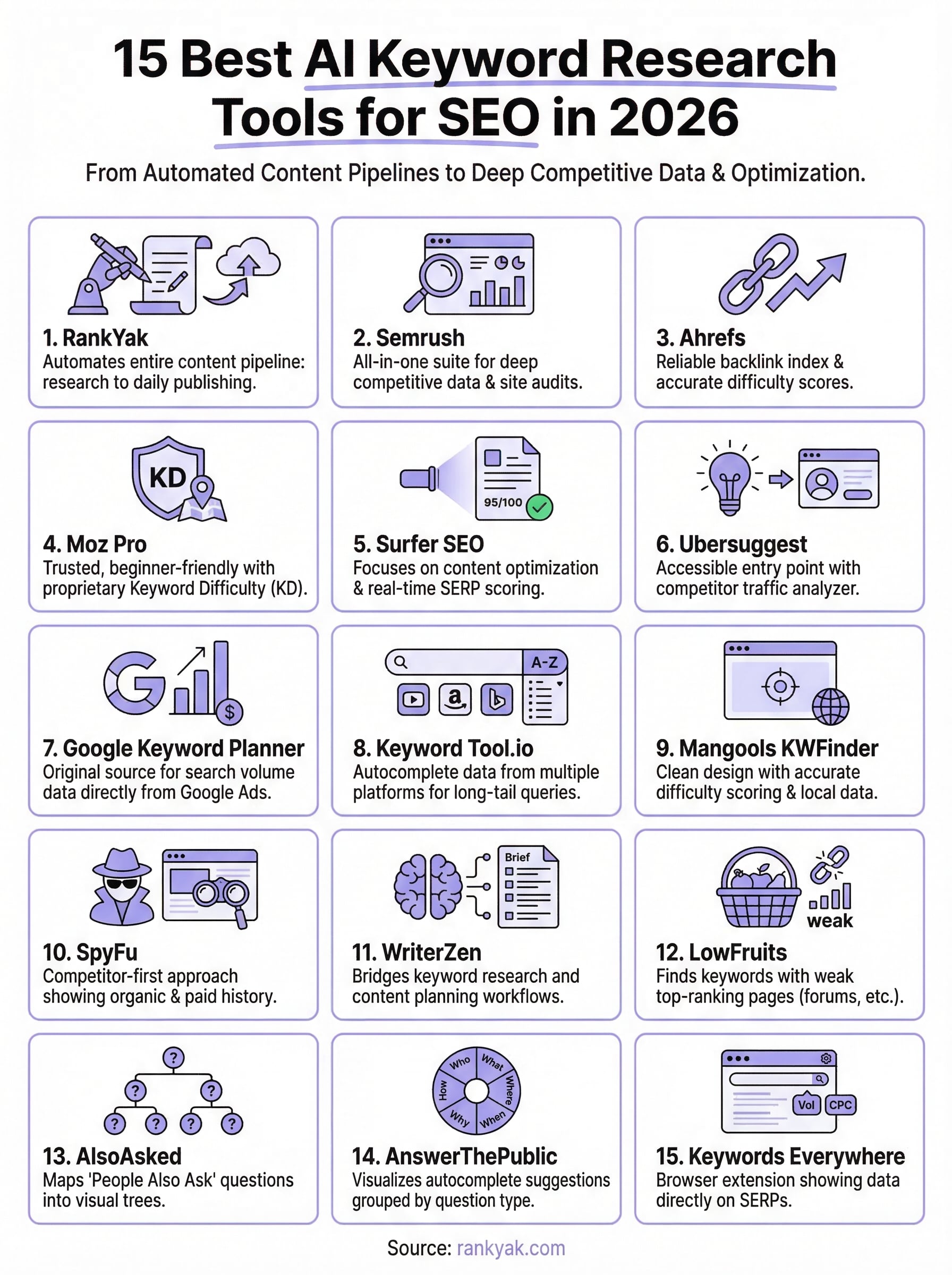
Examples: Semrush (with its personal keyword difficulty and intent metrics), Ahrefs (AI-driven keyword generation and parent topic inference), SE Ranking (auto-generated keyword groups).
2. Standalone AI-Powered Discovery Engines
These are highly specialized tools that focus purely on keyword ideation, clustering, and gap analysis powered by deep learning. They don’t offer rank tracking or full site audits but excel at unearthing untapped long-tail opportunities and understanding search landscapes. Many content-first teams prefer these for their speed and unique data sources.
Examples: Keyword Insights AI (one-click clustering and intent matching), Twinword Ideas (user intent labeling), AlsoAsked (visualizes “People Also Ask” data using AI to map topic trees).
3. AI Content Optimization Platforms with Built-In Keyword Research
These tools reverse-engineer the SERP to create content briefs, then inject keyword recommendations as you write. The AI constantly scans competitors and suggests real-time semantically related terms, ensuring your content covers entities that satisfy machine reading comprehension. They bridge the gap between research and content creation.
Examples: Surfer SEO (NLP-driven keyword density and structure suggestions), Frase (AI-Generated content briefs from SERP analysis), MarketMuse (topic authority scoring and gap analysis).
Core Benefits That Shift Performance Metrics
Adopting the best AI keyword tools delivers more than just a larger keyword list. The benefits fundamentally alter how brands scale their organic visibility and content ROI.
- Dramatic Reduction in Research Time: Clustering thousands of keywords into siloed topic clusters happens in minutes, not days. AI auto-assigns primary and secondary keywords, allowing strategists to focus on creative execution.
- Search Intent Accuracy Over 90%: Leading AI tools classify intent as informational, commercial, navigational, or transactional with high precision, preventing traffic that will never convert from bloating your pipeline.
- Predictive Trend Spotting: Machine learning models detect rising search patterns weeks before they appear in traditional volume databases. Brands can capture early-mover advantage for seasonal or breaking topics.
- Semantic Coverage Scores: Instead of keyword density, you get a comprehensiveness score based on missing entities. This directly correlates with top-10 ranking probability, as the tool knows what terms the top pages share.
- Automated Cannibalization Guards: AI identifies when multiple pages target the same cluster, suggesting mergers or canonical solutions before damage is done.
- Data Source Bias: Most tools rely on clickstream data providers and Google’s APIs, which can underreport very low volume terms or overestimate commercial intent queries. Niche B2B industries often see sparse data.
- Over-Clustering Trap: AI loves neat clusters, but some topics require deliberate overlap. Over-siloing can weaken internal linking and confuse hierarchical structure.
- Creativity Blindness: The tool may miss a culturally relevant angle or newsjacking opportunity because its training set looks backward. Human editorial oversight remains essential to inject timeliness.
- Cost Scaling: Enterprise-grade AI keyword tools can run into several hundred dollars per seat, with usage caps that penalize high-volume discovery needs.
- Treating AI Output as Absolute Truth: Search volume estimates vary wildly between tools. Using AI-generated difficulty scores without manual SERP inspection can lead you to target “easy” keywords that are actually dominated by parasite SEO pages.
- Ignoring Stage of Content Inventory: Applying the same AI clustering to a site with 100 pages versus 10,000 pages requires different approaches. Large sites need the AI to identify content pruning and consolidation opportunities first, not just new cluster creation.
- Forgetting Mobile and Voice Distinctiveness: Many AI tools aggregate data from desktop-heavy panels. Failing to layer in mobile-specific and conversational long-tail data (from tools like AnswerThePublic or AlsoAsked) means missing voice search queries that drive modern featured snippet wins.
- Chasing Zero-Volume AI Suggestions Blindly: Some AI tools surface “hidden gems” with reported zero volume. While these can capture early trend traffic, they should be evaluated against your available crawl budget and internal linking strength. Publishing 50 zero-volume articles dilutes quality signals.
Limitations and Critical Realities to Acknowledge
Despite their power, no tool can replace human strategic overlay. Blindly following AI-generated clusters can lead to content that lacks brand voice or misses conversion nuance. Here are the key boundaries to accept.
Head-to-Head Comparison of Top AI Keyword Tools
Selecting the right platform depends on the size of your operation and the depth of AI automation you require. The table below benchmarks the current market leaders against key decision factors.
| Tool | AI Core Strength | Best For | Key Limitation |
|---|---|---|---|
| Semrush | Intent-driven keyword grouping, personal keyword difficulty, topic authority maps | Agencies, large-scale content ops | Data can overwhelm beginners; steep learning curve |
| Ahrefs | AI parent topic inference, click metrics, content gap by traffic share | Competitive analysis, link-aware keyword strategies | No built-in content editor; less robust clustering than specialized tools |
| Keyword Insights AI | Real-time NLP clustering, intent classification, search console integration | Content planning and siloing at speed | Not a full SEO suite; requires complementary rank tracker |
| Surfer SEO | SERP similarity analysis, entity-based content editor | On-page optimization and brief creation | Discovery database smaller; not for large-scale ideation |
| MarketMuse | Topic modeling, competitive content scoring, inventory automation | Enterprise content strategy, site-wide topical authority | High price point; requires dedicated training |
| Frase | AI-generated briefs from top SERP consensus, question extraction | Freelancers and SMBs moving fast | More briefing than deep clustering; less comprehensive keyword DB |
Practical Guide: Building a Keyword Strategy Using AI
Implementing these tools effectively requires a repeatable workflow. The following step-by-step process prevents analysis paralysis and ensures every discovery translates into publishable content.
Step 1: Seed Expansion and Intent Layer
Start with 5–10 core business topics. Input them into your chosen AI keyword tool. Instead of grabbing all suggestions, first filter by intent. Extract informational queries for blog posts, commercial investigation queries for comparison pages, and transactional terms for product or category pages. Tag these in a shared workspace. This segmentation alone prevents you from trying to rank a product page for a “how-to” term.
Step 2: AI-Powered Clustering and SERP Validation
Run the extracted list through a clustering engine. Set parameters for cluster tightness (usually a similarity threshold of 75–85%). The AI outputs groups with a canonical lead keyword. Immediately validate the top 3 clusters by manually checking the SERP. If the top-ranking content for a cluster’s lead term is overwhelmingly video or a local pack, your text-based article may not fit the dominant intent. Adjust accordingly or deprioritize.
Step 3: Content Brief Generation Using Entity Gaps
For each validated cluster, generate a content brief. The A The brief should include a recommended word count range, heading structure, and the list of semantically related terms to include naturally. Assign this brief to writers; the tool’s grading feature then keeps the draft aligned with the entity model.
Step 4: Post-Publish Interlinking Automation
After publishing, use your SEO suite’s AI-powered interlinking suggestions. Many tools now scan your entire site and recommend where to place contextual links from older pages to the new asset. Accepting these suggestions reinforces the topical cluster signal and distributes page authority, a step often overlooked in manual workflows.
Common Mistakes When Using AI for Keyword Strategy
Adopting powerful technology without adjusting the strategic lens leads to costly errors. Avoid these patterns to protect your organic growth.
Key Notes for Maximizing ROI with AI Keyword Tools
Extracting full value from your subscription requires blending AI efficiency with human editorial standards. First, define conversion event value thresholds before opening the tool. Knowing that a lead from an informational keyword has a 2% close rate versus 12% from a commercial intent term changes which clusters get priority resource allocation.
Second, schedule a monthly “intent shift” audit. AI tools refresh their models, and Google updates can reclassify intent. A term that was transactional last quarter may now show informational results. Setting a calendar to re-cluster your top 50 queries prevents optimizing for the wrong page type.
Finally, integrate your AI tool’s API into dashboards or scripts that alert you when competitor pages gain new entities. This turns the tool from a static research assistant into a real-time organic radar system, enabling you to update content proactively rather than reacting to ranking drops.
Frequently Asked Questions About AI Keyword Research
What is the most accurate AI keyword tool for search volume?
Accuracy varies by region and industry, but platforms using Google Keyword Planner data supplemented with proprietary clickstream models, like Ahrefs and Semrush, generally provide the most reliable volume ranges. For granular low-volume terms, consider combining them with Google Search Console query data imported into an AI clustering tool.
Can AI keyword tools fully replace manual research?
No. AI speeds up data processing and pattern detection, but human analysis is required to interpret business context, cultural nuance, and conversion potential. The best workflow combines AI-generated clusters with manual SERP verification and editorial judgment on brand alignment.
How do AI tools determine keyword difficulty differently?
Many now analyze the specific characteristics of top-ranking pages—domain authority, number of referring domains, content depth scores, and on-page optimization signals—and then predict how difficult it would be for your specific site. This is more personalized than generic “difficulty scores” that assume a new domain.
Which AI keyword tool is best for a small business budget?
Frase and Ubersuggest offer entry-level AI features at lower price points. For pure clustering power on a lean budget, Keyword Insights AI provides a pay-as-you-go model that lets you ramp up as needed. Combining a free Google Ads account for base data with a low-cost clustering tool can be effective.
Do AI keyword tools understand local search intent?
Advanced tools now incorporate location modifiers and “near me” pattern analysis. Semrush and SE Ranking allow you to filter and cluster keywords with geographic tags. However, for hyper-local strategies, always verify with actual map pack appearances and local competitor scraping.
Conclusion
The best AI keyword tools have evolved from simple list generators into strategic command centers that interpret intent, map competitive landscapes, and predict content gaps with startling accuracy. Choosing the right one hinges on clearly identifying whether you need an all-in-one suite, a dedicated clustering engine, or a real-time content optimizer. The real competitive moat, however, isn’t the tool itself—it is the workflow you build around it. Pair AI-driven discovery with rigorous manual SERP validation, stage-aware content planning, and continuous intent audits. This synthesis of machine efficiency and human insight is what separates brands that merely publish content from those that dominate entire topic areas for years. By integrating the guidance in this framework, your team turns raw keyword data into a scalable organic growth machine that consistently captures and converts search demand.
Xem thêm:
- AI SEO Content Engagement: The Complete Guide to Boosting Rankings and Reader Retention
- Mastering AI Pillar Pages: The Future of Topic Cluster Architecture in SEO
- AI SEO LLM Referral Traffic: The Complete Guide to Winning AI Search Visibility
- AI SEO Email Outreach: The Complete Guide to Automating Link Building in 2025
- AI NLP SEO: The Complete Guide to Optimizing Content for the Age of Intelligent Search
Bài viết cùng chủ đề:

AI SEO SEO Automation with Make: The Complete Workflow Guide

AI SEO SEO Automation with Zapier: The Complete Workflow Guide

AI SEO SEO Automation with n8n: The Complete Workflow Guide
AI SEO SEO Automation with Gemini: The Complete Guide to Scaling Organic Growth

AI SEO SEO Automation with Claude: The Complete Guide to Scaling Content in 2025

AI SEO SEO Automation with ChatGPT: The Complete Playbook for 2025

AI SEO & SEO Automation for Affiliate Sites: The 2025 Playbook for Passive Income Growth
AI SEO & SEO Automation for Bloggers: The Complete Guide to Scaling Your Content

AI SEO & SEO Automation for Agencies: The Complete 2025 Playbook

AI SEO and SEO Automation for Ecommerce: The Complete Playbook for 2025

AI SEO & SEO Automation for WordPress: The Complete Playbook for 2025
AI SEO SEO Automation Strategy: The Complete Playbook for 2025

Mastering the AI SEO SEO Automation Process: A Complete Guide to Scaling Organic Growth
AI SEO SEO Automation System: The Complete Guide to Scaling Organic Growth in 2025
AI SEO SEO Automation Platform: The Complete Guide to Scaling Organic Growth in 2025
AI SEO SEO Automation Software: The Complete Guide to Scaling Organic Growth in 2025















